You already shipped the proof, the thing you never sent is the bill.
By Alessandro Magionami
Published: 2026-08-12
URL: https://shipwithai.substack.com/p/stop-working-for-free-start-working
Last week we told you to ship one live AI project and put the link where clients can see it.
Say you did it.
The URL works.
The demo is clean.
You sent it to five people who know the problem.
Then what happened?
For most engineers, nothing. The link sits in a DM. The project sits on a subdomain. You refresh your inbox and wait to be discovered.
We did the same thing for months. We had proof and we kept making more of it (a second project, a nicer landing page, another post) as if the first client would arrive once the portfolio was heavy enough.
The portfolio was never the problem. The problem was that we never named a price and never sent a bill. The proof was ready. The transaction wasn't.
So this week we're moving the finish line one more notch. Not a live link. A sent invoice — even if the number on it is zero.
Our first minibook is out: The Reluctant Engineer
It’s for engineers who’ve watched AI produce garbage and concluded the model was the problem.
The book doesn’t tell you you’re wrong; it tells you you’re half right. Slop is a process defect; it shows up exactly where verification, permission layers, a clean context window, and someone actually reading the diff are missing. “AI writes crap code” is like “juniors write crap code”: sometimes true, and the answer was never to fire the juniors.
So it doesn’t ask you to lower your standards; it asks you to raise the controls.
7 chapters, ~16,000 words, beginner basics deliberately stripped out. Exercises you run in a real terminal, not read about.
Two kinds of bad advice about free work
Search "should I work for free" and you get two answers, both wrong for where you are.
The hustle crowd says never work for free, know your worth, charge from day one.
Clean slogan.
It ignores that you have no case study, no testimonial, and no name a stranger recognizes. Charging from day one is easy to say when someone already trusts you.
The engineer instinct says the opposite: don't charge, just build more.
Another project, another repo, another certificate. Keep proving you can build until the work speaks for itself. It never does. Code doesn't start conversations about money. People do, and you're avoiding the part where you talk to them about money.
Both camps skip the same thing: the transaction. One skips it by demanding cash you can't command yet. The other skips it by hiding in the build forever.
There's a third move.
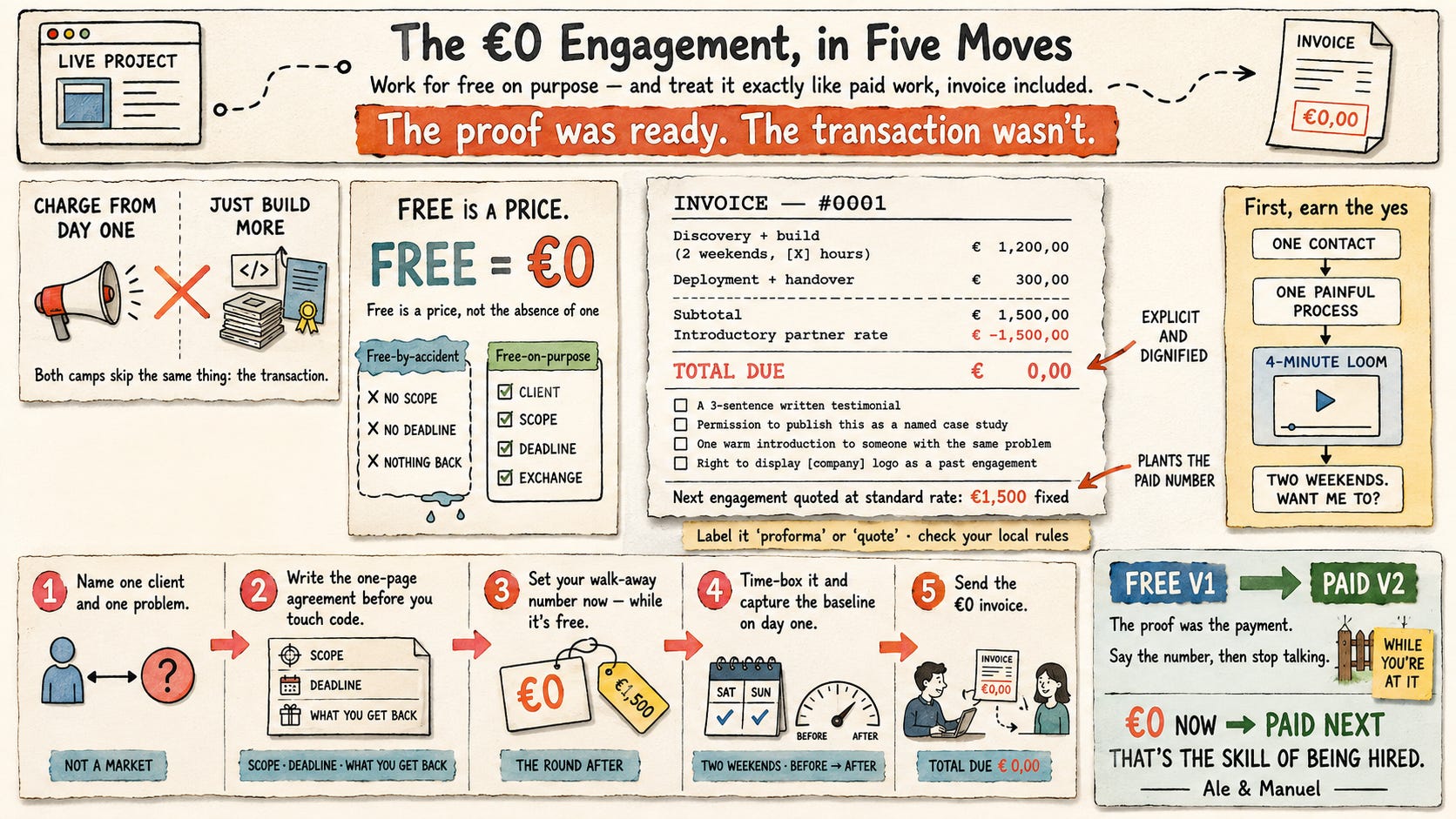
Work for free on purpose, and treat it exactly like paid work, invoice included.
Free is a price, not the absence of one
"Free" is a number. It's zero.
A number is something you set deliberately, defend, and put in writing. The failure isn't charging zero, it's charging zero by accident, with no scope, no deadline, and nothing coming back to you.
Free-by-accident is how resentment starts. You "help out," the request grows, weeks pass, and you have neither money nor a case study, just a favor nobody remembers.
Free-on-purpose is the opposite.
You pick the client.
You write the scope.
You set the deadline.
You decide, before you start, exactly what the zero buys you: a case study, a testimonial, a named referral, the right to show the logo.
Then you send an offer that says all of it out loud.
The honesty is the differentiator. Everyone else is either pretending free is generosity or pretending it's beneath them. You're saying: this is free, here's precisely what I get for it instead of money.
First, earn the yes
Before any of this works, the client has to say yes, and "want some free work?" is the wrong opener. It reads desperate, and desperate is not the register you want for your first engagement.
Lead with a diagnosis instead. Pick one contact whose workflow you already understand. Offer to look at a single painful process and tell them, for free, exactly what you'd fix and why. Fifteen minutes, no pitch. Send it as a four-minute Loom, not a document, they watch you think through their problem, which is worth more than any list of technologies on your profile.
The audit is the ask. At the end of it: "I could build the first version of this for you. No charge, I want it as a reference case. Two weekends. Want me to?" You've already shown the value, so the yes is small. Now you're at move one with a real name.
The €0 engagement, in five moves
1. Name one client and one problem.
Not a market. One person who has one recognizable problem you can solve in a fortnight. If you can't write their name, you're not ready to work for free, you're ready to keep building for no one. The live project from last week already points to the kind of client; pick the real human behind it.
2. Write the one-page agreement before you touch code.
Scope, deadline, and what you get back. Three sections, one page. This is the guardrail that turns a favor into a professional engagement. It also gives you a document to point at when the scope starts to creep, and on free work, it always creeps.
3. Set your walk-away number now, while it's free.
Decide the price this work would cost before anyone can haggle you down. You'll never say the number out loud this round. You're rehearsing it for the round after, when a warm contact asks "can you just do a quick one for me?" and you need a real answer that isn't a flinch.
4. Time-box it and capture the baseline on day one.
Two weekends, total hours written down. Before you change anything, record the before-metric, how long the task takes today, how many steps, how often it breaks. "After" without "before" is not a case study. It's a screenshot.
5. Send the €0 invoice.
When you deliver, send an actual invoice. Line-itemed. The total is €0,00. The line items are everything that isn't cash. This is the move almost nobody makes, and it's the whole point.
The artifact: your €0 proof invoice
Paste this, fill the brackets, send it as a PDF the day you deliver.
INVOICE  —  #0001
From:  [your name] · [your email] · [your site or live-project link]
To:    [client name] · [company]
Date:  [delivery date]

Engagement:  [one line — "For [client], turns [painful input]
into [useful output] in [time]."]

Line items                                             Amount
------------------------------------------------------------
Discovery + build (2 weekends, [X] hours)            €  1,200,00
Deployment + handover                                €    300,00
------------------------------------------------------------
Subtotal                                             €  1,500,00
Introductory partner rate (first engagement)        € -1,500,00
------------------------------------------------------------
TOTAL DUE                                            €      0,00

Settled in kind — by countersigning below:
[ ] A 3-sentence written testimonial
[ ] Permission to publish this as a named case study
[ ] One warm introduction to someone with the same problem
[ ] Right to display [company] logo as a past engagement

Next engagement quoted at standard rate: €1,500 fixed
per scope of similar size.

Signed: ____________________     Date: __________
Two things this document does that a friendly "no charge, don't worry about it" never will.
It makes the trade explicit and dignified. The client sees the real value — €1,500 — and sees exactly what they're giving instead of cash. That's a fair exchange, on paper, not a favor they'll forget by Friday.
And it plants the paid number. "Next engagement quoted at standard rate" is the whole conversion mechanic. You're not hoping they'll pay next time. You told them the price, in writing, while they were happy with your work.
But won't a €0 invoice look strange?
Two worries stop people from sending it. Both have short answers.
"Isn't it fake?" No. It's a proforma, a quote that happens to total zero. You're putting a real exchange on paper: work in return for proof. That's more honest than an unpriced favor, not less.
"Is it a tax problem?" A zero-total document isn't a fiscal invoice and usually isn't a taxable event on its own. But the non-cash things you receive can carry barter or VAT rules where you live, especially once you're registered as a freelancer. So label it "proforma" or "quote," keep a copy, and check your local rules before you make it a monthly habit. Don't let that stop the first one, it's a PDF, not a tax filing.
Scripts for the awkward part
"Wait — why are you invoicing me if it's free?"
Because I want you to see what the work is worth, and I want us both clear on the terms. The cash total is zero. What I'm asking for instead is the testimonial and one introduction. That's a real trade, so it goes on paper like a real one.
"Can't you just keep doing it for free / do the next one cheap?"
Happy to keep going, the next piece is a fixed €1,500 for a scope this size. The free round was to prove it works for you, and it did. This is where it becomes normal paid work.
Say the number, then stop talking. The silence after a price is the hardest second in the whole business and the most important. Don't fill it.
What the whole arc looks like
Marco runs a three-person creative agency. Every new lead means a night rewriting the same proposal from scratch. You've heard him complain about it twice.
You send a four-minute Loom: here are the ninety minutes a week I think I can give you back, and here's roughly how. He replies the same day.
You send the one-pager. Scope: a tool that turns a filled-in brief into a first-draft proposal. Deadline: two weekends. What you get back: a testimonial, one introduction, the right to name the agency. You capture the baseline before touching anything, ninety minutes per proposal, six a week.
You build the narrow thing and nothing else: brief in, editable draft out. You deliver, and you send invoice #0001, €1,500, discounted to €0, settled in a testimonial and one warm introduction to the agency two doors down with the exact same problem. Marco signs.
Ten days later, the neighbor emails. That one isn't free.
That's the whole arc. A complaint you'd already heard turns into a paid pipeline, and the only thing that converted proof into a client was a document you were willing to send.
Build the exit and the upgrade in from the start
Two failure modes to design around.
The freebie that never converts. Some won't. Scope it so v1, the working core, is free, and the obvious extensions are the paid v2. Split it on paper before you build. If they never upgrade, you still delivered a clean, finished thing you can show, and the €0 invoice already collected the testimonial and the intro. The proof was the payment.
The freebie that quietly becomes a job. This is why the one-pager and the walk-away number exist. The moment "while you're at it" arrives, you point at the scope line and quote the paid rate. Free-on-purpose has an edge. Free-by-accident doesn't, which is why it eats you.
The point was never the money
You proved you can build last week. That's done. Stop re-proving it.
The €0 invoice proves something a fifth project never will: that you can name a client, scope the work, set a price, defend it, deliver, and close. That's not a portfolio skill. That's the skill of being hired.
The number on this one is zero. You're not doing it for the money. You're doing it so that the next time the number isn't zero, sending the invoice feels like something you've already done.
Because you will have.
— Ale & Manuel
PS. Reply with one line: the name of the person you'd send a €0 invoice to this month, and the one problem you'd solve for them. Naming them is the whole first move — do it in the reply box and it's half real already.
When you're ready, two more ways we can help:
1. AI Side-Project Clarity Scorecard. Find what's blocking you from shipping your first side project.
2. NoIdea. Pick a ready-to-start idea born from real user problems.