Building is the easy part now. Knowing what to build is the skill that compounds. Here is the workout.
By Alessandro Magionami
Published: 2026-06-13
URL: https://shipwithai.substack.com/p/your-side-project-is-your-idea-selection
Hey there,
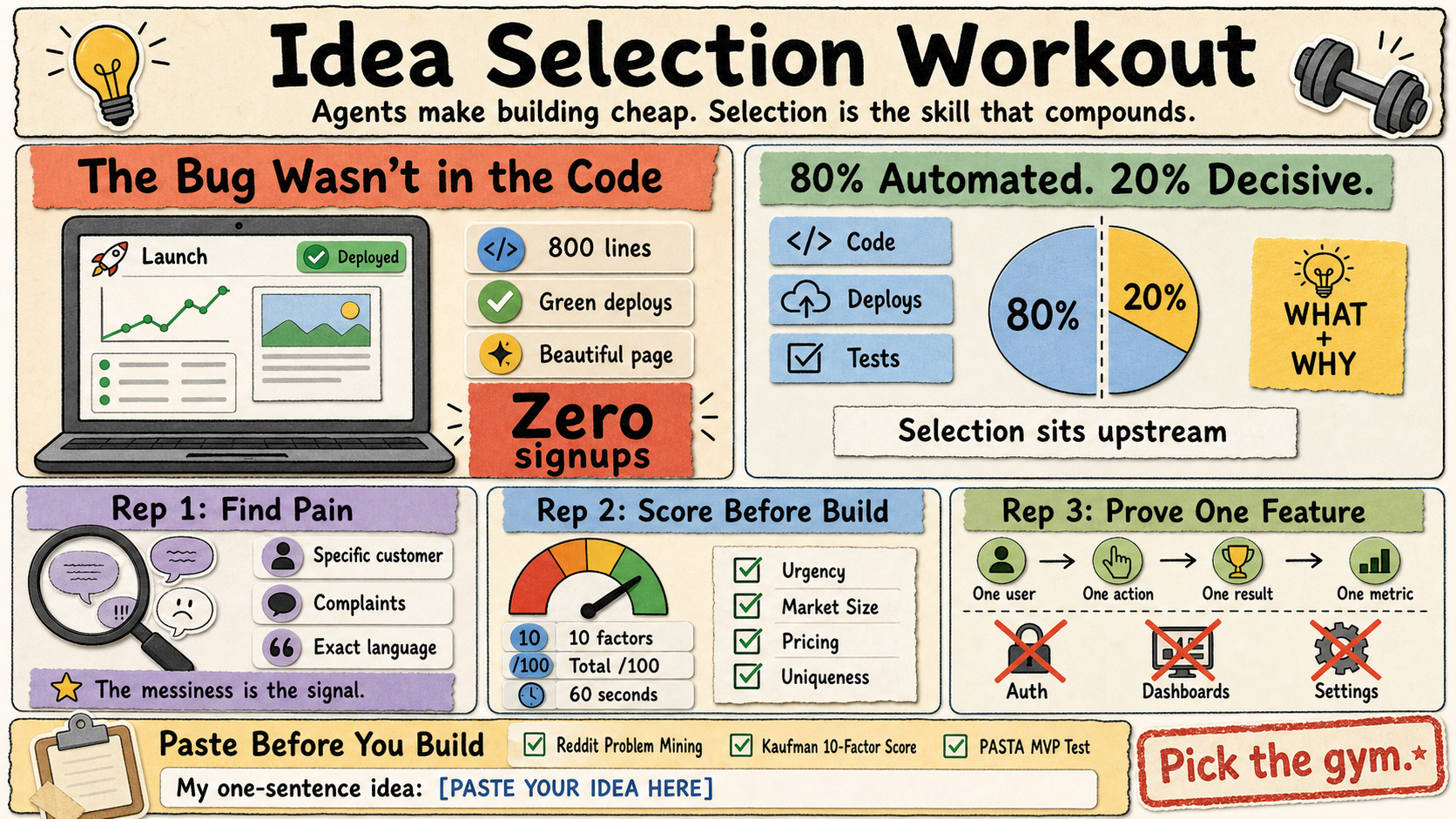
Last month we built something nobody asked for — again. We spent a weekend on it. Claude Code wrote 800 lines. The deploys were green. The page was beautiful. Zero signups. Not "low signups." Zero.
We sat there staring at a perfectly functional product that solved a problem nobody had. The agent built exactly what we asked. The bug wasn't in the code. The bug was in the sentence we typed at the start.
We've done this enough times now to spot the pattern. When build cost collapses — when scaffolding a side project takes 30 minutes — the bottleneck isn't building. It's knowing what to build. And we kept treating idea selection like a gut call instead of a trainable skill.
CNBC ran the numbers on June 1: the generative AI market is restructuring the job market. The developers getting hired aren't the ones who type the fastest prompts. They're the ones who know which problems are worth solving. Idea evaluation is the skill that compounds.
Every side project you ship is a rep. But the rep that matters isn't the coding. It's the selection.
Yesterday: dragging n8n nodes, debugging connections, JSON typos at midnight. Counted the Saturday hours you've burned on it?
That's the real bill. It doesn't show up on your cloud invoice. It shows up as Sundays you didn't ship.
Autom8n skips it. Type the workflow in plain English. Get the n8n JSON in 5 minutes — with a guide so you actually understand what's running. The first one needs a tweak. The fifth saves you a Saturday.
The skill nobody's training
Your agents handle 80% of the week now.
- The code.
- The deploys.
- The tests.
The remaining 20%, knowing WHAT to build and WHY, is the entire job. And almost nobody is training it deliberately.
We shipped the HOW edition a few weeks ago — steering your agents. We shipped the WHY edition last week — the three gates that close the trust gap. This edition closes the trilogy.
WHAT to build is the skill that sits upstream of both.
Most developers with access to AI agents have five ideas in a notes app right now. Maybe ten. They all sound plausible. They all pass the "someone would probably use this" test. But you can only build one this weekend — and the wrong pick costs you a weekend plus the opportunity cost of not building the right one.
The difference between the developer who ships something people actually use and the developer who ships into the void is not better prompts. It's better filtering. And filtering is trainable.
Three frameworks. Three reps. One workout that turns your next side project from a build sprint into an idea-selection gym session.
→ Rep 1: Reddit problem mining — find what's actually hurting
Most side project ideas start with "here's a cool thing AI can do now." That's backwards. The best ideas start with "here's a problem people are already complaining about, in their own words."
Reddit problem mining is a three-step framework we built from watching how real user language carries signal that polished problem statements miss.
Step 1: Target a specific customer in a specific situation. Not "remote workers." Not "developers." "Remote developers who joined a startup in the last six months and can't tell if anyone notices their work." Precision is the lever. More precision → less noise.
Step 2: Search for complaints, not discussions. Don't browse subreddits. Search for the messy, frustrated language real people use when they're venting. Read the comments, not just the original posts. The depth is in the thread — that's where people elaborate on why the problem actually hurts.
Step 3: Compile exact language. If five people describe the same pain using similar words, you've found marketing copy AND a product spec. Don't paraphrase. Don't clean it up. The messiness is the signal.
The AI lever here is now packaged as a skill, not a prompt you have to keep rewriting. It generates the messy first-person vent phrases, points you at the communities where the pain probably lives, and tells you what themes to look for. If you want sourced URLs, ask the agent to browse from there. The skill is explicit about not inventing receipts.
Rep 1 gives you a list of real problems. Rep 2 tells you which one to build.
→ Rep 2: Kaufman 10-factor evaluation — score before you build
Josh Kaufman's framework from The Personal MBA is the simplest idea evaluation tool we've found. Ten factors. Each scored 1 to 10. Total out of 100. Run it on multiple ideas and build the one with the highest score.
The factors: Urgency (do people hunt you down to get this solved?), Market Size (can you count them on one hand?), Pricing Potential (will they pay a premium?), Customer Acquisition Cost (do they come knocking without spending much?), Cost of Value Delivery (does delivering the product eat your wallet?), Uniqueness (instantly recognizable or blends into the crowd?), Speed to Market (launch next week or next year?), Upfront Investment (shoestring or mountain of cash?), Upsell Potential (do they keep buying?), Evergreen Potential (still useful in a decade or fades next season?).
The magic isn't the score itself. The magic is that scoring forces you to articulate WHY you think this idea is urgent, or unique, or evergreen. The gap between "score of 7" and "score of 3" forces you to see what you've been telling yourself that doesn't hold up.
Before AI, a manual Kaufman evaluation took 30 minutes per idea. With an agent, it takes 60 seconds. Paste in your one-sentence description, get scores with motivation for each factor, plus a summary of strengths, weaknesses, and overall viability. Run it on five ideas. Build the top scorer.
Most people skip this step entirely. They build the first idea that sounds plausible. Rep 2 is the discipline that kills obviously bad ideas before you invest a weekend in them.
→ Rep 3: PASTA — prove one feature has value before you build anything else
Rep 2 picked the idea. Rep 3 validates whether it's worth building at all — with a real metric, not a gut feeling.
PASTA is our one-feature MVP framework. Five steps, one week, one constraint: one user, one action, one result, one metric.
Pick the Job Story and metric. "When
AI the one-pager. Prompt your agent for a ruthlessly scoped spec: 6-step user journey, minimal data model, required UI only, fake/stub strategies, 3 Given/When/Then tests, and — this is the discipline — a Not-Doing list. Auth, dashboards, settings, admin panels. All not-doing.
Slice to essentials. Build one screen, one POST endpoint, three tests, a landing headline, one instrumented metric. Everything else is fake. Mocks, static data, manual queues. The point is proving value, not building infrastructure.
Test with humans. Five to ten hand-picked testers. Track the funnel: visits → clicks → attempts → successes → "useful" ratings.
Assess the metric. Hit it? Earn the right to add one adjacent feature. Miss it? Don't pile on — tighten the job story, fix the flow, run the loop again.
PASTA includes a companion prompt called PASTA Skeptic — a blunt, confused first-time user that asks five brutal questions about value, speed, and clarity before you ship. It catches the confirmation bias that makes you hear what you want to hear from testers.
(Yes, the agent can build the whole product in a weekend. Yes, that's faster than running PASTA. Yes, the whole product nobody asked for still has zero users. That's Rep 3.)
→ The workout: install the skill, run the rep
We turned the whole evaluation workout into a reusable agent skill: evaluate-side-project.
Instead of pasting a giant prompt into your agent and hoping it follows the structure, the skill gives the agent the workflow directly. You give it one sentence. Optional context helps:
- target user
- pricing model
- distribution channel
- competitors
- constraints
- available build time
Then it runs the three reps in order:
- Reddit Problem Mining — 10 messy first-person vent phrases, 3-5 communities to inspect, and recurring themes to look for.
- Kaufman 10-Factor Score — each factor scored 1-10, total out of 100, with rationale instead of vibes.
- PASTA MVP Test — one Job Story, one metric, one Not-Doing list, five skeptical first-user questions, and a PASS/FAIL verdict.
Install it with the Skills CLI:
npx skills add Ship-With-AI/skills --skill evaluate-side-project
If you’re using Claude Code’s native plugin system:
claude plugin marketplace add Ship-With-AI/skills /plugin install ship-with-ai@ship-with-ai-skills
Then run it in your agent:
Use evaluate-side-project on this idea: [PASTE YOUR ONE-SENTENCE IDEA HERE]
Better version, if you already know the shape:
Use evaluate-side-project on this idea: [PASTE YOUR ONE-SENTENCE IDEA HERE] Target user: Pricing model: Distribution channel: Constraints: Competitors: Available build time:
Run it on your current idea this weekend. Then run it on your second-best idea. Build whichever scores higher.
If both fail, even better. You didn’t lose a weekend. You got the rep anyway.
The agents got us from zero to deployed in a Saturday. The frameworks got us from deployed to a product someone actually wanted. The gap between those two outcomes isn't luck. It's a process.
You're going to build side projects either way — the build cost is too low not to. The question is whether each project trains you to pick better problems or just produces more code nobody asked for. One option compounds. The other doesn't.
Pick the gym.
— Ale & Manuel
PS. Run the workout prompt on your current side project idea. Reply with your Kaufman score out of 100 and which factor surprised you most. We'll share the most interesting ones next week — anonymously, unless you tell us to name you.
When you're ready, two more ways we can help:
1. AI Side-Project Clarity Scorecard. Find what's blocking you from shipping your first side project.
2. NoIdea. Pick a ready-to-start idea born from real user problems.
Ship With AI is a reader-supported publication. To receive new posts and support my work, consider becoming a free or paid subscriber.