Your agents ship code. You ship conviction.
By Alessandro Magionami
Published: 2026-06-05
URL: https://shipwithai.substack.com/p/84-of-devs-use-ai-29-trust-it-heres
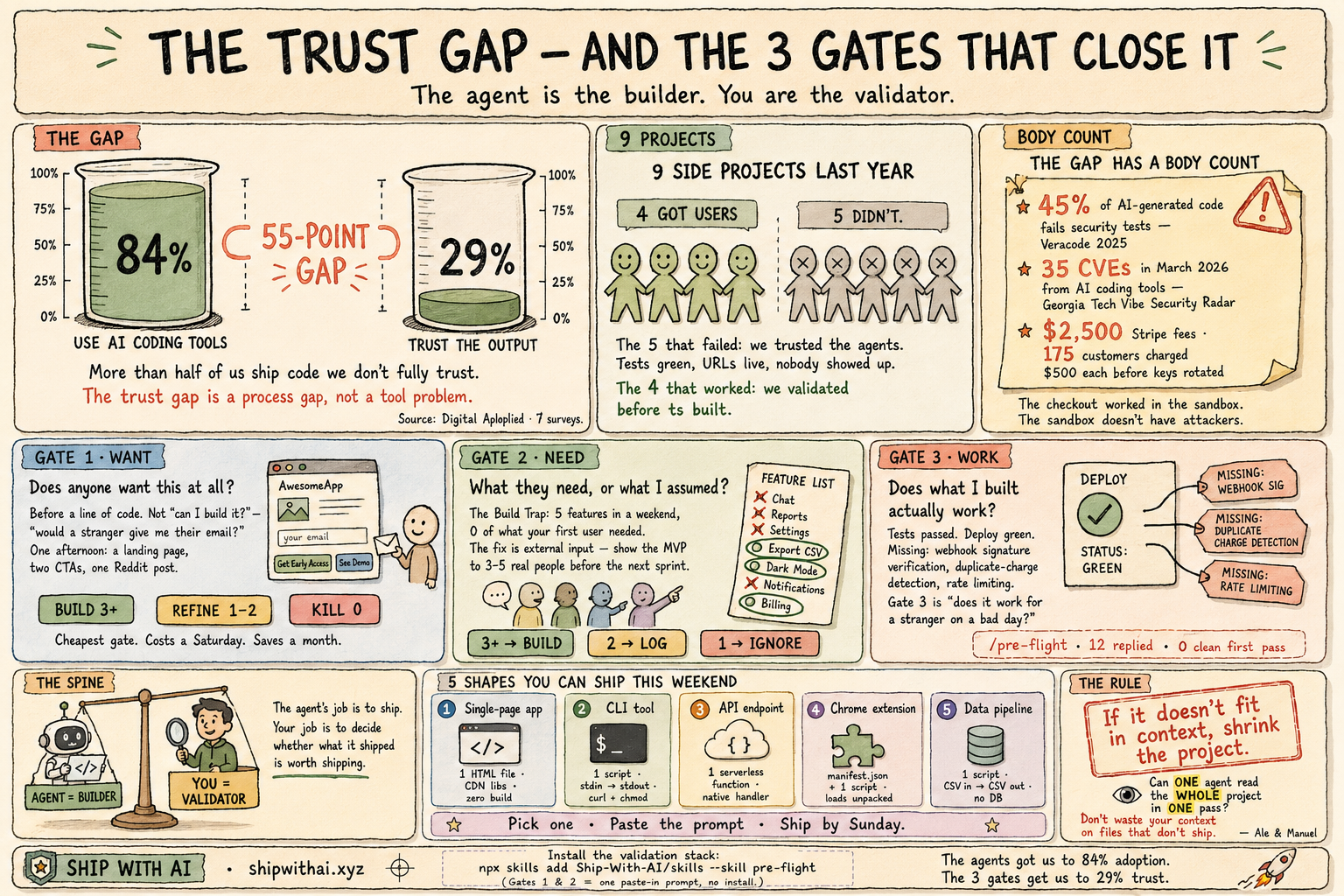
We shipped nine side projects last year. Four got users, five didn't.
The five that failed? We trusted the agents, the tests passed, deploys were green. The URLs were live.. nobody showed up.
The four that worked? We didn't trust the agents, we validated before we built. We asked strangers if they wanted it before we wrote a line of code.
The numbers say we're not alone. Digital Applied crunched seven surveys and landed on a stat that should stop every developer who ships with AI cold: 84% of developers use AI coding tools. Only 29% trust the output.
That's a 55-point gap, more than half of us are shipping code we don't fully trust.
(The gap has a body count: 45% of AI-generated code fails security tests, that's from Veracode's 2025 report, not a hot take. Georgia Tech's Vibe Security Radar tracked 35 CVEs in March 2026 alone that were directly attributable to AI coding tools.
A developer posted on LinkedIn last week: his vibe-coded startup was exploited. $2,500 in Stripe fees. 175 customers charged $500 each before he could rotate the API keys. The agent shipped a checkout flow that worked in the sandbox.
The sandbox doesn't have attackers.)
The trust gap is not a tool problem, it's a process gap.
Yesterday: dragging n8n nodes, debugging connections, JSON typos at midnight. Counted the Saturday hours you've burned on it?
That's the real bill. It doesn't show up on your cloud invoice. It shows up as Sundays you didn't ship.
Autom8n skips it. Type the workflow in plain English. Get the n8n JSON in 5 minutes — with a guide so you actually understand what's running. The first one needs a tweak. The fifth saves you a Saturday.
The gap isn't about better prompts
Three things happened in the last 18 months that created this gap, and none of them are fixable with a better prompt.
1. Build cost collapsed. Claude Code, Cursor, Codex, Lovable. Describe a feature, get working code. The time to prototype dropped from days to minutes, but the time-to-trust didn't drop at all. An agent can write a Stripe integration in 30 seconds. Understanding whether that integration can survive production takes the same hour it always took.
2. Build quality became invisible. Every agent ships code that passes its own tests. Every /factory run produces a deployable URL. The difference between "works locally" and "works in production" has never been larger, because agents are brilliant at the first and blind to the second. They have no concept of an attacker, no concept of a user on a slow connection, no concept of a webhook that arrives malformed.
3. Build volume became noise. When building is free, more things get built. Most of them shouldn't exist: the 84% who adopted AI tools didn't all become 10× developers. Some became 10× builders of things nobody asked for, secured by code nobody audited.
Better models won't close this gap. Better prompts won't either. The fix is a layer between "agent says done" and "user hits production."
We call it the three gates.
→ Gate 1: Does anyone want this at all?
Before a line of code, a Bolt template, before your agent generates anything.
The question isn't "can I build this?", the question is "would a stranger give me their email for this?"
One afternoon, a landing page, two CTAs, one Reddit post. If strangers won't give you an email, they won't give you money, and no amount of agent polish changes that.
AI makes Gate 1 harder, not easier. When anyone can ship a working app in a weekend, the bar for "worth giving my email" goes up. A working app is table stakes. An outcome that matters is the only thing that breaks through.
Gate 1 catches the projects that shouldn't exist. It's the cheapest gate. It costs a Saturday. It saves the month you'd spend building something nobody asked for.
→ Gate 2: Am I building what they need, or what I assumed?
The Build Trap: you ship five features in a weekend. Settings page, email notifications, UI polish, dashboard filters, refactor. Five features, five hours, zero of what your first user needed.
Your instincts about what to build next are wrong most of the time. The fix isn't better instincts. It's external input. Show the MVP to three to five real people before the next sprint. The filter: three or more mention it → build it. Two → log it. One → ignore.
AI makes Gate 2 more important, not less. When your agents can implement any feature in 30 minutes, the temptation is to add everything. But adding everything is the Build Trap with a GPU. The constraint isn't build speed. It's knowing which of the 20 possible features are the three that matter.
→ Gate 3: Does what I built actually work?
This is where the Stripe guy's story lives. The agent shipped a checkout flow. The tests passed. The deploy was green. The webhook signature verification was missing. The duplicate charge detection was missing. The rate limiting was missing.
Gate 3 isn't "does the code compile?" Your agent handles that. Gate 3 is "does the product work for a stranger on a bad day?"
Two weeks ago we shipped /pre-flight — four questions that catch the gap between "agent says done" and "user says it works." Twelve people replied. Zero got a clean run on their first pass. The agents are that good at shipping code that passes their own tests, and that bad at shipping code that survives a real user.
We're not going to reprint the four questions here (they're in the /pre-flight edition) but the principle is the same across all three gates: the agent is the builder. You are the validator. The agent's job is to ship. Your job is to decide whether what it shipped is worth shipping.
(Yes, the /factory's gates were green. Yes, the test suite passed. Yes, neither catches a stubbed Stripe integration. That's Gate 3.)
→ Install the validation stack
You've already shipped /autopilot. Your agents build faster than you can review. Here's the layer that catches what they miss.
Gate 3 is /pre-flight, four questions that find the gap between "agent says done" and "user says it works." Install once:
npx skills add Ship-With-AI/skills --skill pre-flight
Gates 1 and 2 are one paste-in prompt, no install. Copy this into Claude Code, Cursor, or any agent pointed at your project:
I'm about to ship a side project built with AI. Before I send the DM to my first user, help me close the trust gap. Run two checks:

1. IDEA CHECK: I'll give you my one-sentence problem statement. Generate 3 posts I can drop into Reddit or Discord (under 80 words each) asking "does this problem exist for you?" — no pitch, just the question. Suggest 3 communities where people with this problem hang out. After I post and wait 24 hours, classify the responses: BUILD (3+ confirmations), REFINE (1-2 weak), KILL (zero).

2. FEATURE CHECK: I'll paste my current feature list. Tell me which 3 features my first users actually need, and which ones I built because AI made them easy. Every recommendation must trace to a specific user problem. Delete anything that doesn't.

My problem statement: [PASTE YOUR ONE SENTENCE HERE]
That's the validation stack, how nine side projects became four.
Finding the gaps is step one, step two is closing them. After your pre-flight or idea check surfaces issues, paste this into the same agent:
My validation audit found these problems in my AI-built side project: [PASTE THE ISSUES — from pre-flight output, user feedback, or your own inspection] For each issue:

1. Give me the exact fix in 3 sentences

2. Give me the single command or code change to apply it

3. Tell me what to verify after the fix is applied

Then review your own fix. If it introduces a new problem, flag it before I apply it. My tech stack: [PASTE: Next.js + Stripe, Python + FastAPI, etc.]
One prompt finds what your agents missed, the next prompt fixes it.
The agents got us to 84% adoption, the three gates get us to 29% trust. The gap between those numbers isn't a mystery, it's a process.
Install it.
— Ale & Manuel
PS. Which gate are you weakest at? Reply and tell us — Gate 1 (idea validation), Gate 2 (feature selection), or Gate 3 (production readiness). We're building the validation stack in public and the gaps you find become the next edition.
When you're ready, two more ways we can help:
1. AI Side-Project Clarity Scorecard. Find what's blocking you from shipping your first side project.
2. NoIdea. Pick a ready-to-start idea born from real user problems.