Written author interview for AI Everywhere, Vol. 4, Chapter 9: The Compute Trap: Escaping The New Digital Feudalism
By Farida Khalaf
Published: 2026-09-03
Welcome to the next She Writes AI interview episode covering our second book collaboration stream for the AI Everywhere series. In this new cohort, we’re exploring the personal journeys and professional expertise of 32 authors from 18 countries worldwide who are redefining our relationships with machine intelligence. 
If you’re new to **, welcome! We’re a free, inclusive community of 760+ women and nonbinary writers in 60+ countries worldwide, with a focus on AI and data. Allies of all genders are welcome.
Learn more: About | Books | Categories | Directory | Digests | Donate | Herstory | Join | Subscribe | Updates | Welcome | World Map
For more insights from interviewer *, see her Lights On by Farida* newsletter or youtube.com/@faridakhalaf25.
About My Guest: Nadina Dorene Lisbon
Today I (*) am joined by Nadina Dorene Lisbon, a distinguished Salesforce Certified Technical Architect (CTA) and strategic advisor who specializes in the human side of enterprise technology. Nadina is the creator of TechSips, where she translates complex system mechanics into "sovereign strategies" for executive leadership. With a career spent solving massive problems of data and scale, she brings a uniquely grounded perspective to the AI conversation, one that looks past the "weightless" marketing of the cloud to reveal the heavy industrial reality underneath. Her central thesis is that we are building the future of human reasoning on top of the most fragile supply chain in history*, and unless we understand the physical infrastructure of our intelligence, we are merely "tenants on someone else’s land". Covers and subtitles for Book2 (Volume 2, Volume 3, and Volume 4) will be revealed this summer. Stay tuned!
In this interview, Nadina Dorene Lisbon explores the "Compute Trap," a new form of digital feudalism where organizations trade ownership for access and convenience for "anesthetic". She breaks down the shift from software as a tool you purchase to cognitive capacity as a utility you rent, introducing the concept of the "Tax on Human Thought". Nadina highlights the hidden risks of "Vendor Lock-In 2.0," where businesses don't just rent servers, but inadvertently rent the corporate personality and operational logic of their provider. She offers a tactical blueprint for "Architectural Rebellion," advocating for Small Language Models (SLMs), cognitive abstraction, and decentralized defiance to help enterprises reclaim their technical sovereignty and own the ground they build upon.
Interview With: Nadina Dorene Lisbon
Below is Nadina Dorene Lisbon’s full interview response to *’s questions on her chapter: The Compute Trap: Escaping The New Digital Feudalism.*
Intended Audience: Enterprise architects, technical strategists, and business leaders responsible for designing, scaling, and governing systems who need to understand the physical and economic vulnerabilities of centralized cloud intelligence.
Foundations and Personal Identity
The “Weightless” Myth: You describe the cloud as a “heavy, industrial reality” involving fiber optic cables, megawatts, and millions of gallons of water. Why is it dangerous for business leaders to keep viewing AI as a “weightless, infinite” resource?
Nadina: It is dangerous because you cannot budget for something you believe is free and lasts forever. A business leader who thinks compute is weightless will not ask where the water comes from and will not price the electricity. So ask them this. If it were their city, their drinking water, would they care more? The answer is usually yes, and that is the problem.
The “Tax on Human Thought”: You argue that we are moving from an era where software was a tool to a reality where cognitive capacity is a utility we rent. What is the long-term risk for an enterprise that “rents” its intelligence rather than owning its core logic?
Nadina: You end up with nothing to own. You rent the reasoning, so the reasoning is not yours, and neither is the behavior your customers see. You cannot negotiate, because you cannot walk away. And when you finally switch models, the new one behaves differently and your product does too. You did not build an intelligent system. You built a sophisticated user interface for someone else’s brain.
“If you do not understand the physical infrastructure of your intelligence, you are already a tenant on someone else's land.” - Nadina Dorene Lisbon
The Silicon Choke Point: You mention that the foundation of the infinite cloud rests on a handful of fabrication plants in geopolitically tense regions. How should the threat of a “forced migration”, caused by chip scarcity or model deprecation, change how a CTO plans their roadmap?
Nadina: Plan for it as a certainty, not a risk. Chip scarcity will not show up on your roadmap with a label that says geopolitics. It shows up as a forced migration in the middle of your quarter. OpenAI’s GPT-4.5 launched, got a deprecation notice in under 2 months, and was shut off entirely 4.5 months after launch. That left teams roughly 90 days to migrate and revalidate. So every workflow should declare which model version it assumes, what breaks when that version retires, and who owns the migration test plan.
Vendor Lock-In 2.0: Unlike traditional software migration, you say building on proprietary AI models means renting a “corporate personality.” If an enterprise is forced to switch models, why is it more than just a matter of refactoring code?
Nadina: Refactoring assumes the logic stays yours. In a traditional migration you once moved data, rewrote code, and the system still behaved the way you built it. Swap a proprietary model and the behavior changes. Every prompt you tuned and every workflow downstream of it has to be revalidated. Your code did not change. Your product did.
The Metered Privilege: You state that access to intelligence is a “metered privilege, not a guaranteed right.” In an era of increasing water stress and power grid instability, how can an enterprise ensure its operations don’t “go dark on someone else’s schedule”?
Nadina: By making sure nothing critical depends on a provider staying up. Run a local fallback on hardware you own, and design every workflow to degrade instead of stop.
The “Enshittification” Cycle: You apply Cory Doctorow’s concept to enterprise AI. Can you walk us through the transition from the “honeymoon phase” of cheap APIs to the “margin collapse” that happens when a provider establishes market dominance?
Nadina: It starts as a honeymoon. The API is cheap, integration takes days, and the board applauds how fast you shipped. Hooray. Then it spreads, because it works, and every query goes to the cloud whether it needs to or not. A fixed cost becomes a meter nobody is watching. Then the provider has your volume and its own power bill. The price moves, or your model version retires. You cannot negotiate and you cannot leave, because you never built the logic. You rented it.
"We are transitioning from an era where software was a tool you purchased to a reality where cognitive capacity is a utility you rent. This is the tax on human thought.” - Nadina Dorene Lisbon
The SLM Rebellion: You advocate for Small Language Models (SLMs) that can be hosted in-house. Why is “precision” becoming more valuable than the “brute force” of trillion-parameter models for standard corporate tasks like routing IT tickets?
Nadina: Because a model that understands quantum physics or sixteenth century poetry is not better at routing an IT ticket, it is only more expensive.
Cognitive Abstraction: One of your steps to escape the “compute trap” is implementing a routing gateway. How does decoupling an application from a specific proprietary model provide a “circuit breaker” for business continuity?
Nadina: Simply put, the gateway means your application never knows which model it is talking to. When a provider shuts off an API or doubles the price overnight, you change one route instead of rewriting your business logic. The failure stops at the gateway instead of reaching your customer. You reroute and keep moving.
Rigorous Cognitive Governance: You suggest that architecture review boards should demand a “failover strategy that does not rely on a public internet connection.” Why is this level of “ruthless efficiency” now a requirement for technical leadership?
Nadina: Accountability. If your system cannot function without a connection to someone else’s data center, you did not design a system. You designed a dependency. The review board is the last place to catch that before it ships, and an offline failover is the only test that proves the difference.
Digital Sovereignty: Your final message is that the ultimate competitive advantage is “the sovereignty of owning the exact ground you build upon.” For a leader today, does this mean avoiding big cloud providers entirely, or simply changing the architecture of the relationship?
Nadina: Not avoidance. The cloud is not the enemy, and going back to server closets is not a plan. It means changing the terms. Own your data. Keep a fallback you control, and make sure no single provider decides what you are allowed to build. You can rent the compute. Do not rent the ground.
A Word from Nadina Dorene Lisbon
The cloud makes building easy, and easy is how you stop noticing what you no longer own. If that is your kind of problem, I write about it every week in TechSips with Nadina:  TechSips with Nadina: The NewsletterSip on concentrated tech wisdom, actionable strategies, and fresh perspectives every week.By 🌻🥷💜 Nadina Dorene Lisbon ☕️🍵
“The future does not belong to those who can write the best prompt for a rented algorithm. The future belongs to those who own their data, control their infrastructure, and govern their own compute.“ - Nadina Dorene Lisbon
Why This Matters
Nadina Dorene Lisbon’s perspective emphasizes:
-
The Industrial Reality: AI is not weightless; it is measured in megawatts, raw silicon, and millions of gallons of water, creating severe geographical and environmental vulnerabilities.
-
Vendor Lock-In 2.0: Unlike traditional software, migrating between AI models changes the behavioral output of your system, meaning you lose the predictability of your own infrastructure.
-
The Scarcity Trap: As silicon and electricity reach physical limits, access to intelligence becomes a metered privilege, exposing enterprises to margin collapse and forced migrations.
-
The Rise of SLMs: Precision is becoming more valuable than brute force; Small Language Models allow organizations to host intelligence within their own private networks, cutting latency and costs.
-
Cognitive Sovereignty: Reclaiming independence requires a shift toward decoupled reasoning, where the core application layer is never hardcoded to a single proprietary model.
Thank You, Nadina Dorene Lisbon, for this incredibly rigorous and sobering guide to the physical foundations of artificial thought. For every leader trying to build a resilient enterprise in a world of "rented intelligence," her chapter in AI Everywhere is the definitive blueprint for Architectural Sovereignty.
Nadina reminds us that true technical leadership requires a deep awareness of the "smokestacks and power grids" behind the screen. Her final message is a call to strategic ownership: don't just write prompts; govern your compute with the same discipline you apply to your most critical assets. I personally highly recommend following her work at techsips.nadinalisbon.com, where she continues to uncover the hidden structures in our digital chaos
And if you’re interested in more conversations like this, consider subscribing to She Writes AI. I’ll continue sharing insights from the voices shaping the future of AI, including contributors from 30 new chapters in AI Everywhere where 32 women from across five continents explore how artificial intelligence is changing the world we live in, and how we can change it for the better.
References
For more insights on the books in Stream II, see aiEverywhereBooks.com — our beautiful book series website created by **: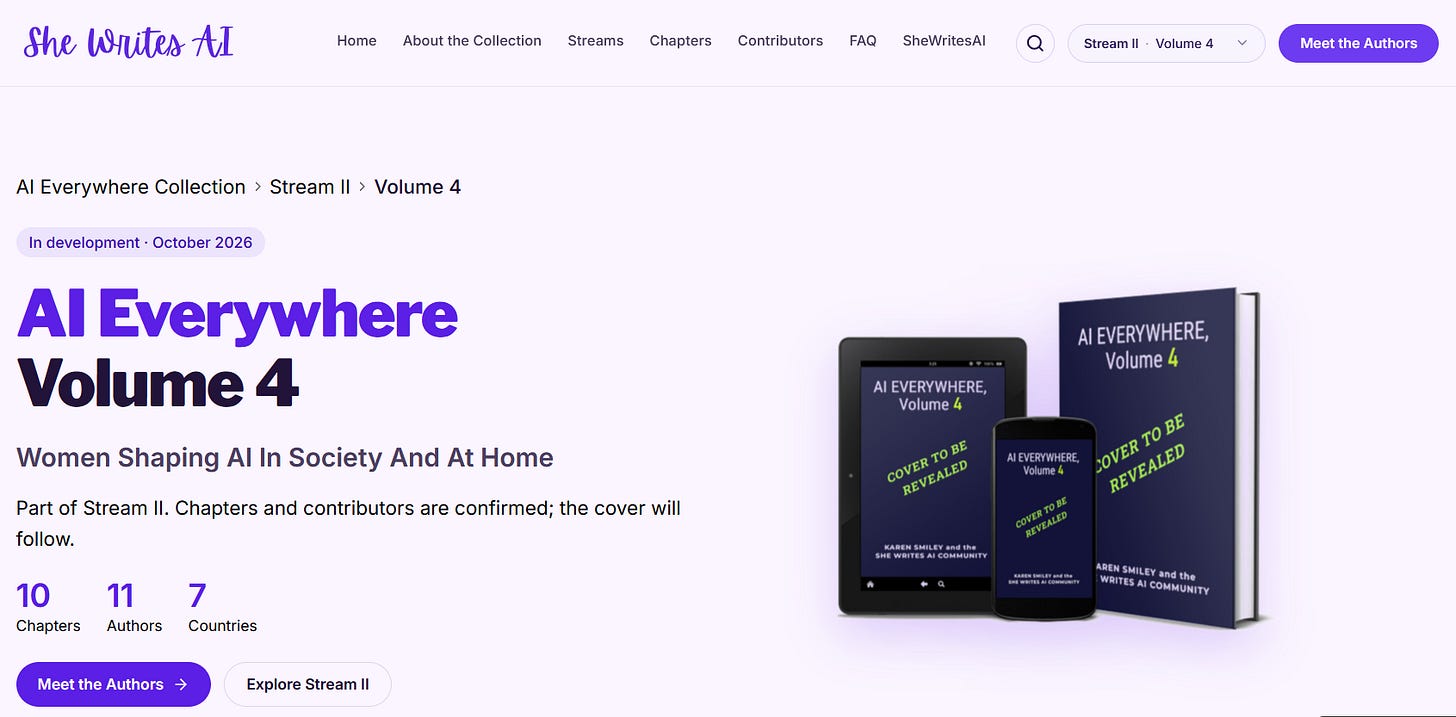
Where To Buy, How To Read and Listen, Ways To Review
-
Buy Volume 1 (now in ebook and print on Amazon, Gumroad, Lulu, Ingram Spark, and many reading platforms)
-
Tips from our publisher on how to buy an Amazon ebook from a country that isn’t a ‘KDP marketplace’, and how to read the ebook without a Kindle device (free)
-
Look for our new abridged audiobook edition!
-
Review links (we’re on Amazon, Goodreads, and Storygraph)
Ways To Support
To help cover book-related costs (ISBNs, proof copies, etc.) as well as other * community services, we follow the Wikipedia model. We are now accepting donations via paid subscriptions and can also now accept one-time tips through Stripe (‘digital ink’). All donation sizes are welcome and help keep these book authoring opportunities free for She Writes AI Community members worldwide! Patrons and Sponsors are acknowledged on our book site. Read more*.
Thanks as always for your support in every form. We appreciate it all. Hearts, shares, restacks, and comments are awesome!