Neha Kabra on five business decisions that reduce AI dependence across models, vendors, human judgment, organisational context, and evaluation.
By Neha Kabra
Published: 2026-09-04
Introduction
This article is a guest post by * Community member . Neha is an enterprise operator working at the intersection of business, AI, data and technology. Over nearly two decades across consulting, including as a Partner at McKinsey in London, and banking, she has led large-scale value creation programmes. She writes her newsletter HumAnIzing* about the realities of enterprise tech & AI: how organisations make choices, manage risk and context, and turn technological capability into business value.
Today Neha is sharing her experiences around five key business decisions organizations can make to improve their resilience to dependencies on AI models. — * for *
Thank you for subscribing to She Writes AI!
(always free for everyone, thanks to our donors)
Opening
The model you choose today may not be the model you want six months from now.
That matters because AI is moving from individual tools into business workflows. Once a model sits inside customer interactions, decisions, controls and day-to-day work, changing it becomes a business decision too.
We can already see different approaches emerging.
OpenRouter gives enterprises access to hundreds of models through a common layer, with routing, failover, spend controls and policies governing which models and providers can handle different requests.
Perplexity Computer takes a different approach. A task can be broken down, with different parts routed across models and agents suited to the work.
Thinking Machines Lab is experimenting with another architecture. One model stays in real-time interaction with the user, handling the conversation and clarifying what is needed. When deeper reasoning or longer-running work is required, it can delegate the context to a second model working in the background.
These are different patterns, but they point in the same direction: model routing is becoming an important design choice.
And routing is only one part of the decision.
Choosing an LLM is one design choice. The harder question is how you manage enterprise dependence on it over time.
I think that comes down to five business questions:
-
How should work be routed? Match capability, cost and control to the task.
-
Who should your business depend on? Decide how much dependence you are willing to place on any single model, vendor or architectural choice.
-
Where should humans stay in the loop? Keep judgment where it creates the most value.
-
Who owns your organisational context? Treat context as an asset that should remain portable.
-
How should AI be evaluated once it is live? Measure what happens to the business, and build checks around the models making it happen.
1. How should work be routed?
Match capability, cost and control to the task.
A summarisation request does not need the same model as a complex credit decision. A routine internal query does not need the same controls as a customer complaint or a regulated decision.
Start with the lowest-cost model that can reliably do the job. Route to greater capability when the task demands it. At enterprise scale, that choice matters. Model costs compound across millions of requests, longer context windows, retries and the multiple calls sitting inside agentic workflows.
Risk changes the route again.
One repeated pattern in enterprise AI work is using models to check other models. An output can be tested by a second model, with disagreement or uncertainty triggering further review. Human intervention can then focus on the smaller set of cases where the consequence, ambiguity or risk warrants it.
This is also where model risk management needs to evolve. Controls designed around a single model and a human reviewer will struggle as AI systems become more agentic and use several models within the same workflow.
Routing gives you another way to manage that risk. You can decide which work needs more intelligence, which needs more scrutiny and which needs a person.
The objective is simple: spend the money and human attention where they matter.
That raises a second question: who are your vendors of choice, and how much of your AI capability are you comfortable concentrating with them?
2. Who should your business depend on?
There are two forms of enterprise AI dependence: vendor dependence and context dependence.  Neha KabraAnthropic, Fable, and the Two AI Dependencies Every CEO Should UnderstandAnthropic’s decision to restrict access to Fable following a U.S. government request has reignited the debate around Sovereign AI. Governments will have to answer harder questions about access, resilience, and technological independence…Read more2 months ago · 30 likes · 8 comments · Neha Kabra
Vendor dependence is the obvious one. A provider can change access, pricing, capabilities or commercial terms even when the technology itself is working perfectly. Anthropic’s restriction of access to Fable 5 was a useful reminder of that. The risk was expanded from model failure to accessibility.
As AI gets deeper into the organisation, that dependence becomes harder to unwind. Workflows are built around particular capabilities. Integrations accumulate. Teams learn how to work with specific tools. Context starts sitting around those systems.
Model choice, coupled with enterprise context, can become an operating constraint. But this does not mean every enterprise needs five vendors and redundancy everywhere. Optionality comes with duplication costs.
It does mean leadership teams need to know which dependencies they are willing to accept, where they need fallback options, and how portable critical workflows really are.
The same applies to context. The more an external provider understands how your business works, the more valuable that relationship can become. It can also make separation harder.
Complete independence is neither realistic nor desirable.
The goal is dependence by design.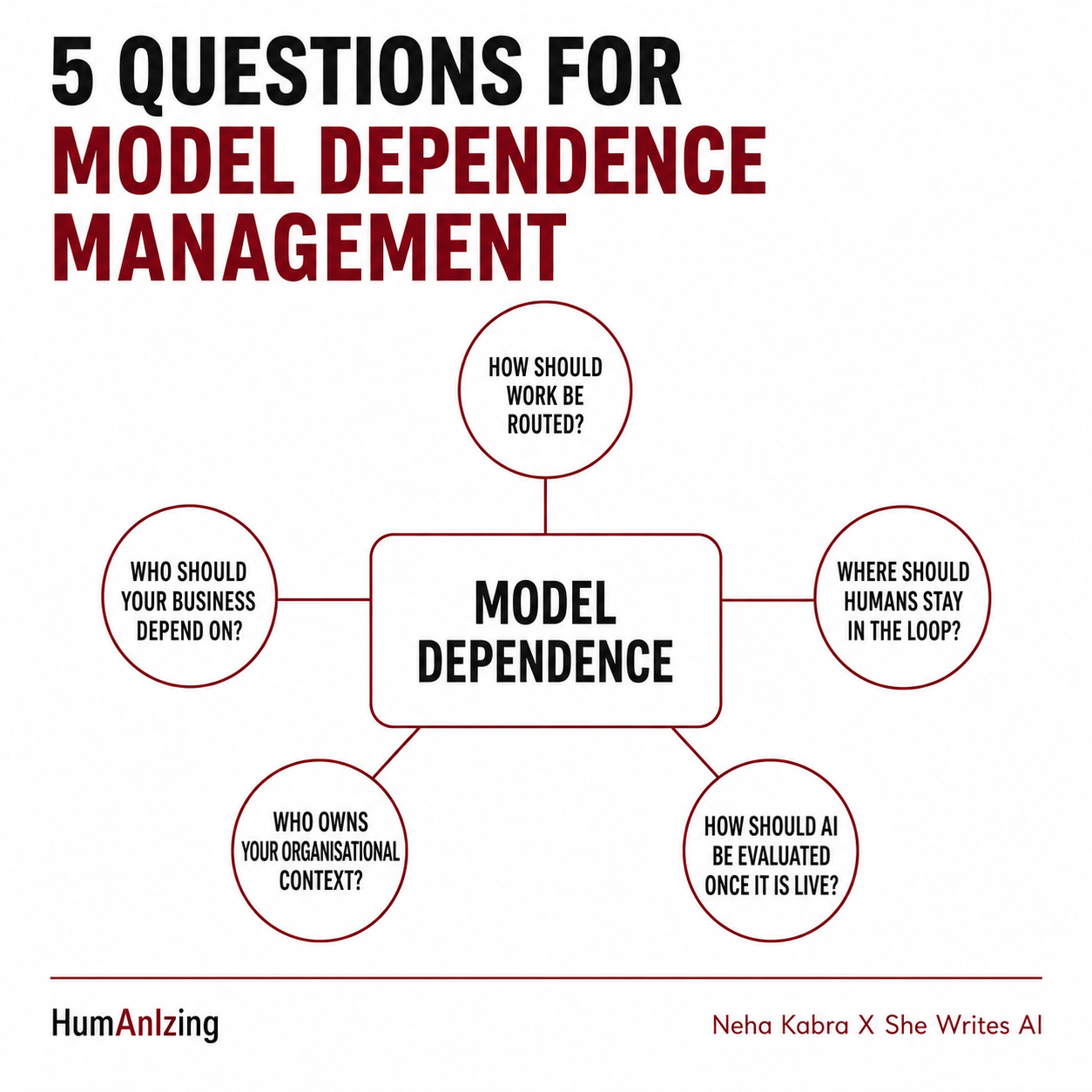
3. Where should humans stay in the loop?
Human-in-the-loop is often drawn as the final box in a workflow: AI does the work, a human reviews it.
That is too simplistic for how enterprise workflows will actually operate.
A real, working enterprise human-in-the-loop is very different.
Take a ten-step process. AI might complete the first two steps, hand the work to a person for the third, take it back for steps four and five, and return it to a human later. Some steps will be deterministic, some probabilistic and some will require human judgment. The workflow is hybrid.
Once you design for that reality, the practical questions change. Where should the handoffs happen? What triggers them? What information moves with the work? And how do you monitor what happens as responsibility moves between humans and AI?
A human receiving work from an LLM midway through a process needs more than its answer. They need to understand the context the model used, what it did, and enough of the reasoning behind the output to decide what happens next.
 Cash & CacheYour Org Remembers Everything. It Understands Less.🧠TL;DR: AI is solving institutional memory. Meetings recorded, decisions documented, context retrievable in seconds. The paradox: organizations may remember more while understanding less. Neha Kabra, McKinsey partner and returning Cash & Cache collaborator, introduces the Context Stitching Layer and explains why. I close with what this means for anyone…Read more2 months ago · 18 likes · 6 comments · Raghav Mehra and Neha Kabra
AI is increasingly assembling the first interpretation a person receives: bringing together evidence, policy, customer history and prior decisions before the human enters the process.
A complete-looking AI generated answer can carry authority that has not yet been tested. That makes explainability and auditability a required part of the human-AI handoff design.
It also connects directly to routing. A human is another destination in the workflow. The system needs to know when work stays with AI, when it moves to another model, and when it reaches a person.
Human-in-the-loop does not mean human-at-the-end. And it certainly does not mean human-checks-everything.
It means designing the points where human judgment enters the workflow, and making sure people have enough context to exercise it.
4. Who owns your organisational context?
Good handoffs depend on good context. That creates the next design question: where does that context come from, and who ultimately owns it?
Enterprise context is more than documents and data. It includes policies, previous decisions, exceptions, customer history, operating constraints and what people have learnt from running the business.
The value comes from stitching these together.
A customer decision might require transaction history, product terms, previous complaints, regulatory policy and an exception made six months ago. Another decision will need a different combination. I have written previously about the need for a Context Stitching Layer: assembling the organisational context relevant to a decision before AI reasons over it.
This creates another risk. An LLM can reason well over the context it receives and still miss an entire part of the picture. The answer can look complete even when the context is not.
So you need to know what was searched, what was retrieved, what was omitted and how conflicting information was handled. Different models or retrieval paths can also be used to challenge whether the right context has been assembled.
Now consider where all that understanding accumulates.
If it sits primarily within one vendor ecosystem, context dependence can become much deeper than data portability. Forward-deployed engineers add another layer. People working alongside your teams learn why processes work the way they do, where the data is unreliable, which exceptions matter and what has already been tried. Some of that knowledge may never make it into an AI system at all.
Your vendor can end up holding machine context, implementation knowledge, and human understanding of how your organisation works.
With so much AI led context dependence, the question is no longer simply where your data sits. It is where understanding of your organisation is accumulating, and whether that understanding remains yours.
5. How should AI be evaluated once it is live?
AI performance can be measured at three levels: model performance, workflow performance and business performance. For the purposes of this post, we will focus on model performance.
For model routing, start with model performance. Which model is best suited to which part of the work?
Thinking Machines Lab offers an interesting example of separation of work between models. Its architecture separates the model interacting with the user from the model doing deeper work in the background. The interaction model stays in the conversation, understands what the user needs and can hand the context to a second model for more sustained reasoning.
That handoff makes model evaluation more interesting. You need to know how well the first model understands and assembles the context, how effectively that context transfers, and how well the second model reasons over it. Cost and latency matter, but so does the quality of context stitching between the two.
Models can also evaluate each other. One model can generate an output, another can challenge it, with the residual uncertain or consequential cases reaching a human.
The evidence then feeds back into routing: which model handles which task, when another model needs to check it, and when the work needs to move elsewhere.
Workflow and business performance still matter. But intelligent routing starts with knowing what each model is actually good at.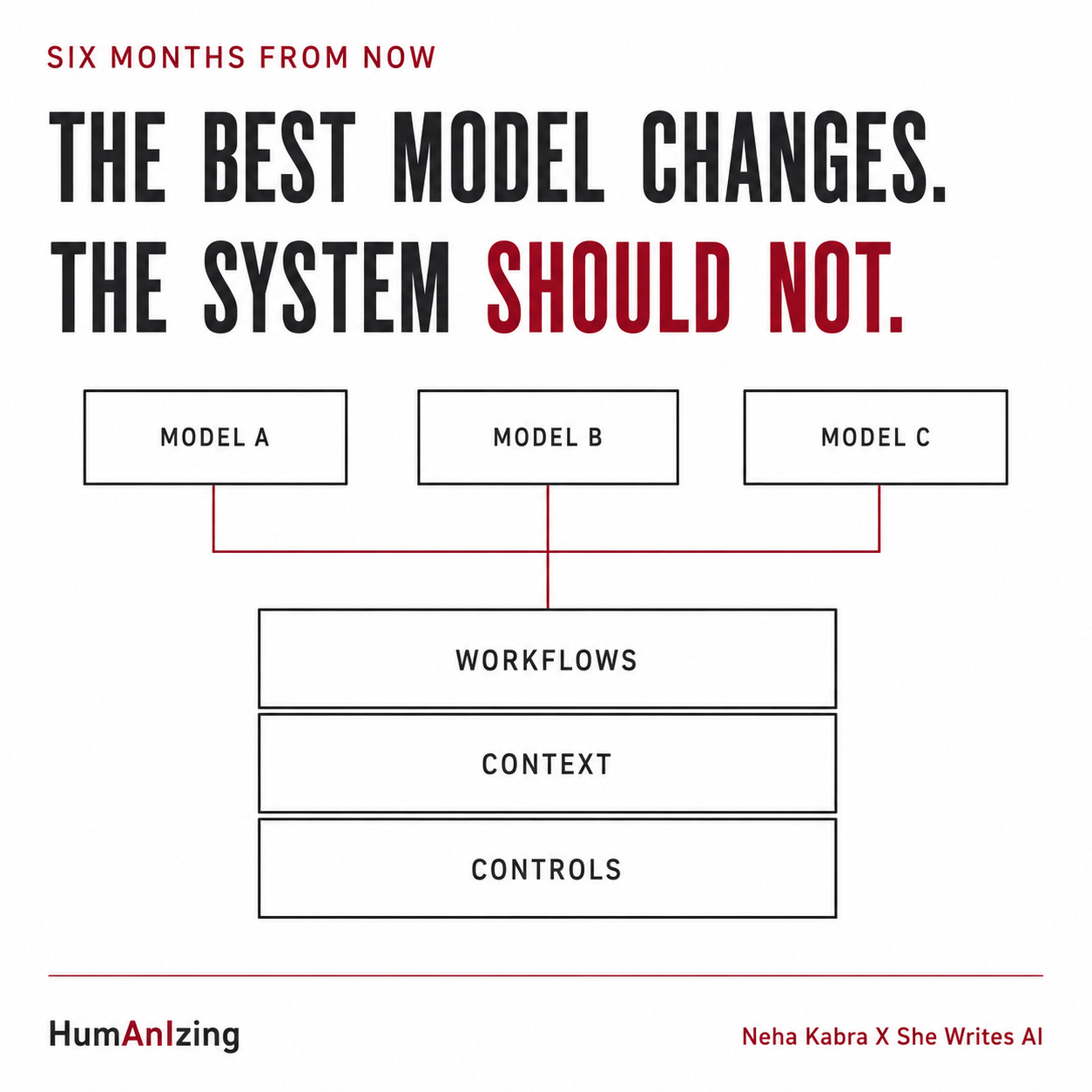
Conclusion
Six months from now, the best model for a particular task will have changed.
That is exactly why the model itself cannot be the centre of the design.
The five questions in this piece are really about where work goes, who does it, what context travels with it, how the output gets checked, and where the organisation is willing to become dependent.
Some dependence is inevitable. The important thing is to know where it sits.
If your workflows, context and controls are built in a way that lets you change models without rebuilding everything around them, you have room to adapt.
It’s called Dependence by design.
 Neha KabraAI is changing technology, competition, organisations, incentives, and power. I write about the second-order effects and strategic shifts leaders can’t afford to miss.
Thank you to * for sharing these thoughts on how enterprises can make five key business decisions to improve their resilience to dependencies on AI models! This article is a continuation of a conversation about an earlier article in my own newsletter about two key risks of AI tool dependencies. If you find yourself inspired by an AI discussion with a community member, feel free to propose a collaboration or guest post like this one through our SheWritesAI DraftKit. — for *
Ways To Support: To help cover community services and book-related costs (ISBNs, proof copies, etc.), we are now accepting donations worldwide via one-time tips through Stripe (‘digital ink’) or Gumroad. We can also accept paid subscriptions in limited geographic regions (due to tax complications that we hope Substack will resolve soon). All donation sizes are welcome and help keep our services free for all women & nonbinary AI writers worldwide! 
Thanks as always for your support in every form! We appreciate it all. Hearts, shares, restacks, and comments are all awesome!