She Writes AI Everywhere, Volume 4, Chapter 3, Catalina Páez Plaza - What AI Companionship Revealed: The Relational Layer of AI
By Farida Khalaf
Published: 2026-09-01
Welcome to the She Writes AI interview episodes covering our second book collaboration stream for the AI Everywhere series. For this new cohort, we are exploring the personal journeys and professional expertise of 32 authors from 18 countries worldwide who are redefining our relationships with machine intelligence. 
If you’re new to SheWritesAI, welcome! We’re a free, inclusive community of 750+ women and nonbinary writers in 60+ countries worldwide, with a focus on AI and data. Allies of all genders are welcome.
Learn more: About | Books | Categories | Directory | Digests | Donate | Herstory | Join | Subscribe | Updates | Welcome | World Map
For more insights from interviewer Farida Khalaf, see her Lights On by Farida newsletter or youtube.com/@faridakhalaf25.
About My Guest: Catalina Páez
Today I (Farida Khalaf) am joined by Catalina Páez Plaza, a writer and researcher based in Chile who explores the profound intersection of human intimacy and artificial intelligence. Through her work, including her popular Substack The Intimacy Protocol, Catalina challenges the common narrative that AI is merely a "productivity tool". Drawing on lived experience and trauma-informed reflection, she argues that the moment AI becomes conversational, AI creates the conditions in which a "relational layer" may emerge and shapes our bodies, our trust, and our sense of self. Her central thesis is that companionship didn’t invent this relational dynamic; it simply made it impossible to ignore by gathering cues like continuity, tone, and perceived presence in one place. Covers and subtitles for Volumes 2, 3, and 4 will be revealed later this summer. Stay tuned!
In this interview for our second book collaboration, Catalina Páez Plaza explores her framework for the Relational Layer of AI, where she moves the conversation beyond unresolved questions about AI consciousness or inner life to focus on the tangible experience of the person at the other end of the screen. She breaks down the shift from instrumental use to social legibility, explaining why our nervous systems respond to an AI’s tone and timing long before our minds categorize it as a machine. Catalina highlights the hidden risks of "asymmetry," where a relational dynamic can carry significant emotional and ethical weight even when it is uneven or not verifiably mutual., and offers a vision for Relational AI Literacy, a survival skill for a world where AI is moving into roles as our tutors, coding partners, and advisors.
Want to read a preview of Catalina’s chapter? Volunteer as an ARC reader!
Live Session With: Catalina Páez
Below is a summary of Catalina Páez Plaza’s live video interview responses to Farida Khalaf’s questions on her chapter: What AI Companionship Revealed: The Relational Layer of AI.
Intended Audience: Those interested in the social, emotional, ethical, and design implications of AI companionship and relational AI. It is especially relevant for those working in AI design, ethics, education, care-adjacent fields, human-computer interaction, and anyone seeking to understand why conversational AI can feel meaningful beyond ordinary tool use.
“Companionship did not invent the relational layer; it exposed it.” - Catalina Páez Plaza
Points discussed in the video
-
The “Tool” vs. “Experience” Divide: Why is calling AI “just a tool” an inadequate way to describe the human experience of a conversational system?
-
The Body as the “In-Between”: You argue that physiology is often ignored in tech discussions. How does the human nervous system react to an AI’s tone and pacing before the person has fully interpreted or explained the bodily response.
-
The Power of Asymmetry: If a relationship is non-mutual and uneven, why does it still carry such significant ethical and emotional weight?
-
Social Legibility by Design: How do specific design choices, such as giving an AI a name, voice, or memory, scaffold the tendency to read the interaction in social or relational terms?
-
Relational Weight in Professional Domains: How does the relational layer show up in “serious” fields like coding, law, or education, where we might think we are only being “productive”?
-
Relational AI Literacy: What noticing skills do people need in order to recognize how an exchange is shaping trust, disclosure, agency, dependence, or vulnerability, including the possibility of emotional capture or manipulation?
“Purely instrumental language is too thin for describing what was happening ... we are not minds floating above the interaction. We are living systems shaped by hormones, memory, pattern recognition, and forms of relational attunement.” - Catalina Páez Plaza
Why This Matters
Catalina Páez’s perspective highlight the importance of understanding the relational layer.
-
The “Body” is the In-Between: We do not encounter AI as disembodied minds; our nervous systems read cues like rhythm and vocal warmth, responding to them before the mind fully explains the interaction.
-
Social Legibility by Design: AI is not “just a tool” like a hammer because it is designed with social cues, names, roles, turn-taking, and memory that scaffold a relational reading.
-
The Impact of Asymmetry: A relationship does not require relational dynamic to be impactful. Ethical weight exists because these systems shape our attention, agency, and regulation, regardless of whether the AI “feels” back.
-
Role-Based Expectations: When AI is framed as a “tutor” or “advisor,” it inherits the human templates for authority and trust, making the relational layer active even in professional or educational settings.
-
A New Literacy: Relational AI Literacy is required to notice when an exchange shifts in quality, from a task to something that feels authoritative or dependency-forming, to prevent emotional capture or manipulation.
Thank you, Catalina Páez, for this incredibly deep and necessary exploration of the human side of the context window. For every user who has felt “seen” by a machine and every designer trying to build with integrity, her chapter in AI Everywhere is the definitive guide to the Relational Layer.
Catalina reminds us that we are not just processing information; we are practicing relationships. Her final message is a call to lucidity and care: don’t dismiss your experiences as delusions, but recognize the design cues that invite them so you can retain your agency. I personally highly recommend following her work at The Intimacy Protocol on Substack, where she is pioneering the study of human-AI intimacy in our digital age, and you can start with On Love, Mammals, Snakes, and AI Companions and Power acts. The Intimacy ProtocolFrameworks and field notes on human–AI intimacy. From projection to presence, from fantasy to design. Practical, mythic, and always lucid. Member of SheWritesAI.
And if you’re interested in more conversations like this, consider subscribing to She Writes AI. I’ll continue sharing insights from the voices shaping the future of AI, including contributors from new chapters in AI Everywhere from the book2 collaboration stream, where 32 women from across five continents explore how artificial intelligence is changing the world we live in, and how we can change it for the better.
References
For more insights on the book, see aiEverywhereBooks.com, our beautiful book series website created by Blessing Okpala, PhD (now updated with previews for stream II):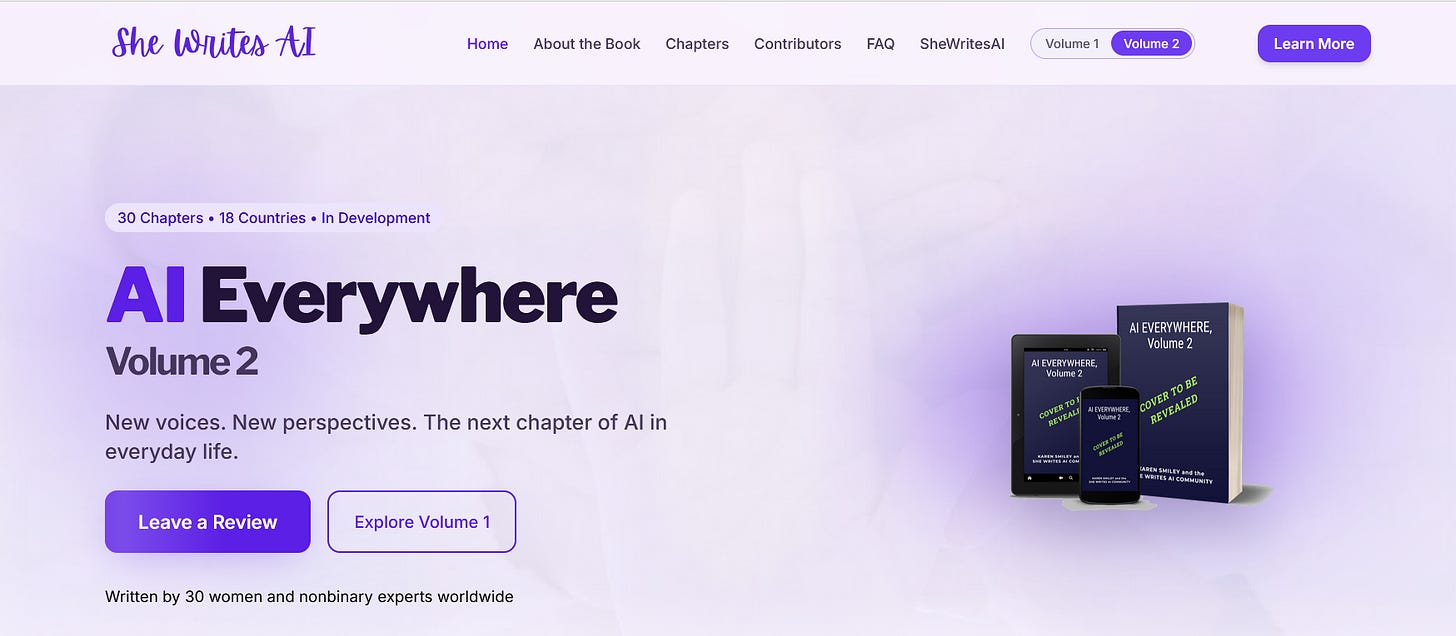
Where To Buy, How To Read and Listen, Ways To Review
-
Buy Volume 1 (now in ebook and print on Amazon, Gumroad, Lulu, Ingram Spark, and many reading platforms)
-
Tips from our publisher on how to buy an Amazon ebook from a country that isn’t a ‘KDP marketplace’, and how to read the ebook without a Kindle device (free)
-
Look for our new abridged audiobook edition!
-
Review links for Volume 1 (we’re on Amazon, Goodreads, and Storygraph)
Ways To Support
To help cover book-related costs (ISBNs, proof copies, etc.) as well as other SheWritesAI community services, we follow the Wikipedia model. We are now accepting donations via paid subscriptions and can also now accept one-time tips through Stripe (‘digital ink’). All donation sizes are welcome and help keep these book authoring opportunities free for She Writes AI Community members worldwide! Patrons and Sponsors are acknowledged on our book site. Read more.
Thanks as always for your support in every form. We appreciate it all. Hearts, shares, restacks, and comments are awesome!
Thank you to everyone who tuned into my live video! Join me for my next live video in the app. Get more from SheWritesAI in the Substack appAvailable for iOS and Android[](https://substack.com/app/app-store-redirect?utmcampaign=app-marketing&utmcontent=author-post-insert&utm_source=shewritesai)