By Tiger Capital Research
Published: 2026-07-21
URL: https://princetonchen.substack.com/p/super-earnings-week-kicks-off-with
Daily Market Read II | Category: Earnings & AI Capex | Date: July 21, 2026
Tiger Capital Research
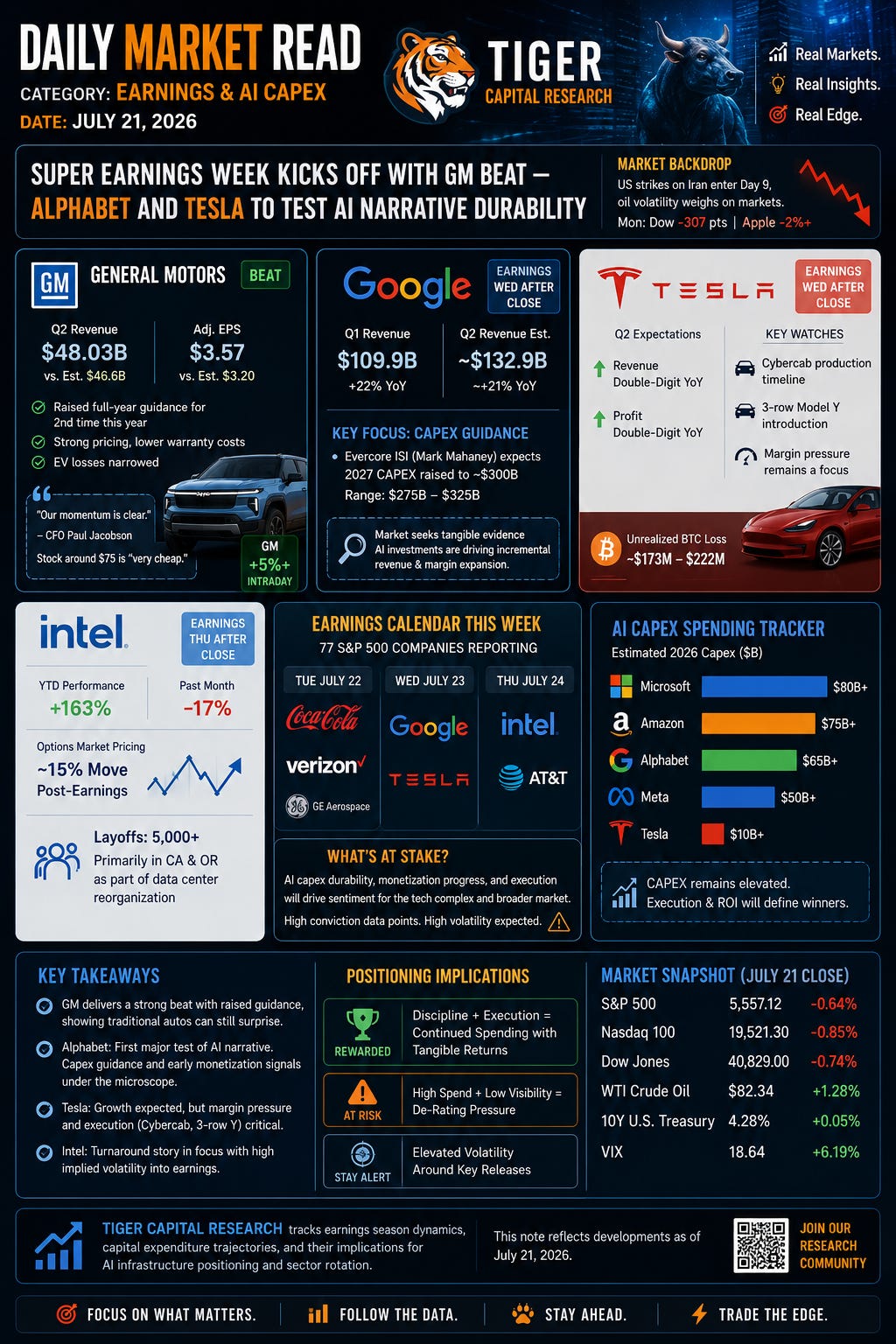
The most consequential earnings week of the season began with a strong showing from General Motors. The company reported second-quarter revenue of $48.03 billion and adjusted earnings per share of $3.57, both ahead of expectations, while raising full-year guidance for the second time this year. Shares rose more than 5 percent intraday. Management highlighted solid vehicle pricing, lower warranty costs, and a narrowing of electric vehicle losses as the primary drivers. CFO Paul Jacobson described the company’s momentum as “clear” and characterized the stock around $75 as “very cheap.”
While GM provided a constructive start, investor attention quickly shifts to the more consequential reports scheduled for Wednesday after the close. Alphabet and Tesla will report on the same evening, followed by Intel on Thursday. This cluster of results arrives against a backdrop of recent semiconductor weakness and growing market skepticism about whether the massive AI-related capital expenditures are translating into commensurate returns.
Alphabet: First Major Test of the AI Narrative
Alphabet’s first-quarter revenue grew 22 percent to $109.9 billion, driven primarily by search and cloud. Consensus for the second quarter points to revenue growth of roughly 21 percent. The more important signal, however, is expected to come from capital expenditure guidance. Evercore ISI analyst Mark Mahaney anticipates that Alphabet may raise its 2027 capex outlook to approximately $300 billion, within a range of $275–325 billion. The market is actively seeking tangible evidence that AI investments are beginning to generate incremental revenue and margin expansion.
Not everyone shares the same level of optimism. Some strategists have cautioned that any material reduction in planned spending could trigger a negative feedback loop across the broader AI ecosystem. Banks have explicitly advised clients to focus on capital expenditure commentary during this earnings season. Alphabet’s results will therefore serve as an early read on whether the hyperscaler spending cycle remains on track or is beginning to moderate.
Tesla: Growth Expected, but Margin and Execution Concerns Persist
Tesla is expected to deliver double-digit year-over-year growth in both revenue and profit for the second quarter, aided by deliveries that exceeded expectations. The stock, however, remains approximately 22 percent below its recent peak, with profit margin contraction remaining a primary focus for investors. The post-earnings conference call is likely to center on the production timeline for the Cybercab and the introduction of a three-row Model Y variant.
The company also disclosed an unrealized loss of roughly $173–222 million on its Bitcoin holdings during the quarter. While not material to the overall financial picture, it adds another layer of volatility to an already closely watched name.
Intel and Broader Context
Intel reports Thursday after the close. The stock has risen approximately 163 percent year-to-date but has given back 17 percent over the past month. Option markets are pricing in potential post-earnings moves of around 15 percent. The company has already announced further U.S. layoffs exceeding 5,000 positions, primarily in California and Oregon, as part of a broader data center reorganization.
This week’s slate of 77 S&P 500 companies reporting earnings unfolds against a backdrop of geopolitical tension, with U.S. strikes on Iran entering their ninth day and contributing to oil price volatility that weighed on Monday’s session (Dow down 307 points, Apple down more than 2 percent). The combination of elevated AI-related spending scrutiny and macro uncertainty has created a more cautious tone heading into the results.
Positioning Implications
The earnings calendar this week offers a series of important data points on the durability of the AI investment thesis. GM’s beat demonstrates that traditional automotive fundamentals can still deliver positive surprises. Alphabet’s results, however, will carry greater weight for the broader technology complex, particularly regarding the trajectory of capital expenditure and early signs of monetization. Tesla’s update will test whether execution momentum can overcome margin pressures and valuation concerns.
Investors should prepare for elevated volatility around these releases. Companies that can demonstrate both continued spending discipline and tangible progress toward revenue realization are likely to be rewarded. Those perceived as lagging on either dimension may face additional pressure. The week’s outcomes will help clarify whether the recent semiconductor and AI-related weakness represents a healthy digestion of elevated expectations or the beginning of a more sustained reassessment of the capex cycle.
Tiger Capital Research tracks earnings season dynamics, capital expenditure trajectories, and their implications for AI infrastructure positioning and sector rotation. This note reflects developments as of July 21, 2026.