By Tiger Capital Research
Published: 2026-07-21
URL: https://princetonchen.substack.com/p/bofas-hartnett-flags-extreme-bullishness-ab7
Daily Market Read I | Category: Semiconductors & Memory Cycle | Date: July 21, 2026
Tiger Capital Research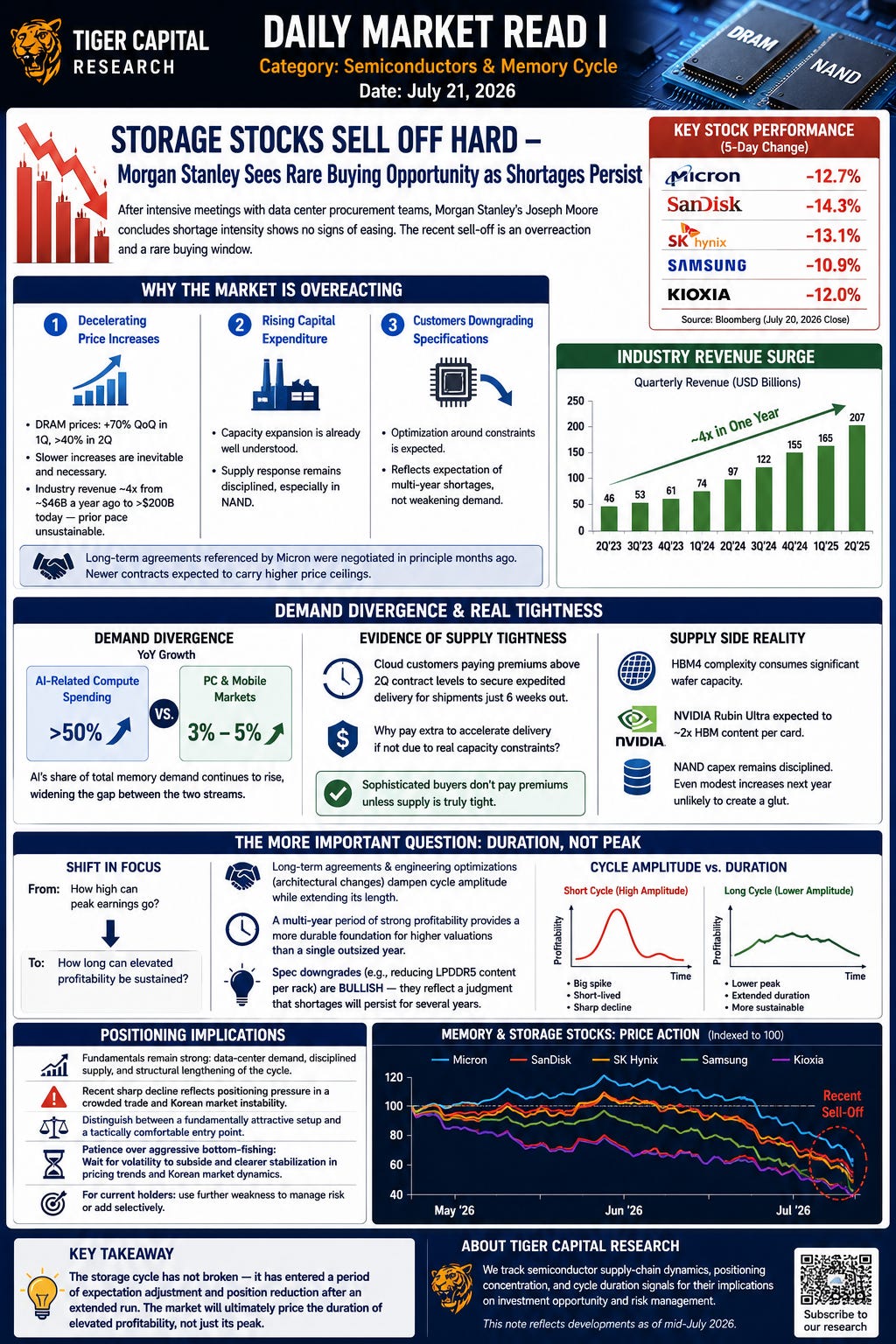
Memory and storage names have been hammered in recent sessions, with Micron, SanDisk, SK Hynix, Samsung, and Kioxia all under significant pressure. Yet Morgan Stanley’s semiconductor analyst Joseph Moore, after an intensive round of meetings with data center procurement teams last week, concluded that the underlying shortage intensity shows no signs of easing. In his view, the sell-off represents an overreaction to concerns that were already visible weeks ago, creating what he describes as a rare buying window.
Why the Market Is Overreacting
The three main worries cited by investors — decelerating price increases, rising capital expenditure as companies expand capacity, and customers beginning to downgrade specifications — are not new developments. DRAM prices rose approximately 70 percent quarter-over-quarter in the first quarter and more than 40 percent in the second. While the rate of increase is slowing, Moore argues this was inevitable and even necessary. Industry quarterly revenue has roughly quadrupled from around $46 billion a year ago to over $200 billion today. Sustaining the earlier pace of price gains on this much larger base would be unrealistic and would ultimately choke off demand.
On long-term agreements, Moore notes that Micron referenced conservative pricing during its earnings call, effectively capping both upside and downside for certain contracts. He believes these older agreements were largely negotiated in principle months ago and are simply taking longer to finalize legally. Newer contracts, by contrast, are expected to carry higher price ceilings.
Demand Divergence and Real Tightness
The current cycle is unusual because demand is overwhelmingly driven by data centers rather than the traditional mix of consumer electronics, PCs, and smartphones. AI-related compute spending is growing at over 50 percent year-over-year, while the PC and mobile markets expand at just 3 to 5 percent. As AI’s share of total memory demand continues to rise, the gap between the two demand streams will only widen.
Evidence of genuine supply tightness is visible in procurement behavior. Cloud customers are reportedly paying premiums above second-quarter contract levels to secure expedited delivery of memory for shipments just six weeks out. Moore asks a pointed question: why would sophisticated buyers pay extra to accelerate delivery if they were simply managing inventory or gaming the system? The answer, in his view, is straightforward capacity constraints.
On the supply side, HBM4 manufacturing complexity will consume significant wafer capacity, and Nvidia’s upcoming Rubin Ultra platform is expected to roughly double HBM content per card. NAND capital expenditure has remained disciplined industry-wide; even if it rises modestly next year, it is unlikely to create a meaningful supply glut.
The More Important Question: Duration, Not Peak
Moore shifts the analytical focus from “how high can peak earnings go?” to “how long can elevated profitability be sustained?” Long-term agreements and customer engineering optimizations (such as architectural changes to work around memory constraints) serve to dampen the amplitude of the cycle while extending its length. A multi-year period of strong profitability provides a more durable foundation for higher valuations than a single outsized year followed by a sharp reversion.
The much-discussed risk of specification downgrades — Nvidia’s moves to reduce LPDDR5 content per rack and optimize overall memory architecture — is interpreted by Moore as bullish rather than bearish. These efforts reflect a judgment that memory shortages will persist for several years. Once supply eventually eases, memory content per system is expected to rise again.
Positioning Implications
The fundamental picture painted by Morgan Stanley — persistent data-center-driven demand, disciplined supply response, and structural lengthening of the cycle — supports the view that current prices embed excessive pessimism. However, the speed and breadth of the recent decline also reflect genuine positioning pressure in an extremely crowded trade. Volatility remains elevated, and Korean market instability continues to weigh on sentiment.
For investors, the distinction between a fundamentally attractive setup and a tactically comfortable entry point is important. While the long-term case for memory intensity in AI infrastructure remains compelling, jumping in during the current high-volatility clearing phase carries elevated near-term risk. A more measured approach would involve waiting for volatility to subside and for clearer signs of stabilization in both pricing trends and Korean market dynamics before committing fresh capital. Those already positioned may use further weakness to manage risk or add selectively, but the immediate environment favors patience over aggressive bottom-fishing.
The storage cycle has not broken. It has simply entered a period of expectation adjustment and position reduction after an extended run of strong performance. How the market prices the duration of elevated profitability — rather than just its peak — will determine whether current levels ultimately prove to be an attractive entry or a value trap.
Tiger Capital Research tracks semiconductor supply-chain dynamics, positioning concentration, and cycle duration signals for their implications on investment opportunity and risk management. This note reflects developments as of mid-July 2026.