By Tiger Quant Researcher
Published: 2026-07-22
URL: https://princetonchen.substack.com/p/ai-as-national-strategic-competition
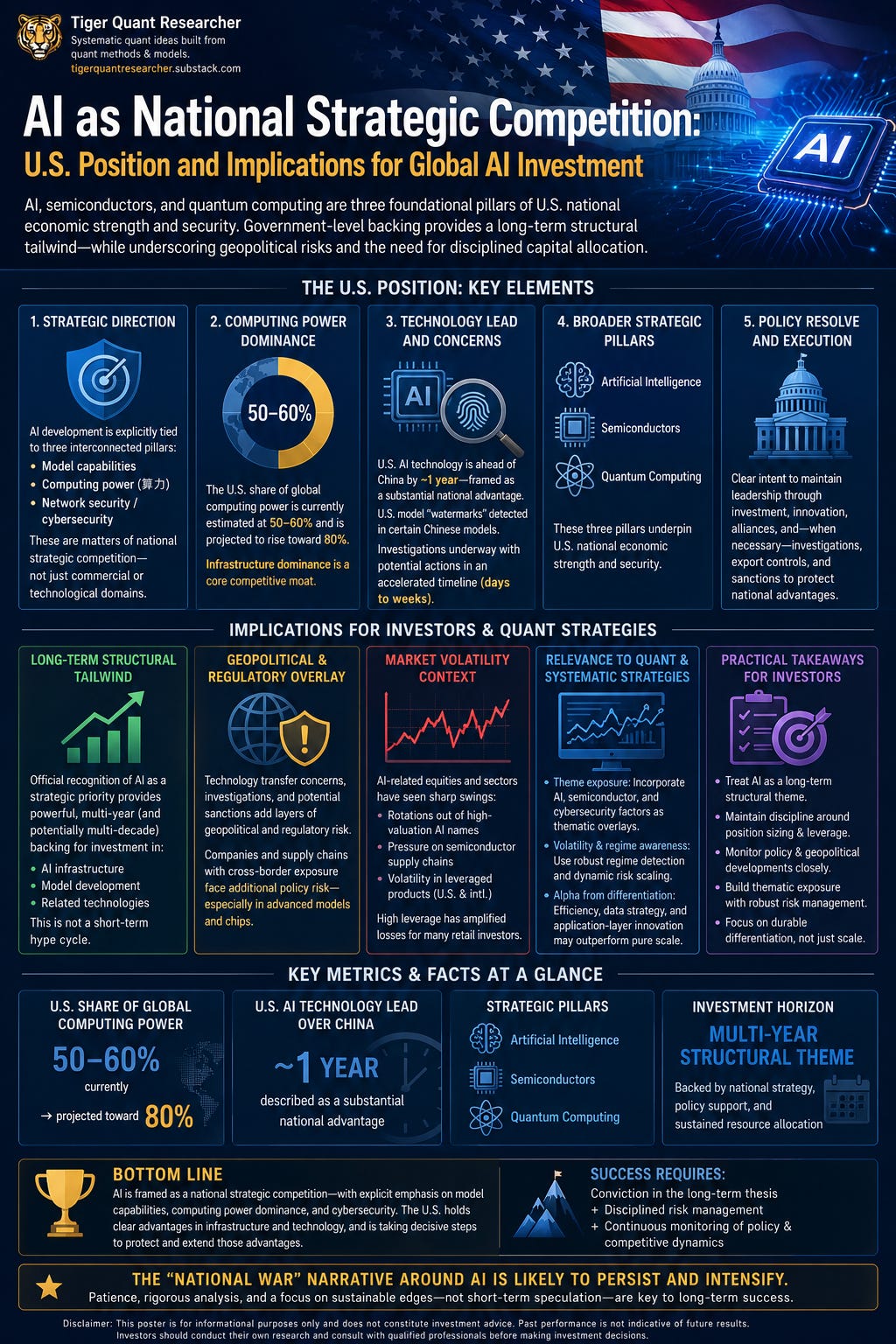
Core Thesis
Recent statements from senior U.S. officials frame artificial intelligence — specifically model capabilities, computing power, and network security — as a national strategic-level competition. The United States currently accounts for roughly 50-60% of global computing power (with expectations of rising toward 80%), and maintains an approximate one-year lead in AI technology over China, which is described as a significant national advantage. Concerns have been raised about foreign models carrying “watermarks” from U.S. models, with investigations and potential actions under consideration. AI, semiconductors, and quantum computing are positioned as three foundational pillars of U.S. national economic strength and security. This official framing provides clear government backing for long-term AI investment while also underscoring geopolitical dimensions and the need for disciplined capital allocation amid ongoing market volatility.
Key Elements of the U.S. Position
Strategic Direction
AI development is explicitly tied to three interconnected pillars:
• Model capabilities
• Computing power (算力)
• Network security / cybersecurity
These are not treated merely as commercial or technological domains but as matters of national strategic competition. The message is that the United States holds meaningful advantages and intends to maintain leadership.
Computing Power Dominance
The U.S. share of global computing power is currently estimated at 50-60% and is projected to increase significantly. This dominance in infrastructure is viewed as a core competitive moat that supports continued leadership in model development and deployment.
Technology Lead and Concerns
U.S. AI technology is described as being ahead of China by roughly one year — framed as a substantial national advantage. A notable point of contention is the detection of U.S. model “watermarks” in certain Chinese models. Officials have indicated that such transfers are unacceptable and that investigations, along with potential further actions, are being prepared on an accelerated timeline (days to weeks).
Broader Strategic Pillars
AI is grouped with semiconductors and quantum computing as the three foundational pillars supporting U.S. national economic strength and security. This alignment signals sustained policy attention and resource allocation across these interconnected domains.
Implications for Investors and Quant Strategies
Long-Term Structural Tailwind
Government-level recognition and support for AI as a strategic priority provides a powerful backdrop for continued investment in AI infrastructure, model development, and related technologies. This is not a short-term hype cycle but an officially acknowledged multi-year (and potentially multi-decade) national priority.
Geopolitical and Regulatory Overlay
The explicit discussion of technology transfer concerns, potential investigations, and sanctions adds a geopolitical dimension to AI investment. Companies and supply chains with significant cross-border exposure (especially involving advanced models or chips) face additional layers of regulatory and policy risk that must be monitored.
Market Volatility Context
AI-related equities and related sectors have experienced sharp swings, including rotations out of high-valuation AI names, pressure on semiconductor supply chains, and volatility in leveraged products (both in the U.S. and internationally). Retail investors using high leverage have been particularly vulnerable during these moves. The official strategic framing does not eliminate near-term volatility; rather, it underscores that this is a long-term theme best approached with patience and appropriate risk management.
Relevance to Quant and Systematic Strategies
• Theme exposure: Systematic strategies can incorporate AI infrastructure, semiconductor, and cybersecurity factors or baskets as explicit thematic overlays, while remaining mindful of policy and geopolitical event risk.
• Volatility and regime awareness: Periods of sharp rotation or policy-driven volatility (as seen recently) highlight the value of robust regime detection and dynamic risk scaling in quant models.
• Alpha from differentiation: As AI becomes more strategically contested, differentiation in model efficiency, data strategy, and application-layer innovation may become relatively more valuable than raw scale alone — an area where certain quant-informed or efficiency-focused approaches may have an edge.
Practical Takeaways
• Treat AI as a long-term structural investment theme backed by national strategic priority in major economies, rather than a short-term trading fad.
• Maintain discipline around position sizing and leverage. High leverage has amplified losses for many retail participants during recent rotations and volatility spikes.
• Monitor policy and geopolitical developments closely — statements around technology transfer, export controls, and international competition can drive meaningful market moves.
• For systematic strategies, consider building explicit exposure to AI infrastructure and related themes while incorporating robust risk management that accounts for policy-driven regime shifts.
• Focus on companies and strategies with durable differentiation (technology, data, application focus, or cost/efficiency advantages) rather than pure scale plays that may face increasing scrutiny.
Bottom Line
The framing of AI as a national strategic competition — with explicit emphasis on model capabilities, computing power dominance, and cybersecurity — provides strong official validation for the long-term importance of the theme. The United States positions itself as holding clear advantages in both infrastructure and technology, while signaling resolve to protect those advantages.
For investors and quant researchers, this reinforces AI as a multi-year structural opportunity. However, it does not remove near-term volatility driven by rotations, valuation resets, or geopolitical developments. Success in this environment will favor those who combine conviction in the long-term thesis with disciplined risk management, appropriate leverage (or lack thereof), and continuous monitoring of policy and competitive dynamics.
The “national war” narrative around AI is likely to persist and intensify. Those who approach it with patience, rigorous analysis, and a focus on sustainable edges — rather than short-term speculation — are best positioned to benefit from the structural shifts underway.
Tiger Quant Researcher
Systematic quant ideas built from quant methods & models.