By Tiger Capital Research
Published: 2026-06-24
URL: https://princetonchen.substack.com/p/masayoshi-son-pushes-back-hard-on
Daily Market Read II | Category: Regime Read | Date: June 24, 2026
Tiger Capital Research
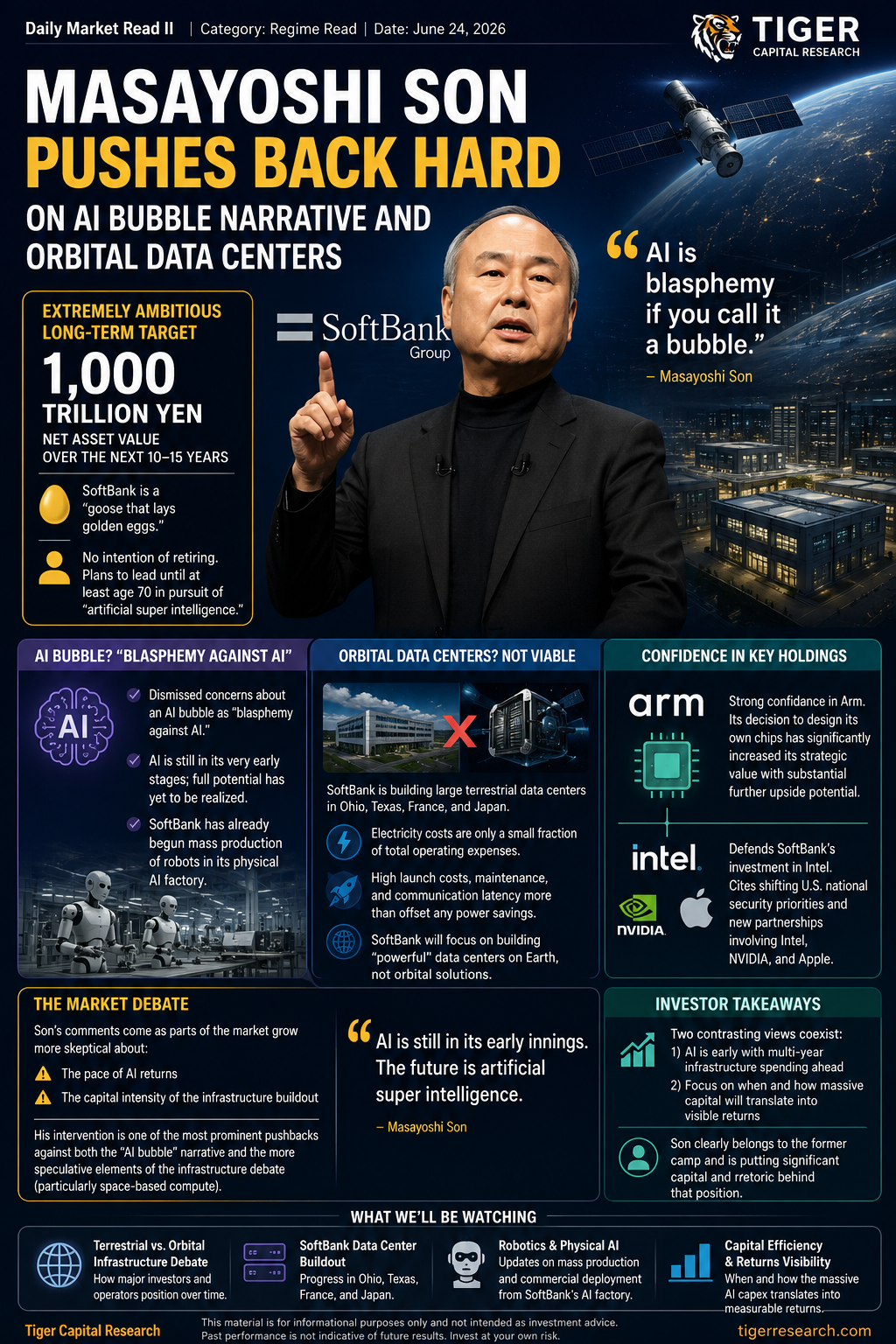
SoftBank founder Masayoshi Son used his annual shareholder meetings to deliver a forceful defense of the AI investment cycle and to directly challenge Elon Musk’s vision of orbital data centers.
Son set an extremely ambitious long-term target: growing SoftBank’s net asset value to 1,000 trillion yen over the next 10–15 years. He described the company as a “goose that lays golden eggs” and expressed frustration that its current market value significantly trails the value of its underlying assets. He made clear he has no intention of retiring and plans to lead the company until at least age 70 in pursuit of what he calls “artificial super intelligence.”
On the AI narrative, Son was unequivocal. He dismissed concerns about an AI bubble as “blasphemy against AI,” arguing that the technology is still in its very early stages and that its full potential has yet to be realized. He highlighted that SoftBank has already begun mass production of robots in its physical AI factory and positioned the company as one of the first globally to manufacture robots at scale.
Son also addressed the debate around data center infrastructure. While SoftBank is actively developing large terrestrial data center projects in Ohio, Texas, France, and Japan, he explicitly downplayed the viability of building data centers in orbit. He argued that electricity costs represent only a small fraction of total data center operating expenses.
In contrast, the high costs of launching equipment into space, ongoing maintenance, and communication latency would more than offset any power savings. Son stated that SoftBank intends to focus on building “powerful” data centers on Earth rather than pursuing orbital solutions.
On key holdings, Son expressed strong confidence in Arm, noting that its decision to design its own chips has significantly increased its strategic value, with potential for substantial further upside. He also defended SoftBank’s investment in Intel, citing shifting U.S. national security priorities and new partnerships involving Intel, NVIDIA, and Apple.
The comments come at a time when parts of the market have grown more skeptical about the pace of AI returns and the capital intensity of the buildout. Son’s intervention represents one of the most prominent pushbacks against both the “AI bubble” narrative and the more speculative elements of the infrastructure debate (particularly space-based compute).
For investors, the speech reinforces two contrasting views currently coexisting in the market: one that sees AI as still in its early innings with multi-year infrastructure spending ahead, and another that is increasingly focused on when and how the massive capital being deployed will translate into visible returns. Son clearly belongs to the former camp and is putting significant capital and rhetoric behind that position.
We will continue to monitor how major investors and operators position themselves on the terrestrial versus orbital infrastructure debate, as well as any updates on SoftBank’s data center and robotics initiatives.
Tiger Capital Research