By Tiger Capital Research
Published: 2026-06-24
URL: https://princetonchen.substack.com/p/semiconductor-selloff-leveraged-etf
Daily Market Read I | Category: Sector Read | Date: June 24, 2026
Tiger Capital Research
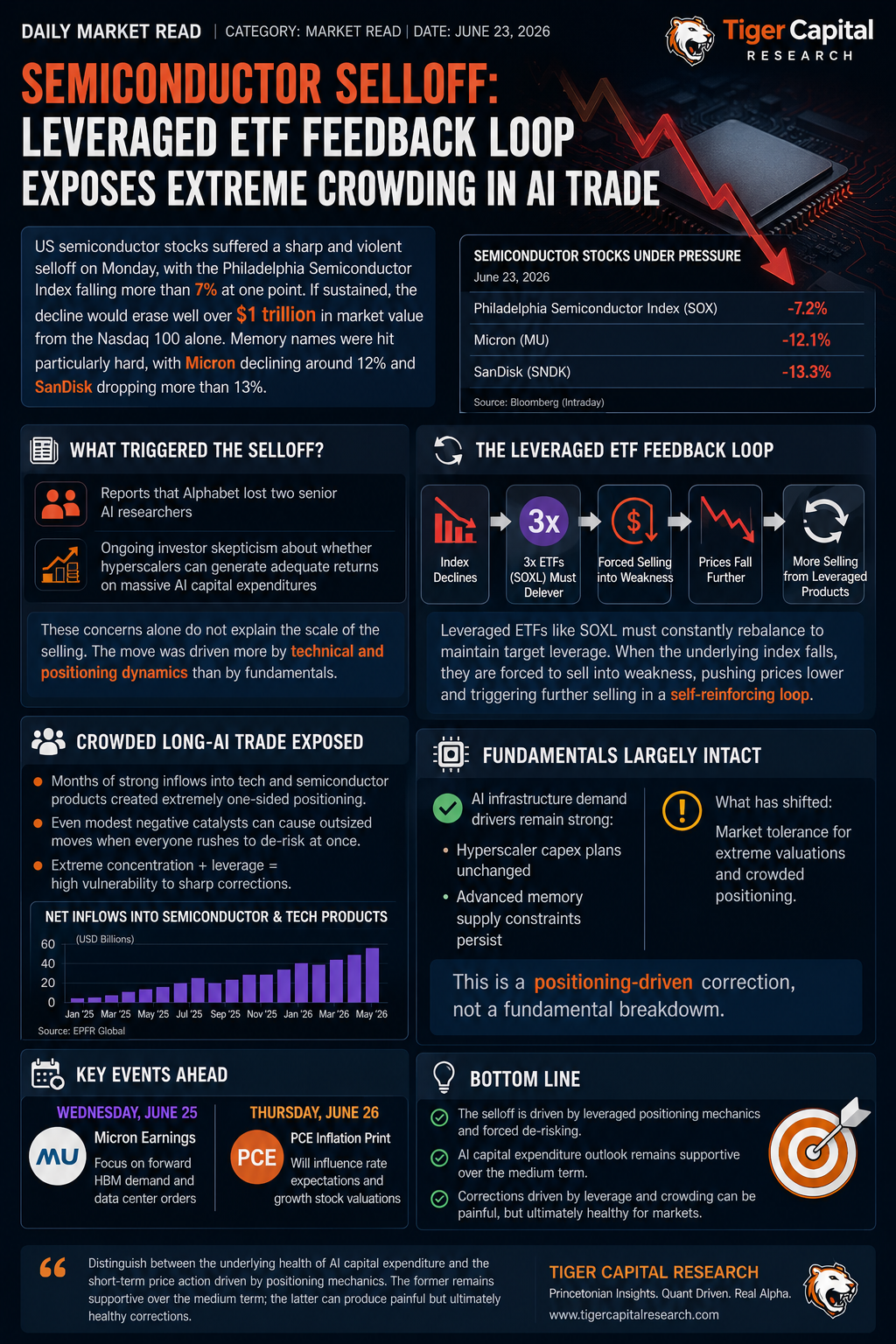
US semiconductor stocks suffered a sharp and violent selloff on Monday, with the Philadelphia Semiconductor Index falling more than 7% at one point. If sustained, the decline would erase well over $1 trillion in market value from the Nasdaq 100 alone. Memory names were hit particularly hard, with Micron declining around 12% and SanDisk dropping more than 13%.
While headlines framed the move as another reckoning with AI valuations, the speed and magnitude of the decline were driven more by technical and positioning dynamics than by any sudden deterioration in fundamentals.
The immediate triggers included reports that Alphabet had lost two senior AI researchers and ongoing investor skepticism about whether hyperscalers can generate adequate returns on their massive AI capital expenditures.
However, these concerns alone do not explain the scale of the selling. The more powerful force was the mechanical behavior of leveraged products, particularly 3x semiconductor ETFs such as SOXL. These vehicles must constantly rebalance to maintain their target leverage.
When the underlying index falls, they are forced to sell into weakness to reset their exposure, which in turn pushes prices lower and triggers further selling from other leveraged vehicles. This creates a self-reinforcing feedback loop that can amplify moves far beyond what underlying fundamentals would justify.
The selloff also exposed how concentrated and crowded the long-AI trade had become. After months of strong inflows into technology and semiconductor-focused products, positioning had grown extremely one-sided. In such environments, even modest negative catalysts can produce outsized price action as investors rush to reduce risk simultaneously.
Importantly, the core drivers of AI infrastructure demand — hyperscaler spending plans and supply constraints in advanced memory — have not materially changed in recent days. What has shifted is market tolerance for the extreme valuation multiples and crowded positioning that had built up during the rally.
The next two trading sessions will provide important tests. Micron is scheduled to report earnings on Wednesday, where investors will focus closely on forward commentary around HBM demand and data center orders. On Thursday, the PCE inflation print will influence rate expectations and, by extension, growth stock valuations.
For now, the decline looks more like a forced de-risking of an overcrowded trade than a fundamental rejection of the AI investment thesis. That said, it serves as a clear reminder that when a sector’s advance becomes heavily dependent on leverage and concentrated positioning, even relatively contained fundamental concerns can trigger sharp and disorderly moves.
Investors should distinguish between the underlying health of AI capital expenditure and the short-term price action driven by positioning mechanics. The former remains supportive over the medium term; the latter can produce painful but ultimately healthy corrections.
Tiger Capital Research