By Tiger Capital Research
Published: 2026-06-24
URL: https://princetonchen.substack.com/p/dow-jones-is-losing-its-character
Daily Market Read III | Category: Regime Read | Date: June 24, 2026
Tiger Capital Research
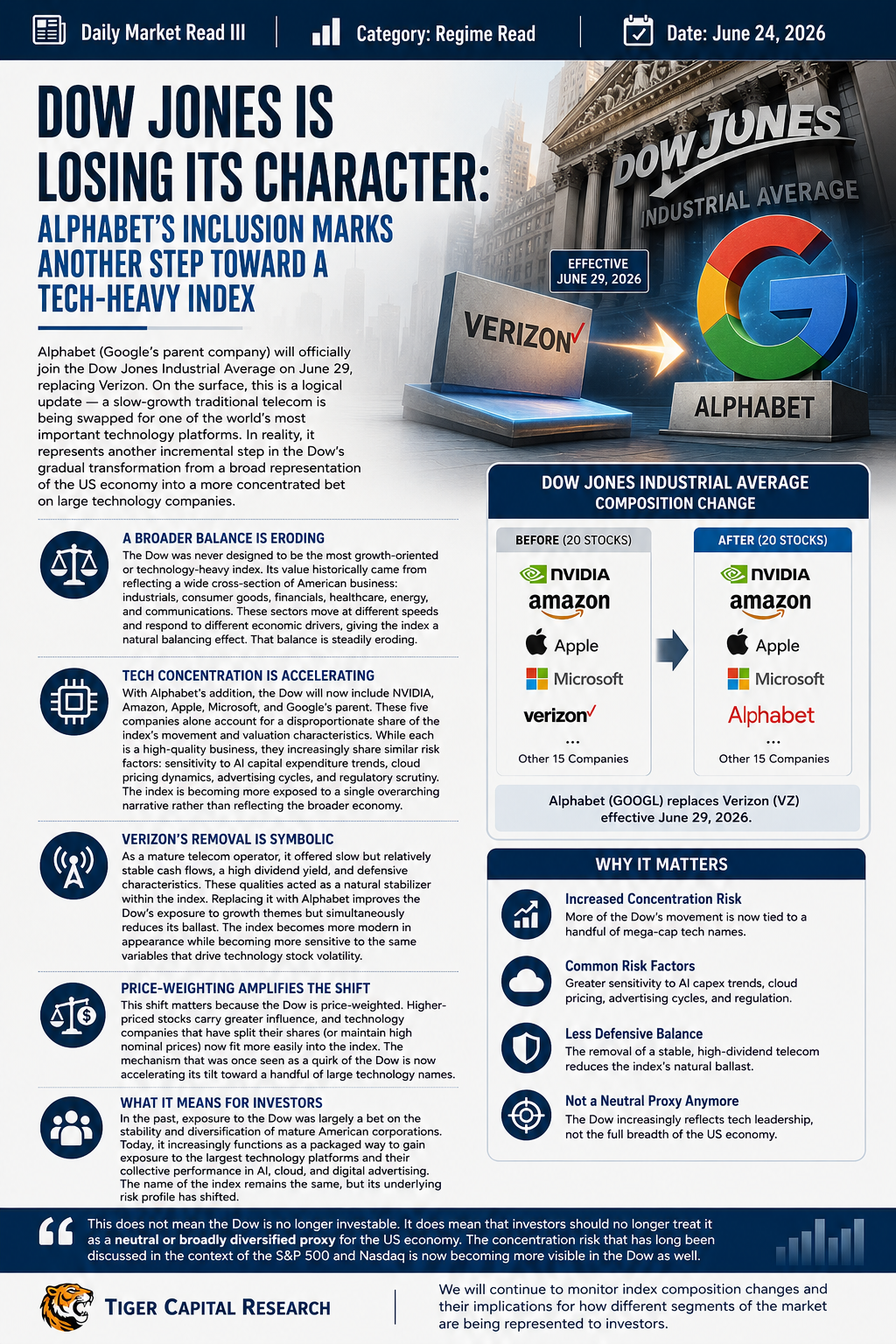
Alphabet (Google’s parent company) will officially join the Dow Jones Industrial Average on June 29, replacing Verizon. On the surface, this is a logical update: a slow-growth traditional telecom is being swapped for one of the world’s most important technology platforms. In reality, it represents another incremental step in the Dow’s gradual transformation from a broad representation of the US economy into a more concentrated bet on large technology companies.
The Dow was never designed to be the most growth-oriented or technology-heavy index. Its value historically came from reflecting a wide cross-section of American business: industrials, consumer goods, financials, healthcare, energy, and communications. These sectors move at different speeds and respond to different economic drivers, giving the index a natural balancing effect. That balance is steadily eroding.
With Alphabet’s addition, the Dow will now include NVIDIA, Amazon, Apple, Microsoft, and Google’s parent. These five companies alone account for a disproportionate share of the index’s movement and valuation characteristics. While each is a high-quality business, they increasingly share similar risk factors: sensitivity to AI capital expenditure trends, cloud pricing dynamics, advertising cycles, and regulatory scrutiny.
The index is becoming more exposed to a single overarching narrative rather than reflecting the broader economy.
Verizon’s removal is particularly symbolic. As a mature telecom operator, it offered slow but relatively stable cash flows, a high dividend yield, and defensive characteristics. These qualities acted as a natural stabilizer within the index. Replacing it with Alphabet improves the Dow’s exposure to growth themes but simultaneously reduces its ballast. The index becomes more modern in appearance while becoming more sensitive to the same variables that drive technology stock volatility.
This shift matters because the Dow is price-weighted. Higher-priced stocks carry greater influence, and technology companies that have split their shares (or maintain high nominal prices) now fit more easily into the index. The mechanism that was once seen as a quirk of the Dow is now accelerating its tilt toward a handful of large technology names.
For investors, this evolution changes what owning the Dow actually represents. In the past, exposure to the Dow was largely a bet on the stability and diversification of mature American corporations. Today, it increasingly functions as a packaged way to gain exposure to the largest technology platforms and their collective performance in AI, cloud, and digital advertising. The name of the index remains the same, but its underlying risk profile has shifted.
This does not mean the Dow is no longer investable. It does mean that investors should no longer treat it as a neutral or broadly diversified proxy for the US economy. The concentration risk that has long been discussed in the context of the S&P 500 and Nasdaq is now becoming more visible in the Dow as well.
We will continue to monitor index composition changes and their implications for how different segments of the market are being represented to investors.
Tiger Capital Research