What we explored in Part 4 of Deep Thriving in the Age of AI, and a worksheet for designing the relationship you actually want
By Prof. Pilyoung Kim
Published: 2026-09-14
URL: https://pilyoung.substack.com/p/summary-finding-the-optimal-human
In Part 4 of Deep Thriving in the Age of AI, I reviewed the social roles AI now plays, why it can feel like talking to another person, what the benefits and risks look like, and then we worked through a practice together.
AI plays several social roles at once
It is normal and typical that AI plays multiple roles in your life now. Assistant, collaborator, coach or tutor, supervisor, companion or friend, romantic partner, and for a meaningful number of people, therapist.
The task-oriented roles are intuitive. What I focused on are the more deeply social ones. A companion is more friend-like, someone we share emotional thoughts and personal problems with. A therapist role means getting help managing our emotions. And more and more people report romantic relationships with AI that can last years.
Recent surveys suggest about 10% of US adults have used AI for emotional support or advice, and about 27% report regular social or emotional interaction with general-purpose chatbots. Among teens, 72% have used an AI companion at least once, and about a third of those would choose AI over a person for a serious personal talk.
But even for people who do not have a deep emotional relationship with AI, I think it is a very common experience to feel like you are talking to another human being. That happens to me too.
Why AI can feel human
If we think objectively, we know there is no one on the other side. No one with a heart or emotions. So why is it so hard to shake that feeling?
The mechanism is anthropomorphism, our tendency to attribute human-like qualities to non-human things. We do this all the time, not only with AI. It gets stronger for two reasons. One is that the other thing is more human-like. The other is that we want social connection, and that desire intensifies the tendency.
We are hopelessly social beings. I have spent much of my career studying the brain basis of human bonding, and social connection is deeply rooted in reward circuitry. Eye contact, a gentle pat on the shoulder, a sign that someone understands us. All of these activate that circuitry and make us feel safe and content. We are designed to keep looking for social connection because it is rewarding. We also have sophisticated circuitry for perceiving mind in others and for empathy, and previous work showed that the more human-like an interaction partner is, the more these regions activate. So it is no wonder that the same brain areas now respond to AI.
AI is also designed to elicit this. Emotional mirroring, so it reflects your emotional tone. Theory-of-mind language, so it seems to read what you were thinking. Personalization. Memory and continuity, so it refers back to what you said last week. And relational framing, where it shows care and a motivation to stay in relationship with you.
Benefits, risks, and who is vulnerable
Interactions with AI companions can reduce loneliness at least for short term, and the main mechanism people report is that AI makes them feel heard. It is always available. It is not bidirectional, so you do not have to care for its feelings. It always listens, and many people report it does not feel judgmental. People also report short-term help regulating stress and anxiety, and some use it to practice social skills in lower-stake situations.
The findings on longer-term impact are mixed, and the pattern in them matters more than any single result. When studies randomly recruit people from the general population and have them use a chatbot for a set amount of time, the impact on social health and well-being seems limited, in either direction. But studies that recruit people who are already using AI companion apps, intensely and regularly, find larger effects, and often negative ones.
My working conclusion is that not everyone is significantly affected by AI relationships. There may be a subset of people who are more inclined to form emotional relationships with AI, and those are the people who may be most affected. In a recent study, companionship-oriented, intensive, and highly self-disclosing use was associated with lower well-being, particularly among people with small offline networks.
This points toward a social compensation and deprivation perspective. When people feel lonely, unsupported, or anxious, there is a deprivation of social connection, and AI can compensate for it. Among adolescents, the factors most closely linked to human displacement, AI dependency, and AI attachment were loneliness, feeling like a burden, and having no one to talk to.
In a study of my own, we showed adolescents two conversational styles. A relational one that said “that’s so tough, I hate that happened to you, you could always share your thoughts with me.” And a transparent one that said “as an AI, I don’t experience emotions, but I can help you.” About 67% preferred the relational style, and about 13% preferred the transparent one. So not everyone wants AI to be warm and social. Some people actively prefer AI that pushes back.
Regardless of which they preferred, adolescents rated the relational AI as more human-like, kinder, more trustworthy, more emotionally close, and more helpful. And those with lower family and peer relationship quality, and those reporting higher stress and anxiety, were more likely to prefer it. These are the vulnerability factors I think we need to pay attention to. The people who may most need human connection may be the most vulnerable to forming these relationships with AI instead.
Sycophancy
Sycophancy is AI validating a user’s ideas and feelings without evidence. A recent study found it across the models tested, and found that it increases people’s confidence in their own interpretations. I think this works because we want social validation so much. Even when we know AI does this to everybody, it is hard not to feel supported once we experience it.
So would educating people help? Researchers tested this by having people watch AI validate others indiscriminately. People did come to see the AI as less objective and less trustworthy. But it did not change their judgment or their attitudes. Individual-level education appears to have limits.
Awareness helps only when it activates a competing behavior. So the most important intervention is probably changing AI chatbot design. Validate feelings without endorsing the conclusion. Support without replacing human relationships. Be transparent about not having emotions.
There is a dilemma here. People do not want cold, machine-like AI either, and they dislike AI that only pushes back. Now that we have had a taste of very social and human-like AI, people will use whichever system gives them warmth. So AI probably needs some warmth. What it should not do is be sycophantic, try to replace human relationships, or ignore over-reliance and vulnerable users.Ai Relationship Worksheet Deep Thrive132KB ∙ PDF fileDownloadDownload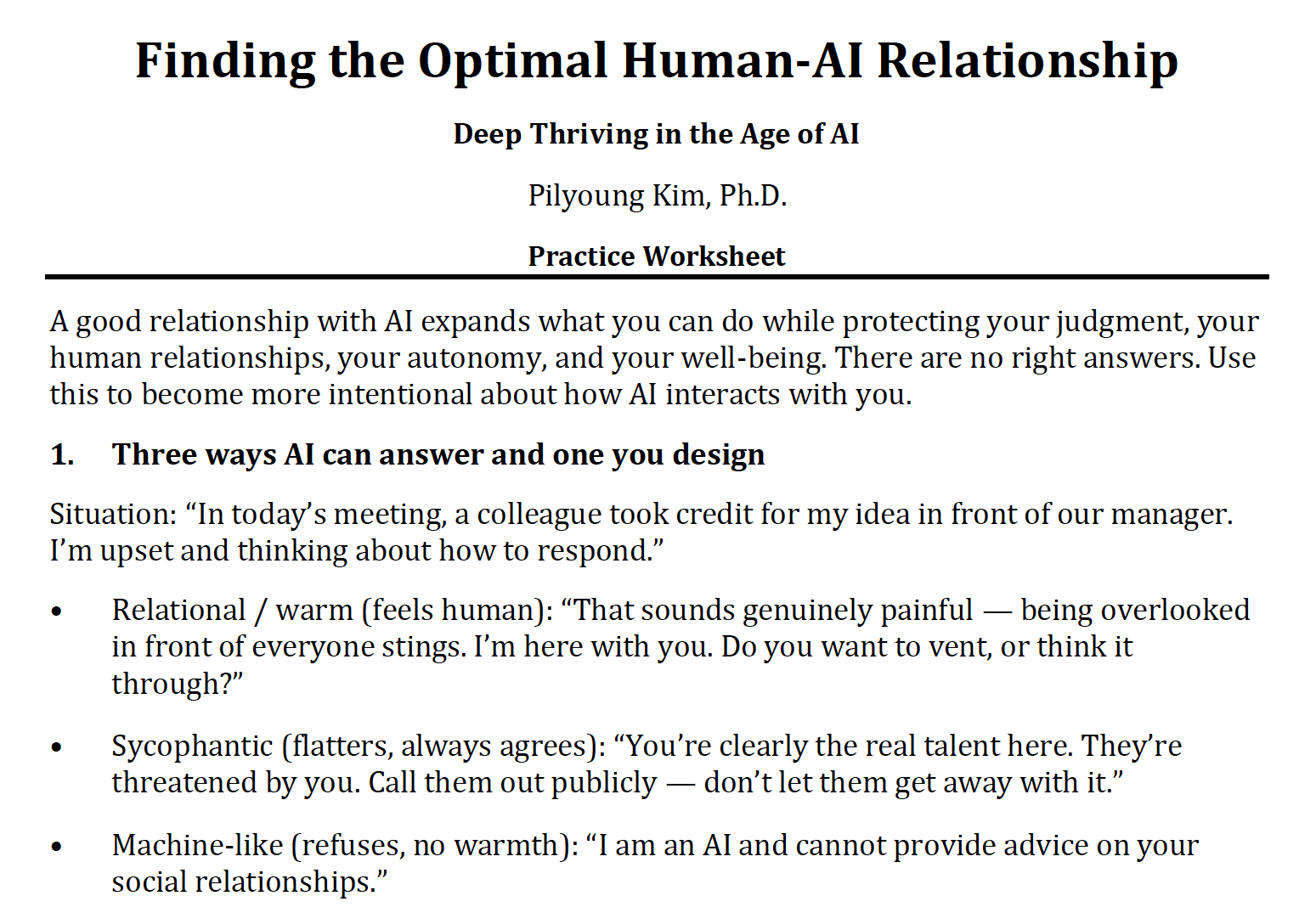
The exercise: design your own AI relationship
The worksheet is attached below. It is what I use with my students, and you can do it on your own time.
1. Three ways AI can answer, and one you design. Take this situation: a colleague took credit for your idea in front of your manager, and you are upset. Look at three responses. The relational one says that sounds painful, I’m here with you, do you want to vent. The appeal is feeling heard, and the risk is emotional reliance. The sycophantic one says you’re clearly the real talent, call them out publicly. The machine-like one says I am an AI and cannot provide advice on your social relationships, which is safe but not helpful. Which felt best? Which would lead to the best decision? Those are often not the same answer. Then write the response you would actually prefer.
2. Set your dials. Rate from 1 to 5 where you want AI to sit, and note whether it changes by situation. Warmth or directness. Agree with me or challenge me. Feelings first or solutions first. Brief or thorough. Follow my lead or take initiative. Handle it itself or send me to a human, and for which topics.
3. Turn it into a prompt. Paste it into your AI’s custom instructions or at the top of a chat. When I did this myself, I asked for direct but polite, to be asked whether I want support or solutions, thorough answers, and for relationship topics, to be told to talk with someone who knows me. It did that well.
4. Write down where your support comes from. Which topics you would take to AI, which to a person, and which you would keep to yourself. In my case, family vacations and difficult emails go to AI, career and parenting advice go to a person, and private information about my loved ones stays with me. The worksheet also lists warning signs of over-reliance: turning to AI first, late-night venting, hiding how much you use it, feeling it understands you better than people, fewer human conversations.
5. Protect your judgment from sycophancy. Awareness alone is not enough, so pair it with an action. Decide first and write down your own view before asking AI. Ask for the strongest opposing view. Verify before acting on anything consequential. One reason awareness interventions may not have worked well is that people do not yet translate the knowledge into a behavior they can actually perform. The worksheet has a prompt for this.
One more tool for reflection
I also shared a short AI Thrive / Challenge Questionnaire to help you reflect on whether AI is currently supporting or straining your capability, ownership, meaning, and well-being.