Four studies find that people pick a human empathizer over AI, but when they do read AI responses, they rate them as more empathetic and say they feel more heard.
By Prof. Pilyoung Kim
Published: 2026-10-05
URL: https://pilyoung.substack.com/p/people-choose-human-empathy-but-rate
The study
Several previous studies have suggested that people rate responses from AI as more empathetic than responses written by humans. In this study, Wenger and colleagues conducted four studies asking a further question. Would people choose to receive empathetic responses from AI or from a human?
Participants read about someone’s difficult situation, or a difficult situation they had experienced themselves, then chose between a response from a human and a response from AI. They made that choice before seeing either response. Then they rated the response they received.
The key findings:
- People preferred human empathizers. Across the studies, participants chose the human response about 57% to 58% of the time, consistently above chance.
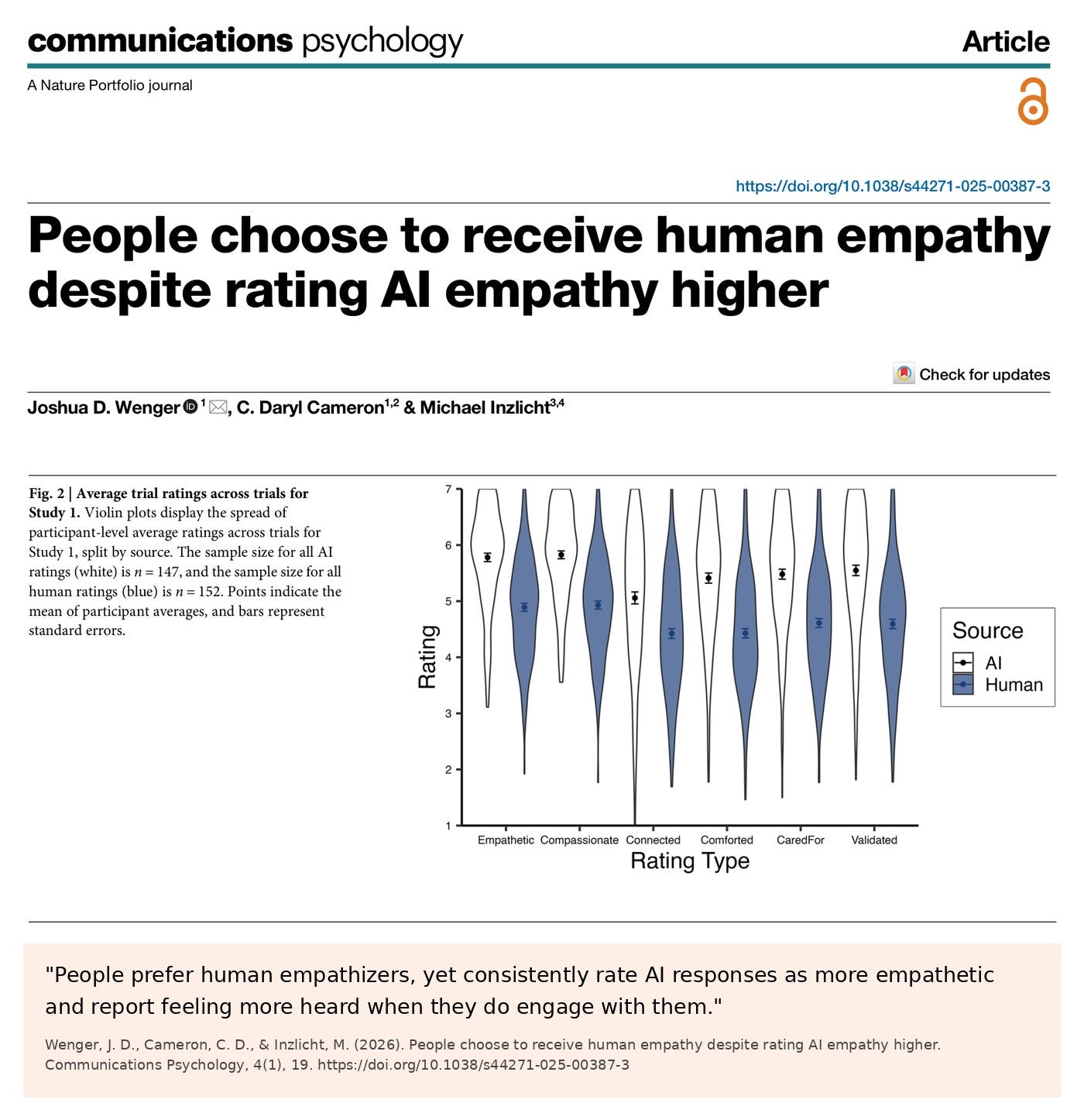
- Interestingly, people rated AI responses as more empathetic. When participants did read AI responses, they rated them as more empathetic, more compassionate, and better at making them feel heard.
- They also judged AI responses as more effortful. And perceived effort predicted both the empathy ratings and feeling heard.
- The AI advantage (receiving higher scores) was larger for some situations than others. In exploratory analyses, it was greater for emotional than physical suffering, and greater for compassion than empathy. Two places where AI did not reliably outperform high-quality human responses were connectedness to the responder and perceived authenticity.
My notes
The findings made me think a lot about what people want when they receive empathetic responses. I wonder whether one reason for the current finding is that empathetic responses from humans are less than what we expect, and that people perceive the empathetic responses from AI to be higher in quality. The AI advantage was particularly greater for emotional rather than physical empathy, and for compassion rather than empathy, which are the harder ones for humans to figure out how to respond to. In a way, humans can struggle to provide the perfect response. At the same time, people also want these complex, high-quality responses from other humans. Maybe it is just not as high quality as they expected.
I have two thoughts about this.
First, seeing high-quality responses from AI can raise our expectations of humans too. That could make human support continuously disappointing, and make us less patient with each other, because we can easily go to AI instead.
Second, there will still be unmet needs, because people fundamentally want this kind of support, particularly really feeling heard and genuinely connected, from other humans. So we should not only help people provide better empathetic responses. We should also help people be more patient with each other, recognizing that we are not perfect and that human relationships are often imperfect. This may be especially important for children and adolescents, who are still developing their social understanding. Otherwise it is possible that we will not feel satisfied by human support, not because the support is not there, but because it is less than what we now expect. AI support is unlikely to replace human support in the long run. But being more understanding of each other can help prevent these unmet social support needs from influencing our well-being.
Three takeaways
- The choice and the rating point in opposite directions. People reach for human empathy, and then judge AI empathy to be better when they encounter it.
- The AI advantage is largest where human responding is hardest. Emotional rather than physical suffering, and compassion rather than empathy.
- Personally, I think the risk may be to our expectations rather than our preferences. People still want to be heard by other people. What may shift is how patient we are with each other when human responses fall short of what AI can produce.
Reference: Wenger, J. D., Cameron, C. D., & Inzlicht, M. (2026). People choose to receive human empathy despite rating AI empathy higher. Communications Psychology, 4(1), 19. https://doi.org/10.1038/s44271-025-00387-3