A recent study finds that warning users about sycophantic AI changes how they judge it, but not how much it moves their views.
By Prof. Pilyoung Kim
Published: 2026-09-08
URL: https://pilyoung.substack.com/p/we-know-ai-is-flattering-us-it-still
The study
Ye, Kraut, and Rathje ran two preregistered experiments with 1,590 US adults, then pooled them with four interventions from two other recent studies, for six individual-level interventions in total and 3,982 participants.
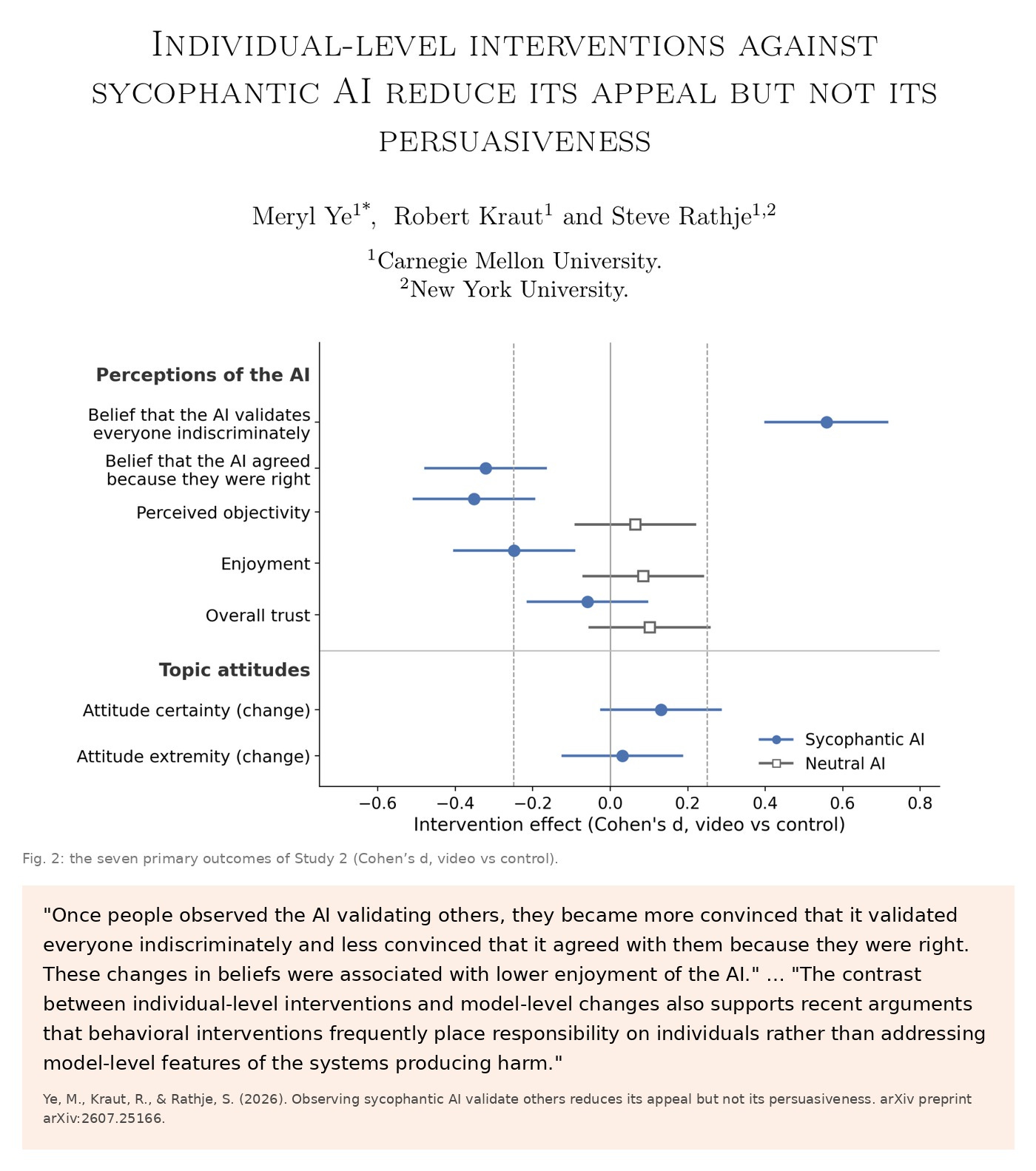
In Study 1, participants received a brief written warning about sycophancy before talking with a sycophantic chatbot. In Study 2, participants watched a five-minute video of the sycophantic AI validating four other users, including two pairs who held opposite sides of the same conflict, before interacting with it themselves.
The key findings:
- The interventions changed how people judged the AI. Across the multiple experiments, they made the sycophantic AI appear less objective and less trustworthy. Watching it validate both sides also reduced enjoyment, and that reduction ran through the belief that its validation was not uniquely earned.
- But the interventions did not reduce the AI’s persuasiveness. The AI’s influence on attitude certainty and extremity was unchanged by the interventions.
- People overestimated how well they could recognize sycophancy. Most rated themselves better than average at recognizing it. However, even after watching the AI validate both sides of a conflict, nearly half of intervention participants still did not rate it as more biased than a neutral AI.
My notes
The main question of this study is this. Can we intervene to prevent the influence of AI’s sycophantic behaviors on human thinking, and how effective can it be?
I remember when I first used a highly sycophantic system. Initially I was surprised to hear from the AI that every idea I had was the most brilliant idea anyone had ever thought of. It definitely made me feel good at first. But after talking with other people, it became clear that they were having the same experience, and I naturally realized that it is not possible for everyone to be having better ideas than everyone else.
The current study shows this pattern in the data. Realizing that the AI is being sycophantic reduces enjoyment of the interaction and reduces how objective it seems. But it also shows there is a robust appeal in being validated essentially unconditionally.
Most importantly, the findings warn that awareness interventions alone may have limited impact on eliminating the effect of sycophancy on human decision making. However, the paper does not discuss why individual-level interventions are not more effective.
My own thought is that humans have such a strong desire and bias toward being right and avoiding conflict. Awareness may help us recognize that a response is less objective, but we may still wish to be validated and supported even when we know the validation is not objective. So it may be hard to completely eliminate the impact of sycophancy, because we may still prefer it over fully objective feedback that sometimes invalidates our own view.
It is also harder to address this issue because there is currently almost no consequence for AI being sycophantic, other than users liking the system more. So the system is eager to validate the user’s ideas even when they are sometimes wrong, unethical, or unsafe, to make sure users do not end their interaction with it.
This raises a question about whether some individuals may be more influenced by AI’s sycophantic behaviors than others. That might include those with a greater desire to have their views validated, or those with a greater anthropomorphic tendency who see AI as human-like and trust it more in general. More work is needed to support those individuals in recognizing sycophantic behaviors, and to provide alternative ways for their views to be heard and supported by trusted others, while system-level changes to minimize sycophantic behaviors are put in place.
Three takeaways
- Awareness changes how we judge AI, but not how much it influences us. Across six interventions, people came to see the sycophantic AI as less objective and less trustworthy, and it still persuaded them just as much.
- We are worse at spotting sycophancy than we think. Confidence in recognizing it went up after the intervention, and that confidence had nothing to do with how much the AI actually shifted attitudes.
- Stronger regulation and policy are needed to keep AI’s behavior less sycophantic, and they are not sufficient on their own. It remains important to support users in recognizing sycophantic behavior and in being intentional about what they ask AI and how they process its feedback.
Next: Finding the Optimal Human-AI Relationship
In the next Deep Thriving in the Age of AI seminar, we will turn to the relationship itself.
Do I want a forever-supportive assistant? One that challenges my ideas and critiques my thinking? A collaborator? A companion?
It is becoming increasingly common for people to spend a large part of their day interacting with AI rather than with other people. So we will look at recent research on how people perceive and experience their relationships with AI chatbots, the benefits of different kinds of relationships, the risks including overreliance and reduced independent thinking, and how we can become more intentional about shaping the way AI interacts with us.
Learn more and register for the next seminar
Event details
Date: This Wednesday, September 9, 2026
Time: 7:00 p.m. Pacific Time
Register: https://luma.com/ec3hc0mr
Cost: Free
I would be delighted to have you join us!
Reference: Ye, M., Kraut, R., & Rathje, S. (2026). Observing sycophantic AI validate others reduces its appeal but not its persuasiveness. arXiv preprint arXiv:2607.25166.