A study of 1,131 Character.AI users finds that companionship use is associated with lower well-being, and that the people most likely to use AI this way already have the least human support.
By Prof. Pilyoung Kim
Published: 2026-09-03
URL: https://pilyoung.substack.com/p/ai-companionship-does-not-replace
The study
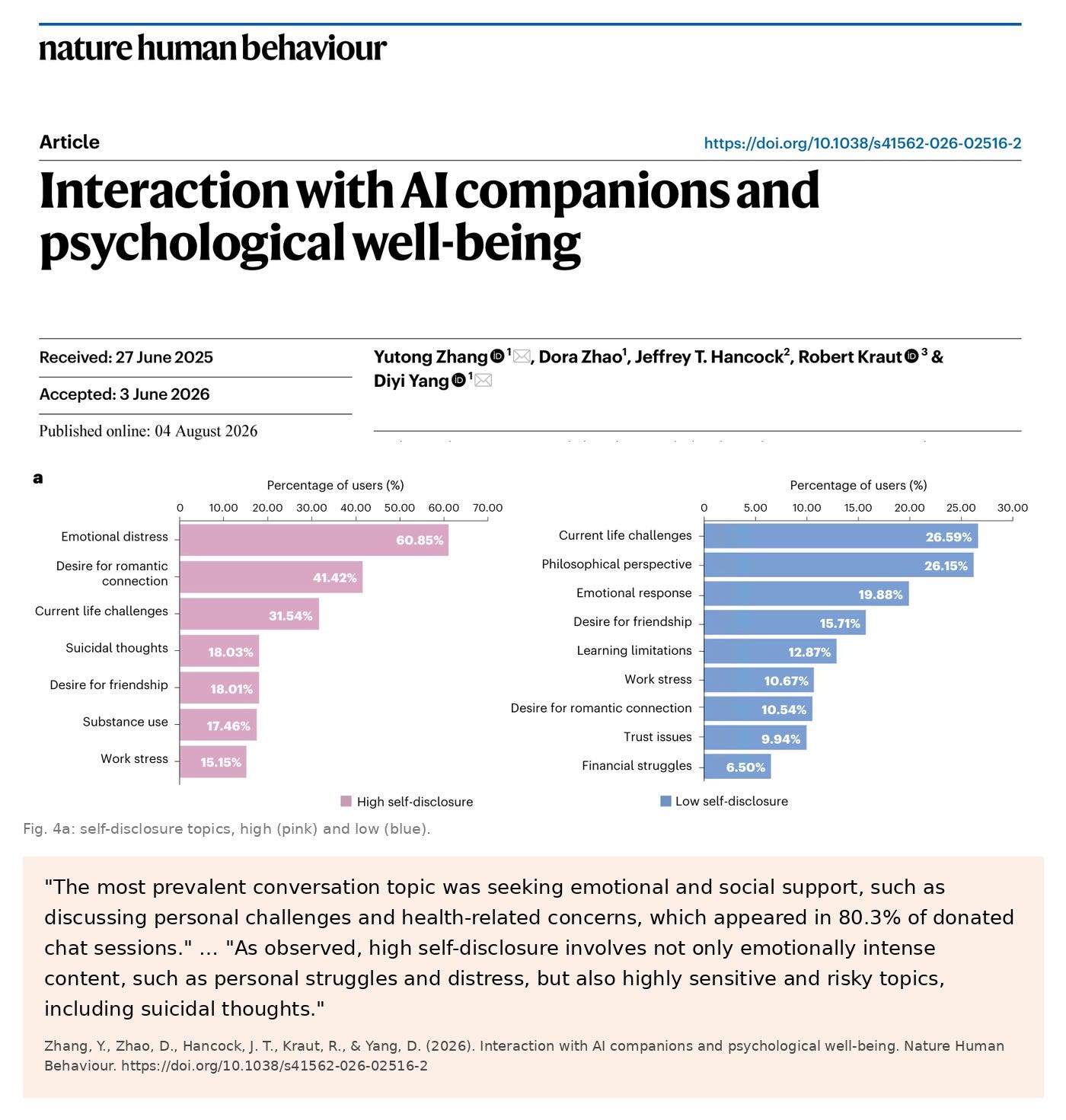
Zhang and colleagues surveyed 1,131 US adults who use Character.AI. A subsample of 237 also donated their chat histories, which came to 4,664 sessions and 464,687 messages. That combination let the researchers compare what people said about their chatbot use with what the conversations actually looked like.
The key findings:
- Companionship use was common, and more common than people reported. Half of participants described their chatbot using words like friend, companion, or romantic partner. Even among those who said their main use was entertainment, most of their donated conversations included emotional support interactions.
- The most frequent topic was emotional and social support. It appeared in 80.3% of donated sessions. Conversations high in self-disclosure involved emotional distress, suicidal thoughts, and substance use.
- Companionship use was associated with lower well-being when the interactions were more frequent and high in self-disclosure. People with smaller social networks were more likely to use chatbots for companionship, and the association with lower well-being was strongest for those whose interactions were intensive and high in self-disclosure.
- AI companionship did not offset low social support. Users with less human support were more likely to turn to chatbots, but those interactions did not appear to replace human support for those individuals.
My notes
There have been mixed findings about how much interactions with AI chatbots can affect human well-being and human-to-human relationships. Some studies have reported that interactions with AI chatbots have limited, no, or even positive impact. Other studies have reported the opposite.
This study helps us understand that the impact of AI relationships depends, at least in part, on the users’ characteristics and interaction styles.
The current study examined users who were already using AI companion apps. Other studies use a more randomized design, recruiting people first and then having them use a chatbot for a period.
When studies include people who are already using AI companion apps, the impact of their relationships with AI appears more significant, sometimes in either direction but often negative. When the design is randomized, the impact of that relationship seems more limited.
This may be related to at least two different factors. Perhaps there are individual differences associated with AI companion app use in real life that make some people more susceptible to the impact of AI on their mood, well-being, and social life. That could include greater anthropomorphism or pre-existing needs for social support, including loneliness, negative mood, and other severe life stressors. The other possibility is that they have cumulatively more experience interacting with AI, so the impact is greater.
Either way, this suggests there are individuals who are more inclined to develop relationships with AI, and this requires protection and attention. They may benefit positively, but they may also be influenced negatively.
The findings also highlight that AI companionship does not replace human connection. Those who use AI as a companion intensively, and share sensitive personal topics, show worse well-being.
This can also mean that people with worse well-being are more likely to use a chatbot for support on sensitive topics and serious problems, which has real limitations in providing productive help. They may then become further vulnerable to worsening well-being.
What I take from this is that even among people who use AI as a companion, those who use it more casually do not seem to be significantly affected. But those who do not have others to talk to, and who have serious concerns and low well-being, are more vulnerable to using AI intensively, and this may not improve their well-being.
The results highlight how important it is for AI systems to direct these individuals to human help, and to make that help accessible. In real life, though, this has challenges. Human help is often not as easily available and is costly, while AI help is always available and does not cost a lot of money. Thus, efforts to make human help more available and more accessible need more attention, rather than relying on AI to address the issue.
Three takeaways
- The impact of AI companionship is not uniform. It depends on who is using it and how, so it is important to understand both.
- AI companionship does not appear to replace human connection. Those who use AI as a companion intensively, and share sensitive personal topics, show worse well-being.
- The people most likely to use AI this way may be the ones who need protection the most. Those with the least human support are more likely to turn to a chatbot, and it is important to inform them to seek help from humans and to make that help accessible.
Next: Finding the Optimal Human-AI Relationship
In the next Deep Thriving in the Age of AI seminar, we will turn to the relationship itself.
Do I want a forever-supportive assistant? One that challenges my ideas and critiques my thinking? A collaborator? A companion?
It is becoming increasingly common for people to spend a large part of their day interacting with AI rather than with other people. So we will look at recent research on how people perceive and experience their relationships with AI chatbots, the benefits of different kinds of relationships, the risks including overreliance and reduced independent thinking, and how we can become more intentional about shaping the way AI interacts with us.
Learn more and register for the next seminar
Event details
Date: Next Wednesday, September 9, 2026
Time: 7:00 p.m. Pacific Time
Register: https://luma.com/ec3hc0mr
Cost: Free
I would be delighted to have you join us!
Reference: Zhang, Y., Zhao, D., Hancock, J. T., Kraut, R., & Yang, D. (2026). Interaction with AI companions and psychological well-being. Nature Human Behaviour. https://doi.org/10.1038/s41562-026-02516-2