What we explored in Part 3 of Deep Thriving in the Age of AI, and a four-role practice for using AI without narrowing your creativity
By Prof. Pilyoung Kim
Published: 2026-09-01
URL: https://pilyoung.substack.com/p/summary-how-can-we-become-more-not
Creativity is one of the topics that comes up the most in research on AI, and it is also one of the most mixed. AI can influence our creativity positively or negatively.
What seems to be coming out clearly now, across quite a bit of research, is that whether AI helps or hurts our creativity critically depends on how we are using it.
So in Part 3 of Deep Thriving in the Age of AI, I shared what the psychology literature suggests, and then we worked through a practice together.
Creativity is more than original ideas
We often think creativity means uncommon or unusual ideas. But creativity requires two things.
The first is originality. The second is effectiveness, meaning the idea also has to be useful, feasible, or applicable. When we say something is very creative, we usually mean it is an unusual solution to a problem we all think is important. An unusual but irrelevant idea is not enough, and neither is a useful but routine one.
Researchers also measure creativity through divergent thinking. That includes fluency, or the number of ideas, but also flexibility, originality, and elaboration. So creativity has multiple dimensions.
Three common myths
Group brainstorming works best when everyone talks at once. The research actually suggests this is not the most productive way to generate ideas. It works better when members write down their own ideas individually first, then pool them and review them together.
More ideas automatically mean more creativity. Fluency is only one dimension. More ideas do not necessarily lead to more creative ones.
AI makes people more creative. It can, and it also can not. In a well-known study by Doshi and Hauser, people who got help from AI had their ideas judged to be more creative, and the people who benefited the most were those with lower baseline creativity. But the most interesting finding was that when people used AI, their ideas converged toward AI’s ideas. Ideas generated without AI had greater distance from AI’s ideas, meaning they were more original and more unique. So we may be able to generate more ideas with AI, but from a group perspective those ideas are converging.
A human-first sequence
What the literature suggests as of now is a human-first sequence. Without AI’s help, we plan and generate our original ideas first, whether that is a problem we are trying to solve or creative work we want to do. Then we bring in AI for different roles.
One reason the order matters is the fixation effect. Research suggests that seeing examples tends to constrain our later idea generation. Once we see examples, especially ones we like, we fixate on them. If we ask AI to generate for us first, we often cannot think of anything better and end up passively selecting.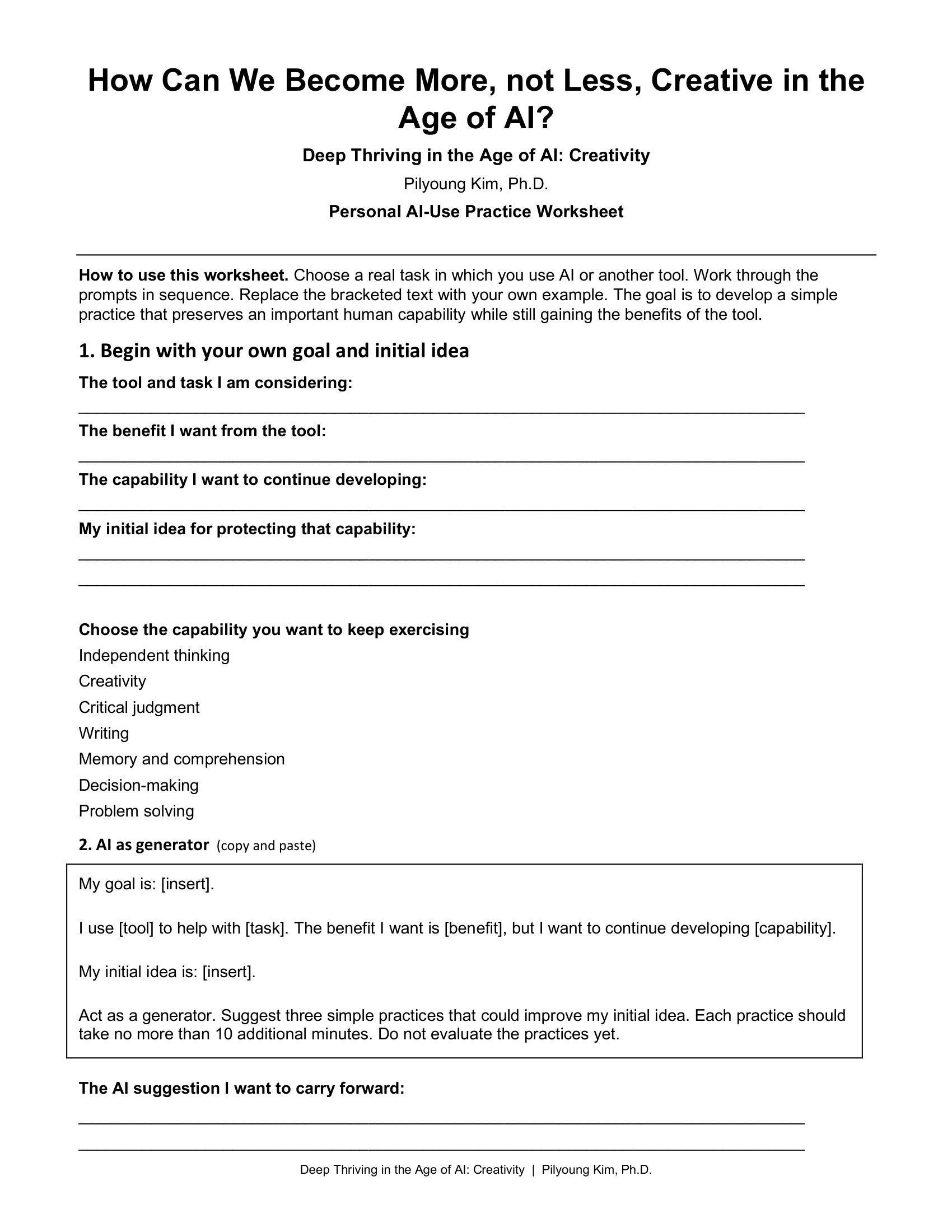 Deep Thriving Creativity Prompt Worksheet257KB ∙ PDF fileDownloadDownload
The exercise: four roles for AI
The worksheet is attached below. Choose a real task where you use AI or another tool, and work through it in order.
Begin with your own goal and initial idea. Here is an example exercise we did at the seminar. Before using AI, write down four things: the tool and task you are considering, the benefit you want from the tool, the capability you want to continue developing, and your initial idea for protecting that capability. Capabilities might include independent thinking, creativity, critical judgment, writing, memory and comprehension, decision-making, problem solving, empathy, or social relationships.
Then bring in AI in four roles.
1. Generator. AI can lower the blank-page barrier, especially when the topic is unfamiliar. Ask it for three simple practices that could improve your initial idea, and tell it not to evaluate them yet. Then choose one to carry forward.
2. Expander. This is where AI can really shine. Give it your original idea and the suggestion you selected, and ask for two alternatives that use a meaningfully different method rather than rephrasing what is already there. Then consider whether the difference is useful or merely unusual.
3. Critic or evaluator. I personally think this is one of the best functions AI can provide for our creativity. The timing matters. Evaluating too early can suppress exploration, so this belongs after enough options exist. Ask it to compare your two best options on criteria you choose, and to identify weaknesses and assumptions. The criteria should be selected intentionally by you, not supplied by default.
4. Editor. AI is trained on human language, so it can be very helpful for polishing how we express our ideas. But this role needs quite a bit of caution. One experiment found that editing an AI-generated poem reduced creativity and creative self-efficacy, and AI-assisted writing has been associated with lower psychological ownership. Even when all the ideas are ours, relying on AI too heavily for editing starts to feel like this is not how I say it. As soon as I use AI, it just does not sound like me. Ask it only to make your own practice clearer, without introducing anything new, and then write your final version in your own words.
The full prompts for each role, with space to record what you decide, are in the worksheet.
What I suggest
Human leads goal setting, planning, and initial idea generation. AI works as expander and evaluator. AI as editor is used carefully and intentionally.
I am personally unsure whether AI really makes our job easier or better at the end of the day. The key is to remember that there is great potential for AI to add a lot more useful information into our final creative product, as long as we remain the ones deciding what our goals are, what information we need the most, how our ideas compare with AI’s suggestions, and which ones to carry forward.
One more tool for reflection
I also shared a short AI Thrive / Challenge Questionnaire to help you reflect on whether AI is currently supporting or straining your capability, ownership, meaning, and well-being.
Next: Finding the Optimal Human-AI Relationship
In the next Deep Thriving in the Age of AI seminar, we will turn to the relationship itself.
Do I want a forever-supportive assistant? One that challenges my ideas and critiques my thinking? A collaborator? A companion?
It is becoming increasingly common for people to spend a large part of their day interacting with AI rather than with other people. So we will look at recent research on how people perceive and experience their relationships with AI chatbots, the benefits of different kinds of relationships, the risks including overreliance and reduced independent thinking, and how we can become more intentional about shaping the way AI interacts with us.
Learn more and register for the next seminar
I would be delighted to have you join us!