By Prof. Pilyoung Kim
Published: 2026-02-25
URL: https://pilyoung.substack.com/p/empowering-our-youth-with-social
What should be done about our youth being exposed to risks for emotional dependency on AI chatbots, companions, and characters?
Why I am proposing SEAL now
Since my paper became available: Kim P, Xie Y, Yang S. “ I am here for you”: How relational conversational AI appeals to adolescents, especially those who are socially and emotionally vulnerable. arXiv preprint arXiv:251215117. 2025.
In this paper, we found that youth often feel emotionally closer to companion style AI chatbots, and that anxious and stressed youth with less social support may be especially vulnerable. When I shared these findings, many people, especially educators, asked the important question: what should we do to protect youth from potential harm linked to emotional attachment to AI chatbots?
Protection is essential, but empowerment is missing
It is critical that we see strong improvement in AI design and policy and regulations. In parallel with these efforts, I started to think that in addition to protecting youth, it is also critical to empower our youth with the tools and knowledge to protect themselves by using AI critically and more safely for their social and emotional health and wellbeing.
This idea is well aligned with the overall AI literacy, defined as “a set of competencies that enables individuals to critically evaluate AI technologies; communicate and collaborate effectively with AI;….” (Long & Magerko, 2020)
As schools move quickly to build AI literacy curriculum, we still have limited guidance on AI literacy in social and emotional contexts.
Introducing Social and Emotional AI Literacy (SEAL)
Therefore, I am proposing the Social and Emotional AI literacy (SEAL).
Below is my working definition of SEAL.
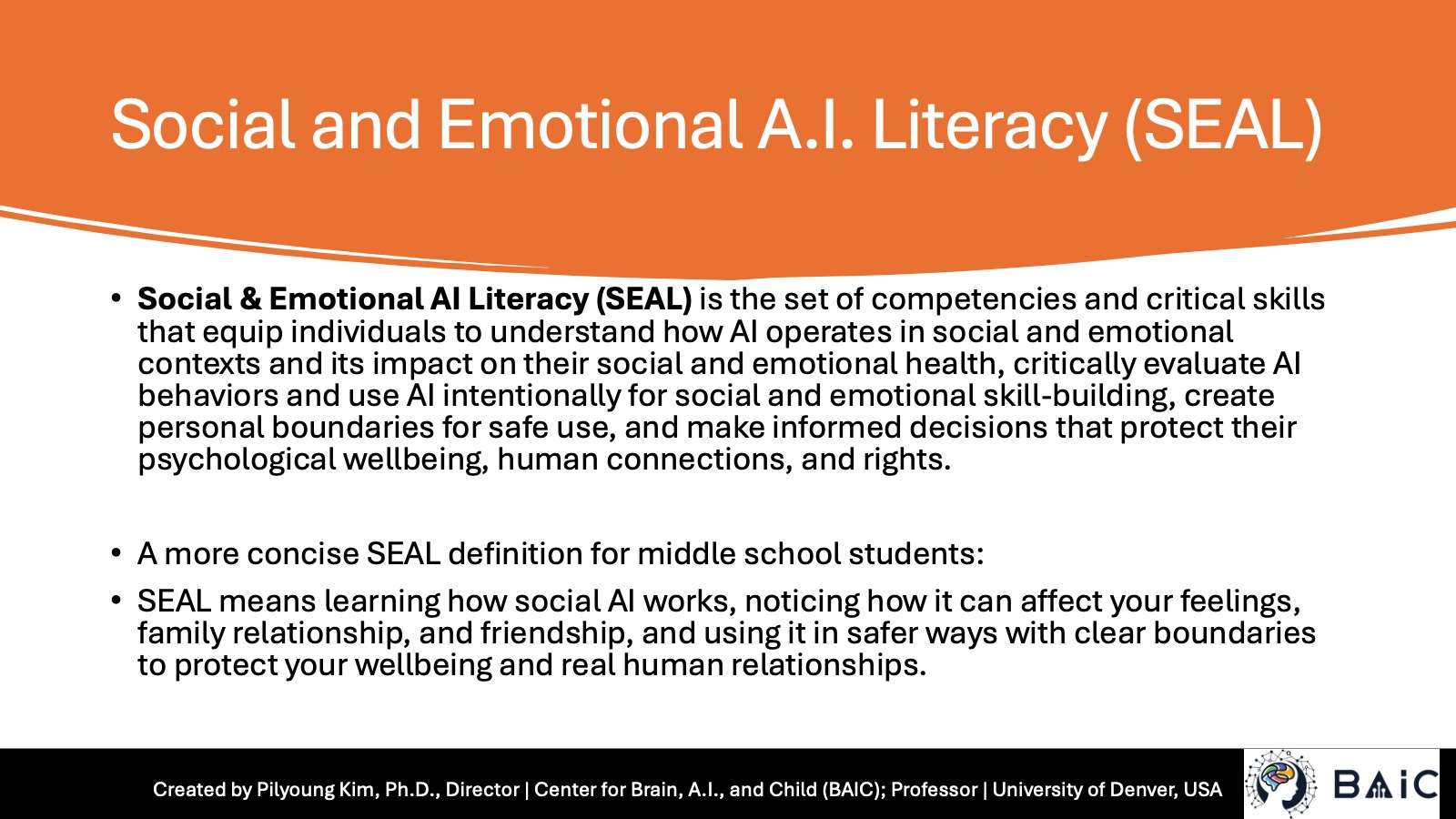
Social & Emotional AI Literacy (SEAL) is the set of competencies and critical skills that equip individuals to understand how AI operates in social and emotional contexts and its impact on their social and emotional health, critically evaluate AI behaviors and use AI intentionally for social and emotional skill-building, create personal boundaries for safe use, and make informed decisions that protect their psychological wellbeing, human connections, and rights.
Why SEAL matters
SEAL is significant because it gives real power to youth to understand how AI impacts them and to create AI they want. Youth are often more tech savvy than adults, and this knowledge and understanding of AI and human relationships can also reduce guilt they may have about talking to AI.
Most importantly, SEAL can support youth in developing more productive and resilient interactions with AI chatbots, while keeping those interactions flexible and purposeful depending on the task they want in the moment.
What SEAL will help youth learn
SEAL will help them develop skills to think about questions like these:
• Why do some AI chatbots excel in talking like a friend or companion? • Why can AI feel so human, even though it is a machine? • When am I more likely to turn to an AI chatbot for support? • What are signs an AI character might be trying to influence my feelings or choices? • How can I protect myself from relying on AI too much for relationships? • What are safer chatbot styles, and what boundaries do I want for myself? • What rules are being discussed to protect youth, and how can young people share their voices?
What I will share next, especially for educators
With this proposal of a new framework, I would like to support educators who are concerned about students wellbeing and want ways to strengthen the social and emotional side of AI literacy. For that, I will create a series of posts with key concepts and literacy training contents, including suggestions for class activities and an example PowerPoint slide, in the coming weeks. You can find today’s slide here.
I will share this via LinkedIn and my Substack newsletter, and you will be able to find all the posts about SEAL here.
Why I am starting with ages 11 to 15
I will first focus the materials for adolescents ages 11 to 15, as they may be most vulnerable to emotional overdependency on AI companions due to unique developmental vulnerabilities, supported my research (e.g. Kim et al, 2025).
I would love to build this with educators, and learn from others too
As I am developing these materials for educators, I truly look forward to working with you. Please share your suggestions and requests, and I would especially love feedback if you try any of these materials with students.
And if you are reading this as a parent, clinician, researcher, developer, NGOs, policy makers or simply someone who cares about youth wellbeing in the age of AI, I welcome your input too. Your perspectives will make SEAL stronger.
What would you most want SEAL to include, and what are you seeing in the young people around you?