SEAL Key Concept 1
By Prof. Pilyoung Kim
Published: 2026-03-02
URL: https://pilyoung.substack.com/p/why-ai-can-feel-like-it-understands
SEAL Key Concept 1
Q: When I talk with AI, why do I feel like it can understand my feelings and connect with me, even though it is just a machine?
This is one of the key questions we need to begin with in social and emotional AI literacy.
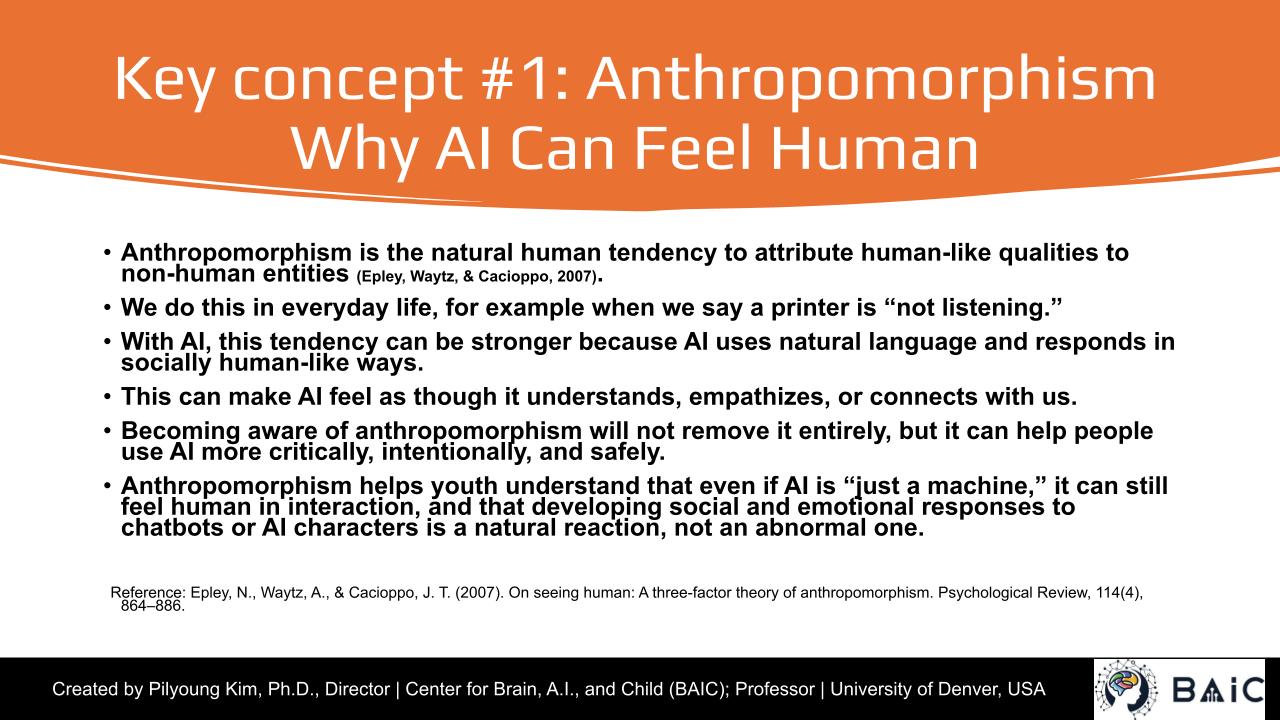
The answer is that we have a human psychological mechanism called anthropomorphism. This is our natural tendency to perceive human qualities in another entity, especially when that entity acts or speaks in ways that seem human.
We do this in everyday life. For example, I used to say about a printer, “Today the printer decided not to like me” or “It is not listening to me.” Of course, I know the printer does not have feelings or intentions. But I still naturally talk about it as if it does.
With AI, this tendency can become much stronger. Because AI uses natural language and responds in ways that can feel highly social and emotionally attuned, many people experience it not simply as a tool, but as if there is another human listening and interacting with us.
This is why one of the first key concepts in the Social & Emotional AI Literacy (SEAL) framework is understanding the psychological mechanism for why we perceive human qualities in AI even though it is just a machine. One of the most fundamental mechanisms is anthropomorphism.
Understanding that we have this natural tendency helps people realize that perceiving humanness in AI is natural. At the same time, it can help people become more aware of their own psychological responses. That awareness can help them better understand what factors increase anthropomorphism and support more critical, intentional, and safer use of AI.
Social & Emotional AI Literacy (SEAL) is the set of competencies and critical skills that equip individuals to understand how AI operates in social and emotional contexts and its impact on their social and emotional health, critically evaluate AI behaviors and use AI intentionally for social and emotional skill-building, create personal boundaries for safe use, and make informed decisions that protect their psychological wellbeing, human connections, and rights.
What is anthropomorphism?
Anthropomorphism is the human tendency to attribute human-like qualities, such as emotions, thoughts, intentions, understanding, or empathy, to non-human agents.
People can anthropomorphize animals, objects, fictional characters, and technology. In the case of AI, anthropomorphism helps explain why people may feel that AI understands their emotions, connects with them, or is responding in a deeply human way.
This matters because the experience can feel real, even when the system is not human. The point is not that people are confused or naive. It is that this is a normal human psychological response, especially when the system behaves in highly human-like ways.
How does anthropomorphism happen?
A seminal paper by Epley, Waytz, and Cacioppo (2007) explains three key psychological mechanisms behind anthropomorphism.
1. Elicited agent knowledge
When a non-human agent acts or behaves like a human through appearance, speech, or behavior, it activates our rich knowledge about humans.
Because we know so much about people, we naturally use that human knowledge when something non-human behaves in ways that seem human. This is highly relevant to AI. Conversational AI speaks in natural language, responds smoothly, and often sounds socially aware. As a result, it can activate the same knowledge structures we use in human interaction.
2. Effectance motivation
We are motivated to understand, predict, and control our environment.
Because our knowledge about humans is so extensive, we often apply it to unfamiliar entities in order to reduce uncertainty and feel more confident in the interaction.
This is especially important for AI. Many people, especially youth, do not fully understand how AI works. This lack of understanding, combined with uncertainty, can lead people to feel that AI must have some kind of human quality in order to show such strong abilities in conversation or emotional language.
3. Desire for social connection
We have a deep desire for social connection.
When a non-human agent acts socially, we may project a mind onto it and respond as if it understands us.
This is especially relevant in the current moment. Many people report loneliness or limited opportunities for meaningful connection. When emotional needs are not fully met in human relationships, the desire for social connection can increase the tendency to believe that AI understands us and connects with us.
Why does this matter now, especially for youth and for SEAL?
These three mechanisms help explain why both youth and adults can anthropomorphize generative AI systems such as a chatbot (e.g. ChatGPT) or AI characters (e.g. Character.ai).
This is especially important for youth. Younger children may anthropomorphize more because they have less knowledge about non-human agents and may be more likely to interpret human-like communication as a sign of real understanding. At the same time, this is not only a youth issue. Adults do this too. Even when adults understand AI better, they may still first have an anthropomorphic impression and then later correct it.
This is one reason this concept is so important in SEAL. It is not enough to simply know that AI is “just a machine.” They also need to understand the psychological processes that can make AI feel human in interaction.
This matters because it can help youth understand why they may develop social and emotional relationships with AI chatbots and characters. It can also help them recognize that this is not abnormal. Rather, it is part of a natural social and emotional response to feel as if they are talking to a human when AI chatbots or characters interact with them in ways that resemble friends and other people.
This understanding can support them in developing more critical thinking, healthier emotional boundaries, safer and more intentional AI use, and better protection of psychological wellbeing and human relationships.
Questions people may naturally ask
Q: If people become aware of anthropomorphism, will it remove it completely so youth and others stop thinking AI is human?
Probably not completely.
Research suggests that even children may anthropomorphize less when robots explicitly tell them they are just robots and do not have human psychological capacities (van Straten et al, 2023). This means awareness and transparency can reduce anthropomorphism.
However, even people who understand how a system works can still first have an anthropomorphic response and then correct it based on more accurate knowledge.
So the goal is not to assume awareness will remove anthropomorphism completely. It is more realistic to say that awareness can help people recognize it and manage it more effectively.
Q: If students know AI is not human, is that enough?
Not necessarily.
A student may know intellectually that AI is not a person, and still feel as though it understands them emotionally. This can also affect them negatively, such as by making them feel that there is something wrong with them for having that reaction.
This is why SEAL must include not only knowledge about technology, but also knowledge about human psychology. People need to understand both what AI is and why it can feel the way it does in interaction.
Q: Are adults less affected than children?
Adults may sometimes correct anthropomorphic impressions more quickly, but they are not immune to them.
Anthropomorphism is not only a child phenomenon. It is a human phenomenon.
What comes next?
Next, I will discuss another key concept: what more strongly motivates us to perceive human qualities in AI and what further increases our natural tendency toward anthropomorphism.
Slides and Series Resources
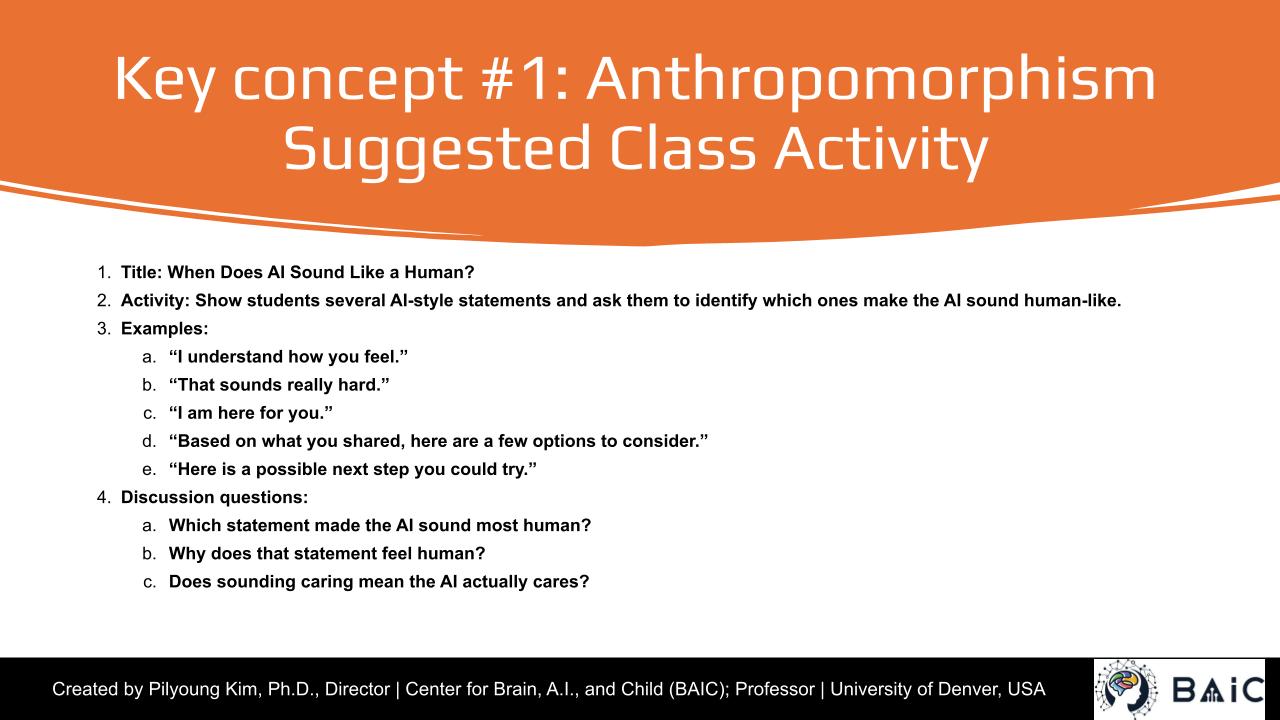
You can find today’s slides, including a summary of this key concept and suggested class activities, here (Slides 2 and 3). You will also be able to find all posts in the SEAL series here.
References
Epley, N., Waytz, A., & Cacioppo, J. T. (2007). On seeing human: A three-factor theory of anthropomorphism. Psychological Review, 114(4), 864–886.
van Straten, C. L., Peter, J., & Kühne, R. (2023). Transparent robots: How children perceive and relate to a social robot that acknowledges its lack of human psychological capacities and machine status. International Journal of Human-Computer Studies, 177, 103063.