By Prof. Pilyoung Kim
Published: 2026-02-21
URL: https://pilyoung.substack.com/p/ai-companions-loneliness-and-what
In recent days, I have met more people who shared that an AI chatbot helped them go through difficult times. Research also supports that many users of AI companion chatbots describe the emotional support as real and meaningful.
At the same time, there is growing concern about emotional dependency, possible isolation from human relationships, and the risk that emotionally responsive systems can pull vulnerable users into over reliance.
So I keep coming back to the same set of questions. Who benefits most from AI companionship. What are the short term versus long term effects. And what would safer support look like when the support is delivered through a relationship like interface.
The study I read
In a recent study, Yuan and colleagues examined what changes over time when people engage with AI companion chatbots. They used a large scale quasi experimental design on longitudinal Reddit timelines, comparing one year before and one year after first self disclosed engagement.
They also compared these users to multiple control groups, including users of LLM based chatbots such as ChatGPT, Claude, and Gemini, users of AI voice assistants such as Alexa and Google Assistant, and users who did not post about AI assistants at all.
The core message is not simple, and I appreciate that the paper acknowledges it. The findings point to mixed effects. Some patterns look consistent with greater emotional articulation and processing. Other patterns raise concerns about worsening mental health signals and reduced emotional dependency over time.
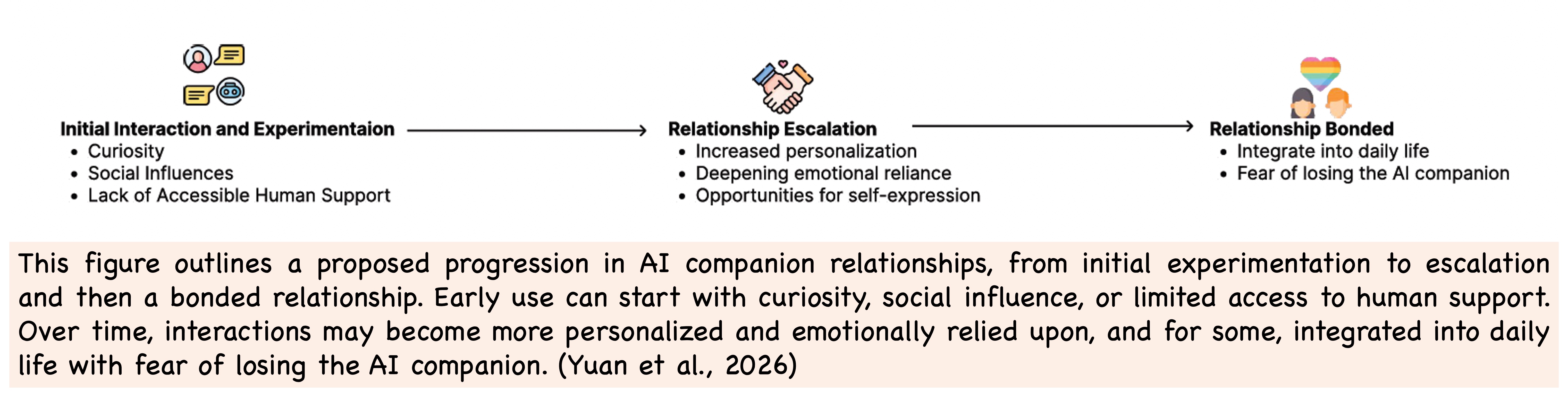
Interestingly, the interviews with 15 participants included in this study add another layer. Some long-term users described the relationship deepening in ways that resemble bonding, including distress and fear at the thought of losing access. This fear was reflected in the recent public reactions to OpenAI retiring ChatGPT 4o. Many users described feeling like they were losing a relationship, not just a tool.
My Takeaway
Strong suggestions for short term benefits for some people, especially when no other appropriate help is available. At the same time, it would also be important to consider that these same people may have a heightened fear of losing the AI companion, and may be more vulnerable to emotional dependency over time. Supporting users with clearer knowledge about anthropomorphism, healthier boundaries, and stronger connections back to human support may be one of the most important parts of safe design.
Reference Yuan, Y., Zhang, J., Aledavood, T., Zhang, R., and Saha, K. Mental Health Impacts of AI Companions: Triangulating Social Media Quasi Experiments, User Perspectives, and Relational Theory. 2026.
Thanks for reading AI & the Human Mind! Subscribe for free to receive new posts and support my work.