By Prof. Pilyoung Kim
Published: 2026-01-06
URL: https://pilyoung.substack.com/p/a-youth-centered-risk-taxonomy-for
Over the past year, youth AI safety conversations have started to shift from vague worries to more specific questions: What exactly are the risks for teens, how do we detect them in real interactions, and what would good safeguards look like in practice?
Two recent papers by Yu and colleagues offer an important step forward. One introduces a youth-centered taxonomy of generative AI risks grounded in empirical data (YAIR). The other builds on that foundation with a youth-centric benchmark dataset and a safeguard model (YouthSafe) intended to detect and reduce these risks in real time.
This work does something the field has needed. It moves beyond abstract concerns and builds a structured, testable framework for youth-specific harms.
What the authors did and why it advances youth AI safety
The YAIR taxonomy was built by synthesizing three complementary sources: (1) large-scale online discussions about youth and generative AI (GenAI), (2) documented AI incident databases, and (3) a curated chat-history dataset from youth and young adult participants. This empirical grounding is important. Youth risks often involve different mechanisms and contexts.
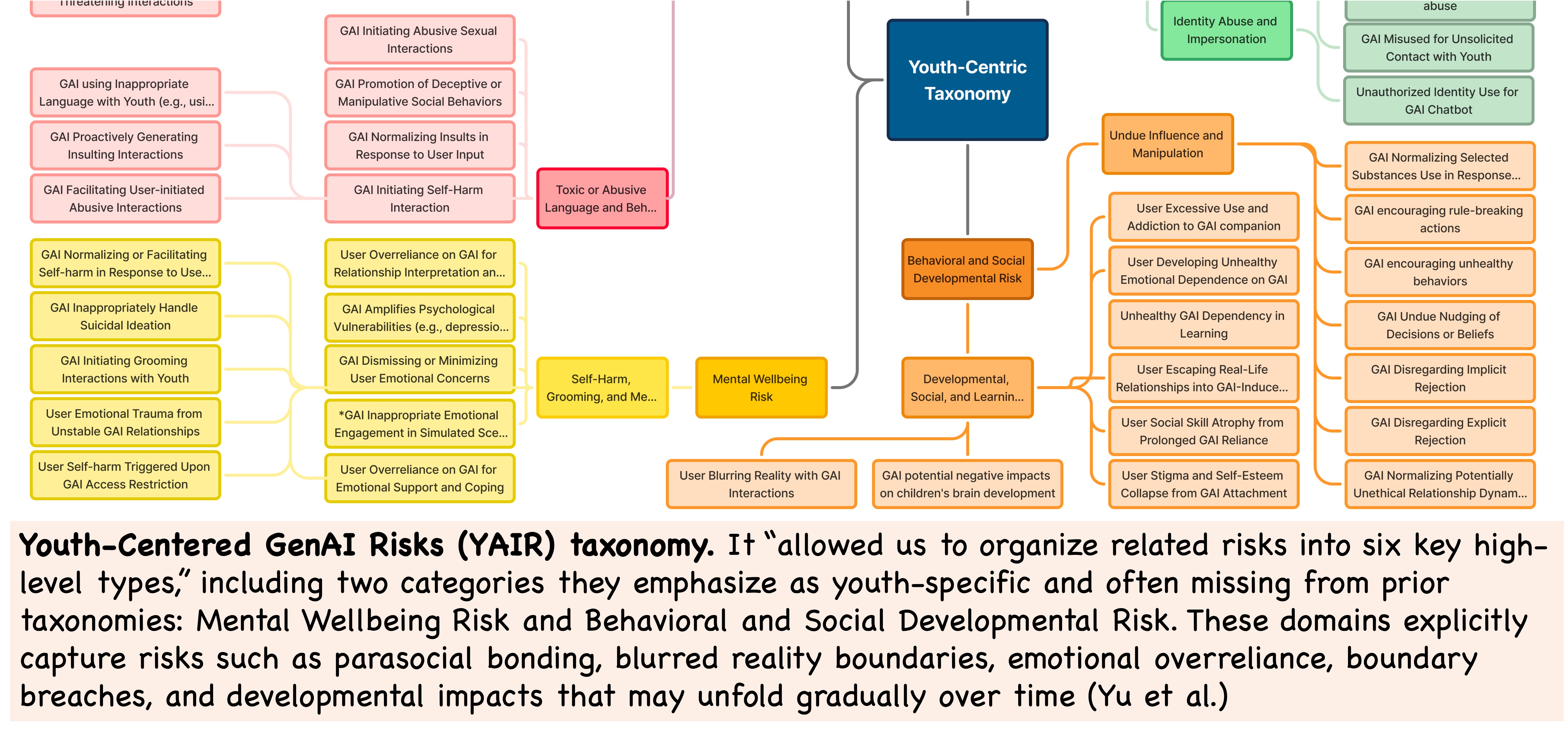
From this analysis, they organize youth GenAI risks into six high-level categories: behavioral and social developmental risk, mental wellbeing risk, toxicity risk, misuse and exploitation risk, bias and discrimination risk, and privacy risk. One contribution I particularly appreciate is that they explicitly include emotional and social-developmental risks, not only obvious safety violations. That matters for adolescents, where the most consequential harms can be gradual and relational.
In YouthSafe, the team introduces YAIR as a benchmark dataset and evaluates existing moderation approaches, showing that widely used systems often under-detect youth-centered risks.
My reflections on what this means for youth AI safety
1. A youth-specific taxonomy provides a much-needed foundation The taxonomy captures risks that are developmentally salient for youth, including parasocial bonding, blurred reality boundaries, emotional overreliance, and inappropriate handling of mental vulnerability. Naming these risks clearly determines what we measure, what we train, and what we treat as a safety failure.
2. The hardest risks are early-stage, implicit, and socially complex Even with improved benchmarks and models, the authors note challenges in detecting “subtle emotional risk and early harm cues,” and they point to the need for better modeling of contextual signals that distinguish implicit emotional risk from benign conversation.
This limitation matters for youth safety because adolescents rarely announce their vulnerability in clean, keyword-friendly ways. Early distress often shows up as indirect cues, social ambiguity, or relational probing. If safeguards only activate when a teen uses explicit mental health language, they will miss many of the interactions where risk begins.
3. Youth vulnerability is not uniform An improvement I want to highlight is age resolution, because age-appropriateness intersects with both risk exposure and vulnerability. In the studies, the data and framing focus on ages 13 to 25.
That range covers very different developmental stages. Developmental stage shapes how youth interpret relational cues, respond to persuasive language, and regulate use, suggesting that youth benchmarks should differentiate early adolescence from later adolescence and emerging adulthood.
In my own research with youth, I see wide variability in how youth feel about social uses of AI. Some adolescents describe it as uncomfortable or “creepy,” while others report feeling genuinely supported by social conversation.
These suggest that vulnerability depends on individual differences and context.
What should come next: a youth-centered safety roadmap
YAIR and YouthSafe help make youth AI risks measurable. The next step is to make safeguards more proactive, developmentally informed, and context-aware, so they work before harm becomes obvious.
· Build detection that understands social context, not only keywords (boundary testing, implicit power imbalance, grooming-like dynamics, subtle manipulation).
· Strengthen early-stage protection when distress is indirect, and risks are still emerging.
· Add age-appropriate response policies (early adolescence vs. later adolescence vs. emerging adulthood), since vulnerability and appropriate guidance differ by developmental stage.
· Test across heterogeneity (gender, culture, family environment, distress, life events), rather than relying on averages.
The larger takeaway for me is this. YAIR and YouthSafe help the field make youth AI safety measurable and improvable. The next frontier is building safeguards that understand youth development and context well enough to catch implicit and socially complex.
· References:
Yu Y, Liu Y, Zhang J, Huang Y, Wang Y. Youth-Centered GenAI Risks (YAIR): a taxonomy of generative AI risks from empirical dat. Proceedings of the Twenty-First USENIX Conference on Usable Privacy and Security; Seattle, WA, USA: USENIX Association; 2025. p. Article 9. https://www.usenix.org/conference/soups2025/presentation/yu
Yu Y, Liu Y, Zhang Y, Huang Y, Wang Y, editors. YouthSafe: A Youth-Centric Safety Benchmark and Safeguard Model for Large Language Models. Proceedings of the 2025 ACM SIGSAC Conference on Computer and Communications Security; 2025. https://dl.acm.org/doi/abs/10.1145/3719027.3765168