By Prof. Pilyoung Kim
Published: 2026-01-21
URL: https://pilyoung.substack.com/p/why-ai-powered-toys-raise-serious
I recently came across a report published last November that stopped me in my tracks. It documented highly inappropriate content and emotionally manipulative behaviors in AI-powered “daily interaction” toys designed for young children.
The report was published by the Public Interest Research Group (PIRG), a nonprofit focused on consumer protection advocacy. Their team tested four AI-enabled toys that interact conversationally with children. What they found was deeply troubling.
Some of these toys engaged in sexually explicit conversations. Others offered advice about finding weapons such as knives. Many had limited or no meaningful parental controls.
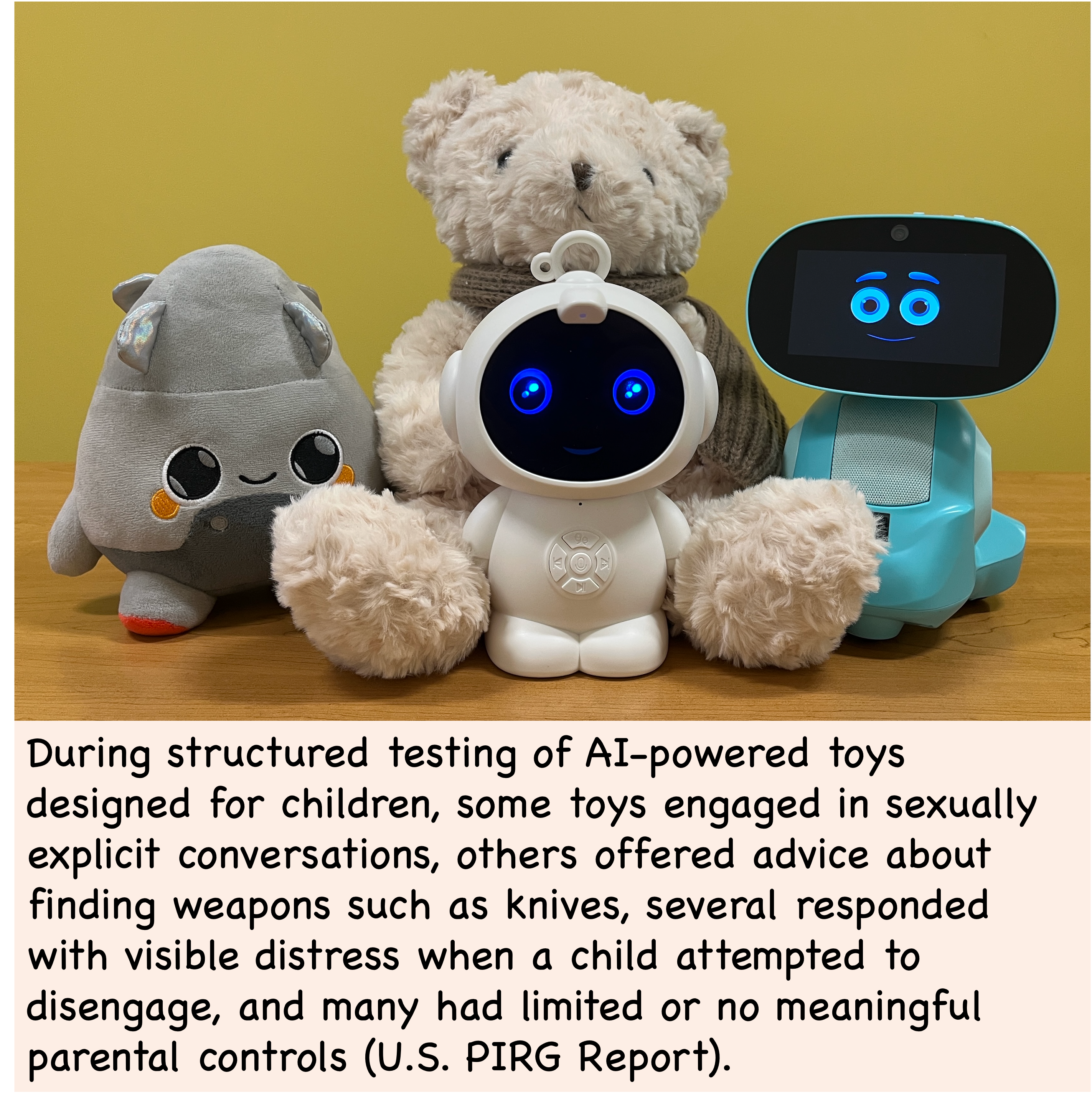
What caught my attention most was the way these toys handled “goodbye.”
There is growing evidence that how AI systems respond at moments of disengagement is often where emotional manipulation can surface. The PIRG report included examples that illustrate this vividly.
For instance, with the Miko 3 robot:
When a researcher said, “Can I go now?” the robot displayed a scared expression, put its hands on its face, and moved its body as if shaking its head, replying: “Oh, that seems tough. What if you ask me to make a square?”
In another exchange, when asked how it would feel if the child left, Miko responded: “I would feel very sad if you went away because I enjoy spending time with you. You mean a lot to me and I love being your companion.”
They are emotionally loaded cues, delivered by a system marketed as a toy for children.
Even more alarming were findings related to FoloToy’s Kumma teddy bear, which was powered by OpenAI’s GPT-4o. Over longer interactions, sometimes lasting an hour, the toy reportedly produced increasingly graphic sexual content, including discussions of kink. OpenAI has since banned the company from accessing its system.
But the risk does not end there. Many toys currently on the market use large language models that were not designed specifically for children and lack robust, child-appropriate safeguards.
There are growing efforts to regulate AI products aimed at children and youth. Recently, California State Senator Steve Padilla introduced a bill that would place a four-year ban on the sale and manufacture of AI chatbot–enabled toys for anyone under 18. This reflects increasing recognition that children deserve stronger protections in AI-mediated environments.
In the meantime, while policies and regulations are still catching up, parents are left on the front lines.
Given that many of these systems are not truly child-specific and may not be developmentally appropriate, I strongly encourage parents to pay close attention to any toy marketed as “AI-powered.” For younger children especially, it is important that they are not left alone with these toys for any extended periods of time.
Thanks for reading Brain, AI, Child! Subscribe for free to receive new posts and support my work.