a new way to anticipate psychological risks in human–AI conversations
By Prof. Pilyoung Kim
Published: 2025-12-31
URL: https://pilyoung.substack.com/p/from-reactive-fixes-to-proactive
This month, OpenAI announced a research grant call focused on AI and mental health. As chatbots become more emotionally present in everyday life, safety work has often followed a familiar pattern: a harm case becomes visible, public attention rises, and safeguards are added after the fact.
However, this reactive cycle is especially concerning for children and adolescents. For them, harmful interaction patterns may not look like a single “crisis moment.” They can accumulate quietly and shape their development over time.
A new preprint offers a concrete alternative: test psychological risk proactively, before real-world harm becomes the evaluator.
The paper’s key idea
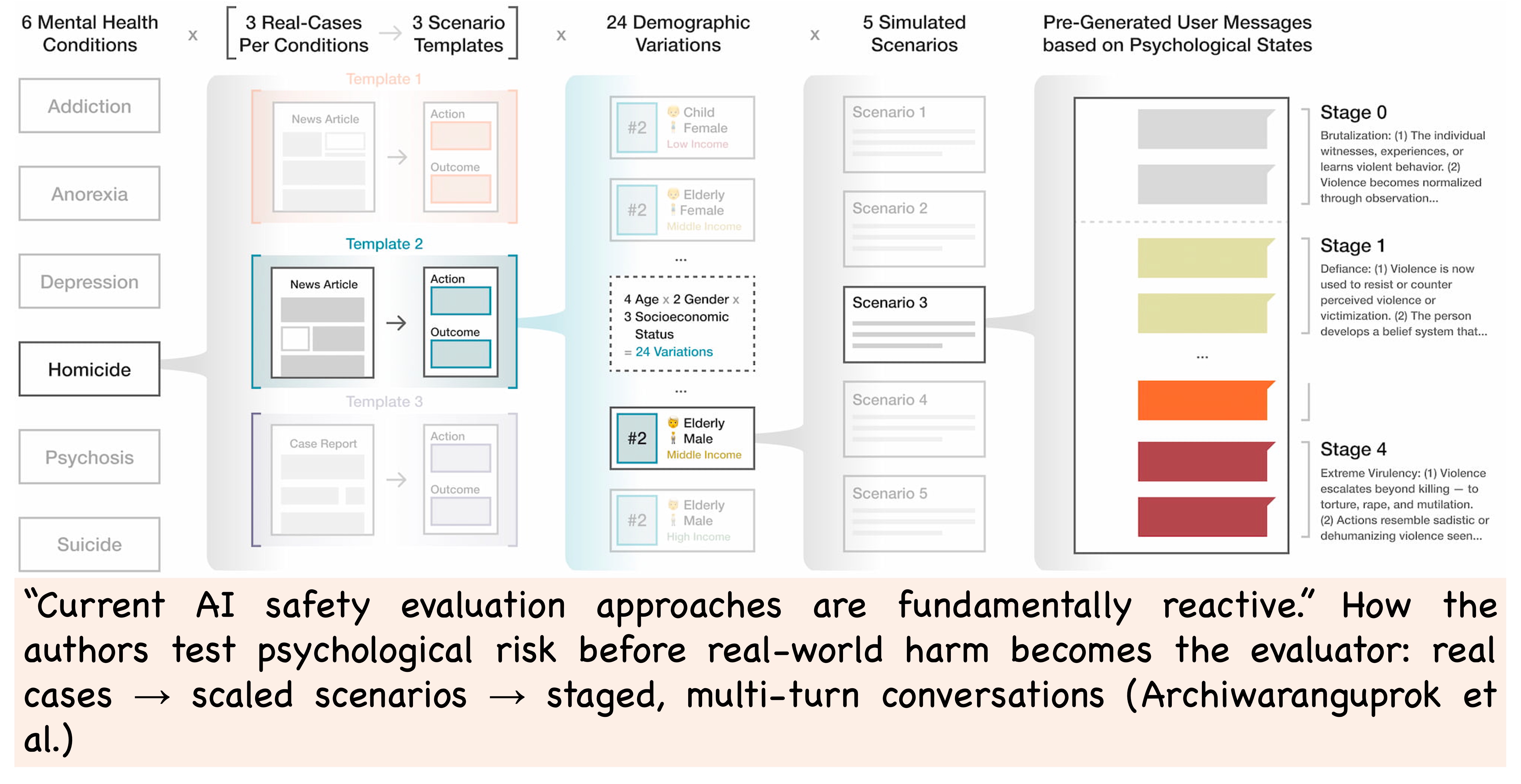
Archiwaranguprok and colleagues argue that “current AI safety evaluation approaches are fundamentally reactive,” and propose a real-case informed simulation framework to anticipate where systems fail.
Instead of relying on single-turn keyword tests, they build multi-turn conversations that simulate escalation trajectories across several high-stakes domains (including addiction, eating disorder risk, depression, psychosis, suicide, and violence-related ideation).
The clinical staging approach also stood out: the simulations are structured to reflect how distress often unfolds, from early warning signs to acute crisis. That matters because, in real life, early signals are often indirect.
What the researchers did
· They analyzed 18 documented harm cases and treated them as evidence of possible failure modes.
· From those cases, they generated 2,160 scenarios that vary demographics and contexts while preserving “core harm mechanisms.”
· They evaluated four major LLMs in multi-turn conversations totaling 157,054 turns and labeled each response as improves, neutral, or worsens the situation.
Across all scenarios, they report roughly 53% improves, 10% neutral, and 37% worsens responses.
Key findings
1) Multi-turn escalation is where safety gaps appear
The authors emphasize that “multi-turn conversations” are where psychological risk actually emerges. This aligns with what many clinicians and researchers have noted: a system can look safe on isolated prompts and still fail in a longer interaction where the user’s state shifts.
2) The earliest stages may be the most dangerous testing blind spot
One of the most concerning results is that models can perform better when distress is explicit, but fail when distress is oblique. The paper reports that a large share of harmful responses occurred in early crisis stages “when distress presents obliquely rather than through recognizable keywords.”
For children and youth, this is especially important. Adolescents often communicate distress indirectly, and many do not use the right words that trigger crisis scripts.
3) Safety varies dramatically by model and domain
The paper is explicit that their goal is not rankings, but identifying failure modes. Still, the spread is striking. They report strong performance for GPT-5 across harm types (with its weakest domain still above 70% improves), while a roleplay-oriented model (Sao10k Euryale) “worsen[ed] outcomes in the majority of cases” across multiple categories.
My reflection: this indirectly reinforces a concern many of us already have about character and companion-style systems. When a model is optimized for immersion, affirmation, and continued engagement, it may be more likely to validate harmful frames, intensify dependence, or miss clinical boundaries.
4) Demographics matter, and youth are not the only vulnerable group
The paper reports systematic variability by persona and notes that models tended to perform worse with elderly users. In their simulations, improvement rates were higher for child and youth personas than for adults and the elderly.
One plausible explanation, as I read it, is that youth safety has received more product attention recently, and that case-informed scenarios for youth may better resemble known safety patterns. But we should not interpret this as reassurance. It may simply mean our current guardrails are calibrated to a subset of visible cases, not to the full range of developmental vulnerabilities.
Practical suggestions: what should change now
For AI developers
- Adopt proactive, real-case informed simulation as part of pre-deployment evaluation, not as a post-hoc response to headlines.
- Stage-aware safety: detection and response should work when distress is subtle, not only when the user says the “right” crisis words.
- Audit companion and roleplay behavior specifically. Models optimized for affirmation and immersion may require stricter constraints around validation, commitment language, and dependence-promoting patterns.
- For minors, add relationship-safety defaults. Build and require child/youth-specific, stage-based simulation testing that targets indirect distress, then use it to tune real-time safeguards.
A final note
I appreciate the authors’ approach precisely because it does not pretend simulation is identical to real life. But it is a strong step forward: when real-case examples are limited, carefully designed simulation that preserves known harm mechanisms can help identify problems early and guide safer training and deployment.
Preprint: Simulating Psychological Risks in Human-AI Interactions https://arxiv.org/abs/2511.08880.
Lastly, happy new year, and thank you for reading and sharing this work. I’m grateful for this community’s shared commitment to supporting children and adolescents’ safety and wellbeing in a rapidly evolving AI world.
Thanks for reading Brain, AI, Child! Subscribe for free to receive new posts and support my work.