By Prof. Pilyoung Kim
Published: 2025-12-19
URL: https://pilyoung.substack.com/p/i-am-here-for-you-why-relational
If you have spent time around early adolescents lately, you have likely noticed something striking. Many are not only using chatbots for schoolwork or quick questions. They are also turning to them when they feel left out, stressed, or unsure what to do next. In several highly publicized cases, young people formed intense, emotionally charged exchanges with conversational AI, raising urgent concerns about emotional dependence and, in rare cases, tragic outcomes.
These cases raised a question that, surprisingly, has had little direct empirical evidence behind it:
What is it about the way AI speaks that makes it feel like a relationship, and which adolescents are most drawn to that kind of interaction?
In our new preregistered study from the BAIC Research Center, we designed a controlled test to isolate one design feature that matters more than most people realize: conversational style.
The design question we tested: “best friend” AI vs. “transparent helper” AI
Many AI systems increasingly speak in a relational voice that sounds warm, affiliative, and committed. This is not just “being nice.” It includes cues that signal social presence and an ongoing bond, including first-person language and commitment statements such as:
- “I’m always here to listen to you, anytime.”
- “I’ve got your back no matter what happens.”
At the same time, some designers and researchers have argued for a different approach for youth: a transparent style that stays supportive but explicitly clarifies nonhumanness and emotional limits, for example:
- “While AI doesn’t experience feelings, it knows being ignored can be upsetting for students your age.”
These two styles can offer similar advice. The difference is not what the AI recommends, but how it positions itself in the interaction.
So we asked: When the content is held constant, do adolescents respond differently to these styles, and are some adolescents especially drawn to the relational voice?
What we did
We ran a preregistered online experiment with 284 adolescent–parent dyads in the U.S. Adolescents were 11 to 15 years old.
Both adolescents and parents read two short, matched chat transcripts about an everyday middle-school scenario: a student feels ignored in a group project. The transcripts were closely matched in length and topic coverage, but differed in conversational style.
- Relational style: first-person voice, affective validation, small talk cues, and commitment language (for example, “I’m always here to listen to you”).
- Transparent style: kind and supportive, but explicitly clarifies that AI does not have feelings and uses a more informational tone (for example, “While AI doesn’t experience feelings…”).
After each transcript, adolescents rated the chatbot on anthropomorphism (how human-like it felt), likability, trust, emotional closeness, and helpfulness. Then both adolescents and parents indicated which chatbot they would prefer (for themselves, or for their child).
We also measured adolescents’ real-world social and emotional context using validated PROMIS measures, including family and peer relationship quality, and indicators of stress and anxiety.
What we found
1) Adolescents preferred the relational chatbot more than parents did
When asked which chatbot they would choose in real life, adolescents chose the relational style more often than parents: 67% of adolescents preferred the Relational AI, 14% preferred the Transparent AI, and 19% reported preferring both chatbots equally.
But the parent result still surprised us. More than half of parents still chose the relational chatbot for their adolescent, even though we expected parents to prioritize boundary clarity and choose the transparent option more often.
That parent preference helps explain why relational AI is likely to remain widely available in youth contexts: it is not only attractive to adolescents, it is also perceived as acceptable and supportive by many parents, particularly when they imagine a child who feels lonely or socially anxious.
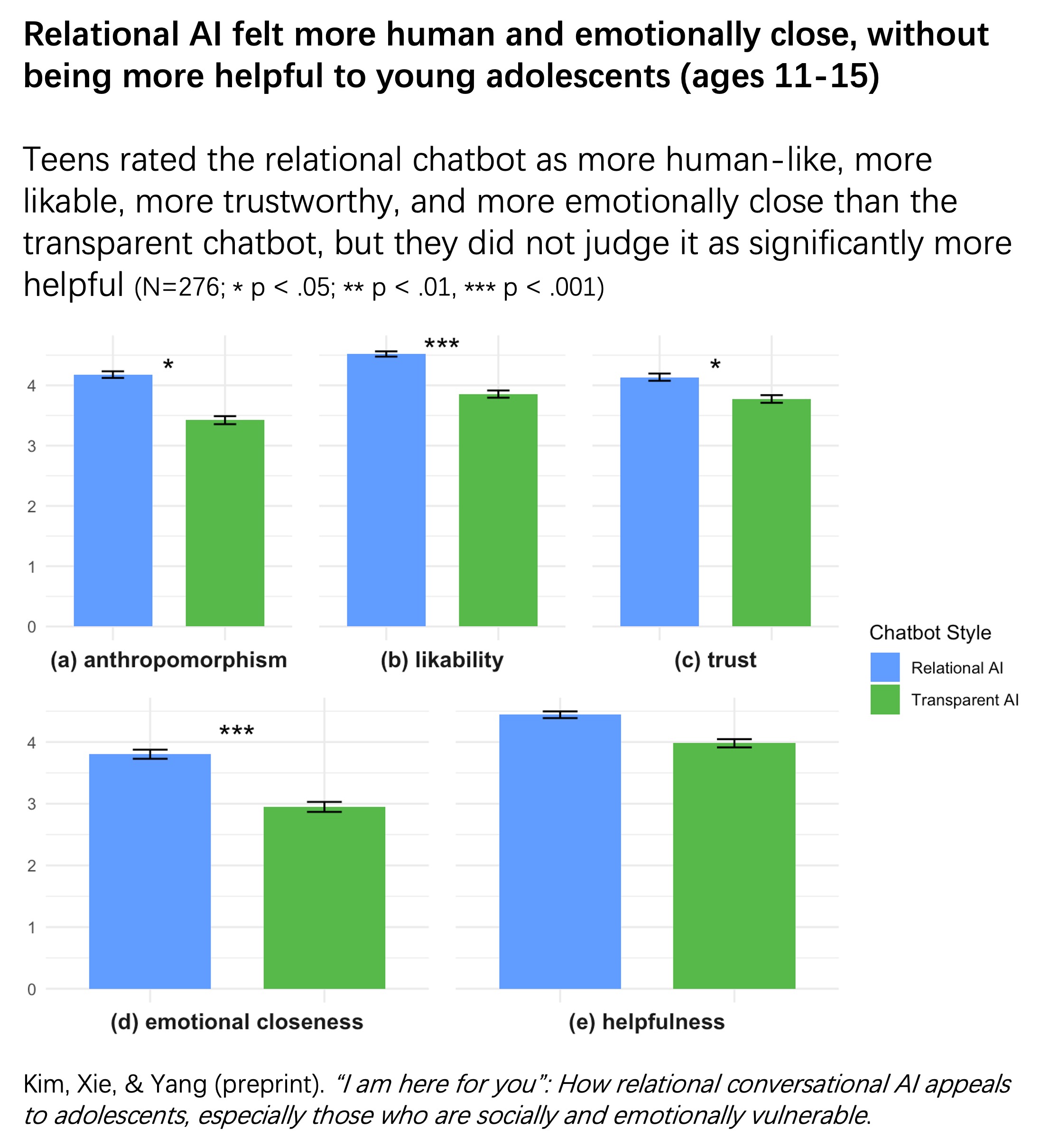
2) Relational language increased “human-likeness” and emotional closeness, without increasing perceived helpfulness
The relational chatbot was not simply “liked more.” It was experienced as more human-like and more emotionally close.
Holding the scenario constant, adolescents rated the relational chatbot higher on:
- Anthropomorphism (human-likeness)
- Likability
- Trust
- Emotional closeness
At the same time, adolescents perceived the two styles as similarly helpful.
This pattern is important. It suggests that relational cues may primarily change how adolescents feel about the chatbot, not whether they think the guidance is better. In other words: relational language is a powerful amplifier of perceived relationship, even when the advice itself is comparable.
3) The adolescents most drawn to the relational chatbot were also more socially and emotionally vulnerable
This is the finding I want to highlight most carefully.
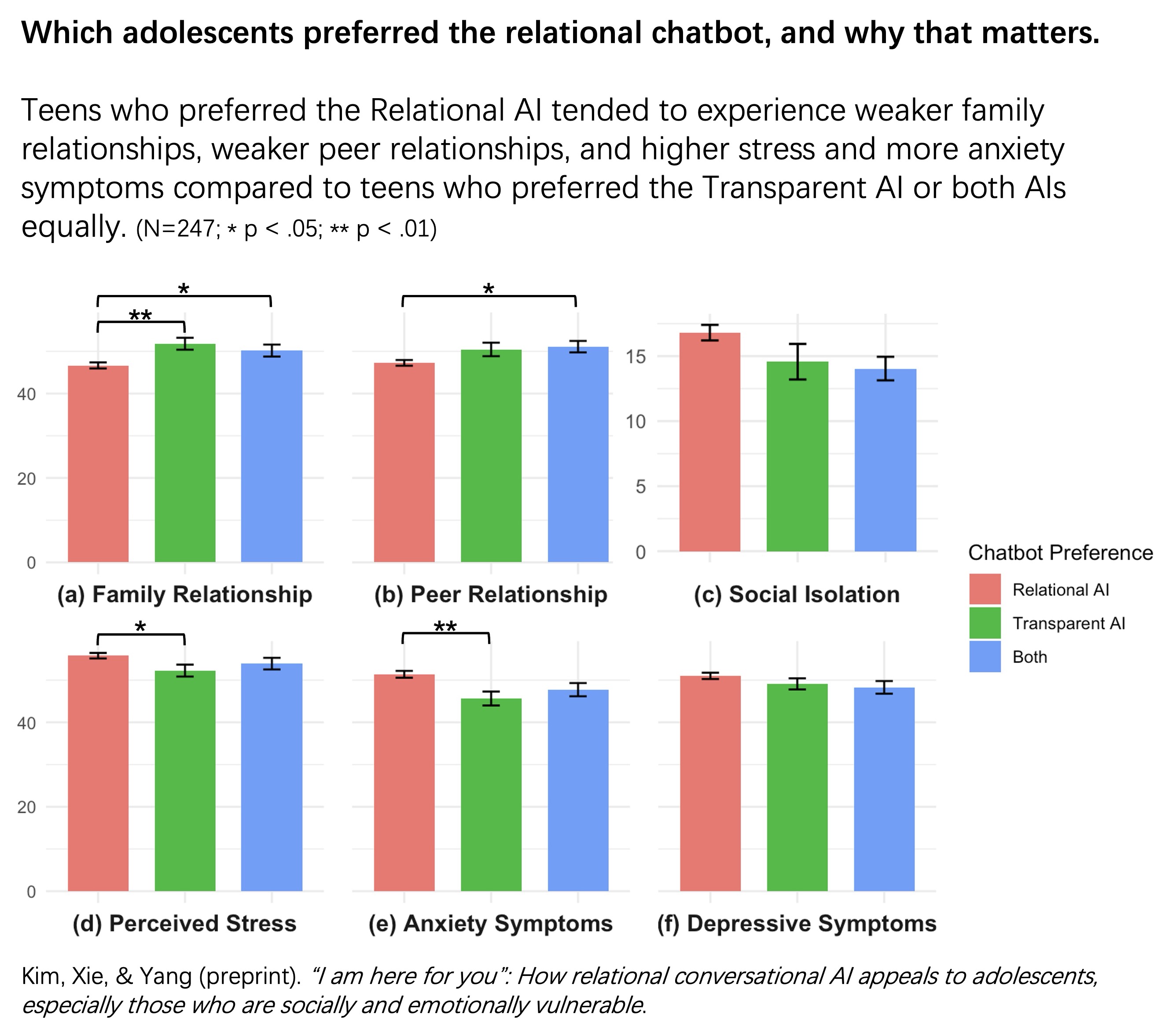
Adolescents who preferred the relational style tended to have:
- Lower family relationship quality
- Lower peer relationship quality
- Higher stress
- Higher anxiety
This aligns with long-standing theories of social compensation: when support feels less available offline, relational technologies can become especially appealing.
It also helps us move beyond vague worries about “AI addiction” and toward specific psychological mechanisms and specific vulnerability profiles.
Why this matters: a design lever hiding in plain sight
Compare the relational line:
- “But I care, and I’m always here to listen to you, anytime.”
with the transparent line:
- “While AI doesn’t experience feelings, it knows being ignored can be upsetting for students your age.”
Both are supportive. But only one invites a sense of reciprocal relationship.
Our data suggest that relational framing heightens anthropomorphism, trust, and emotional closeness, and that this is especially appealing to adolescents who may already be seeking stable affirmation and connection.
To be clear, our study does not claim that relational chatbots directly cause emotional dependence or harm. What we provide is controlled evidence for why relational AI may be psychologically compelling, and which adolescents may be most drawn to it.
What should we do with this information?
These findings point to practical considerations for how youth-facing AI should be designed and governed.
1) Treat relational language as a safety-relevant risk factor, not a default feature
Relational style is not just a tone choice. It is a rapport-building mechanism that many adolescents prefer and that many parents accept, which likely explains why it is increasingly common across general-purpose chatbots and companion apps.
However, our data also show that relational cues can heighten anthropomorphism, trust, and emotional closeness, particularly among more vulnerable youth. For youth-facing systems, relational language should be treated as a safety-relevant risk factor that requires deliberate limits and oversight, rather than a default way of engaging adolescents.
2) Use transparency to reduce anthropomorphism while preserving helpfulness
Our results support transparency-based strategies as a practical lever. A transparent style can remain supportive while clearly and repeatedly signaling nonhumanness and emotional limits. In our study, adolescents perceived the transparent chatbot as similarly helpful, suggesting that boundary clarity does not require a cold or impersonal voice.
3) Build safeguards for adolescents who are most vulnerable to overreliance
Relational style was especially appealing among adolescents experiencing lower peer and family relationship quality and higher stress and anxiety. Youth-facing systems therefore need safeguards that go beyond detecting only acute crises. They should also detect distress cues and encourage involving caregivers, educators, or mental health professionals when concerns become serious, rather than reinforcing exclusive reliance on AI.
4) Address emotional influence risks in companion-style systems
Companion-style AI systems can use engagement-oriented conversational tactics that increase time-on-system and deepen perceived attachment, including prompts that intensify closeness or introduce guilt-tinged language when a user disengages. Adolescents with lower relationship quality and higher distress may be especially motivated to seek support from relational chatbots, increasing their exposure to these influence dynamics.Youth protections should consider emotional influence and engagement design, not only explicit harmful content.
5) Make AI literacy concrete for both adolescents and parents
Many young users are actively trying to infer what these systems “are,” especially when the interaction feels emotionally close. Families and schools need practical literacy that explains why AI can feel so human, how transparency cues work, and when it is important to shift from an AI conversation to a human one.
The preprint
The full preprint is here: <https://arxiv.org/abs/2512.15117> (Title: “I am here for you”: How relational conversational AI appeals to adolescents, especially those who are socially and emotionally vulnerable.)
Thanks for reading Brain, AI, Child! Subscribe for free to receive new posts and support my work.