By Prof. Pilyoung Kim
Published: 2025-12-05
URL: https://pilyoung.substack.com/p/how-do-young-childrens-brains-respond
💡 New preprint alert from our team at the BAIC Center and collaborators!
Young children are starting to use AI chatbots in their everyday learning and play, but how do they actually see these systems? And what is happening in their brains 🧠 when they interact with AI versus with a parent?
Thanks for reading Brain, AI, Child! Subscribe for free to receive new posts and support my work.
In our new study, we invited kindergarteners (ages 5–6) to create stories with a friendly AI character, “Fluffo,” powered by a large language model. Children told stories in three settings: with the AI chatbot alone 🤖, with their parent alone 🫂, and with both together 🫂🤖, while we recorded prefrontal brain activity using fNIRS.
We found that children attributed surprisingly rich mental states to the AI, especially around perceptive abilities (seeing, hearing) and epistemic abilities (understanding, learning). Those who more strongly believed the AI could “see” and “hear” showed greater activation in right dorsomedial prefrontal cortex 🧠 during AI-only interaction, a region involved in thinking about others’ minds.
The same children showed lower activation in this region when a parent was present with the AI, and higher AI-only activation was linked to feeling more “scared” by the end of the session.
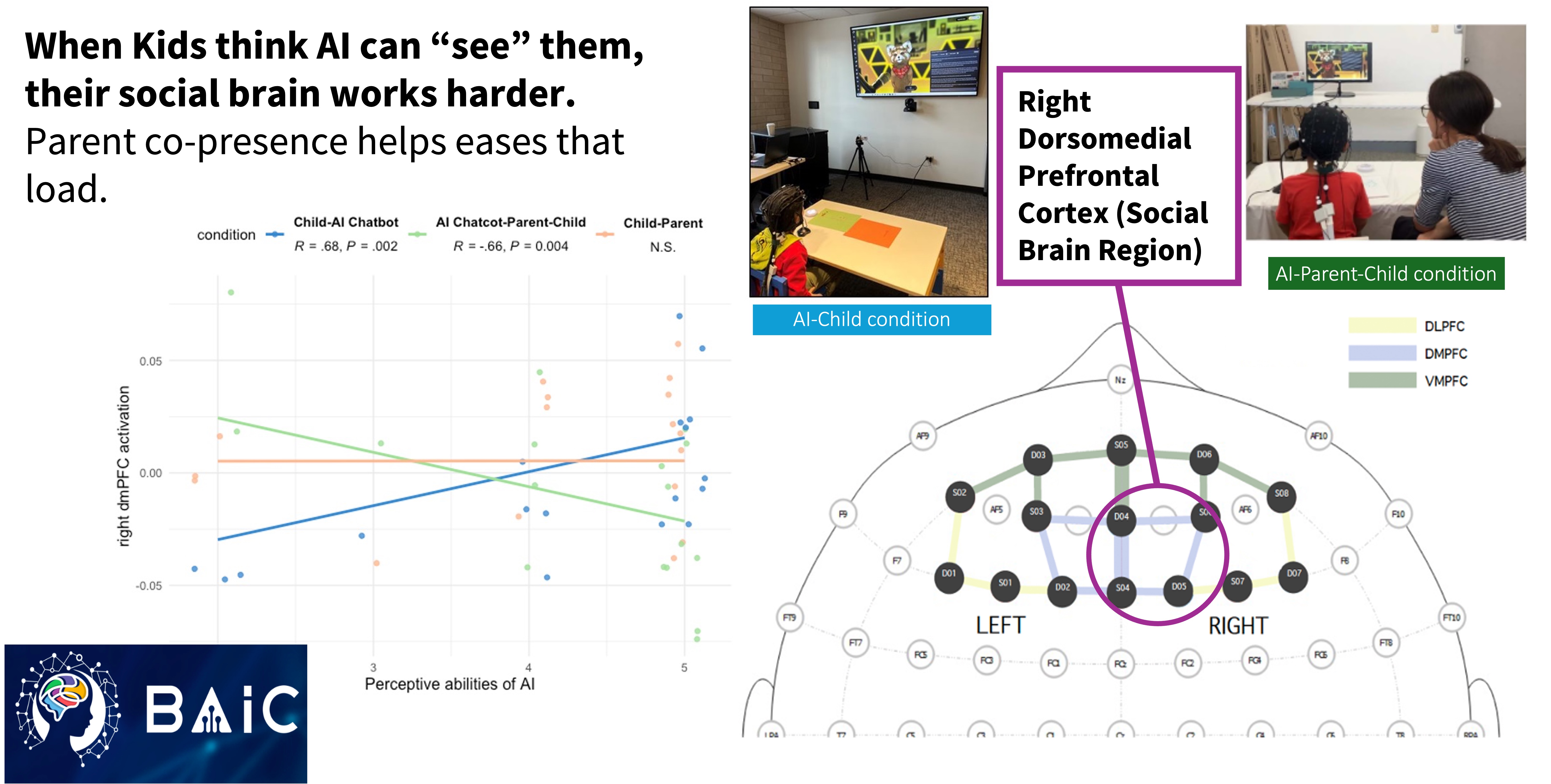
Together, these findings suggest that for some young children, highly anthropomorphized AI can place extra cognitive and emotional demands on the brain and that parent co-presence may help buffer and interpret these novel interactions.
The full study is now available as a preprint: 🔗 Young children's anthropomorphism of an AI chatbot: Brain activation and the role of parent co-presence
Deep gratitude to the families who participated, and to our wonderful BAIC center researchers (Jenna Chin, Yun Xie, Alina Mali, Elizabeth Wolfgram) and collaborators (Nolan Brady, Tom Yeh, Sujin Yang, Mohsena Ashraf, Seungwook Lee).
AI #ChildDevelopment #Neuroscience #Storytelling #Chatbots #BrainDevelopment #Parenting #HCI #fNIRS #AIandChildren
Thanks for reading Brain, AI, Child! Subscribe for free to receive new posts and support my work.