A Conversation with the Chief Scientist at Everyone AI
By Prof. Pilyoung Kim
Published: 2025-12-01
URL: https://pilyoung.substack.com/p/intent-impact-and-the-bridges-in
I first met Dr. Mathilde Cerioli at the Early Head Start Network’s Special AI Roundtable back in June. Mathilde is the Chief Scientist and cofounder of Everyone AI (https://everyone.ai/), a nonprofit focused on child-centered, safe, and evidence-based AI. We recently crossed paths again when she invited me to join the iRAISE international coalition with the Paris Peace Forum, which is working to advance standards that protect children’s cognitive and socio-emotional development in the age of AI.
Most recently, she moderated a panel at the 8th Paris Peace Forum and posed questions such as “What becomes possible when we work together?” to leaders from UNICEF, OpenAI, and Sesame Workshop.
Mathilde started as a clinician and child neuropsychologist, working directly with young people and their families. Now she spends her days translating developmental science into standards, coalitions, and policy conversations about AI and children.
What struck me in our conversation is how clearly she sees both sides at once: the real promise of AI for learning and access, and the accumulating risks that can quietly reshape childhood. She draws on experience across academia, clinical work, startups, and policy advising, and offers a rare perspective on how to bridge conversations among researchers, AI developers, and governments in both the United States and Europe.
Thanks for reading Brain, AI, Child! Subscribe for free to receive new posts and support my work.
In this newsletter, I share some of the most valuable insights from my interview with her.
From child neuropsychology to AI safety
Her path began far from Silicon Valley. She trained and worked as a clinician-neuropsychologist in Montreal, with a clear intention to stay close to children and families. Early on, she created a structured program using commercially available board games and video games for teens from low-income backgrounds with borderline intellectual functioning. Over 12 weeks, teens came in for regular training sessions while she and her colleagues carefully measured changes in attention and cognitive skills.
The key lesson for her was simple and demanding: if you want children to learn, design details matter.
Later, when she began consulting for edtech and game startups, that lens followed her into product rooms. She kept seeing beautifully engineered apps that missed basic facts about children. How long can a seven-year-old actually stay focused? What does it take to learn to read, not just recognize letters on a screen?
She saw a recurring assumption that simply adding educational content would make a product educational. In her view, that confusion matters much more in the era of generative AI. In the past, a weak educational app mostly cost time. Now, systems can respond, guide, and simulate social interaction. If they get developmentally important things wrong, children may not just miss out on learning; they may learn the wrong lessons about relationships, agency, and knowledge.
That shift pushed her to study AI more directly, including formal training, and to take on a role many teams do not yet have: the person who brings child development research into the room and explains where the risks and opportunities really sit.
Turning science into safeguards
Her years in early-stage companies turned out to be ideal preparation for running science in a small nonprofit. In a startup, she told me, you have to do everything: email, slides, and strategy. That experience shaped how she thinks about impact now.
At everyoneAI, she describes her Chief Scientist role less as a traditional lab director and more as a translator and bridge builder. She spends a lot of time asking:
- What does developmental science already know that product teams and policymakers need right now?
- How do you explain those findings in language that a designer, an engineer, or a regulator can actually use?
She sees a structural communication problem at the heart of child AI safety. Researchers and industry do not naturally speak to each other. Governments and international organizations are trying to catch up with a fast-moving field, often with limited technical or developmental detail.
Her work focuses on accelerating the pieces of this system that can move faster: bringing the right people into the room, helping each side understand the other’s constraints, and turning research findings into specific decisions about product standards, governance, and regulation.
EveryoneAI’s multidisciplinary founding team perfectly illustrates the identified need for creating bridges among expertise and knowledge. Board President Gregory Renard brings deep technical and ethical AI leadership, Executive Director Anne-Sophie Seret drives cross-sector coordination, and Youth and Education Coordinator Céline Malvoisin grounds the work in real classroom experience. Together, they embody the kind of cross-sector collaboration the field urgently needs.
What the 2024 cross-disciplinary review changed
In 2024, she led a broad review of AI and childhood that has been widely cited across sectors. Synthesizing that literature did not just map the field. It also changed her own perspective on industry.
Going in, she assumed many developers did not care enough about children. Working closely with teams shifted that view. She came to see that a substantial number do care about child wellbeing but lack the expertise, frameworks, or institutional support to act on that concern. In her words, they need real bridges, not just criticism from afar.
That realization helped catalyze the iRAISE coalition work at Everyone AI. The report made it clear that good ideas on paper were not enough. There needed to be structures where researchers, companies, and policymakers work together on concrete problems, instead of each side writing separate documents and hoping someone else will adapt them.
Furthermore, to write the review fairly, she pushed herself to look systematically at benefits, not only at risks. That process surfaced more promising use cases than she expected, including ways AI might expand access to learning and support for children who are currently underserved.
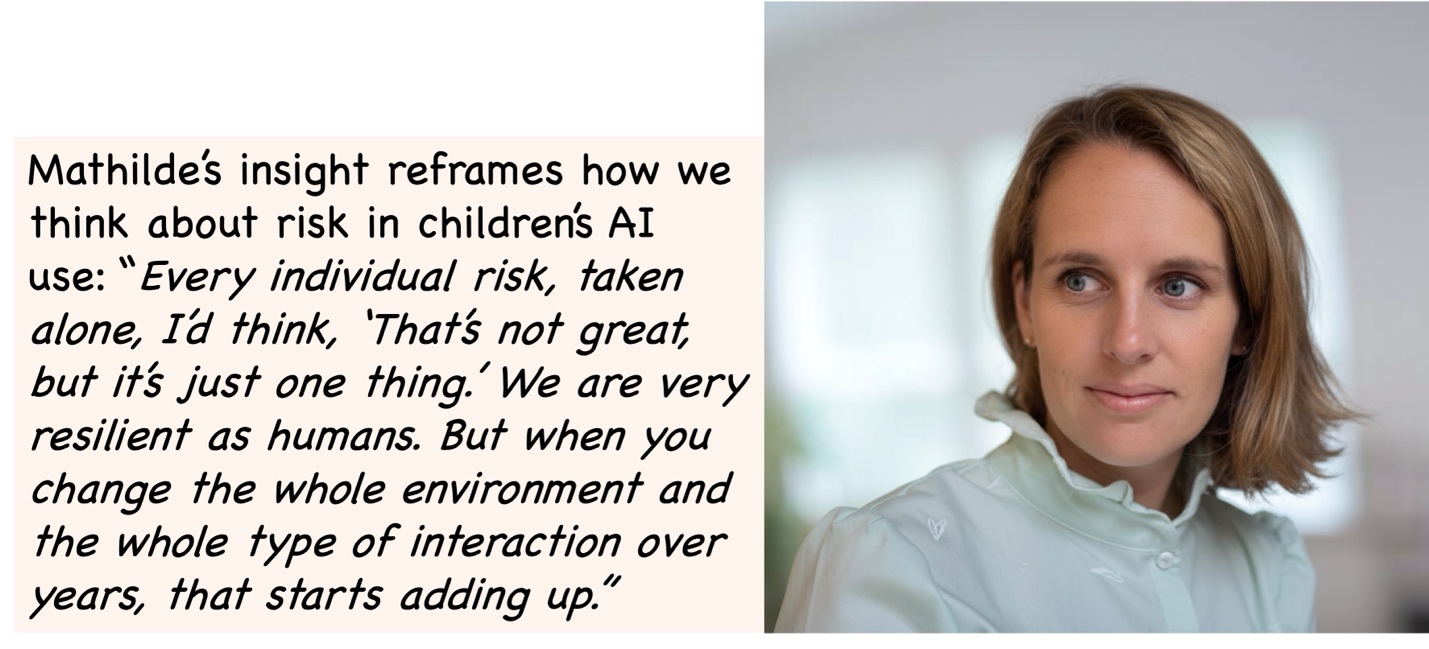
At the same time, the work crystallized one of her central worries. Many individual risks look small if you consider them one by one. She is most concerned about what happens when those small misalignments show up across many products and platforms, day after day, over years of development. We have very little historical perspective on what it means for entire childhood environments to be reshaped this quickly by adaptive systems.
Inside iRAISE: coordination that actually works
Everyone AI co-leads iRAISE with the Paris Peace Forum, a coalition focused on AI and children. This collaboration bridges science and education with international diplomacy. The goal is simple to describe and hard to execute: encourage strong industry standards for child safety, and work with governments so those standards inform policies and regulations that stick.
They advise organizations, including contributing to UNICEF’s revised AI Policy guidance and other international NGOs, offering both technical input and a child development lens. Equally important, they try to bring together actors who might otherwise work in parallel:
- Companies that design and deploy AI systems used by children
- Researchers and NGOs who study harms, benefits, and equity
- Governments and international bodies that set rules and norms
One design choice she emphasizes is the focus on collective commitments instead of relying on isolated good behavior. If a single company strengthens safeguards for children while competitors do not, that company may face pressure to relax its standards. A coalition model can help avoid a race to the bottom by making certain practices expected across the sector rather than optional extras.
To support this, iRAISE runs labs where people from research, NGOs, governments, and industry spend focused time together around specific problems. These sessions surface practical obstacles on each side and identify where someone else in the ecosystem could remove a barrier or share knowledge.
She is also interested in using AI itself to navigate the policy and safety landscape. Right now, practitioners routinely feel ten reports behind. She imagines tools that let a policymaker, designer, or teacher ask a concrete question and quickly see what existing guidance or evidence is most relevant, without reading everything ever written.
Guidance for families and educators
Her advice for families starts with something very basic and often uncomfortable: adults need some hands-on experience with AI themselves. It is hard to guide children around a technology you have never touched. The good news is that large language models are conversational. You do not need to know how to code to explore them together.
She suggests a few practical practices that families can adopt now:
- Try simple creative exercises together, such as using image generators. Ask a child to imagine a playful scene, then work together to describe it in enough detail that the system produces something close. This turns prompting into a lesson in language, perspective taking, and precision, rather than a secret tool a child uses alone.
- When AI is used around homework, treat it as a way to surface background knowledge when a child is stuck, not as an automatic essay writer. Ask the system for an overview, then model how to check what is true, what is missing, and what still needs the child’s own thinking.
- Talk explicitly about AI companions wherever they appear, including within messaging and social apps. Explain why those systems can feel so responsive and comforting, and why it still matters to practice relationships with real people. Crucially, keep the door open so a child can talk about these systems without feeling judged.
For schools and universities, she would like to see a clear shift in what counts as success. If education continues to focus almost entirely on outputs, it becomes rational for students to offload as much work as possible to AI. A healthier direction is to value process, reasoning, and growth, and to design assessments around what cannot simply be handed to a machine.
Across both home and school, she argues for standards and regulations that do not leave families to carry this alone. Clear rules for age-appropriate design, transparency when products are marketed for mental health, and baseline protections for children across platforms would ease the burden on parents and teachers who are already stretched thin.
My takeaways
Spending time with this conversation and her work, I came away with a few core lessons.
- Bridging intent and impact in industry.
Writing the report shifted her view of developers from “they do not care” to “many care but lack the bridges, tools, and support to act on that care.” A key theme in her work is how to create those bridges so conversations between researchers, builders, and policymakers are easier, and so well-intentioned teams can turn concern for children into concrete safeguards.
- Bridges are part of the safety system.
Coalitions, translation roles, and structured labs are mechanisms for turning research into real safeguards and for making it easier for companies and governments to do the right thing for children.
- Small risks can become large when multiplied across contexts.
Most individual interactions with AI will not make or break a childhood. The concern is when similar patterns repeat across the tools children use for learning, play, and social connection, year after year. We need frameworks that take that cumulative exposure seriously, not just headline-grabbing extremes.
In this interview, Mathilde provided a rare 360-degree view of child AI safety. Her path through a PhD in academia, clinical work with children and families, and hands-on experience in startups gives her an unusually complete view of what it takes to build safe and genuinely educational apps for kids. She can look at the same product through the eyes of a researcher, a clinician, and a product team that has to ship. Her insight ultimately asks us to notice structure, accumulation, and the everyday environments where children encounter these systems, and then to build the bridges that make safer choices possible at scale.
Thanks for reading Brain, AI, Child! Subscribe for free to receive new posts and support my work.