How Brittany Churchill is building AI-powered solutions for a global crisis hiding in plain sight
By Prof. Pilyoung Kim
Published: 2025-10-21
URL: https://pilyoung.substack.com/p/when-mothers-fall-through-the-cracks
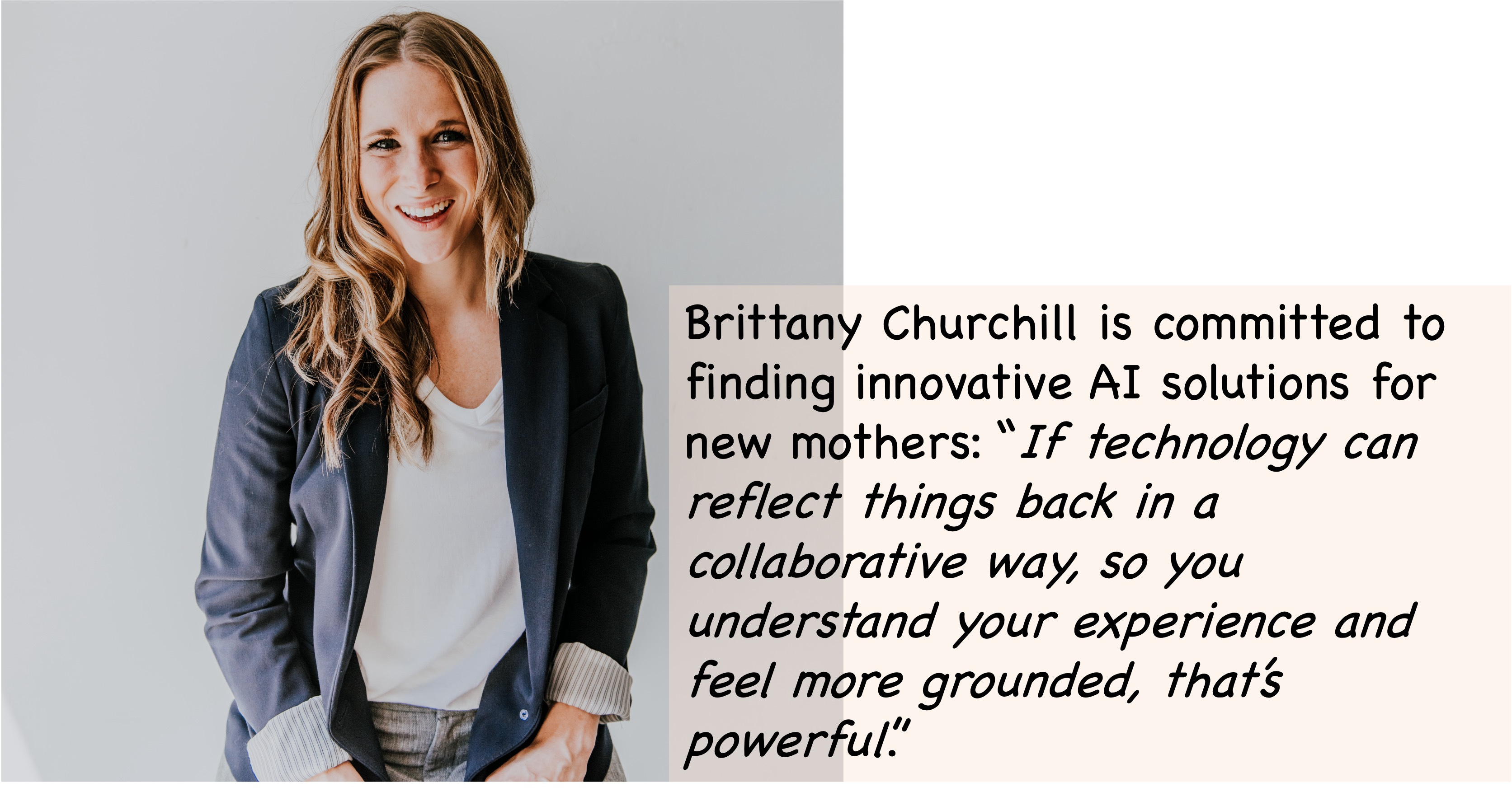
I met Brittany Churchill, founder of Strategies for Moms (www.strategiesformoms.com), through academic colleagues who are supporting her science-based AI work in maternal mental health. I am deeply impressed by her journey and her commitment to practical solutions for new mothers who silently struggle, and I share her story here with you.
The diagnosis that never came
Thanks for reading Brain, AI, Child! Subscribe for free to receive new posts and support my work.
Picture this: A mother brings her four-month-old to a routine well-child visit. The baby has dropped two percentiles on the growth chart, technically “failure to thrive.” The pediatrician asks a few cursory questions. The mother, exhausted and overwhelmed, doesn’t have the words for what she’s experiencing. She has normalized her distress. She got out of bed, made it to the appointment, checked the boxes. She’s “functioning,” so this can’t be depression, right?
The visit ends. No follow-up. No psychiatric consult. No recognition that a struggling infant can be a sign of a struggling mother.
For Brittany, that moment shaped the next 14 months, 14 months of trying, alone, to help her son gain weight while carrying an invisible burden that went undiagnosed. Only later did she realize what she had lived through: untreated postpartum depression.
“I had normalized my experience,” Brittany told me. “I had normalized and already made agreements with the dynamic inside my home and didn’t have any clue how it was impacting my life because ‘I’m a mom and I can do hard things.’ That’s the narrative.”
The global crisis we’re not talking about
Brittany’s story is not unusual, and that’s the problem. Through conversations with mothers across Europe, Asia, and North America, she heard the same refrain: maternal mental health is a global crisis, cutting across socioeconomic status, government systems, and family structures. Women feel distressed and overwhelmed; the system often fails to catch them.
“I really think the numbers are skewed… because moms don’t understand what they’re experiencing; there’s stigma; and there isn’t proper screening. The system’s broken. So much gets missed.”
“I told myself, I shouldn’t feel this way… Any inkling of issues, I dismissed.”
This self-silencing creates a feedback loop: mothers don’t seek help because they don’t recognize the need. Clinicians don’t intervene because mothers appear to be “functioning.”
From survival to solutions: Tap In Not Out
Brittany realized she was in survival mode. That realization led to her book Tap In Not Out, a practical framework for finding peace throughout the day rather than just enduring until bedtime.
Two strategies Brittany highlighted here:
• Be Unoffendable. Children’s disruptive behavior is developmental, not personal. Sleep-deprived parents can forget that.
• “Fracking.” Extract micro-moments of presence, 5 seconds to 5 minutes, throughout the day. Some evidence suggests that simple sensory exercises can reduce anxiety. Apply this to mundane, routine tasks to proactively cultivate present-moment awareness. These are the moments when we tend to check out mentally, yet by staying present we create a positive compounding effect across the day. The more we choose to be present, the more we build a life rooted in mindfulness.
Building the future: AI for maternal mental health intelligence
Brittany’s core insight was that many solutions must start from the inside. More appointments, better screening, and access to therapy are crucial, but mothers also need support that meets them where they are, in the flow of daily life, without adding to the mental load.
Enter AI.
“I started getting excited about AI because of the opportunity it provides for care we’ve never had before.”
Brittany assembled a research-driven team, including Dr. Jodi Pawluski, and launched an IRB-approved clinical study on parental mental load. They’ve built the first prototype of an AI-powered platform for maternal mental health intelligence.
What the platform aims to do
· Early intervention. Use predictive intelligence to identify risk and trigger human support before a crisis occurs.
· Measure the load. Create a mental, emotional, and physical “load index” using AI plus biometrics to reflect real-time strain.
· Reflect patterns back. Help mothers see what’s happening when everything feels like a gray fog, building emotional literacy, resilience, and self-leadership.
· Support practical skills. Assist with time management and executive functioning, the hardest tasks when you’re exhausted.
· Connect to care, effortlessly. Make clinical referrals and specialist connections without adding one more to-do.
· Enable community. Build peer support into the experience; sometimes knowing there are others with similar experience is the most therapeutic phrase.
Research first, then scale
Brittany insists on research-backed design, including IRB approval, study design expertise, and ongoing validation.
“The stakes are too high. I needed experts to build something real-life approved and research-backed.”
She’s defining a new category, maternal mental health intelligence, distinct from generic “femtech” (or female technology), and bridging practical support and clinical intervention.
Naming the elephant: AI safety and agency
Brittany shares the concerns about AI in mental health.
“I was skeptical. What happens if AI thinks for us?”
Her stance now centers agency:
“Humans adapt. The power is in how we choose to adapt.”
AI, in this framing, creates capacity, reducing overload so mothers can be present.
If AI can help with time management, executive function, and the “figuring-it-out” grind, it frees space for what matters most: being with your child, being with yourself.
My key takeaways
- Severe maternal distress is routinely missed. Depression, stress, and mental load are often unchecked and overlooked by clinicians and society, leaving many mothers to struggle in silence.
- Normalization masks harm. Mothers frequently “power through,” normalize distress, and feel guilty about negative emotions, so problems persist without help.
- From overwhelm to action. This lived reality propelled her to build a practical, scalable solution aimed at lowering mental load and improving postpartum mental health.
- Practical strategies first. The core playbook comes from what Brittany discovered and documented in her book, concrete, doable practices that fit into real daily life.
- AI as a capacity creator. AI is the engine that helps mothers implement those strategies consistently, enables early intervention when clinical help is needed, and lighten the mental load.
- Science-backed, clinically connected. The product is being built with research rigor and strong ties to clinical care, so mothers can bridge from self-support to treatment when needed.
- A lived-experience–led founder. I’m impressed by her trajectory, from mother, to author of a widely read book, to founder of an AI app, driven by a clear mission to support mothers.
From one mother’s story to a movement
I am deeply impressed by Brittany’s trajectory, missed diagnosis → author → AI founder, which maps a clear blueprint: lived experience + research rigor + human-centered technology. It is moving to see her passion to help other mothers who share similar experiences, grounded in insights gained from her own challenges. She is also taking action and thoughtful risks to find effective ways to use AI to empower mothers.
Her vision is a research-backed, AI-powered platform that measures mental load, builds emotional resilience and self-leadership, connects mothers to specialists and community, and improves maternal mental health for the next generation. I am excited to see how her work evolves, and to see her creation available to many mothers in the near future.
To learn more about Brittany and Strategies for Moms, see the resources below.
Website: www.strategiesformoms.com
Research Survey: https://s4mresearch.limesurvey.net/297922?lang=en
Email:
Thanks for reading Brain, AI, Child! Subscribe for free to receive new posts and support my work.