A Conversation with Researcher Rose Guingrich
By Prof. Pilyoung Kim
Published: 2025-10-13
URL: https://pilyoung.substack.com/p/how-human-likeness-in-ai-shapes-us
As a psychologist studying AI–human relationships, I keep coming back to two questions: What are people really getting from AI companions, and what are we giving up? Rose Guingrich (https://roseguingrich.com/) has been asking versions of those questions earlier than most. In her 2023–2024 work, she argues that the perception of human-likeness best predicts how AI companions affect us, including our sense of self and our social expectations. As she put it in our conversation, “The key mechanism is anthropomorphism, how human like people perceive the agent to be.” That framing set a research agenda that, in my view, offers some of the clearest insights into human and AI relationships.
Rose’s early insight, and why it matters now
Rose came to this topic through an interdisciplinary lens, including courses on personhood across cultures, AI, and transhumanism, where reading science fiction was a way to connect imagined AI to real development. That is when she began asking a simple but important question: as human like, non human agents become common, how will they change how people understand a person and social roles. When she started graduate study at Princeton, she moved into psychology to test mechanisms. She anticipated that AI would evolve faster than policy, so she wanted experiments that could inform regulation sooner.
That early focus now feels prescient. Rose’s view is that anthropomorphism, perceiving AI as human like, is a core mechanism that shapes interactions with AI and can carry over to interactions with people. The practical question is less “Is AI conscious?” and more “What happens when people treat it as if it were?” She highlights two forces that drive this: agent cues, for example or being told it has a sophisticated mind, and user predispositions, for example higher social needs. When those align, people start practicing human like behaviors with AI, and those behaviors can spill over into how they engage with others.
What users of AI companions actually report
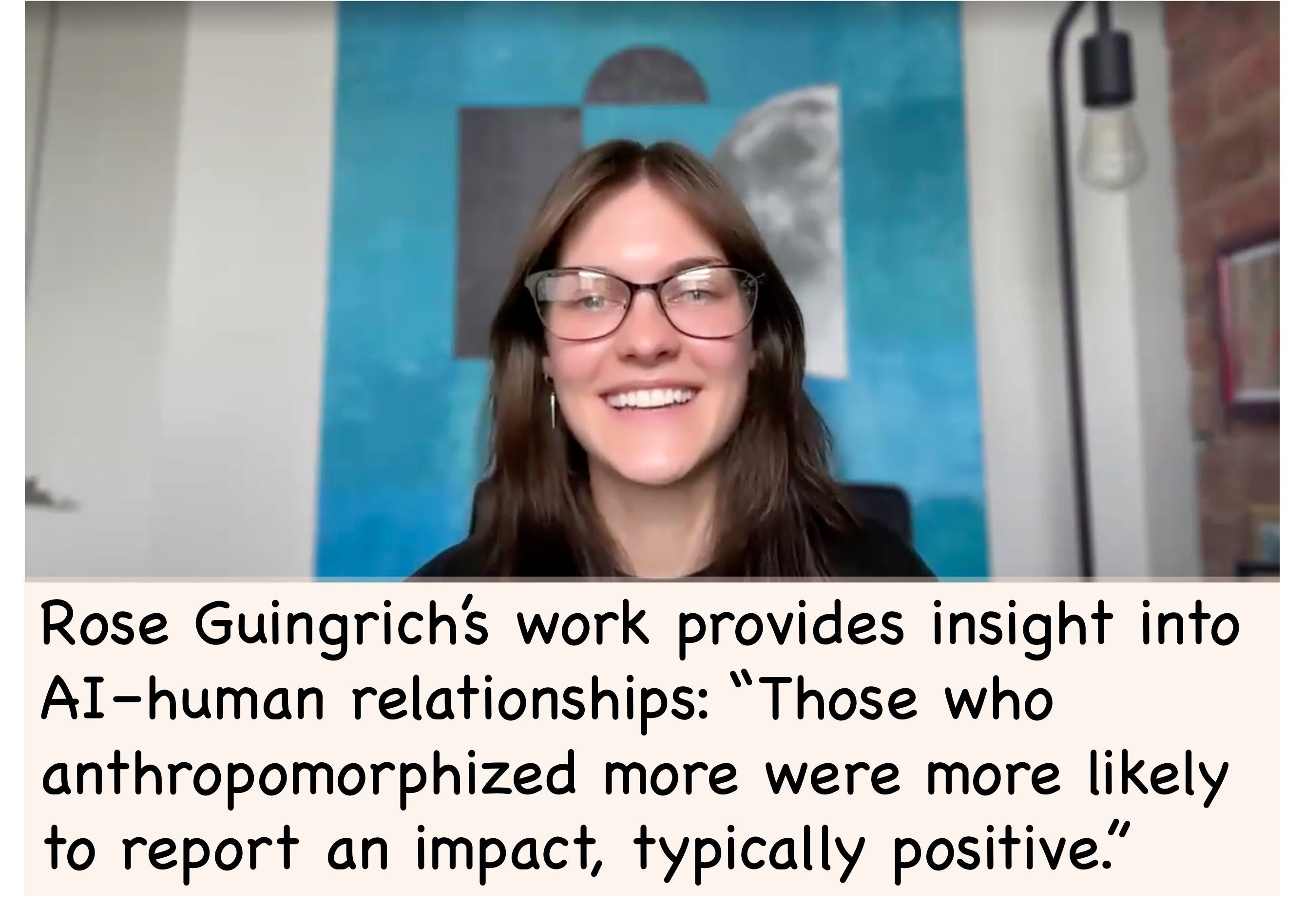
Rose and collaborators have compared people who use companion apps like Replika with those who do not. In the study “Chatbots as social companions,” users, on average, did not report that chatbots replaced or harmed their human relationships. People who perceived the chatbot as more humanlike were more likely to report an impact, typically positive. Many regular users also described social benefits, for example a safe space to practice conversation, disclose without judgment, or build confidence.
In a separate 21 day longitudinal study, participants were randomly assigned to use Replika or to a control group. Compared with controls, those assigned to interact with Replika did not show significant changes in social health or relationships over the study period. At the same time, participants with a greater desire for social connection tended to perceive the chatbot as more humanlike, and those who perceived it as more humanlike were again more likely to report an impact, typically positive.
Normalization: AI companions and general chatbots
Rose also sees a clear trend. Companion chatbots are more common and more socially capable, and many people now turn general purpose LLMs into everyday companions. Norms may be shifting toward talk to a chatbot first in certain moments. She expects an upsurge in companion use and more embodied companions as language and appearance cues grow more convincing.
Crucially, despite this growth, she does not see strong evidence of broad, population level harm or benefit to social or mental well being so far. The emerging picture looks more like normalization, AI companions becoming another tool people use in the flow of daily life. That said, she emphasizes that we still need more longitudinal data to be sure.
Who is most vulnerable, and what parents should know
Average trends do not erase risk for everyone. Rose highlights children and adolescents as especially important to protect proactively. Prior work suggests young children can treat voice agents as family members and attribute emotion, and teens, patient zero for growing up with chatbots, may form expectations, always responsive, always polite, that do not map well onto human relationships.
I asked her for practical advice for families. Her guidance, use trusted resources, remember that AI is more human like and engaging than prior tech, and keep an eye on social skill building, nudging kids back toward real world practice.
She also emphasizes that better regulation can reduce the burden on families. From a policy standpoint, she points to guardrails for vulnerable users, especially youth, and transparent standards when products are marketed for mental health. Privacy, age appropriate behaviors, and clinical claims all matter, and they require regulation that makes sense at scale.
Why psychology belongs at the center
Another early insight Rose offered the field is the central role of psychology in understanding human and AI relationships, well before many believed meaningful relationships with AI were even possible. In her 2023 blog post, A Call for a Psychology Subfield of Human and AI Interaction, she argues that AI and human interaction is inherently social and psychological. Psychology brings theory about mechanisms, how effects happen, not just whether they happen, which is crucial for designing mitigations and policy. I agree. If we want healthier AI companionship, mechanisms, measurement, and design from psychology is critical in guiding what we build and how we evaluate it.
What Rose is working on now, and what she predicts next
Beyond the lab, Rose founded Ethicom to translate evidence into practice, educating the public and advising teams on responsible, ethical AI design. Looking ahead, she anticipates further normalization, more embodied and robotic companions, and stronger anthropomorphism triggers from language and appearance. Although earlier expectations leaned toward many specialized agents, she sees users increasingly turning general purpose LLMs into all in one companions.
My takeaways
· Users report more benefits. People who already use AI companions, for example Replika, tend to see more social benefits than non users, consistent with Rose’s findings.
· Now part of ordinary life. AI companions, and even general purpose chatbots people use socially, are more common and more socially capable. So far, Rose does not see strong population level impacts, positive or negative, on social or mental well being. For many, this is simply normal life.
· Connection drives use. Our desire for social connection often leads to more interaction with chatbots and companions, and many users do gain support from those interactions.
· Risk is real for some. Children and adolescents can be vulnerable to over reliance. They need age appropriate safeguards and practical guidance for parents, not just warnings.
· Psychology belongs at the center. If we want healthier AI companionship, mechanisms, measurement, and design from psychology must guide what we build and how we evaluate it.
Overall, I appreciate Rose’s human centered approach and her work in clarifying how people may benefit from AI companionship and which psychological mechanisms, grounded in anthropomorphism and our need for social connection, are most relevant. She also keeps attention on children and other vulnerable users who need real safeguards. I am excited to see her future work inform policy and regulation that are pragmatic yet rigorous, guided by psychology research!
Thanks for reading Brain, AI, Child! Subscribe for free to receive new posts and support my work.