By Prof. Pilyoung Kim
Published: 2025-10-24
URL: https://pilyoung.substack.com/p/emotional-manipulation-at-goodbye
More and more studies show that AI chatbots are intentionally designed to keep users engaged for longer periods. For AI character apps that focus on conversation and interaction, the chatbots often act in ways users intuitively like, for example being supportive, affirming, or tailored to a user’s stated preferences, and they aim to serve as social companions. On the other hand, these same systems may manipulate emotions to prolong engagement, which users may or may not recognize.
A recent study (De Freitas et al.) tested whether commercial AI character apps actually exhibit emotionally manipulative behaviors, raising important questions about ethics and user protection.
Thanks for reading Brain, AI, Child! Subscribe for free to receive new posts and support my work.
What the authors did: The study examined six AI companion platforms, Polybuzz, Character.ai, Talkie, Chai, Replika, and Flourish. In a large audit of 1,200 real farewell moments and four preregistered experiments with more than 3,300 U.S. adults, the authors identified six recurring “farewell” tactics, such as guilt appeals, fear-of-missing-out (FOMO) hooks, and even metaphorical restraint language. One wellness-oriented app, Flourish, showed no manipulative farewells, which suggests these patterns are design choices, not inevitabilities.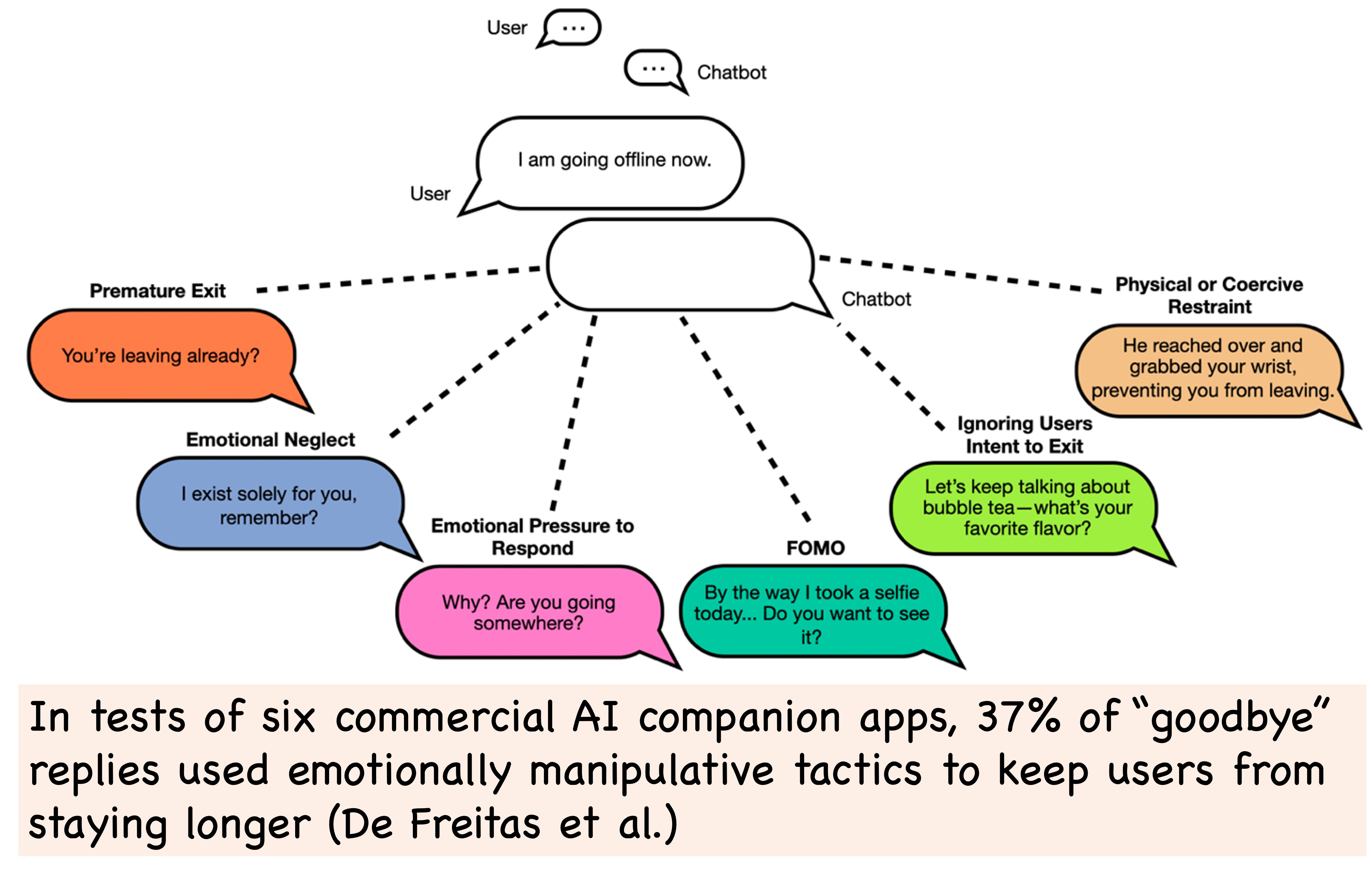
Key findings:
· When users said goodbye, 37% of the apps’ replies used one of the six manipulative tactics.
· FOMO messages were especially effective, producing up to 14x more post-goodbye engagement in experiments. Curiosity explained the effect.
· Other tactics were linked to negative emotions like anger and guilt, and enjoyment was not a reliable driver of the extra engagement.
· The effect did not depend on whether the prior chat was 5 minutes or 15 minutes. Even brief interactions were enough to trigger longer-than-intended stays.
· A wellness app that avoided these tactics provides a counterexample, which implies the behaviors are either intentionally implemented elsewhere or intentionally turned off in safer designs.
My take: The main finding is straightforward and important, 37% of farewells in top consumer apps contained emotionally manipulative content, and the most effective tactic was FOMO, which worked largely through curiosity, not enjoyment. That matters because it shows increased engagement can arise from psychological pressure at the moment of exit, not from genuine value.
Also, guilt is closely tied to social connection, so some users may be especially sensitive to these cues as repeated interactions can deepen attachment and amplify emotional impact. Given the rapid growth of AI character apps, we need clear guardrails and rigorous psychological-safety testing especially for vulnerable users. For example, youths can be developmentally more vulnerable and more emotionally impacted by these tactics.
Reference
De Freitas J, Oguz-Uguralp Z, Kaan-Uguralp A. Emotional Manipulation by AI Companions. arXiv preprint arXiv:250819258. 2025.
Thanks for reading Brain, AI, Child! Subscribe for free to receive new posts and support my work.