Unlock the shift from automation to simulation with my step-by-step playbook on digital-twin agents, strategic modeling, and organization-wide transformation
By Nate
Published: 2025-07-16
URL: https://natesnewsletter.substack.com/p/the-complete-141-page-guide-to-ai
Despite all the hype, most of us are getting AI agents wrong.
I’m serious. Look, I get it—the hype around AI is dizzying. Every week another "revolutionary" AI tool promises to automate away our inbox, our tasks, and maybe even our coffee breaks. It’s exciting, it’s overwhelming, and honestly, it's exhausting.
But here's the cold, hard truth: if you're using AI only to "do" tasks, you're barely scratching the surface of what’s possible—and you're missing the quiet revolution happening right under your nose. And you’re not alone! 95% of the people and companies I talk to are using AI agents primarily for doing right now. We are all (collectively) missing out by allocating so heavily to agents-that-do vs. agents-that-model.
We're stuck in a fundamental misunderstanding about AI agents. Everyone talks about them as glorified productivity assistants—faster writers, smarter chatbots, tireless task completers. Do do do. It’s all execution words. But that’s like using your smartphone solely as a flashlight: sure, it works, but you're ignoring the capabilities that change your life.
The real power—the game-changing, transformative potential—isn’t in AI agents that "do," but in AI agents that “model.”
What does that mean? It means using AI not to automate your emails, but to predict what will happen when you send them. It’s about shifting your perspective from simple task automation to strategic simulation—what’s called “digital twin” modeling. It’s creating virtual copies of your customers, products, and even entire markets, running scenarios that predict outcomes, pinpoint opportunities, and identify risks before they become crises.
Why is this so important?
Because in business (and our personal lives), decisions are everything. A single bad decision can cost millions, derail a promising product, or miss a market shift entirely. At home, a bad decision can cost a career, a house, a promising relationship. Depending on our responsibilities, we make 8-24 or so high impact decisions a year. What if we had a solid AI agent modeling framework for all of those decisions? How much better would our lives be? How much better would our companies operate? How much better would our products be? That’s why this guide exists.
And here’s the kicker: the traditional decision-making process is broken. It’s too slow, too risky, and often relies on gut feelings or partial data. But imagine if you could test your ideas against hundreds or even thousands of possible futures before you bet real money. Imagine compressing months—or even years—of learning into just days or hours. Imagine knowing exactly how customers would respond to a new feature, a pricing change, or a marketing campaign before you roll it out.
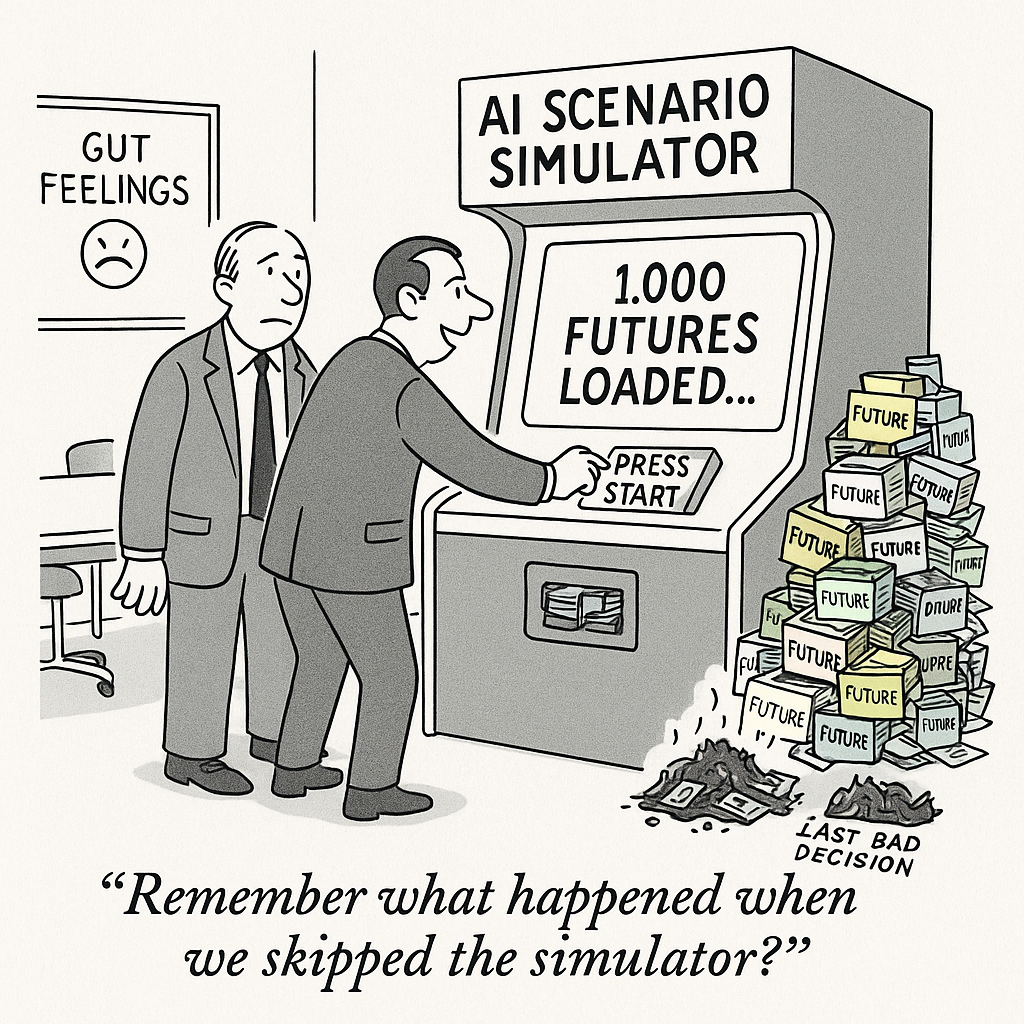
This is the quiet revolution we're facing, and it’s why the shift from "doing" to "modeling" is critical.
Inside this comprehensive 141-page guide (yes I did it again), I've unpacked exactly how you can leverage AI agents as digital twins to supercharge your decision-making and transform your organization. It’s divided into three indispensable sections:
- *Strategic Vision for Leaders
You'll get clear, concrete examples of how companies are already achieving 20-46% improvements in performance through modeling. Real-world case studies from industries like marketing, automotive, healthcare, and finance show how to calculate ROI, align stakeholders, and forecast the business impact. I lay out a roadmap, backed by data, to take you from basic persona modeling to advanced, society-scale simulations that let you confidently peer into the future.*
- *Practitioner's Guide for Builders
Here’s your step-by-step manual for turning vision into reality. I cover three robust approaches (prompting, fine-tuning, RAG), offer detailed workflows, advanced multi-agent simulation methods, and crucially, the 85% accuracy benchmark you need before deployment. Expect clear code examples, validation frameworks, and practical templates that turn abstract theory into hands-on implementation.*
- *Transformation Playbook for Change Leaders
This section addresses the toughest part of the puzzle: cultural and organizational change. You'll get a structured approach—from a rapid 30-day start to a comprehensive 3-year enterprise transformation plan. Plus, I tackle head-on the ethical considerations, governance structures, and cultural shifts required to move beyond hype into sustainable, scalable success.*
And the practical value? I didn't skimp. You’ll find ready-to-use templates, step-by-step guides, real-world case studies, and precise metrics. Consider this your HQ for translating sophisticated AI modeling techniques into tangible business results.
I’ve spent months researching, testing, refining, and consolidating these insights. This guide isn't speculation or hype—it’s battle-tested, pragmatic advice based on real-world results from companies around the world that are already putting this into practice. And it matters profoundly because the organizations that embrace modeling won’t just move faster—they’ll move smarter, more confidently, and far ahead of their competitors.
Yet despite this revolutionary potential, modeling remains overlooked precisely because it's subtle. Its value isn't immediately visible like automating an email or a task. When it works perfectly, it feels like nothing special happened at all—just a smart decision made smoothly. But that’s exactly the point: modeling quietly prevents disasters, uncovers hidden opportunities, and accelerates learning in ways simple automation never can.
So here's my challenge to you:
If you're serious about leveraging AI—if you're committed to outperforming competitors, avoiding costly missteps, and driving exponential growth—then you need to understand this shift. You need to move from seeing AI as a tool that merely "does" to one that vividly shows what could be.
You need to move from thinking of AI agents as “tools that help you do” to “thinking partners that help you compress time itself to make smarter decisions.”
I wrote this guide to give you one place for everything you need to make this shift a reality. It’s a big guide because what I’ve found experientially is that organizations really struggle with this transition without extra help. We need not just a tools list and an implementation plan, but a mindset shift. We need to start thinking about the future as partially computable, and that’s a new one for us as humans!
Because here's the thing: modeling doesn’t just beat doing—it transforms it. Your AI agents that do? They’ll do better if they have stronger decisioning allocating their resources. Getting AI agents-as-models right unlocks downstream benefits across your entire execution layer. And whether you operate at Fortune 100 level or are building on your own, there are practical ways to use AI agents as world modelers to improve your own decisioning.
The (simulated) world is waiting for you. Let’s get started…
Subscribers get all these newsletters!
What's in the Box: A Complete Guide to AI Agents as Digital Twins (all 141 pages!)
This comprehensive resource is a three-part masterclass on transforming your organization from task automation to strategic modeling using AI-powered digital twins. Here's what you'll find inside:
The Core Paradigm Shift The resource opens with a compelling argument: while most organizations use AI agents to do tasks (write emails, answer queries), the real power lies in using them to model people and systems. This shift from automation to simulation enables companies to test strategies, predict outcomes, and make decisions with unprecedented clarity.
Part 1: Strategic Vision (For Leaders)
The first section establishes the business case with concrete examples. You'll discover how companies achieved 20-46% performance improvements through digital twin modeling, learn about different types of twins (individual experts, customer segments, entire processes), and explore the science behind persona modeling. Key highlights include ROI frameworks showing 10x returns and a future roadmap spanning from today's text-based personas to tomorrow's society-scale simulations.
Part 2: Practitioner's Guide (For Builders)
The technical heart of the resource provides step-by-step instructions for building your first digital twins. You'll learn three implementation approaches (prompting, fine-tuning, RAG), discover advanced techniques like multi-agent simulations, and explore industry-specific workflows for marketing, healthcare, sales, product development, and finance. The guide includes code examples, validation frameworks, and the critical "85% accuracy benchmark" for knowing when models are good enough to deploy.
Part 3: Transformation Playbook (For Change Leaders)
The final section tackles organizational change with detailed implementation roadmaps: a 30-day quick start, 90-day pilot program, and 3-year enterprise transformation plan. It addresses ethical considerations, cultural transformation strategies, and provides extensive resources including templates, measurement frameworks, and connections to the broader digital twin community.
Practical Value Throughout, you'll find downloadable templates (in guides), guides (above), and real-world case studies (below and in the guides). This is intended to be your HQ for turning AI agents into modelers. I’ve written guides that help you turn abstract AI concepts into actionable business strategies, complete with metrics, governance frameworks, and solutions to common implementation blockers.
This isn't just another AI guide—it's a comprehensive 141 page blueprint for organizations ready to move beyond simple automation to harness AI's true potential: modeling alternate realities to make better decisions faster.
Want the entire guide in one big document? Here it is!
Want the Quick Start Guide first? Right here
The Market for AI Agents as Digital Twins—A 4 Page Overview
Not sure where to start? I have a handy reference guide to picking the playbook that’s right for you. You’ll find it at the end of this post as well.
The Quiet Revolution: Why Modeling Beats Doing in the Age of AI
A Fundamental Misunderstanding
The current discourse around AI agents reveals a profound misunderstanding of where their true power lies. Walk into any boardroom discussion about AI, scan the latest tech conference agenda, or browse through implementation case studies, and you'll find an overwhelming focus on agents as doers – entities that execute tasks faster, cheaper, and at scale. We celebrate the AI that writes our emails, codes our software, and answers our customer queries. We measure success in tasks completed and hours saved.
But this is like using a telescope as a hammer. We're so enamored with AI's ability to do that we're missing its far more transformative capability: to model.
The guide assembled here represents more than a comprehensive manual for building digital twins. It's a manifesto for a different way of thinking about AI agents – not as sophisticated task executors, but as reality simulators that fundamentally alter how we make decisions. This shift from doing to modeling isn't just another feature or use case. It's a paradigm change that unlocks something we've never had before: the ability to explore alternate timelines, compress time itself, and make decisions with a clarity that was previously impossible.
The Exponential Value of Alternate Timelines
When an AI agent executes a task, it saves linear time. When it writes an email that would have taken you 10 minutes, you gain 10 minutes. The math is simple, the value clear but bounded. But when an AI agent models a scenario – when it becomes a digital twin of your customer, your market, or your organization – something fundamentally different happens. You gain access to alternate timelines.
Consider what this means in practice. A marketing team can now run 50 campaigns in parallel universes, watching how each plays out with different customer segments before spending a single dollar in our timeline. A product team can launch features to thousands of digital customers, observing adoption patterns, identifying edge cases, and refining the experience through multiple iterations – all before writing the first line of production code. A CEO can test strategic decisions against market conditions that don't yet exist, preparing for futures that haven't arrived.
This isn't just faster decision-making. It's different decision-making. When you can explore alternate timelines, you're no longer choosing between options based on intuition or limited data. You're choosing between futures you've already seen unfold. The reduction in uncertainty is profound. The mitigation of risk is transformative. The ability to find optimal paths through complex decision spaces approaches something we might call prescience.
Time Compression as Competitive Advantage
The modeling paradigm does something else remarkable: it compresses time in ways that executing agents cannot. An AI that automates a process might turn a 10-hour task into a 1-hour task – a 10x improvement. But an AI that models can turn a 10-year market evolution into a 10-hour simulation – a nearly 10,000x compression.
This time compression isn't just about speed. It's about learning cycles. In traditional business, you launch a product, wait months or years to see how the market responds, learn from the results, and iterate. Each cycle teaches you something, but the cycles are agonizingly slow. With modeling agents, you can run hundreds of these cycles in the time it used to take to run one. Each simulation teaches the same lessons that reality would have taught, but without the cost, without the risk, and without the wait.
The compound effect is staggering. While your competitors are on their third iteration based on real-world feedback, you're on your three-hundredth based on simulated feedback. Your rate of learning, and therefore your rate of improvement, follows an entirely different curve. This isn't incremental advantage – it's exponential divergence.
The Disproportionate Gains of Modeling
Here's why modeling agents deliver disproportionate value compared to executing agents, a point conspicuously absent from most AI discourse:
Execution scales linearly, modeling scales exponentially. When you deploy an AI to handle customer service, each interaction saves a fixed amount of time and cost. Deploy it to twice as many interactions, get twice the value. But when you deploy an AI to model customer behavior, the value compounds. Each simulation informs the next. Patterns emerge that no single interaction could reveal. The thousandth simulation might unlock an insight that transforms your entire business model.
Execution automates the known, modeling discovers the unknown. An executing agent handles what you've already defined – answering questions you've anticipated, following processes you've mapped. It makes the familiar faster. A modeling agent explores what you haven't yet imagined – revealing customer needs you didn't know existed, identifying failure modes you hadn't considered, discovering opportunities in spaces you weren't even looking.
Execution saves costs, modeling generates revenue. The ROI of execution is typically measured in cost reduction – hours saved, headcount reduced, errors eliminated. The ROI of modeling is measured in new value creation – products that succeed instead of fail, markets entered with confidence instead of trepidation, strategies that anticipate rather than react.
Why This Point Remains Unmade
The question arises: if modeling agents are so transformatively valuable, why does the discourse remain fixated on execution? Several factors conspire to hide this truth:
Execution is visible, modeling is invisible. When an AI writes an email or answers a query, the output is tangible, immediate, measurable. When an AI prevents a bad decision through simulation, the avoided disaster never materializes. Success through modeling often looks like nothing happening – the product that wasn't launched because simulations showed it would fail, the market that wasn't entered because models revealed hidden risks, the crisis that didn't occur because scenarios anticipated it.
Execution is familiar, modeling is foreign. We understand automation because we've been doing it since the industrial revolution – replacing human labor with machines. But simulation at this scale and fidelity? That's genuinely new. We lack the mental models and organizational structures to fully grasp and govern it.
Execution is tactical, modeling is strategic. It's easier to justify an AI that will handle 1,000 customer tickets per day than one that might reveal a new business model. The former has clear, immediate ROI. The latter requires vision, patience, and a tolerance for exploring what might be rather than optimizing what is.
The Broader Implications
The shift from agents as doers to agents as modelers represents more than a technological evolution – it's a philosophical transformation in how we relate to time, uncertainty, and decision-making itself. We're moving from a world where we must live with our choices to one where we can preview them. From a reality where time flows in one direction to one where we can fast-forward, rewind, and explore parallel tracks.
This capability raises profound questions. If we can simulate the outcomes of our decisions with high fidelity, do we bear greater moral responsibility for our choices? If we can compress decades of market evolution into hours of simulation, how does that change competitive dynamics? If we can model human behavior accurately enough to predict it, what does that mean for free will, privacy, and human agency?
The guide presented here doesn't just explain how to build digital twins. It provides a framework for thinking about these questions, for navigating this new landscape where the boundary between simulation and reality becomes increasingly porous. It recognizes that the organizations that master modeling won't just outperform their competitors – they'll be playing an entirely different game.
A Call to Action
The future belongs not to those who can execute fastest, but to those who can model most clearly. Not to those who can do the most, but to those who can see the farthest.
The tools exist today. The techniques are proven. What's needed is a shift in mindset – from asking "How can AI do this for me?" to asking "How can AI show me what's possible?"
This guide represents more than the sum of its sections. It's an invitation to join the quiet revolution, to be among the first to truly understand that in the age of AI, modeling beats doing every time. Not because doing isn't valuable, but because knowing what to do – with the clarity that only simulation can provide – is transformative.
The organizations that grasp this truth won't just make better decisions. They'll make different decisions. They'll operate with a kind of strategic omniscience that will seem like magic to those still trapped in the execute-first paradigm. They'll compress time, explore futures, and navigate complexity with a confidence born from having seen what others can only guess at.
This is the real revolution. Not agents that do, but agents that show us what could be.
The Evidence and The Skeptics: Real-World Proof of the Modeling Revolution
From Philosophy to Practice: Where Modeling Already Wins
The shift from agents as doers to agents as modelers isn't theoretical—it's happening now, delivering results that validate every philosophical claim. Consider these quiet revolutionaries who've already crossed the divide:
Renault's Time Machine. The French automaker doesn't just use digital twins to automate design tasks. They've built comprehensive vehicle simulations that compress entire development cycles. The result? A 60% reduction in development time and a stunning compression from the industry-standard four years to just 24 months for model-to-market. This isn't about doing CAD drawings faster—it's about simulating thousands of design iterations, crash scenarios, and manufacturing approaches in parallel timelines. Each virtual prototype teaches them what a physical prototype would have, but in days instead of months, at pixels instead of millions in bent metal.
BMW's Infinite Factory. The Bavarian manufacturer has created what they call a "Virtual Factory"—not to automate production, but to model it. Plant managers can now test thousands of line-change permutations overnight. What once required "several weeks of physical re-rigging" happens with a click. But here's the key: they're not just automating the planning process. They're exploring alternate factory configurations that would have been too risky or expensive to try in reality. They're finding optimal layouts that no human planner would have imagined because they can simulate the complex interactions of workers, robots, and parts flows through countless scenarios.
Formula 1's Crystal Ball. Perhaps nowhere is the modeling advantage more visceral than in F1, where teams now simulate every rival's pit strategy in real time, pre-playing outcomes lap-by-lap. They're not using AI to execute pit stops faster (that's still very much a human art). They're using it to model what will happen under different strategic choices—when to pit, which tires to use, how rivals might respond. This informational edge shows up on the podium. The teams that model best, win most.
The Marketer's Multiverse. Forward-thinking marketers have quietly shifted from campaign automation to campaign simulation. They're running hundreds of campaign simulations before spending a dollar, moving beyond simple A/B tests to explore a vast space of creative options, timing strategies, and audience combinations. There are entire apps for this now. The traditional approach—launch, learn, iterate—is being replaced by simulate, optimize, then launch with confidence. One media company I’ve talked with reported testing multiple dozens of campaign variants overnight through digital twin audiences, identifying winners that delivered double digit percentage higher engagement than their traditional planning process would have produced.
The Compounding Evidence
The numbers tell a story that execution-focused metrics miss entirely:
Market Adoption Acceleration. Gartner projects that over 40% of large enterprises will run persistent digital twins by 2027. That was back in 2023, and it’s more true now than it was then. But here's the crucial detail: enterprises are not adopting these for cost savings—they're adopting them for revenue discovery. New products, new markets, new business models that emerge from simulation. The ROI isn't in doing things cheaper; it's in finding things you wouldn't have found at all.
Learning Rate Divergence. The math is inexorable. If your competitor learns three times a year from real product launches while you learn three hundred times a week from simulations, the knowledge gap compounds exponentially. This isn't "operational excellence"—it's strategic time arbitrage. You're literally operating with information from the future, seeing the board ten moves ahead while others debate their next move.
Value Multiplication. Because each simulation feeds the next, insights compound. The thousandth run can expose nonlinear breakpoints—pricing cliffs where demand suddenly drops, capacity choke points where systems fail, interaction effects between features that create unexpected value. These insights are invisible to linear analysis but become obvious in simulation. They're the "aha" moments that reshape entire strategies.
Steel-Plated Objections (And Why They're Wrong)
Let's address the elephant in the room: most energy is going into figuring out how AI agents execute tasks because that is vastly easier than figuring out how use agents to improve decisioning through modeling. It’s hard to think about how you think. It requires a deeper level of change than installing AI-agents-as-doers requires (and they’re not easy, either). Here's how I think about some of the objections I tend to hear most often:
"Models are only as good as the data"
The Objection: Garbage in, garbage out. If our data is flawed, our simulations will be fantasy. We'll make confident decisions based on false premises.
The Reality: This is true—and completely solvable. The solution stack that works in practice has three layers: First, rigorous data provenance tracking so you know exactly what assumptions underpin each simulation. Second, continuous back-testing against real outcomes to calibrate model accuracy. Third, Bayesian calibration loops that automatically down-weight stale or inaccurate signals.
F1 teams and BMW both run digital-twin/real-world reconciliation after every race or production cycle. When reality diverges from simulation, they don't abandon the model—they improve it. The model gets better over time, approaching ever-higher fidelity. Meanwhile, companies relying on intuition alone never improve their decision-making accuracy at all.
"Simulations breed false confidence"
The Objection: People will treat model outputs as gospel, making bold bets based on simulated certainty that doesn't exist.
The Reality: Only if you use simulations wrong. Also, you were probably over-confident in your lack of data anyway. Leading practitioners use models to bound probability distributions, not to predict exact outcomes. They run thousands of scenarios to understand the range of possibilities, then design strategies robust across many futures. Think of it as Lean Startup methodology, but with a thousand virtual MVPs explored before you build the first real one.
The key is cultural: teams must understand that models show what could happen, not what will happen. They're tools for expanding option space and stress-testing decisions, not crystal balls. Used correctly, they increase humility by showing how many ways things could unfold.
"Compute costs will explode"
The Objection: Running thousands of simulations sounds expensive. The cloud bills alone could eat any ROI.
The Reality: Today's pay-as-you-go GPU fleets plus advances in surrogate modeling mean marginal simulation cost approaches zero once the twin is trained. Renault's €26 million simulation center pays for itself after avoiding just two physical prototypes. The compute cost of running a marketing simulation might be $100, but it replaces focus groups costing $100,000.
Moreover, the cost curve favors simulation. Computing gets cheaper every year. Physical prototypes, real-world tests, and human time get more expensive. The economic logic is inevitable.
"Our organization isn't ready for this"
The Objection: Our culture is built around execution and deliverables. People won't understand or value prevention and optimization through simulation. This is the hardest one! It is a C-suite decision to change this, and I’ve rarely seen it change.
The Reality: Change the incentives. Tie bonuses to decision quality (measured after outcomes are known) rather than activity metrics. When leaders see that avoiding a bad $50 million launch counts as a win—and shows up in their compensation—culture flips fast.
Start small. Pick one high-stakes decision and show how simulation could have improved it. Build credibility through quick wins. Soon, teams will demand simulation capabilities because they'll see colleagues making better decisions with less risk.
The Practical Path Forward
For those convinced by philosophy but seeking pragmatic first steps:
Start with a Micro-Twin. Don't attempt to model your entire business on day one. Pick a single, well-understood process or customer segment. Build a twin around one KPI—perhaps customer churn or demand forecasting. Prove value in a bounded domain before expanding.
Establish Calibration Discipline. From day one, implement rigorous comparison between simulated predictions and real outcomes. Make this visible. Celebrate when models are wrong—it's learning that makes them better.
Create New Metrics. Traditional KPIs measure execution. You need new ones for modeling: Simulation-Adjusted Decision Velocity (how fast you can make high-quality decisions), Expected-Value Uplift per Simulation (how much each modeling exercise improves outcomes), Model Fidelity Trending (is your twin getting more accurate over time?).
Address Ethics Early. Model bias, privacy concerns, and the potential for counter-factual manipulation are real issues. Include a "red-team the twin" process where skeptics try to break or misuse models. Build governance before you need it.
The Ultimate Test
Here's how you know the modeling revolution is real: Bad simulations lead to bad decisions faster. Good simulations lead to near-prescient strategy.
The companies embracing modeling aren't just making better decisions—they're making different decisions. They're choosing paths that execution-focused competitors can't even see. They're compressing decades of learning into months of simulation. They're turning time itself into a competitive weapon.
The evidence is mounting. The tools exist. The early adopters are pulling ahead. The question isn't whether modeling beats doing—it's whether you'll be among the first to truly grasp this advantage or among the last to wonder how your competitors seem to know the future.
The quiet revolution isn't quiet anymore. It's time to choose your side.
Which Part Should I Read? Your Navigation Guide
Quick Role Finder (30 seconds)
I am a...
- CEO/C-Suite Executive → Start with Part 1
- Technical Lead/Data Scientist → Start with Part 2
- Program/Project Manager → Start with Part 3
- Product Manager → Read Part 1 (Sections 1-3), then Part 2 (Section 6)
- Marketing Leader → Read Part 1 (Sections 1-3), then Part 2 (Section 6: Marketing Applications)
- Sales Leader → Read Part 1 (Section 3), then Part 2 (Section 6: Sales Applications)
- HR/L&D Leader → Read Part 1 (Sections 1-3), then Part 3
- Innovation/Strategy Lead → Read all of Part 1, then Part 3 (Section 9)
- Individual Contributor → Start with Part 2 relevant to your function
- Consultant/Advisor → Read Part 1 first, then others based on client needs
Goal-Based Navigator
I need to...
Make the Business Case
- Read: Part 1 (especially Section 3: The Business Case)
- Time: 45-60 minutes
- Key outputs: ROI examples, success metrics, case studies
Build My First AI Twin
- Read: Part 2 (start with Section 4)
- Also helpful: Quick Start Guide (separate document)
- Time: 2-3 hours
- Key outputs: Step-by-step instructions, templates, code examples
Transform My Organization
- Read: Part 3 complete, then Part 1 for vision
- Time: 2-3 hours
- Key outputs: Roadmaps, change management strategies, governance frameworks
Understand the Technology
- Read: Part 1 (Section 2), then Part 2 (Sections 4-5)
- Time: 2 hours
- Key outputs: Conceptual understanding, technical foundations
Address Concerns/Risks
- Read: Part 3 (Section 8: Ethics), then Part 1 (Section 3: ROI)
- Time: 1 hour
- Key outputs: Risk mitigation strategies, ethical guidelines
Situation-Based Guide
"We're just exploring AI possibilities"
- Start with: Part 1 (complete)
- Next: Executive Summary
- Why: Get inspired by possibilities before diving into details
"We have budget and need to execute"
- Start with: Part 2 (Section 4) and Quick Start Guide
- Next: Part 3 (Section 11: Implementation Roadmaps)
- Why: Move quickly from decision to action
"We tried AI and it didn't work"
- Start with: Part 3 (Section 9: Building a Modeling-First Organization)
- Next: Part 2 (Section 7: Measuring Fidelity)
- Why: Identify what went wrong and how to fix it
"We need to convince skeptical stakeholders"
- Start with: Part 1 (Section 3: Business Case)
- Prepare: Executive Summary as leave-behind
- Why: Hard numbers and peer success stories convince
"We're scaling from pilot to production"
- Start with: Part 3 (complete)
- Review: Part 2 (Section 5: Advanced Techniques)
- Why: Scaling requires organizational change, not just tech
Recommended Reading Paths
Path 1: Executive Fast Track (2 hours)
- Executive Summary (10 min)
- Part 1, Section 1: The Hidden Revolution (20 min)
- Part 1, Section 3: The Business Case (30 min)
- Part 3, Section 11: Implementation Roadmaps - Year 1 only (20 min)
- Part 1, Section 10: Future Vision (20 min)
Path 2: Technical Implementation (4-5 hours)
- Part 2, Section 4: Building Your First Digital Twins (60 min)
- Quick Start Guide (30 min hands-on)
- Part 2, Section 6: Industry Applications - your sector (45 min)
- Part 2, Section 7: Measuring Fidelity (30 min)
- Part 2, Section 5: Advanced Techniques (45 min)
- Part 3, Section 12: Resources (reference as needed)
Path 3: Organizational Transformation (3-4 hours)
- Part 1, Sections 1-3: Foundation (90 min)
- Part 3, Section 9: Building a Modeling-First Organization (45 min)
- Part 3, Section 11: Implementation Roadmaps (60 min)
- Part 3, Section 8: Ethics and Best Practices (30 min)
Path 4: Industry-Specific Deep Dive (2-3 hours)
- Executive Summary (10 min)
- Part 1, Section 3: Business Case (30 min)
- Part 2, Section 6: Your Industry Application (45 min)
- Part 3, Section 11: 30-Day Quick Start (30 min)
- Part 2, Section 4: Building Twins - relevant sections (45 min)
Cross-Reference Guide
When reading Part 1, you might also want:
- Concrete examples → Part 2, Section 6 (Industry Applications)
- Implementation timeline → Part 3, Section 11 (Roadmaps)
- Quick proof of concept → Quick Start Guide
When reading Part 2, you might also want:
- Business justification → Part 1, Section 3
- Ethical guidelines → Part 3, Section 8
- Organizational readiness → Part 3, Section 9
When reading Part 3, you might also want:
- Technical requirements → Part 2, Section 4
- Vision to inspire teams → Part 1, Section 1
- Future possibilities → Part 1, Section 10
Time-Constrained Options
Have 30 minutes?
- Read: Executive Summary + Part 1, Section 1
- Outcome: Understand the paradigm shift
Have 1 hour?
- Read: Executive Summary + Part 1, Section 3 (Business Case)
- Outcome: Make go/no-go decision
Have 2 hours?
- Read: Part 1 complete
- Outcome: Full strategic understanding
Have 1 day?
- Read: Your role-specific path + Quick Start Guide
- Outcome: Ready to begin implementation
Special Situations
Board Presentation Due:
- Part 1, Section 3 + Executive Summary
- Create slides from "By the Numbers" callouts
Pilot Project Starting:
- Quick Start Guide + Part 2, Section 4
- Keep Part 3, Section 11 handy for reference
Addressing Concerns:
- Part 3, Section 8 (Ethics) + Part 1, Section 3 (ROI)
- Prepare FAQ from common pitfalls sections
Training Team:
- Part 2 relevant sections + create workshop from Quick Start
- Use Part 3, Section 9 for culture change
Remember: This guide is designed to be read in parts or as a whole. Start with what's most urgent for your situation, but consider reading all parts eventually for complete mastery. The Executive Summary and Quick Start Guide are always good starting points regardless of your role.
Final Thoughts
As we stand on the cusp of this quiet revolution, the implications stretch far beyond individual businesses or industries. The ability to simulate decisions and foresee their outcomes doesn’t just reshape organizations—it transforms societies. When we make better decisions at scale, we unlock efficiencies, reduce waste, and prevent harm in profound ways.
Imagine healthcare systems predicting and preventing outbreaks rather than merely responding. Picture urban planners who model the futures of entire cities, reducing congestion and pollution before problems even arise. Think about educators who tailor learning precisely to every student's needs, ensuring no one falls behind. Each good decision compounds, multiplying benefits across communities, economies, and ultimately, generations.
Yes, these are big dreams. I’m not saying we’ll unlock all these dreams tomorrow. But all of the really interesting innovations we’ve had as a species started as big dreams. And sometimes progress came faster than we thought! Never forget that the New York Times was pooh poohing flight while the Wright Brothers were working on the concept for their airplane.
Progress can happen quickly, and one of the characteristics I’ve learned to respect about the AI revolution we’re living through is just how fast things can change. I think we’re at the very bleeding edge of AI agents as modelers, and I’m excited to see what’s up ahead.
But as powerful as this capability is, it carries enormous responsibility. Modeling requires transparency, ethical stewardship, and constant vigilance against bias or unintended consequences. We must ask ourselves how we ensure these tools remain fair, accessible, and accountable.
The decision-making revolution is not just technological—it's profoundly human. It demands we become wiser custodians of the future, using our newfound clarity not merely for competitive advantage, but to build a society that anticipates, adapts, and thrives. Ultimately, how we leverage this extraordinary power will define our collective future. Let’s choose wisely.
I make this Substack thanks to readers like you! Learn about all my Substack tiers here
Links: AI Agents as Modelers and Digital Twins
Below is a handpicked list of 15 high-quality resources that align with and extend the paradigm shift discussed here—from AI agents as task automatons to strategic modelers and digital twins for business transformation. The collection blends research, industry analysis, and implementation guides so you get a complete picture of what other thought leaders are saying on this.
Thought Leadership & Strategic Vision
- Understanding AI Agents: From Task Automation to Strategic Modeling
Explores the core idea of moving beyond productivity to deeper system simulation and digital twin modeling.
- The Role of AI in Strategic Decision Making
Harvard Business Review's look at how organizations use AI to model complex choices, reduce risk, and outcompete through decision intelligence.
- Strategic AI: From Automation to Simulation
Gartner's deep dive into why simulation and model-driven agents represent a new, transformative competitive advantage.
Practical Implementation & Technical Deep Dives
- Building AI Agents for Complex Decision-Making
Academic perspective on building, validating, and deploying multi-agent modeling systems.
- AI Agents as Digital Twins: The Future of Predictive Analytics
A practical discussion on using AI agents as business and customer digital twins to run future scenarios.
- How AI is Revolutionizing Simulation and Modeling
MIT Technology Review's reporting on advanced modeling, scenario-planning, and digital simulation in various sectors.
- The Quiet Revolution of AI Modeling
Explores why the impact of modeling agents is exponential and often overlooked, with rich real-world illustrations.
- Digital Twins in Industry: Case Studies and Applications
Real examples from IBM on how factories, supply chains, and products benefit from digital twin-driven simulations.
Business Impact & Case Studies
- Digital Twins and AI: Transforming Business Decision-Making
Deloitte's overview of digital twins supporting rapid, low-risk innovation, including automotive and healthcare references.
- AI Agents Beyond Automation: Modeling the Future
VentureBeat features use cases showing how modeling agents unlock previously unobtainable business insights.
- AI Agents as Reality Simulators
Nature Machine Intelligence article on simulating human/market behavior and ethics in reality modeling at scale.
Future Trends, Governance & Ethics
- The Future of AI Agents: Modeling and Decision Intelligence
TechCrunch's guide to the next generation of agents as simulation engines for organizations and products.
- Ethics and Governance in AI Modeling
WHO's comprehensive guidance on ethics and governance for AI in health, addressing bias, decision-making transparency, and responsible deployment of large multi-modal models.
- From Doing to Modeling: The Next AI Paradigm
Fast Company explores the shift from automation to modeling as the defining business advantage of the coming decade.