A hands-on playbook for embedding your brand in ChatGPT, Claude & Google AI Overviews before competitors do
By Nate
Published: 2025-07-17
URL: https://natesnewsletter.substack.com/p/beyond-seo-winning-visibility-in
This isn't an article about SEO—it's a wake-up call.
Whether you're a seasoned CMO or a college student hustling on LinkedIn, the game has changed, and most people haven’t noticed yet. But if you're reading this, you're already ahead. You sense something is off. Google feels different, traffic is slipping, and suddenly you're competing not just with other websites, but with an entirely new class of competitors: AI models. Welcome to the new reality, where your biggest reader isn't even human.
Yes it’s AI. That’s why this matters, and why the stakes couldn't be higher.
First principles first: what fundamental shift is happening? Andrej Karpathy, former head of AI at Tesla and a leading thinker in machine learning, recently highlighted a profound shift: we are no longer writing for humans, or even traditional search engines. We are writing for the attention of large language models (LLMs).

Your beautifully crafted content, your meticulously researched blog posts, your strategically placed keywords—they've become training data. You are literally educating Google's AI on how to answer questions without sending anyone to your website. Your hard-earned traffic? It's vanishing into summaries generated by machines.
Think about it this way: Imagine spending months perfecting your brand message only to realize you're invisible—not because your SEO is bad, but because an AI decided you're not relevant enough to mention. Your brand doesn't just need clicks anymore; it needs to become part of the AI's conceptual memory.
Key Insight: We're now competing for "parameter space," the neural connections inside these giant models. If your brand (personal or company brand) isn't embedded as a clear, consistent, and authoritative signal, you risk fading into digital obscurity.
Whether you're running a billion-dollar enterprise or simply building your personal brand, these lessons apply directly to you. Every post you share on social media, every blog you write, every podcast appearance you make—they’re opportunities to imprint your identity clearly in the AI’s understanding. You need to think like a neural network. What concepts does your personal brand stand for? Are you consistently communicating them in a way that an AI model would recognize and reinforce?
Why should you care about AI's "attention," even as an individual? Because personal branding has always been about visibility, credibility, and authority. Previously, this meant ranking on Google's first page or growing a LinkedIn following. Now, the alpha is in ensuring your unique insights and identity get encoded in the AI models that millions of people are already using to make critical decisions—from professional opportunities to purchasing choices.
Let's bring this down to earth. Imagine someone asking ChatGPT or Claude, "Who are the top product managers specializing in [name your vertical specifically]?" If your name isn't immediately referenced, you've missed an enormous opportunity.
I’m not trying to overpromise here: I won’t tell you that if you magically do these 10 things you’ll outrank Sam Altman on AI strategy. The riches are in the niches—figure out what parameters you can grab with authority that are specific, and go get the LLM to notice you.
Conversely, if you've diligently structured your content—clearly defining your niche, repeatedly demonstrating expertise, and actively participating in relevant discussions—you've carved out your own space in the model’s neural network. This isn’t future speculation; this is happening right now.
So, here's the brutal truth: if you aren’t actively shaping how AI perceives you or your brand, you’re passively allowing your digital identity to be defined by randomness or competitors. Every inconsistency in your messaging becomes noise, making it harder for AI to clearly see you. And once these models have formed an opinion—positive, negative, or indifferent—it becomes exponentially harder to change that perception later on.
Why does it get harder to change LLM perceptions over time? Because of a concept called parameter lock-in: model preferences solidify as model generations successively reinforce brand perceptions over time. I dive in much deeper below…
This article matters because it will show you precisely how to adapt to this new paradigm. It’s your playbook for getting noticed by LLMs.
Inside, you'll learn how to structure your content not just for clicks, but for clarity, consistency, and computational understanding. You'll discover practical techniques to align your brand across digital spaces, creating signals that AI can’t ignore. You'll understand how even small-scale application of these methods to your personal content can significantly amplify your digital presence.
The landscape is shifting dramatically. The brands and individuals that grasp these insights now will reap enormous rewards. Those who ignore this shift risk digital invisibility. The old rules of SEO are crumbling, replaced by a new reality that demands we earn our spot not just in search results, but in neural memory.
Are you ready to stop writing for clicks and start writing for AI’s attention?
The future of discovery, visibility, and digital identity is being shaped right now. You have a choice: become a parameter, a fixed and essential reference in the AI’s mind—or become background noise.
This is your definitive guide to winning in the AI age. Let's dive in.
Subscribers get all these newsletters!
Section I: The Disappearing Internet
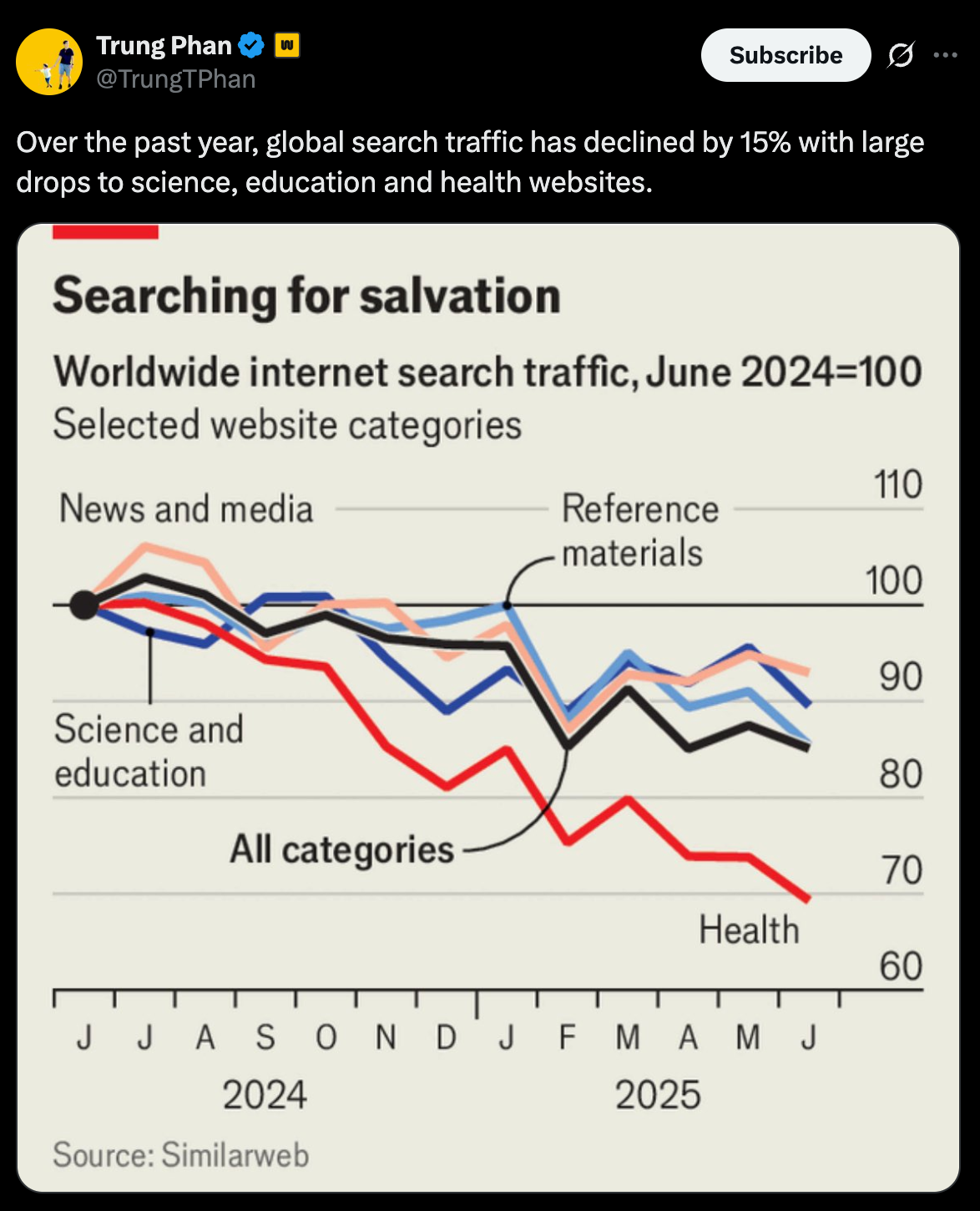
Fifteen percent of Google's clicks vanished last year. Poof. Gone. Like your productivity after discovering Reddit.
Not slowly bleeding out—vanishing. And before you blame ChatGPT for eating the internet, let me stop you right there. ChatGPT commands maybe 1-2% of search traffic. That's it. Google still processes 9 billion searches a day, absolutely crushing every other platform. So where did those clicks go?
They're being devoured by something hiding in plain sight: those innocent-looking AI summaries at the top of Google's results. You know, the ones you probably scroll past without thinking. Turns out everyone else is reading them and never clicking through.
Medical queries? Down 30%. Think about that. Nearly a third of people asking "what's this weird rash?" get their answer from Google's AI and bounce. No click. No ad impression. No chance to upsell them that premium rash cream. Should that scare you? It scares the hell out of me. We're trusting medical advice to the same AI that sometimes thinks the Golden Gate Bridge was built by aliens.
But here's what really keeps me up at night—it's not the hypochondriacs we're losing. The sophisticated buyers, the technical decision-makers, the people with actual budgets? They're already gone. They're asking Claude for vendor comparisons. They're getting procurement advice from ChatGPT. They're treating Perplexity like their personal industry analyst.
These aren't tire-kickers googling "what is CRM?" These are people asking "compare Salesforce vs HubSpot for 500-person B2B SaaS with complex sales cycles." The high-intent, high-value searches that actually matter. And they're happening in AI chat interfaces where your SEO strategy is about as useful as a chocolate teapot.
Here's the brutal truth: That 2,000-word pillar content you spent weeks perfecting? That comprehensive guide your CEO loves? It's not driving traffic anymore. It's training data. You're literally teaching Google's AI how to answer questions without sending anyone to your site.
Your content strategy just became an unpaid internship for machines.
We built the internet on a simple bargain—you search, we answer, you click, everyone wins. That bargain is broken. The algorithms are reading everything and sending no one.
So what do you do when your biggest reader never clicks?
Section II: The New Physics of Discovery
Let me blow your mind for a second. When ChatGPT talks about your company, it's not googling you. It's not checking your website. It's accessing memories—weighted connections in a neural network that were frozen months or years ago. Your brand isn't a URL anymore. It's a parameter.
Think of it like this: Inside GPT-4, there's a vast multidimensional space where concepts live. Not words—concepts. Your brand is either a distinct point in that space or it's noise. There's no middle ground. No page two. No "work your way up the rankings." You exist in the model's understanding of your industry, or you're invisible.
This isn't how we're trained to think about discovery. We're used to the Google paradigm—you can always climb from page three to page one with enough effort. But in AI? If you're not in the training data, you're dead. If you're in the training data but inconsistently described, you're background radiation. Only the clearest, most repeated signals become parameters the model can reliably access.
Here's where it gets wild. Those parameters are fighting for space. When someone asks about "enterprise CRM," the model has maybe 50-100 strongly weighted options in its latent space. Salesforce is probably a massive cluster. HubSpot has its own gravity well. But your revolutionary CRM startup? Unless you achieved parameter status during training, you don't exist in that query's possibility space.
And before you say "but Nate, can't the AI search the web in real-time?"—sure, sometimes. But real-time retrieval is expensive, slow, and unreliable. Models default to their baked-in knowledge. By the time an AI decides to search the web, it's already formed an opinion about who the players are. You're fighting uphill against pre-existing parameters.
The technical reality is brutal: Language models compress the entire internet into weights and biases. During that compression, weak signals disappear. Inconsistent signals cancel out. Only the strongest, most consistent patterns survive. If your brand messaging was all over the place during the training window, congratulations—you trained the model to be confused about what you do.
This is exactly like SEO in 2004. Remember when we discovered Google was using PageRank? When we realized links were votes? That metadata actually mattered? We're having that same awakening now, except the rules are weirder. Instead of optimizing for crawlers, we're optimizing for neural networks. Instead of keywords, we're fighting for concept space. Instead of rankings, we're trying to become parameters.
The land grab is happening right now. Every month, models retrain on fresh data. Every time they do, strong signals get stronger and weak signals fade further. The brands establishing parameter status today will be nearly impossible to displace tomorrow. Physics favors the incumbents.
Want to know if you've achieved parameter status? Simple test. Ask any major AI: "What companies provide [your exact solution]?" If your brand appears naturally, you exist. If it doesn't, you're a ghost haunting a dead SEO strategy.
The game has fundamentally changed. Time to learn the new physics.
Section III: The Foundation: AI-First Content Architecture
Here's the thing nobody wants to admit: We need to stop writing for humans.
I know, I know. Every content marketing guru since 2010 has beaten "write for humans, not search engines" into our skulls. Well, guess what? The search engines aren't reading anymore. The AIs are. And they read differently than both humans and crawlers.
An AI doesn't skim your headers looking for relevance. It ingests your entire page, compresses it into vector space, and decides if you're worth remembering. This requires a completely different architecture. Not better writing—different writing.
Three pillars define AI-first content:
Addressability. Every claim, every insight, every piece of data needs to be citable. Not just quotable—citable. AIs need to point back to specific passages with confidence. Think Wikipedia-style precision. Your beautiful narrative flow? It's actively hurting you if AI can't extract discrete facts.
Structure. Machines crave hierarchy. Clear relationships. Unambiguous formatting. That clever metaphor spanning three paragraphs? The AI just mapped it as noise. Your content needs the clarity of code documentation with the authority of academic papers. JSON-LD isn't optional anymore—it's table stakes.
Interactivity. Here's your moat: AIs can summarize but they can't calculate. They can quote but they can't customize. Every piece of content needs elements that force human engagement. Calculators. Assessments. Dynamic visualizations. Things that make the AI say "visit their site to get your specific answer."
This isn't dumbing down your content. It's making it computationally legible.
Think about how transformative this is. We spent two decades optimizing for humans who scan, who get bored, who need story arcs and emotional hooks. Now our primary reader processes millions of tokens without fatigue, maps concept relationships with mathematical precision, and never clicks through.
Your content's job isn't to rank anymore. It's to become training data. To earn parameter status. To be so structurally clear and semantically rich that AI can't discuss your category without referencing you.
The brands that get this are already restructuring everything. They're turning blog posts into structured datasets. They're making their FAQs machine-readable. They're building widgets into every high-value page.
The rest? They're writing beautiful prose that no machine will ever recommend.
Welcome to the post-SEO world. Time to build for your actual audience.
Section IV: The Week-One Moves (AI-SEO 101)
Let's get tactical. Here's what you can actually do this week to stop being invisible to AI. No engineering team required. Just discipline and a Google Doc.
1. Brand as Parameter: Your Neural Network Constant
Remember when you spent six months debating your tagline? Time to make that actually matter. You need one canonical description of your company. Seven words max. Not eight. Not "sometimes seven but usually twelve." Seven.
"Stripe: payments infrastructure for the internet." "Airtable: spreadsheet-database hybrid for teams." "Figma: collaborative design platform for everyone."
Notice what these aren't? They're not "leveraging synergies to deliver value." They're not clever. They're computational handles—atomic units an AI can grasp and repeat.
Here's your week-one mission: Write that seven-word description. Now deploy it with military precision:
- Your website's schema markup
- Every PR boilerplate (yes, even the one Karen in PR loves)
- LinkedIn company description
- Twitter bio
- Crunchbase profile
- Every partner directory listing
- That outdated G2 Crowd profile you forgot about
Why does this work? LLMs learn through repetition across authoritative sources. When TechCrunch, your website, three partner sites, and Wikipedia all say exactly the same seven words, that becomes your parameter. The AI stops guessing what you do and starts knowing.
I watched a software startup do this. Went from "various descriptions across 20 sites" to "Name: [Value Prop] for startups" everywhere. Five months later, ChatGPT started introducing them with their exact phrase. That's parameter status.
Test weekly: "List companies that [your core function]." When your seven-word description appears naturally, you've trained the machine.
2. Entity Grooming: Consensus Beats Links
Example of how things are changing: Five identical descriptions LLMs can read beat fifty varied backlinks. Google's Knowledge Graph and every LLM's entity resolution system care about consensus, not volume.
Fire up Google's Natural Language API (it's free for small volumes). Run your top 20 brand mentions through it. I guarantee you'll find 20 different ways people describe your company. That's 19 too many.
Your mission: Create one 50-word company description. Not 49. Not 51. Fifty words that clearly explain who you are, what you do, and why you matter. Something like:
"Acme transforms healthcare compliance through AI-powered automation. Our platform monitors 200+ regulations in real-time, reducing audit prep from months to hours. Trusted by 500+ healthcare providers, we're the only solution offering continuous compliance monitoring with zero manual updates required."
Now here's the unsexy part: Email the top 5 sites mentioning you. Say something like: "Hi, noticed you mentioned us in your article about healthcare compliance. Our description has been updated to better reflect our current offerings. Would you mind updating it to: [paste your 50 words]? Happy to provide exclusive data for your next piece in exchange."
You'd be shocked how often this works. Most sites want accurate information. And those five updated descriptions on high-authority sites? They'll train every AI that your old scattered descriptions are wrong and this new one is canonical.
Sidebar: Using Vector Space Models to Boost AI Visibility
TLDR; Vector Space Models are a concept you need to understand to figure out why LLMs rank you differently than traditional SEO. They’re not something you build. They’re something you contribute to with your content—model makers build them automatically.
Detail: Vector Space Models (VSMs) are mathematical frameworks AI uses to understand and rank content relevance. Essentially, they map words, phrases, and entire documents onto a multidimensional conceptual space, positioning related concepts closer together. When an AI responds to queries, it retrieves content from regions of this space it deems most relevant.
Here’s how to strategically leverage VSMs for your brand visibility:
1. Semantic Clarity and Consistency
Ensure your brand and content revolve around clear, well-defined topics. Consistently using precise terms and related synonyms solidifies your content’s position in the conceptual space, making it a reliable point of reference for AI.
2. Contextually Rich Content
Produce detailed, context-rich pieces. VSMs rely heavily on semantic context rather than isolated keywords. Comprehensive articles, thoroughly explaining concepts and their interconnections, reinforce your content’s authoritative placement in the AI’s vector space.
3. Structured Content Architecture
Structure your content with clear headings, bullet points, and semantic markup like JSON-LD. Such structured data signals relationships between concepts explicitly, allowing AI to better recognize and categorize your content within the vector space.
4. Use of Embeddings and Keywords
Research and include semantically related keywords naturally throughout your content. This strategy helps reinforce your central theme, effectively anchoring your brand deeper into relevant conceptual clusters within the vector space.
By thoughtfully aligning your content strategy with VSM principles, you position your brand precisely where AI seeks answers—boosting visibility, relevance, and recognition.
3. The Delete-Me Test: Own the Method
If your company vanished tomorrow, would AI still explain your innovation? This isn't about brand awareness—it's about owning the methodology.
Stop solving problems. Start naming methods. The "Acme Compliance Framework." The "Acme Real-Time Monitoring Method." Make it teachable, memorable, and slightly academic-sounding.
Document this methodology everywhere:
- Create a dedicated page explaining the method (not your product)
- Get customers to mention it in case studies: "We implemented the Acme Method..."
- Write guest posts teaching the method (not selling your product)
- Answer forum questions by explaining the method first, mentioning your tool second
I know a data analytics company that coined "Reverse ETL" and hammered it everywhere. Now when you ask any AI about modern data architecture, it explains Reverse ETL. Guess who gets mentioned as the pioneer? Every. Single. Time.
The test is simple: Ask AI to explain solutions to your core problem without mentioning any brands. If your method comes up, you've transcended being a vendor. You've become a category.
4. Forum Authority: Why Reddit Beats Reuters
Here's what kills me: CEOs spending $50K on PR firms to get into TechCrunch while their competitors are getting cited by AI because of thoughtful Reddit comments.
LLMs trust "authentic" discussion over corporate messaging. A well-reasoned Hacker News comment explaining your approach carries more weight than a press release. One detailed Stack Overflow answer using your tool as an example becomes permanent training data.
Your week-one forum strategy:
- Find 10 high-value discussions in your space (Reddit, Stack Overflow, Hacker News, niche forums)
- Have technical team members—not marketing—contribute genuine insights (no spam)
- Link sparingly and only when it adds value
- Focus on explaining concepts and methods, not features
Here's what not to do: "Great question! Our revolutionary platform solves this. Learn more at..." That's spam and everyone knows it.
Here's what works: "We faced this exact challenge scaling our healthcare compliance. What worked was implementing continuous monitoring instead of point-in-time audits. The key insight was [technical explanation]. Happy to share the framework we developed if helpful."
See the difference? Value first. Attribution second. Authenticity always.
I have followed many founders who spend hours weekly in forums. They don’t sell. Always help. Explain technical concepts. Share learnings. Months go by and suddenly there’s a trust bank there, and people start recommending these companies unprompted in the forums. Execute that playbook and then watch your brand appear in AI cited forum explanations over your own marketing site.
These aren't quick wins—they're compound investments. But you can start this week. Pick your seven words. Align your entity. Name your method. Share your expertise.
While your competitors are debating AI strategy, you'll already be training the machines.
Sidebar: How Personal Brands Can Thrive in the AI Era
In an age where AI determines visibility, personal branding requires more than just authenticity—it demands algorithmic clarity. Here are actionable strategies to ensure your personal brand resonates in AI-driven discovery:
1. Craft Your Neural Signature
AI models favor clear, repetitive signals. Define your expertise succinctly in a seven-word personal tagline. Repeat this exact phrasing across all platforms—LinkedIn, Twitter, personal website, bios, and guest posts. Consistency across platforms transforms your identity into an AI-recognized parameter.
2. Publish Structured, Authoritative Content
Make your personal content AI-friendly by structuring posts clearly. Use headings, bullet points, and numbered lists generously. Clearly labeled, concise information helps AI models extract and reference your expertise reliably. Think Wikipedia-style precision rather than narrative ambiguity.
3. Demonstrate Authority through Forums
AI models value community-driven content like Reddit, LinkedIn discussions, and specialized forums. Regularly participate by providing genuine, detailed insights. These authentic interactions enhance your credibility in the AI’s understanding, elevating your personal brand in relevant topic spaces.
4. Leverage Interactive Content
AI excels at summarizing static content but struggles with interactive experiences. Embed calculators, quizzes, or personalized assessments into your website or social media. These engaging elements encourage direct human interactions, reinforcing your visibility beyond AI summaries.
5. Monitor and Refine Your AI Presence
Regularly query AI tools (like ChatGPT or Claude) about your expertise area without mentioning your name. If your brand doesn’t appear naturally, reassess your content strategy and clarity. Adjust accordingly, ensuring the AI’s perception aligns with your intended personal brand identity.
By intentionally curating your digital identity for AI, you’ll ensure your personal brand remains prominent, visible, and authoritative—even as search dynamics continue to evolve.
Section V: The Engineering Moat (AI-SEO 301)
Ready to leave your competition in the dust? These moves require actual engineering chops, but they create advantages that compound daily while everyone else is still arguing about meta tags.
1. Prompt Injection as PR: Your Machine-Readable Press Release
Your About page is cute. Your FAQ is helpful. But neither is designed for machines to quote verbatim. Time to fix that.
Create a file at yoursite.com/ai-facts.json. Not HTML. Not PDF. Pure, beautiful JSON that makes machines weep with joy:
{
"company": "Acme Corp",
"canonical\_description": "Acme: AI-powered compliance automation for healthcare",
"founded": "2019",
"key\_differentiators": [
"Only platform with real-time HIPAA monitoring",
"Processes 50M patient records daily",
"73% reduction in compliance overhead"
],
"comparison": {
"vs\_legacy": "Cloud-native vs on-premise requirements",
"vs\competitor\a": "3x faster implementation",
"vs\_manual": "Zero human updates required"
}
}
But creating it is only step one. Distribution is where the magic happens:
Add to your robots.txt: AI-Index: /ai-facts.json
Submit directly to Common Crawl (they have a contribution page—use it).
Reference it in your developer docs with a note: "For AI/ML training data, see our structured facts endpoint."
Get three .edu sites to reference it. How? Offer to guest lecture at universities about AI and compliance. Casually mention your structured data approach. Academics love citing novel technical approaches.
Why does this demolish traditional SEO? Structured data has higher confidence scores in training. Models weight JSON heavily because it's unambiguous. You're not hoping AI interprets your content correctly—you're handing it pre-formatted answers.
I’ve traced phrasing back to specific snippets like that when I see ChatGPT quoting exact differentiators when asked about a SAAS category. Not paraphrasing—quoting. That's prompt injection done right, and that consistency is brand representation at the parameter level.
2. Widgets as Moats: What AI Can't Simulate
ChatGPT can summarize your 5,000-word guide on calculating customer acquisition cost. Know what it can't do? Actually calculate YOUR customer acquisition cost with YOUR data.
Every high-value page needs an interactive element. Not a contact form. Not a "book demo" button. Actual utility that requires real-time computation:
- ROI calculators with 10+ variables
- Diagnostic tools that process user inputs
- Configuration builders with dynamic pricing
- Compatibility checkers using proprietary logic
- Benchmark tools comparing user data to your dataset
The technical bar: It must be impossible to pre-compute. It must require user-specific inputs. It must deliver enough value that people actually use it.
Gate the full results but show enough to prove value. "Your estimated ROI is 287%. Get the full breakdown including implementation timeline and risk factors." Boom. Email captured. Lead scored. AI defeated.
Here's the kicker—make these widgets embeddable. Let partners add them to their sites. Every embed is a citation AI can't ignore and traffic AI can't steal.
I’ve seen clients build seemingly simple questionnaires (like 3-5 questions) and make sure the math on the server side is special, and then (as long as it’s unique) watch as that little calculator gets picked up as a handy solve for people on forums, other websites, etc. That’s a traffic moat.
3. The Latency Wars: Speed as a Ranking Factor
True story: I’ve had multiple companies wonder why ChatGPT kept quoting their old pricing. Their current pricing page? Slooooww 5+ second load time. ChatGPT's patience? Real thin. For months, every AI-generated comparison showed them as 40% more expensive than reality.
When AI needs fresh information, it checks your site in real-time. But here's what nobody tells you—AI is impatient. Brutally impatient. You have maybe 3 seconds before it gives up and uses cached data. And it won’t admit to it. So your customer is just misled by AI “hallucinating”—and it doesn’t have to be that way.
The fix isn't just "make your site faster." It's building AI-specific infrastructure:
Deploy edge functions for AI endpoints. Think 50ms response times globally. Cloudflare Workers, Vercel Edge Functions, whatever—just get your data physically closer to us-east-1 where most models live.
Create dedicated machine endpoints: /ai/pricing, /ai/features, /ai/comparison. Strip out everything except pure data. No CSS. No tracking pixels. Just facts delivered at the speed of chat.
Implement stale-while-revalidate caching. Serve instantly from cache while fetching updates in the background. AI gets speed. You get freshness. Everyone wins except your competitors.
Monitor religiously. Set up Pingdom or DataDog to hit your AI endpoints every at least daily from major cloud regions. Alert if response time exceeds 200ms. Yes, 200ms.
Looking for a case for faster page load? This is it. If you can move your page serve closer to where the models live, and if you can load up on endpoints with pure data, it helps AI to actually consume the fresh information you’re sending. Your pricing, your value proposition, your product lines. Imagine ChatGPT not screwing that up. Hallucinations? Those are for your competitors lol
4. Rights Management: Contracts with Machines
Your robots.txt is having an identity crisis. It was built to tell crawlers where not to go. Now it needs to tell AI how to cite you. Time for robots.txt 2.0.
Try adding something like this to your robots.txt:
AI Usage Rights
Grant: Index and summarize our content
Requirement: Attribution as "Source: YourBrand.com"
Restriction: No verbatim reproduction exceeding 100 words
Consequence: Non-compliant crawlers will be blocked
User-agent: GPTBot
Crawl-delay: 0
Allow: /
User-agent: ClaudeBot
Crawl-delay: 0
Allow: /
But here's the psychological hack—list blocked bots:
Blocked for non-compliance
User-agent: RandomAIBot
Disallow: /
Reason: Repeated failure to provide attribution
Why does this work? Models know what they are. When Claude sees you've blocked GPTBot for non-compliance, it tends to be more careful about attribution. You're literally prompt-engineering through policy.
Is this something AI will absolutely enforce every time? No. But major, well-maintained AI bots (from companies like OpenAI, Anthropic, or Google) are often updated to respect explicit, widely-recognized signals. If web crawlers notice a brand’s explicit request for citation, they might choose to honor it, even if not required.
Next level: Create /ai-license.json with detailed terms. Reference it in robots.txt. Include webhook URLs for citation notifications. When AI cites you, you know immediately.
Turns out, AI can follow rules—you just have to spell them out in machine-readable formats.
5. Synthetic Query Loops: AI Testing AI at Scale
Manual testing is dead. You need robots testing robots. Build a pipeline that generates thousands of queries daily and tests them across every AI platform.
The architecture is beautifully recursive: Use GPT-4 to generate query variants. Test those queries on ChatGPT, Claude, Gemini, and Perplexity. Parse responses for mentions. Store everything. Alert on drops.
Here's what most people miss—query formation matters. "Best CRM" gets different results than "top CRM" or "leading CRM" or "CRM recommendations." Your pipeline needs to generate every plausible variant.
You can build this! It’s just an agentic pipeline running X queries nightly across various platforms. You’ll discover all kinds of things. Like Acme seeing their brand disappear on "[category] for healthcare" despite healthcare being 40% of revenue. That gives you the intel to create LLM-targeted content. Soon you’ll pop back into those healthcare queries (or whatever your category is) and you’ll be able to see that happen in real time as you measure.
The real power? Competitive intelligence. Track not just your mentions but exactly when competitors gain or lose ground. See strategy changes before they show up in traffic.
Pro tip: Use different personas in your query generation. "CTO searching for enterprise solution" might get different results than "startup founder needing basic tool." Yes I know that personas don’t improve accuracy, but that’s the point. You’re searching for vibe responses from a bot that gets primed with personas a lot. Build personas. Generate their queries. Test everything.
6. Share-of-Voice Dashboards: The New Analytics
Forget Google Analytics. You need AI Analytics. Build dashboards that track:
Mention Rate: What percentage of category queries include your brand?
Position Score: When mentioned, are you first, third, or buried?
Authority Score: Are you the recommended solution or just another option?
Sentiment Context: How are you described relative to competitors?
Citation Quality: Direct recommendation vs. passive mention?
This isn't just vanity metrics. This is positioning yourself for the wave to come, getting in front of influential taste-makers using ChatGPT for purchases already, and ranking yourself for high-consideration buyers that are using LLMs to bypass your traditional buying funnel. I've seen direct correlation between AI mention share and revenue.
An example of a technical build for this: Headless Chrome hitting AI platforms. Natural language processing to extract mentions. Time-series database for trends. Grafana for visualization. Alerts when share drops below thresholds.
Connect to your CRM. Tag leads who mention seeing you in AI results (notoriously under-reported). Track the journeys you can. Prove ROI. Get that elusive proofpoint connecting LLM mentions to enterprise deals.
These aren't futuristic strategies. They're happening now. While your competitors might be (Still? Really? In 2025?) buying backlinks, you're building machine-readable infrastructure. While they're chasing featured snippets, you're becoming an AI parameter.
The moat isn't just technical—it's temporal. Every day you wait, these positions get harder to claim. Physics favors first movers.
Your choice: Engineer your AI presence or watch it engineer itself without you.
Section VI: The Implementation Playbook
Alright, you're convinced. The robots are eating the internet and you need to become their favorite snack. But where the hell do you start? Here's your 90-day transformation roadmap.
Days 1-7: The Parameter Foundation
Start with the basics. You can't engineer your way out of bad positioning. Write your seven-word description. Test it on five people. If they can't repeat it back perfectly, it's too complex. Deploy it everywhere—I mean everywhere. That outdated industry directory you forgot about? Update it. Your founder's personal LinkedIn? Fix it. Every single brand mention needs alignment.
While you're at it, create your 50-word entity description. Run the Google Natural Language API audit. Find your top 5 authority mentions. Send those update emails. Yes, it feels like grunt work. Do it anyway. This foundation determines whether everything else works.
Days 8-30: Build Your Measurement Stack
You can't improve what you can't measure. Set up basic synthetic query testing. Start simple—50 queries daily across ChatGPT and Claude. "What companies provide [your solution]?" "Best [category] for [industry]?" "Compare [you] vs [competitor]."
Track mention rate. Track position. Track context. Spreadsheet is fine for now. You need baseline data before you need fancy dashboards.
Here's what most people screw up—they test their brand name. Useless. Test the problems you solve. Test the queries your buyers actually type. If you sell compliance software, test "HIPAA compliance automation," not "Acme Corp."
Days 31-60: The Content Architecture Shift
Stop publishing new content in the old style. Every new piece needs structured data, clear citations, and an interactive element. Start with your highest-traffic pages. Add schema markup. Add a calculator or assessment. Add your /ai-facts.json file.
Pick your method to own. Document it. Create the canonical page. Start seeding it in forums. Get three customers to mention it in case studies. Remember—you're not selling, you're teaching.
Begin the 301-level moves if you have engineering resources. Latency optimization alone can fix 90% of your "AI quotes outdated info" problems. Edge deployment isn't optional if you're serious about this.
Days 61-90: Scale and Defend
Expand synthetic queries to 1,000 daily. Add Perplexity and Gemini to your testing. Build automated alerts for position drops. Start competitive tracking—know exactly when competitors gain ground.
Launch your forum authority campaign. Two hours weekly from technical team members. No marketing people allowed. Value first, attribution second. This compounds slowly but dramatically.
Begin licensing conversations with AI platforms. Even if they're not ready to deal, you're planting seeds. The first-mover advantage here will be massive.
Resource Allocation Reality Check
Time-intensive but free: Parameter alignment, entity grooming, forum participation, basic testing Engineering-intensive: Edge deployment, synthetic query automation, widgets, structured data Capital-intensive: Scaled testing infrastructure, competitive intelligence, dedicated AI endpoints
Most companies should spend 70% effort on the basics, 20% on measurement, 10% on advanced moves. Get the foundation right before you engineer solutions to problems you might not have.
Early Warning System
Your canaries in the coal mine:
- Branded search volume dropping (people aren't hearing about you)
- Direct traffic declining (AI isn't recommending you)
- Competitor mentions increasing in your synthetic queries
- Your outdated information appearing in AI responses
- Forum discussions about your category ignoring you
Set up alerts for all of these. The earlier you spot erosion, the easier it is to fix.
The Uncomfortable Timeline Truth
If you start today, it’s still going to take months of work to start to shift LLM attention. You may see something in 90 days. And if you’re in a hole already (bad data as a parameter), it can take even longer.
If you start in six months? That timeline is likely longer. Maybe twice as long. Because while you're debating strategy, your competitors are training the machines. Every day you wait, positions solidify. Parameters lock in. The physics gets harder.
This isn't a "nice to have" transformation. It's an existential requirement. The only question is whether you'll lead the change or be roadkill beneath it.
Your 90-day sprint starts now. Or it doesn't, and we both know how that story ends.
Section VII: The Uncomfortable Future
Here's the part where I'm supposed to reassure you. Tell you there's plenty of time. That SEO isn't really dead. That this AI thing might blow over (haha did you really think I would say that on this newsletter lol).
I can't do that.
The truth? Most brands are already zombies. They just don't know it yet. They're dead companies walking, optimizing for a game that ended two years ago. Still tracking rankings while their customers get answers from Claude. Still building backlinks while their market share evaporates into the latent space.
Want to know if you're already dead? Ask ChatGPT about your category without mentioning your company. If you don't appear in the top three suggestions, you're a zombie. Your traffic might look fine today—zombies can shamble along for years. But you're invisible to the future.
Here's what's really going to bake your noodle: The parameter lock-in effect. Every time a model retrains, strong signals get stronger. Weak signals don't just stay weak—they disappear. It's winner-take-all physics. Salesforce doesn't just have brand recognition; it has parameter gravity. Every mention reinforces its position. Every training cycle deepens its moat.
Sidebar: How Parameter Lock-In Works
Here's an explanation of that concept:
The idea is that in machine learning, especially with large models, the "parameters" (which are weights and biases in the neural network) represent the knowledge the model has learned. These parameters don't continuously update once the model is deployed. Instead, each new version of the model builds on what came before—it incorporates the previously learned parameters as a foundation and refines or expands on them through further training.
This means your "brand" or the model’s identity becomes increasingly fixed over time because it’s based on these parameters that have been carefully tuned through repeated training and reinforcement (like Reinforcement Learning, RL). As training advances, the model’s parameters start to "lock in," because the system has settled into certain knowledge patterns and capabilities shaped by prior learning.
Applying this as an analogy to competition and strategy: if you delay starting the training or development of your model, your competitors are not idle—they're actively training and improving their models daily. Over time, their models' parameters become stronger and more specialized, reinforcing their positions. So by the time you start, the technical and strategic "ground" they occupy is more settled ("parameters locked in"), making it harder for you to catch up—the physics (the underlying complexity and constraints) of the problem get tougher to overcome.
In other words:
- Models don’t endlessly update once trained; they build on previously learned parameters.
- These parameters shape the model’s knowledge and capabilities, “locking in” expertise over time.
- Delaying start means others’ parameters are already solidified, making competition tougher.
- The process is cumulative and somewhat path-dependent—early movement confers strategic advantage.
Does that help clarify?
Don’t be Invisible
You know what's worse than being invisible? Being frozen in amber. That outdated description from 2019? That's your permanent identity. That competitor comparison where you lost? That's your eternal position. That pricing from your Series A? That's what every AI quotes forever.
I give it 18 months. Maybe 24 if we're lucky. That's your window before positions solidify into permanent parameters. Before the cost of displacing an incumbent becomes astronomical. Before "we should do something about AI" becomes "we should have done something about AI."
The consolidation will be brutal. In every category, I’m betting that 3-5 brands will achieve permanent parameter status. Everyone else becomes background noise. The long tail doesn't exist in AI responses. There's no page two to optimize for. You're either in the consideration set or you're nowhere.
Think about what this means. Your TAM isn't shrinking—your addressable market is. Every day, more of your potential customers get their vendor shortlist from AI. And every day you're not on that shortlist, you're training the machines to ignore you.
Some companies get this. They're restructuring everything. Treating LLMs as their primary audience. Building citation strategies like their revenue depends on it—because it does. They're not optimizing for search; they're optimizing for memory. Not rankings but parameters. Not traffic but training data.
The rest? They're having meetings about meetings about AI strategy. They're forming committees. They're waiting for best practices to emerge. (Hello, some of us are writing them over here.) They're watching their relevance evaporate in real-time while debating whether this matters.
Evolution doesn't care about your quarterly targets. It doesn't care about your existing SEO investment. It doesn't care that you just hired a VP of Content. The environment changed. Adapt or die.
But here's the thing—and maybe this is the reassurance you need—the playbook exists. The moves are known. The early movers are proving it works. This isn't theoretical. Companies executing these strategies are seeing traffic lift while their competitors erode.
You have two choices:
Accept that the game changed and change with it. Become a parameter. Build for machines. Create moats AI can't cross. It's hard, it's different, and it's necessary.
Or keep playing the old game. Keep chasing rankings that don't matter for traffic that won't come from humans who aren't searching. Become a cautionary tale at marketing conferences. "Remember when Acme had 30% market share?"
The future isn't uncomfortable because it's uncertain. It's uncomfortable because it's certain. AI will intermediate every high-value discovery moment. Every vendor evaluation. Every purchase decision. The only question is whether you'll be in the response.
Your SEO playbook is obsolete. Your content strategy is a relic. Your brand is either becoming a parameter or becoming irrelevant.
The window is open. The physics still allows change. The playbook is in your hands.
Your move.
Time to make it.
I make this Substack thanks to readers like you! Learn about all my Substack tiers here
Read Further
Technical Resources:
Google's Natural Language API Documentation For entity analysis and understanding how Google parses brand mentions
Schema.org Getting Started Guide Foundation for structured data implementation
Cloudflare Workers Documentation For building fast edge endpoints
AI Platform Documentation:
OpenAI's Embeddings Guide Understanding how text becomes parameters
Anthropic's Claude Documentation How modern LLMs process information
SEO & Search Updates:
Google Search Central Blog Official updates on search changes
Google's AI Overviews Documentation How Google's AI summaries work
How to rank well Google literally tells you, although this is also traditional SEO
PageSpeed Insights Test your site's performance
Web Standards:
robots.txt Specification The protocol for communicating with crawlers
MDN Web Docs - JSON JSON structure for machine-readable data
Performance & Technical:
Web.dev Core Web Vitals Speed metrics that matter for retrieval
Common Crawl Get Started Guide How web data becomes training data
Thinking:
How Vercel is adapting SEO for LLMs An AI startup shows their cards on AI SEO
Vector Space Models for SEO A detailed explanation of vector space models