The best teams aren't just using AI differently—they've discovered something deeper about how humans and machines think together. Here's what everyone else is missing.
By Nate
Published: 2025-04-11
URL: https://natesnewsletter.substack.com/p/your-team-is-using-ai-wrong-the-hidden
I didn’t mean for this one to end up at 7200 words, promise. The truth is that team productivity is probably the biggest question swirling around AI and work right now—we see lots of anecdotal evidence that AI helps individuals but team gains are much more difficult to measure.
But AI is in our team work spaces already! AI underlies that PRD you just read, that Pull Request you just reviewed, it’s AI taking notes in the meeting, it’s AI helping your marketing manager come up with 15 LinkedIn post ideas. It’s everywhere, but it’s really hard to figure out how it actually helps us work better as human teams—as more than just individuals.
And the problem slash great thing is, the really interesting stuff gets built in teams! We love working together. And now we have to figure out how to work together with AI. That’s why I wrote this piece. I couldn’t find a thoughtful examination of AI and teams that really squarely faced how prevalent AI already is, and that really squarely addressed why some teams who use AI seem to go much faster than other teams that also use AI (and no, those teams aren’t lying!)
What makes high-performing teams with AI tick? How do you know you’re on a low-performing team, even if you all have ChatGPT subscriptions? (Yes, that happens.) I’ll give you a hint: it’s not just about adopting Agile. It’s not just about re-using the same old 50 years of good management practice to build good teams—those timeless lessons are helpful, but we need to go back to square one in the age of AI—because now we live in a world of distributed cognition.
Read on for a deep dive on what’s changing with AI at work, including characteristics of high- and low-performing teams as well as diagnostic questions to figure out where your team is at and breakthrough ideas to shift the unhelpful AI pattern you may be stuck in. And yes—you can ask those questions and dive in on AI at work even if you’re not a manager! Lots of room for AI champions to upshift team cultures here.
That’s what I’m after here. Grab a cup of coffee and enjoy the ride…
Subscribers get all these pieces!
The Quiet Revolution in How We Think Together
Something subtle yet powerful is quietly transforming how we work together—and most teams haven't quite grasped it yet. This change isn’t about robots replacing jobs or software automating tasks; it's deeper, more subtle, and fundamentally more human.
For the first time in history, meaningful parts of our thinking—our reasoning, decision-making, and even our creativity—are moving outside our minds and becoming shared interactions with AI models. Until now, intelligence has always been deeply personal, internalized within each of us. We generated ideas, analyzed problems, and shaped solutions individually, using our own brains. Collaboration was mostly about communicating that internal thinking outward, through meetings, presentations, emails, or documents.
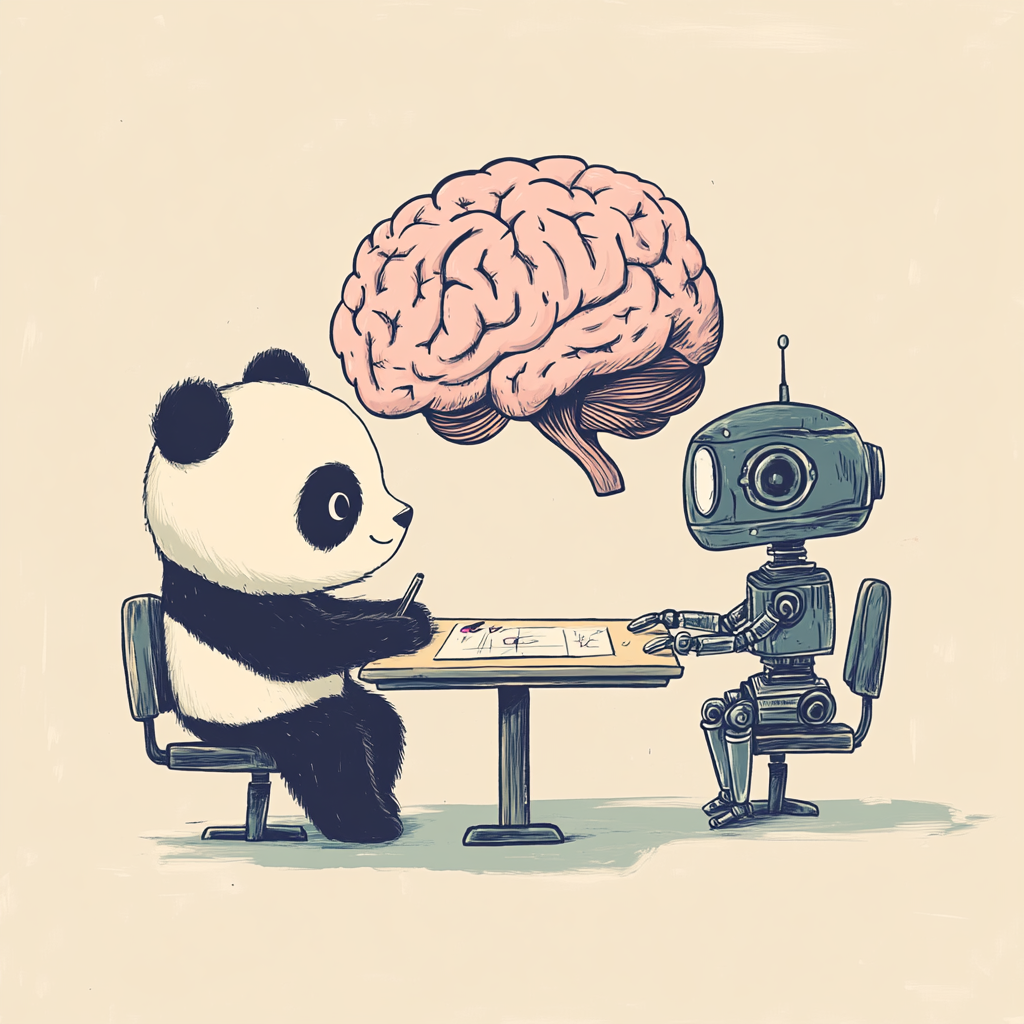
But now, the nature of human thought itself is shifting. Our intelligence isn't confined to our heads anymore; it’s increasingly distributed across networks of humans and AI. We’re not just writing prompts or receiving model outputs—we’re actively thinking and creating in dialogue with intelligent systems. Cognition itself—the mental process of understanding, judgment, and decision-making—is no longer exclusively internal. It's becoming something external, collective, and fundamentally collaborative.
Yet many teams approach this profound change superficially, treating AI like a faster version of familiar tools. They use AI as a productivity hack, hoping to get the same things done more quickly. But that's like using electricity just to build faster candles. This mindset leaves teams stuck—overwhelmed by endless choices, confused by unclear outputs, and disappointed when AI-generated ideas fall short of genuine strategic thought.
High-performing teams, on the other hand, realize that this shift represents a deeper evolution. They understand that integrating AI into teamwork isn't just about speeding up traditional tasks—it’s about rethinking how we collaborate and create entirely. These teams intentionally build new rituals, practices, and behaviors around distributed cognition. They create structured workflows, refine their judgment, and actively shape the ways they partner with AI. They don’t merely use AI—they learn alongside it, continuously evolving their approach.
This matters deeply because the gap between superficial adoption and strategic integration of AI is widening rapidly. Teams that grasp and embrace this new, distributed form of intelligence are already pulling ahead, defining a new level of productivity and strategic clarity. Teams that remain stuck in old patterns—merely using AI as a shallow convenience—risk falling dramatically behind.
This article explores exactly what separates these two kinds of teams. It dives deeply into the behaviors, habits, and mindsets that characterize truly effective collaboration with AI. And it provides practical frameworks to help you recognize your team’s current maturity level and understand exactly how to move forward.
The quiet revolution is already here. It’s not just about AI or technology—it’s about how we think, create, and decide together, as humans, in partnership with intelligent systems. The teams that intentionally master distributed cognition will not just thrive—they’ll define the future.
This moment invites reflection: How will your team adapt? Who will you choose to become?
Part 1: Understanding Distributed Cognition
We're living through a fundamental transformation in the way we think, collaborate, and create—one subtle enough that many teams haven't fully grasped its significance. At the heart of this change is the emerging phenomenon known as distributed cognition.
Traditionally, we’ve viewed intelligence as something internal and personal. We kept knowledge, reasoning, and memory neatly housed within our minds. When we collaborated, we shared the outcomes of our cognition—documents, plans, presentations—as external artifacts, products that emerged from our internal mental processes. Collaboration was essentially a relay race of discrete tasks, each completed individually and passed along sequentially.
But generative AI—tools like ChatGPT and Claude—have quietly disrupted this pattern, subtly shifting cognition itself outside our individual minds and into a dynamic, shared space. Intelligence is no longer exclusively internal. It is increasingly externalized, living partly in the interactions between humans and intelligent systems. AI means our intelligence as a team lives in a gray space between tokens and human thought, and we haven’t given enough attention to how much that changes the game.
Think about it practically. When you engage an AI assistant, you're no longer just outsourcing memory or routine tasks. You're actively volleying ideas back and forth. You're prompting, refining, and synthesizing continuously. The cognitive load once borne solely by your brain now spreads out, partly held within AI-generated suggestions, remembered context, session histories, and prompt libraries. The line between internal thought and external collaboration blurs dramatically.
This shift isn’t just theoretical—it’s evident in everyday behaviors. Previously, writing meant sitting down with a blank page and constructing sentences from your own thoughts alone. Now writing often involves prompting an AI model, iterating based on what the model returns, and curating your final text from an ongoing conversation. Drafting, once linear and isolated, becomes iterative, cyclical, and collaborative, even if your partner isn't human.
In teams, this externalization of cognition means group intelligence itself starts to live partly within these AI interactions. The workspace becomes filled not just with human-created artifacts, but with AI-generated outputs awaiting collective review, synthesis, and integration. Teams find themselves continuously engaged in processes of sense-making—interpreting and shaping outputs into coherent, strategic, actionable intelligence.
Yet most teams today still treat AI superficially—as an advanced autocomplete or as a shortcut. They have yet to realize that what’s at stake is far deeper: the redefinition of how cognition operates at a fundamental level. I know that sounds very fancy but stay with me here I promise this isn’t philosophy class: teamwork is an act of collective intelligence, and AI is sneaking in and shifting how our teams compute as a whole, how we all solve problems and get work done—and most of us haven’t made intentional choices about those changes! Teams that fail to grasp that cognition is changing will remain stuck in familiar, surface-level interactions, oblivious to the real transformative potential of distributed cognition.
Meanwhile, teams that intentionally embrace distributed cognition—actively managing shared contexts, iterating through structured workflows, and prioritizing rigorous human judgment alongside AI collaboration—gain unprecedented cognitive leverage. They move faster, deeper, and smarter, not merely accelerating their old patterns but creating entirely new rhythms of work.
Understanding distributed cognition, then, is not an academic exercise. It's a strategic imperative. High-performing AI teams grasp this intuitively. They recognize they're participating in a profound shift, where intelligence is no longer isolated within human minds but distributed across collaborative loops of humans and AI, dynamically iterating together.
To navigate this new reality successfully, we must clearly understand what distributed cognition means in practice, how it changes our behaviors and expectations, and why it matters so urgently right now. Only then can we begin to intentionally harness its power—transforming our teams, our productivity, and ultimately, our collective intelligence.
This foundational shift is already underway. The question is not whether distributed cognition will reshape how we work—it's whether your team will actively embrace and leverage this transformation or remain passively disrupted by it.
Part 2: High vs. Low-Performing AI Teams
Simply using AI does not automatically ensure a team's effectiveness. And I don’t see that written about enough! The real differentiator lies in how deeply and thoughtfully teams integrate AI into their cognitive processes and workflows. AI is a team sport. High-performing AI teams recognize and embrace this integration explicitly, while low-performing teams continue to treat AI superficially or as an individual productivity tool, missing out on the gains that come with truly distributing cognition and reshaping workflows at the team level. If coordination is the fundamental unit of work, then AI demands we reshape how we coordinate now that a new intelligence has entered the picture!
So what does that look like on the bright side?
Behaviors of High-Performing AI Teams
High-performing AI teams intuitively understand and leverage the power of distributed cognition. Their success stems from clear, deliberate behaviors and practices. I’ve outlined eight here to get you started, but there are probably others.
1. Explicitly manage shared context
Explicit context management involves deliberately and systematically capturing, documenting, and reusing the insights and decisions generated through AI interactions. This practice ensures collective intelligence accumulates effectively, boosting productivity and enhancing the quality of decision-making.
Indicators of High Performance:
- A structured and easily accessible repository of AI interactions, context, and session histories.
- Team members effortlessly access past contexts, significantly reducing repetitive tasks and clarifications.
- Quick and efficient onboarding of new team members through well-documented knowledge bases.
Common Mistakes & Misunderstandings:
- Assuming AI inherently understands context without human intervention.
- Inconsistent documentation, leading to inefficiencies in context retrieval.
- Neglecting regular updates, causing the context repository to become obsolete.
What This Might Look Like: The messy version of this is probably a bunch of shared GPTs and some kind of shared doc with prompts. That’s a start, but teams are going farther than that. A team might maintain a shared, searchable database where every AI interaction is logged meticulously. It’s not impossible! Tools like Langfuse help with that, and more tools are sure to spring up soon.
Anyway, each entry in the collective database clearly details the original prompt, the refined output, and relevant metadata such as the date, project, and responsible team members. Before beginning new tasks, team members consult this database to quickly build upon previous insights, dramatically accelerating their workflow and avoiding redundant efforts.
Actionable Steps:
- Set up some kind of organized, accessible context management system.
- Define clear documentation guidelines for capturing interactions.
- Regularly review and update the context repository (maintain maintain maintain!)
Reflection Questions:
- How quickly and efficiently can our team currently retrieve past contexts?
- Which tasks repeatedly require unnecessary clarifications?
- What prompts are we re-inventing all the time?
- Who’s best on the team at prompting? Will they maintain for us?
2. Prioritize Human Judgment and Taste
Prioritizing human judgment and taste means recognizing that AI can rapidly generate ideas, but the critical and most challenging aspect of productive work is evaluating and selecting among these outputs. High-performing teams rigorously assess AI outputs against clear internal standards of quality, relevance, and strategic alignment, continuously sharpening their collective ability to discern genuinely valuable insights from noise.
Basically, high-performing teams have mechanisms that actively militate against AI hogwash. If it’s just AI, they don’t assume it’s good enough. And if it’s just human, they also don’t assume it’s good enough. The bar is high.
Indicators of High Performance:
- Teams consistently produce outputs that feel strategically aligned, focused, and distinctive, not generic or superficial.
- Clear internal standards and criteria guide the evaluation of AI-generated content.
- Quick, decisive action on selecting or discarding AI outputs demonstrates strong judgment and reduces wasted cycles.
Common Mistakes & Misunderstandings:
- Assuming AI outputs are inherently valuable without rigorous human scrutiny, resulting in low-quality or misaligned deliverables.
- Using AI-generated ideas directly without thoughtful editing or strategic shaping.
- Over-relying on AI's quantitative productivity, generating numerous outputs without clear pathways or criteria for selection.
What This Might Look Like: The messy version of this happens in document feedback sessions where someone says “I think AI generated this” in a nasty way. That’s not particularly productive.
A high-performing team is ok with receiving multiple AI-generated outlines for a product strategy document. Instead of merely choosing the first or most convenient draft, what if the team conducts a structured review session focused on strategic alignment, originality, and clarity. They quickly discard outlines that feel generic or misaligned, rigorously challenging assumptions behind each remaining option. Through a more disciplined review of the optionality that AI makes possible, they arrive at a strategically clear, distinctive direction, refining it further through iterative prompting and human editing. Sounds great, and I know it’s hard in practice.
Actionable Steps:
- Establish clear criteria for evaluating AI-generated outputs (e.g., strategic alignment, originality, relevance to audience, clarity).
- Regularly hold collaborative review sessions explicitly focused on evaluating and critiquing AI-generated ideas.
- Train team members to articulate their judgments explicitly, reinforcing clarity and shared understanding around what makes outputs valuable.
Reflection Questions:
- How clearly articulated and shared are our team's standards for quality and alignment?
- Are we frequently generating many outputs but struggling to decide among them quickly?
- When was the last time we rigorously critiqued and refined an AI-generated idea, rather than simply using it as-is?
- When was the last time we demanded a human idea be up-leveled through AI?
3. Establish Intentional Workflows
Intentional workflows mean clearly defining how team members interact with AI and each other, explicitly specifying roles and responsibilities around tasks like initiating prompts, refining responses, curating outputs, and integrating insights. Structured, transparent workflows reduce confusion, minimize redundancy, and optimize team productivity and focus.
Look this is easier said than done, but fundamentally if AI gives you lots more optionality, it makes decisiveness harder, it makes good taste more valuable, and it requires more thoughtfulness around how stuff gets done. You probably need to audit how value gets created on your team.
Indicators of High Performance:
- Clear documentation of roles and responsibilities around AI interactions.
- Team members readily know their roles and how to hand off work seamlessly.
- Rapid and smooth progression of tasks without frequent bottlenecks or uncertainty about next steps.
Common Mistakes & Misunderstandings:
- Believing AI interactions will organically sort themselves out without explicit structure.
- Leaving roles unclear or assumed, leading to redundancy, duplicated efforts, or confusion.
- Assuming workflows remain static, neglecting to update them as team or AI usage evolves.
What This Might Look Like: A high-performing team might explicitly document their AI interaction workflow in a shared space (like Notion or Confluence). For example: One team member is assigned to draft initial prompts, another specializes in refining and evaluating AI outputs, and a third integrates insights into broader project goals. And you can go beyond that—it’s not just about thinking about AI interaction, it’s about asking your team what they can do less of or do differently now that AI is in the picture.
Tasks would move through clearly defined stages, each role’s contribution would be transparent and recorded, and there would be a clear process for handing off between roles. Updates and adjustments to this workflow would happen regularly during team reflection sessions, ensuring continuous alignment and clarity.
Actionable Steps:
- Clearly define roles for AI-related tasks and document them in a shared workflow diagram.
- Regularly communicate these roles and expectations during team meetings and onboarding.
- Schedule periodic reviews to refine workflows and ensure they're aligned with evolving team needs and AI capabilities.
Reflection Questions:
- Is everyone on our team clear about their role in AI-related tasks?
- Do we often encounter uncertainty about next steps or handoffs?
- When was the last time we formally reviewed and updated our AI-related workflows?
- What are we doing that could be just skipped with a proper AI approach?
4. Invest in Prompt Literacy
Investing in prompt literacy means recognizing that prompting AI effectively is a critical professional skill—not a casual or ad hoc task. High-performing teams deliberately cultivate their ability to communicate clearly and strategically with AI, enhancing the quality and relevance of outputs, and ensuring consistent, efficient interactions.
Prompting is a team sport! We get better much faster when see others prompt. We benefit from seeing both good prompts and bad prompts out in the open, and we benefit from designing prompts together. It’s sort of like pair programming, which I know has gone out of style—but the concept is useful here.
Indicators of High Performance:
- Team members can quickly generate focused, clear, and effective prompts that consistently yield useful and strategically aligned outputs.
- Existence of shared internal prompt libraries and documentation of effective prompting techniques.
- Regular team training sessions and active sharing of best practices around prompt construction and refinement.
Common Mistakes & Misunderstandings:
- Treating prompting casually or assuming no special skill is required, leading to inconsistent or superficial AI outputs.
- Allowing wide variance in team members' prompting skills, which creates unpredictable and uneven outcomes.
- Failing to document successful prompts or insights, causing inefficiencies and repeated trial-and-error approaches.
What This Might Look Like: Look a messy version of this is a lunch-and-learn where prompts are shared and everyone vigorously debates what works and doesn’t work. A fancier version might be monthly workshops focused specifically on effective prompting techniques. Or you might maintain an internal repository of tested, successful prompts organized by task type—such as market analysis, content generation, product ideation—and regularly update it with refinements and new discoveries.
New team members would quickly onboard by studying and applying these documented prompts, rapidly gaining fluency in prompt literacy. Team discussions would idealy frequently involve critically reviewing prompt effectiveness, refining language, and collectively improving how they interact with their AI tools. Yes, this will change your meetings.
Actionable Steps:
- Immediately begin building and maintaining a shared library of effective prompts, categorized clearly by task and outcome.
- Schedule regular team training sessions focused explicitly on prompt techniques, sharing practical examples and collective improvements.
- Encourage peer review of prompts and make prompt quality a regular discussion point in team meetings.
Reflection Questions:
- Do all team members have access to effective prompts, or are some consistently reinventing the wheel?
- How often do we actively discuss and improve the quality of our prompts?
- What is the level of variance in prompting quality across our team members, and how does that affect our workflow?
- What is the rate of learning across the team on prompts? Are only the strongest team members benefiting? Or is everyone learning?
5. Embrace Async-First Culture
This one is a hot take, but there’s a reason for it. I know there is no substitute for live, in-person interaction when it really matters. I’m not saying we don’t need those moments as a team. But I do think it’s important to think about more AI-friendly workflows if we truly want to leverage AI across team workflows.
Embracing an async-first culture means deliberately designing workflows to leverage AI’s ability to sustain productivity across different schedules, locations, and time zones. And by different time zones I don’t just mean distributed teams—I mean that with agentic workflows we’re starting to be able to delegate tasks to agents that work while the team is asleep or doing something else.
High-performing teams can use AI tools to ensure continuous progress without depending quite as heavily on synchronous meetings or real-time coordination, thus scaling up velocity while reducing coordination costs.
Indicators of High Performance:
- Work continues smoothly and effectively across diverse schedules and global locations.
- Reduced frequency and duration of synchronous meetings; meetings become strategically valuable rather than operational necessities.
- AI interactions produce clear, useful outputs independently, supporting autonomous productivity and minimizing delays.
Common Mistakes & Misunderstandings:
- Misinterpreting asynchronous work as simply "working remotely" without deliberately structuring workflows to support independent productivity.
- Over-reliance on synchronous meetings due to mistrust or confusion about AI-generated outputs.
- Failing to fully leverage AI's capabilities, resulting in persistent operational bottlenecks and interruptions.
What This Might Look Like: Well to start with, do you need the meeting? An old question, but especially relevant now. A high-performing team might clearly define asynchronous workflows where AI is tasked to generate initial drafts, market research summaries, or strategic outlines overnight or during off-hours.
Team members would then independently refine, review, or integrate outputs at their own optimal schedules. Regular synchronous meetings would focus only on strategic alignment, collective sense-making, and decision-making, rather than routine updates. Not new advice, but 10x more effective with AI in the picture. This practice would allow AI to pick up more of the coordination burden, allowing team members to move forward independently without frequent disruptions or delays.
Actionable Steps:
- Establish clear guidelines and expectations around asynchronous work, specifying how and when to rely on AI-generated outputs.
- Shift routine updates to asynchronous channels (e.g., written updates, recorded messages) supported by AI-generated summaries.
- Regularly review synchronous meetings to ensure they’re genuinely necessary, productive, and strategically valuable.
- Ask whether an AI agent might usefully pick something up to speed up team rhythms while the team is working on something else or sleeping
Reflection Questions:
- How often does our team rely unnecessarily on synchronous meetings to clarify or review AI-generated outputs?
- Are we effectively leveraging AI to sustain continuous productivity across different schedules and locations?
- What steps can we take immediately to move more tasks into an async-first workflow?
- Have we explored how AI can pick up team coordination costs for us?
6. Dedicate Rituals to Collective Sense-Making
I know this sounds like an episode of Survivor or something, but teams do rituals too (and not just standup). Dedicating rituals to collective sense-making involves explicitly setting aside structured meeting times for teams to collaboratively interpret and evaluate AI-generated outputs. TLDR; AI is 10x’ing content and options presented to the team, so the way you process information needs to change.
Instead of merely exchanging updates, these meetings prioritize aligning on insights, refining strategic direction, and collectively understanding the implications of AI-driven intelligence. This ensures the team remains strategically cohesive and effectively harnesses AI outputs.
Indicators of High Performance:
- Meetings consistently prioritize strategic discussion, interpretation, and synthesis over operational or routine updates.
- Team members regularly leave meetings with clear alignment and unified strategic direction derived from collective interpretation.
- The quality and clarity of team outputs visibly improve after these collaborative sense-making sessions.
Common Mistakes & Misunderstandings:
- Mistaking meetings focused on sense-making for general update meetings or routine status checks, reducing their strategic effectiveness.
- Allowing AI outputs to be passively received without rigorous collective interpretation, leading to superficial acceptance and misaligned strategies.
- Conducting these rituals sporadically rather than consistently, limiting their effectiveness and continuity.
What This Might Look Like: Look the simplest version is “hey does this look stupid—help me pick the best one.” A bit farther on, a high-performing team might schedule weekly dedicated "sense-making sessions," explicitly focusing on critically interpreting recent AI outputs such as market analyses, strategy proposals, or product drafts. During these sessions, team members would collectively review outputs, debate strategic alignment, clarify implications, and agree on specific next steps. These meetings could become central touchpoints for strategic coherence, directly influencing the team's trajectory and decisions, thereby elevating the overall quality and relevance of their work.
Actionable Steps:
- Schedule recurring meetings specifically designed for collective sense-making, distinct from status updates or operational reviews.
- Clearly define meeting objectives around interpretation, alignment, and strategy rather than information-sharing alone.
- Regularly document insights, decisions, and strategic alignments from these sessions for continued clarity and alignment.
Reflection Questions:
- Are we acknowledging the sheer volume of AI optionality created through new AI tooling, and are we willing to change process to adjust for it?
- Do our meetings explicitly prioritize strategic interpretation and sense-making, or do they drift into mere updates?
- How clearly do team members understand the strategic implications of recent AI-generated outputs?
- When was the last time our team collectively refined and aligned on AI-driven intelligence, explicitly shaping our strategic direction?
7. Codify Trust and Accountability
This one isn’t new either, but it sure is important in the age of AI. Codifying trust and accountability involves systematically maintaining transparency around AI interactions by clearly documenting who initiates, edits, refines, and approves AI-generated content. No hiding AI! No shadow work.
High-performing teams own up to their AI usage. They’re proud of it. They rigorously track metadata about these interactions, ensuring clarity, accountability, and trust in AI outputs—critical for smooth collaboration and effective decision-making.
Indicators of High Performance:
- Transparent systems clearly show the history of each AI interaction, including who contributed and made decisions.
- Team members quickly understand the provenance and reliability of outputs.
- Strong accountability around content approval leads to higher trust and fewer doubts or redundant verifications.
Common Mistakes & Misunderstandings:
- Assuming trust will automatically develop without explicit documentation or transparency.
- Neglecting to track critical metadata, leading to confusion about authorship, reliability, and quality of outputs.
- Believing informal processes are sufficient, resulting in inconsistent accountability and reduced trust over time.
What This Might Look Like: Well, start with not shaming people for using AI! Start with modeling talking about AI openly. But you can go farther: A high-performing team might consistently use a shared platform (enterpise AI installs help with this) that automatically logs detailed metadata for each AI interaction—capturing details like original prompts, revisions, the individuals involved at each stage, approval timestamps, and model details. This explicit transparency enables any team member to quickly verify the origin, credibility, and context of AI-generated insights, fostering greater accountability and smoother collaboration.
Actionable Steps:
- Set up standardized templates or automated tools that capture detailed interaction metadata for all AI-generated content.
- Regularly review and refine these metadata practices, ensuring the team consistently adheres to clear accountability standards.
- Promote transparency and accountability by regularly highlighting successful trust-building practices within team meetings.
Reflection Questions:
- When was the last time leadership modeled and praised AI usage?
- How easily can our team currently trace who contributed to each AI interaction and decision?
- Have we ever experienced confusion or mistrust due to unclear or undocumented AI interactions?
- What immediate steps can we take to enhance transparency and accountability around AI-generated content?
8. Iterate Quickly, Prioritize Velocity
Everyone says this one first, but in my view it comes best after a lot of the foundational practices I discuss up top are in place. Iterating quickly and prioritizing velocity means embracing a workflow that rapidly tests, evaluates, and refines multiple AI-generated ideas. Instead of pursuing perfection, high-performing teams focus on incremental improvements, consistently favoring responsiveness and quick decision-making. This accelerates learning, improves adaptability, and significantly enhances team agility.
Indicators of High Performance:
- Teams regularly produce multiple iterations of outputs, promptly refining and discarding less effective options.
- Minimal delays between generating ideas and making decisions on whether to pursue or abandon them.
- Team culture that values rapid experimentation, learning from quick feedback, and adjusting directions swiftly.
Common Mistakes & Misunderstandings:
- Equating speed with careless work or low-quality outcomes, misunderstanding velocity as sacrificing standards.
- Getting stuck refining a single idea to perfection rather than quickly testing multiple options.
- Avoiding decisive action, resulting in prolonged discussions, stagnation, and loss of momentum.
What This Might Look Like: Well, when was the last time you rewarded iteration and optionality in a review cycle instead of emphasizing the quality of the final output as the only bar? A high-performing team might rapidly generate several AI-driven product concepts and immediately test them against clear criteria for viability, market fit, and feasibility. Instead of spending weeks refining one concept, the team quickly eliminates weaker ideas and refines promising ones through successive, rapid iterations. Regular checkpoints would ensure prompt evaluation, quick pivots, and continuous momentum, making the team responsive and agile.
Actionable Steps:
- Adopt clear criteria and structured checkpoints for swiftly evaluating generated ideas.
- Foster a culture that celebrates quick experimentation, rapid learning, and incremental improvements rather than flawless outcomes.
- Clearly document decisions to pivot, pursue, or abandon AI-generated outputs, making the process transparent and understandable for the entire team.
Reflection Questions:
- Are we ok with directional iteration?
- How frequently do we generate and test multiple iterations of ideas rather than pursuing singular perfection?
- Are we currently quick and decisive enough in discarding ineffective ideas and rapidly iterating promising ones?
- How comfortable is our team with rapid experimentation, incremental progress, and quick pivots?
Pitfalls of Low-Performing AI Teams
Now the other side of the coin! AI is not an automatic accelerant. Teams do not default to productive. Low-performing AI teams typically misunderstand or misuse the potential of distributed cognition, leading to several common pitfalls:
1. Treat AI Superficially
Treating AI superficially means teams primarily use AI tools as quick shortcuts or conveniences rather than meaningful strategic collaborators. Instead of deeply engaging with and critically evaluating AI-generated content, these teams passively accept surface-level outputs, resulting in shallow, inconsistent, or misaligned work.
Symptoms of This Pitfall:
- Regular use of AI outputs without substantial refinement or critique.
- Outputs frequently lack depth, originality, or clear strategic alignment.
- Team members often unclear about how or why specific outputs were chosen.
Why This Happens:
- Misunderstanding AI as an automated solution rather than a cognitive partner.
- Viewing speed or convenience as inherently valuable, overlooking the deeper work of evaluating and refining AI outputs.
- Lack of awareness or training in rigorous prompt design and evaluation methodologies.
Typical Consequences:
- Generic, superficial work products that fail to differentiate or achieve clear strategic objectives.
- Increased frustration among team members when AI-generated outputs repeatedly miss the mark.
- Declining trust in AI's value and capability, potentially leading teams to revert to inefficient workflows or abandon AI usage altogether.
What This Often Looks Like: A low-performing team might use ChatGPT to generate a product roadmap. Without critical evaluation, they accept the first generated outline because it seems plausible and quickly addresses the task. However, this roadmap lacks strategic depth, fails to account for nuanced customer insights, and offers no meaningful competitive differentiation. Weeks later, the team finds itself struggling to align efforts or justify decisions, causing confusion, misalignment, and wasted time.
How to Correct Course:
- Immediately establish clear evaluation criteria for AI-generated outputs based on strategic goals and quality standards.
- Train team members to critique, refine, and challenge AI-generated ideas rigorously.
- Adopt routine team meetings explicitly focused on collective sense-making and critical evaluation of AI-driven work.
Diagnostic Questions:
- When was the last time we significantly revised an AI-generated output before using it?
- Can our team clearly articulate why we selected one AI-generated idea over others?
- How often does our final work product feel generic or indistinct due to superficial AI engagement?
2. Substitute AI for Strategic Thought
Substituting AI for strategic thought occurs when teams mistakenly treat AI-generated outputs as complete strategic insights or finished products, rather than as starting points for deeper human analysis. This behavior significantly compromises the depth, originality, and coherence of their strategic outputs.
Symptoms of This Pitfall:
- AI-generated outputs frequently accepted without critical evaluation or significant revision.
- Work often appears superficial, lacking strategic clarity, originality, or clear differentiation.
- Team members cannot articulate the strategic rationale behind AI-driven decisions or outputs.
Why This Happens:
- Misconception that AI-generated outputs inherently possess strategic insight or completeness.
- Desire for rapid results leading teams to neglect thorough strategic analysis or human oversight.
- Overconfidence in AI capabilities, undervaluing the role of human intuition, judgment, and contextual understanding.
Typical Consequences:
- Outputs that fail to resonate with target audiences or deliver meaningful competitive advantage.
- Reduced team capacity for strategic thinking and critical analysis over time, as these skills are underutilized.
- Decline in team morale and engagement when AI-driven outputs consistently underperform or fail to inspire.
What This Often Looks Like: A marketing team quickly generates a campaign strategy using AI tools. Without critical review, they immediately implement it. The campaign launches with polished but generic content, poorly targeted messaging, and superficial market positioning. Audiences respond with lukewarm engagement, and the campaign fails to meet strategic objectives. Post-mortem analysis reveals no one critically evaluated or refined the AI-generated strategy, mistakenly treating it as complete and strategic. Often this results in AI getting blamed!
How to Correct Course:
- Institute mandatory review and critique processes for every AI-generated strategic output.
- Clearly distinguish between idea generation (AI-driven) and strategic refinement (human-driven), ensuring both stages receive appropriate emphasis.
- Regularly reinforce the critical role of human insight, creativity, and intuition through dedicated strategic planning sessions.
Diagnostic Questions:
- Do we blame AI when the issue is the people using it without proper mechanisms and accountability?
- Do we consistently review and critically refine AI-generated content before approving it as final?
- Can we clearly explain the strategic reasoning behind recent AI-generated outputs?
- How often do our final deliverables lack strategic depth, originality, or distinctiveness?
3. Poor Context Management
Poor context management occurs when teams fail to systematically capture, document, and reuse prior context from their AI interactions. Instead of building upon previously established knowledge, these teams repeatedly start from scratch, significantly reducing efficiency and effectiveness.
Symptoms of This Pitfall:
- Frequent repetition of similar prompts and clarification requests across AI interactions.
- Team members regularly spend unnecessary time reconstructing context, re-establishing intent, or duplicating work.
- Lack of accessible documentation or historical knowledge leading to inefficiency and confusion.
Why This Happens:
- Assuming AI models automatically retain context between interactions without explicit documentation.
- Underestimating the effort and structure needed to maintain and retrieve context effectively.
- Neglecting to establish clear responsibilities or accountability for managing team context.
Typical Consequences:
- Consistent loss of productivity due to repetitive, redundant context-building.
- Frustration among team members forced to repeatedly clarify or reconstruct previously addressed information.
- Reduced quality of outputs as context gaps introduce inconsistencies or misunderstandings.
What This Often Looks Like: A product team routinely interacts with AI to generate market research summaries. Due to poor context management, every new interaction with the AI assistant begins without previously gathered insights or historical prompts. As a result, team members spend considerable time restating basic context and instructions, frequently leading to redundant research outcomes. Progress slows down, frustration mounts, and team meetings become repetitive discussions of context rather than strategic advancements.
How to Correct Course:
- Immediately establish a structured, accessible repository for logging and retrieving context from past AI interactions.
- Clearly define roles responsible for maintaining, reviewing, and updating context documentation regularly.
- Provide training on best practices for context management, emphasizing the importance of explicit documentation and regular upkeep.
Diagnostic Questions:
- Do team members frequently repeat efforts or conversations due to inadequate context management?
- Can any team member quickly and easily retrieve historical context from previous interactions?
- Are roles and responsibilities for managing and updating context clearly defined and consistently executed?
4. Option Overload and Indecision
Option overload and indecision occur when teams generate numerous AI outputs without establishing a clear, disciplined process for evaluating and selecting among them. Overwhelmed by excessive options, these teams stall, struggle to make decisive choices, and lose momentum. Adding AI makes these teams worse by most measures!
Symptoms of This Pitfall:
- Frequent delays or prolonged discussions when attempting to select among AI-generated outputs.
- Teams repeatedly revisit decisions due to uncertainty or lack of confidence in their choices.
- General hesitance or reluctance to commit to specific outputs, causing stalled workflows.
Why This Happens:
- Lack of clear criteria or frameworks for evaluating AI-generated ideas or outputs.
- Misbelief that more options inherently mean better outcomes, causing decision paralysis.
- Insufficient trust or accountability structures, making team members wary of committing to potentially suboptimal choices.
Typical Consequences:
- Significant reduction in productivity and project velocity due to indecision.
- Diminished team morale and confidence, as repeated indecision and stalled progress breed frustration.
- Frequent churn in strategic directions or outputs, weakening overall coherence and impact.
What This Often Looks Like: A content team uses AI to generate multiple campaign ideas, quickly producing dozens of potential directions. Without established criteria or clear decision-making processes, the team repeatedly debates the merits of each idea in prolonged meetings. Days or even weeks pass without decisive action. Eventually, under pressure, the team randomly selects an option without genuine conviction or alignment, resulting in a diluted, ineffective campaign.
How to Correct Course:
- Immediately establish clear evaluation criteria and decision-making frameworks to quickly filter and prioritize AI-generated outputs.
- Foster a team culture that values decisive action, clear judgment, and comfortable acceptance of "good enough" solutions, knowing iteration and refinement will follow.
- Implement strict deadlines or checkpoints to enforce decisive selections, minimizing indecision-driven delays.
Diagnostic Questions:
- How frequently does our team stall or delay decisions due to overwhelming AI-generated options?
- Do we have clear, shared criteria for quickly evaluating and selecting among multiple ideas?
- Are our processes robust enough to confidently select outputs swiftly and efficiently?
5. Trust Erosion and Confusion
AI erodes trust on teams when AI isn’t introduced properly. Trust erosion and confusion happen when teams lack clear accountability and transparency in their AI interactions. Without systematically tracking who generated, refined, or approved AI outputs, team members become uncertain about the origins and reliability of the content, significantly impairing their confidence and effectiveness.
Symptoms of This Pitfall:
- Frequent uncertainty or skepticism about AI-generated outputs among team members.
- Repeated questioning or re-validation of previously accepted content.
- Increasing reluctance to use or trust AI-driven insights, leading to slowed or halted decision-making.
Why This Happens:
- Lack of explicit documentation or metadata practices around AI interactions.
- Belief that informal or implicit processes are sufficient, underestimating the need for clear accountability structures.
- Inconsistent or unclear roles and responsibilities regarding AI-generated content approvals.
Typical Consequences:
- Persistent confusion and inefficiency due to repetitive validation efforts.
- Declining productivity as team members repeatedly second-guess or recheck outputs.
- Decreased team morale and cohesion stemming from persistent uncertainty and frustration.
What This Often Looks Like: An analytics team frequently produces AI-generated reports for stakeholders. Without clear accountability, team members struggle to confidently communicate report findings, repeatedly questioning data sources and reliability. Stakeholders sense this uncertainty, triggering additional meetings and redundant validations, dramatically slowing decision cycles and causing frustration for all involved.
How to Correct Course:
- Establish rigorous and transparent metadata logging practices that clearly track who prompted, reviewed, refined, and approved each AI-generated output.
- Define clear roles and accountability for AI-generated content, eliminating ambiguity about responsibility.
- Regularly communicate the value and reliability of outputs by explicitly highlighting successful, documented AI interactions.
Diagnostic Questions:
- Do team members regularly question or doubt the reliability of AI-generated outputs?
- Can we quickly trace the origins and accountability for specific pieces of AI-generated content?
- How clear are roles and responsibilities for approving and verifying AI outputs within our team?
6. Lack of Prompt Discipline
A lack of prompt discipline occurs when teams employ inconsistent or careless prompting techniques across different team members, resulting in unpredictable and uneven AI-generated outputs. Without standardization and clear discipline, teams struggle to reliably replicate successful outcomes or progressively improve their interactions with AI.
Symptoms of This Pitfall:
- AI-generated outputs vary significantly in quality, clarity, and relevance, depending on who created the prompt.
- Team members repeatedly experience uncertainty about the best way to phrase or structure prompts.
- Successful prompt techniques are not documented or shared, causing each team member to continually reinvent effective prompting approaches.
Why This Happens:
- Misunderstanding the critical role prompting plays in obtaining high-quality AI outputs.
- Assuming prompting is intuitive or trivial, requiring minimal effort or training.
- Absence of structured training or resources focused on developing prompt literacy and consistency.
Typical Consequences:
- Inconsistent quality and reliability of AI-generated outputs, reducing overall trust and usability.
- Significant time wasted on repeated trial-and-error prompting rather than strategic refinement and improvement.
- Team frustration and reduced confidence in AI tools, potentially discouraging their use altogether.
What This Often Looks Like: A sales team frequently uses AI to generate client communications. Each team member prompts the AI differently, resulting in inconsistent messaging and tone across client interactions. Customers experience confusion due to varied communication styles and unclear messages. Internally, the team regularly debates optimal prompt wording, never settling on best practices, leading to repeated inefficiencies and frustration.
How to Correct Course:
- Immediately establish standardized prompting guidelines and clear best-practice documentation accessible to all team members.
- Regularly schedule prompt-training workshops and sessions to reinforce and refine effective techniques.
- Implement peer-review or collaborative prompt-refinement sessions to develop consistency and discipline collectively.
Diagnostic Questions:
- Can we even measure prompt variance?
- Are our AI-generated outputs noticeably inconsistent depending on who creates the prompt?
- Do team members have easy access to clear guidelines and examples of effective prompts?
- How often do we explicitly discuss and refine prompting techniques as a team?
7. Over-reliance on Synchronous Workflows
This is like return-to-office mandates at their worst. Teams meeting for the sake of meetings rather than thinking about what’s effectively. Over-reliance on synchronous workflows occurs when teams consistently default to real-time meetings and direct interactions to clarify or review AI-generated outputs. By failing to leverage AI's capability to pick up the coordination load and support asynchronous productivity, these teams negate potential efficiency gains, creating bottlenecks that slow progress.
Symptoms of This Pitfall:
- Frequent synchronous meetings primarily devoted to routine clarifications or updates on AI outputs.
- Team workflows consistently stall or pause waiting for synchronous availability, creating delays.
- Limited evidence of productive asynchronous interactions or independent progression.
Why This Happens:
- Misunderstanding the potential of AI to support autonomous, asynchronous workflows.
- Cultural bias toward meetings and real-time interactions due to a lack of trust in independent, AI-supported tasks.
- Absence of structured asynchronous communication and collaboration tools or practices.
Typical Consequences:
- Reduced productivity and delayed progress due to constant reliance on synchronous interactions.
- Increased scheduling friction, especially across distributed teams or different time zones.
- Frustration among team members who feel overly dependent on synchronous meetings for routine progress.
What This Often Looks Like: A product development team relies heavily on weekly reviews. They think they’re making progress by shifting to reviewing AI-generated product designs and user stories at these reviews. Despite the capability of AI to provide continuous feedback and improvements asynchronously, the team continues to insist on real-time validation. Progress becomes tightly coupled to meeting schedules, slowing the entire development cycle and causing unnecessary delays and friction—ultimately slowing product shipments.
How to Correct Course:
- Transition routine clarifications and reviews of AI-generated outputs to clearly defined asynchronous channels, leveraging tools like shared documents, recorded feedback, or collaborative software.
- Explicitly redefine synchronous meetings to focus strictly on strategic decisions, complex sense-making, or alignment—not routine updates.
- Invest in clear asynchronous protocols and training to ensure teams feel confident and effective in maintaining productivity independently.
Diagnostic Questions:
- Are we willing to meet less if AI can do more?
- Are many of our synchronous meetings primarily focused on routine clarifications of AI outputs?
- Do team members frequently experience productivity blocks waiting for synchronous meetings?
- What immediate steps can we take to shift routine tasks and reviews into an effective asynchronous workflow?
8. Ignoring Reflection and Improvement
Look reflecting is what good teams do, but the need is greater now that we’re introducing an alien intelligence into our workflows. Ignoring reflection and improvement involves teams failing to set aside structured time to evaluate their AI interactions, identify mistakes, and consciously refine their methods. Without regular, deliberate reflection, teams miss valuable opportunities to learn, evolve, and enhance their use of AI, resulting in stagnant or declining productivity.
Symptoms of This Pitfall:
- Persistent repetition of the same mistakes or inefficiencies over multiple AI interactions.
- Team practices and prompting techniques remain static and unoptimized, despite frequent AI usage.
- Productivity gains from AI adoption plateau or decline over time rather than steadily improving.
Why This Happens:
- Viewing reflection sessions as non-essential or lower-priority tasks compared to immediate operational needs.
- Assuming that regular practice alone leads to improvement without deliberate reflection and adjustment.
- Lack of clear structure or dedicated time to engage in meaningful analysis and continuous improvement.
Typical Consequences:
- Persistent inefficiencies or suboptimal use of AI resources, causing frustration and reduced morale.
- Teams become stuck in cycles of repeated errors, never achieving full potential from their AI interactions.
- Reduced competitive advantage as other teams continually refine their practices and become progressively more effective.
What This Often Looks Like: A customer support team regularly leverages AI to draft client responses, initially experiencing quick wins. However, without dedicated reflection and improvement sessions, common prompting errors and response inaccuracies repeat indefinitely. Frustration grows, customer satisfaction stagnates, and the team remains unable to systematically enhance the quality and efficiency of their interactions with AI, leading to overall dissatisfaction and plateaued performance.
How to Correct Course:
- Schedule regular, structured reflection meetings explicitly aimed at evaluating recent AI interactions, identifying recurring issues, and formulating improvement actions.
- Create a simple yet clear framework for capturing reflections, improvement suggestions, and action items from each session.
- Actively integrate learnings and feedback from reflection sessions into updated best practices and prompt libraries.
Diagnostic Questions:
- Are we setting aside extra time to reflect on AI as a team?
- When did we last explicitly reflect on and discuss improvements in our AI interactions as a team?
- Are specific problems or inefficiencies repeating across multiple interactions without resolution?
- Do we have a structured process or regular meeting dedicated to improving our AI workflow practices?
Part 3: Breaking Through the Core Barriers to AI Integration
Transitioning to high performance with AI isn’t merely about adopting a new set of best practices. If it were that straightforward, every team would already be operating effectively. The deeper truth is that most teams struggle to genuinely integrate AI because they're blocked by underlying issues that are harder to identify—and even harder to confront.
Here are three core barriers that prevent teams from moving toward productive, high-value collaboration with AI, along with clear ways to recognize and address them.
Barrier 1: Shallow Understanding and Misaligned Expectations
Many teams superficially adopt AI tools without fully understanding their limitations or capabilities. They see AI as either a magic shortcut or just another piece of software. When reality doesn’t match these ungrounded expectations, disappointment and disillusionment quickly set in.
Signs Your Team is Stuck Here:
- Regularly surprised or frustrated by AI-generated outcomes.
- Frequent abandonment of AI interactions after initial enthusiasm fades.
- Lack of curiosity or deeper exploration of what AI models can and cannot realistically do.
How to Break Through:
- Spend dedicated team sessions unpacking realistic use cases, limitations, and strengths of your chosen AI models.
- Encourage a culture of experimentation coupled with healthy skepticism. Discuss openly what the AI genuinely excels at versus where human judgment remains irreplaceable.
Barrier 2: Lack of Real Accountability and Ownership
AI workflows break down quickly when there’s ambiguity about who owns AI-generated outputs or who is responsible for AI-related outcomes. Without clear accountability, trust erodes, responsibility diffuses, and productivity stalls.
Signs Your Team is Stuck Here:
- Uncertainty about who reviews, approves, or refines AI-generated content.
- Persistent confusion about roles and responsibilities related to AI outputs.
- Frequent hesitation or reluctance to make decisions based on AI content.
How to Break Through:
- Assign explicit accountability. Clearly document and communicate who is responsible for prompting, reviewing, refining, and approving each AI interaction.
- Foster accountability by publicly reviewing successes and failures in AI interactions, making ownership visible and tangible.
Barrier 3: Fear of Letting Go of Familiar Patterns
Even with clear roles and realistic expectations, many teams instinctively revert to traditional workflows out of comfort or habit. AI requires new cognitive patterns and new forms of collaboration—letting go of familiar processes can feel risky and uncomfortable.
Signs Your Team is Stuck Here:
- Persistent return to old workflows despite AI availability.
- Frequent "falling back" into synchronous meetings and manual methods even after attempting async AI-driven processes.
- Anxiety or discomfort expressed by team members around new workflows or technologies.
How to Break Through:
- Deliberately design small experiments to build comfort gradually. Start with non-critical tasks, iterate quickly, and explicitly reflect on results.
- Actively recognize and reward team members who take thoughtful risks, reinforce new patterns, and visibly highlight positive shifts in behavior.
Moving Forward: Daring the Bigger Leap
These barriers aren't simple procedural issues; they're deep-rooted habits and mindsets that require deliberate, reflective effort to overcome. Real AI integration demands candid conversations, explicit ownership, realistic expectation-setting, and the courage to abandon entrenched behaviors. It takes bravery to adopt AI well as a team.
Ask your team honestly:
- Are we clear-eyed about what AI can—and cannot—offer us?
- Have we genuinely clarified accountability and ownership around AI interactions?
- Are we truly willing to abandon comfortable but outdated patterns?
Answering these questions truthfully is your first step. Because shifting toward genuine, high-performance AI collaboration isn’t just about good intentions—it's about deliberately confronting the deeper obstacles that hold your team back.
Learning to Think Together, Again
We’re living through something quietly extraordinary. For hundreds of thousands of years, humans have thought, solved problems, and created mostly inside our own heads. Writing itself is a fairly recent invention in our species’ history! Our ideas have always been personal—something we carefully shaped internally before sharing them outwardly with others.
Now, gently, quickly, and sometimes without noticing, we’re changing that pattern fundamentally. For the first time, our thoughts and intelligence are starting to live partly outside ourselves—in interactions between humans and AI. We're learning how to think, remember, and create together with something that isn’t human. And, yes, that's challenging and even a bit unsettling. And it should be! It would be weird if it wasn’t weird!
This change is not simply about using new technology—it's about relearning how we share ideas, make decisions, and trust one another. It asks us to carefully reconsider our assumptions about ownership, responsibility, and creativity. It's deeply human to feel uncertain as we navigate these new waters.
But there’s also real possibility here. Teams that approach this change openly and deliberately, willing to gently let go of old habits, are discovering fresh ways to collaborate, innovate, and connect. They're finding new depth and clarity in their work, rediscovering the joy of exploring ideas, and solving problems more fluidly.
Ultimately, integrating AI into our collective cognition is about learning how to think together again, in new ways. It requires patience, humility, and thoughtful reflection. We won’t always get it right the first time, and that's okay. The important thing is to be open to learning, aware of how we work, and intentional about how we evolve.
Because at the heart of all this—beyond technology, beyond efficiency—is a simple, human truth: how we work together shapes who we become together.
Let's navigate this thoughtfully. Let's choose intentionally. And perhaps, along the way, we'll rediscover something meaningful—not just about AI, but about ourselves and each other.
For more on AI, subscribe and share!
\Our intelligence is becoming collective, and cute pandas are great!\