Not a prompt guide. Not another ChatGPT tutorial. Just a clear way to see what your job is really made of—and how to use AI to make it smoother, faster, and more sustainable.
By Nate
Published: 2025-04-14
URL: https://natesnewsletter.substack.com/p/if-youre-worried-ai-will-replace
I’ve written extensively about AI disrupting workflows, AI being used at leverage points in workflows, and are we tired of workflows yet? What the heck are workflows? How do they relate to jobs? What do I mean when I talk about tokenized workflows? That’s super vague.
Well not anymore. I wrote this longer piece to help introduce the idea that your job is not your title. Your job is not what’s on the business card. Or what’s on LinkedIn. Or even what’s in the job description. Your job involves a combination of seven key tech workflows, which I’m naming here for the first time. Once you see them, you can’t go back.
And understanding these workflows is the key to understanding where AI can help you. AI is more than ChatGPT, and you’ll learn how to go beyond using ChatGPT to actually using AI strategically to advance your role. You’ll learn how to read the latest model news intelligently, in line with the work you’re doing, so you don’t panic.
Anyway enough of me talking about it let’s get to it!
Subscribers get all these pieces!
I. You Don’t Know Your Workflow (Yet)
Right now, millions of us are afraid.
We’re afraid we’re going to lose our jobs. Not next year. Not after AGI. Now.
We’re watching ChatGPT write emails better than we can. We’re watching Claude summarize 50 pages in seconds. We’re seeing startups use LLMs to ship in a weekend what used to take a team a month.
And we’re quietly wondering: What’s left for me?
If that’s you, I want to start by saying something simple: You’re not wrong to be afraid.
The ground really is shifting. And the uncomfortable truth is: most of us can’t explain what we do all day in a way that would protect us from the shift.
Not because we’re lazy. Not because we lack skill. But because we’ve never had to name the structure of modern work before.
You know your output: a report, a presentation, a product spec, a campaign, a piece of code. But if someone asked you—how did you get from blank page to artifact? What steps did you take? Where did you pause? Who did you depend on? How did you know it was done?—you’d probably shrug.
Because the motion of your work—the invisible process that turns raw input into real output—has never been something you were expected to see, much less describe.
Until now, that didn’t matter. You could succeed just by doing the work. You didn’t have to explain how the work flowed.
But now, there’s something in the room that can do the output faster than you. And the only part it can’t do—the part that still belongs to you—is the workflow: the structure, judgment, nuance, and motion behind the output.
That’s the part you need to understand.
That’s the part you need to protect.
And more importantly, that’s the part you can grow—once you learn how to see it.
This Piece is About You—Not AI
I know I know. Most of my pieces are AI lol—Let me tell you what this piece is really about.
It’s not about AI. It’s about learning to see the shape of your own work.
Because what you do isn’t a list of tasks. It’s not a job title. It’s a set of recurring workflows—repeatable motions of thinking, deciding, creating, sharing, and improving.
Most of us have never mapped those motions. We’ve never had to.
But LLMs don’t work with task lists. They work with motion. They don’t just respond to instructions. They amplify structure. They carry context, reformat intent, track change, expose patterns.
If your motion is clean and intentional, they will multiply your impact. If your motion is messy and unexamined, they will multiply your confusion.
That’s why we feel disoriented right now. We’re watching parts of our job dissolve, and we don’t know how to anchor what’s left.
So let’s anchor it—together. Let’s name the real shape of modern work. Let’s map the seven motions that actually make up your day, no matter what role you’re in. Let’s show how those motions used to work, how AI changes them, and where the leverage points are.
Because once you can see your own motion, you can own it.
Once you can own it, you can improve it.
And once you can improve it, you’re not replaceable.
You’re the one designing the system everyone else depends on.
This Is a Reframing, Not a Survival Guide
You don’t need to become an AI expert. You need to become an expert in how your work actually works—and how to work with the machine to make it better.
You’re not being replaced.
You’re being invited—to see your work with fresh eyes, and more agency than you’ve ever had before.
Let’s begin.
II. What’s Really Changed: The End of Output-Based Work
Let’s be honest.
For most of the modern knowledge economy, your value was tied to your output.
You wrote the report. You shipped the code. You ran the campaign. You built the slide deck.
Your workflow—the how—was invisible. What mattered was the final artifact.
Even your tools reinforced this:
- Google Docs doesn’t care how the draft came together.
- Figma doesn’t care how many times you reworked the UX.
- Your calendar doesn’t distinguish between meaningful motion and performative meetings.
Most of us have built careers on the assumption that the output is what matters.
But LLMs have changed that. Completely.
Because now, the output is cheap.
ChatGPT 4o can write a decent draft.
Claude can summarize five meetings better than you can.
Gemini can synthesize 50 pages of customer feedback into a tidy table.
ChatGPT o3-mini-high can write a product brief, analyze a dataset, and catch edge cases before you’ve opened your laptop.
You don’t even have to be technical anymore to automate something your team used to do manually (well, up to a point).
And that raises the obvious—but terrifying—question:
If my output is no longer my edge… what is?
Here’s the answer: Your motion.
Your ability to understand, shape, and improve the motion of your work.
Not just what gets done, but how it moves from intention to result.
That’s the new playing field. And it’s where LLMs either help you—or hollow you out.
What LLMs Actually Do Well
Think about what an LLM actually does well:
- It extends structure.
- It reframes ideas.
- It carries forward context.
- It surfaces buried connections.
- It reformats your intent into multiple formats, voices, and tones.
But it can’t do this:
- Feel when the update ritual is broken.
- Sense when a meeting is pretending to be alignment.
- Know when a stakeholder has lost context.
- Detect that a technically perfect spec still misses the point.
You can. (And for more on what only you can do, you can read my note about Polyani’s Paradox and work.)
That’s why the real change isn’t the newspaper headlines about LLMs replacing jobs.
It’s that they reveal the structures underneath jobs—and reward people who can work on those structures, not just within them.
Lineages, Not Leaderboards
And this is where things are about to speed up again.
This week, OpenAI is expected to release o3. Possibly o4-mini. Maybe even an open-source frontier model. And it won’t stop there. There will be more models next week.
And it’s going to be hard to believe that a blog post—or anything really—has staying power in a world that’s changing so fast. So let me let you in on a principle that’s been guiding my newspaper (slash S slash Perplexity slash wherever you get your news) reading for awhile: New models don’t change the game. They deepen it.
Each model belongs to a lineage—a family of strengths shaped by training, tuning, and purpose. And if you understand the lineage, you can use new models without panic.
One thing to keep in mind as you read as you read these lineages, is that lineages cut across workflows. Like deliberate thinking happens across a lot of the workflows we’ll discuss! So don’t be surprised to see o3 or o1 show up in a few different places in this article. Lineages are like model ingredients for the workflow soup you’re crafting.
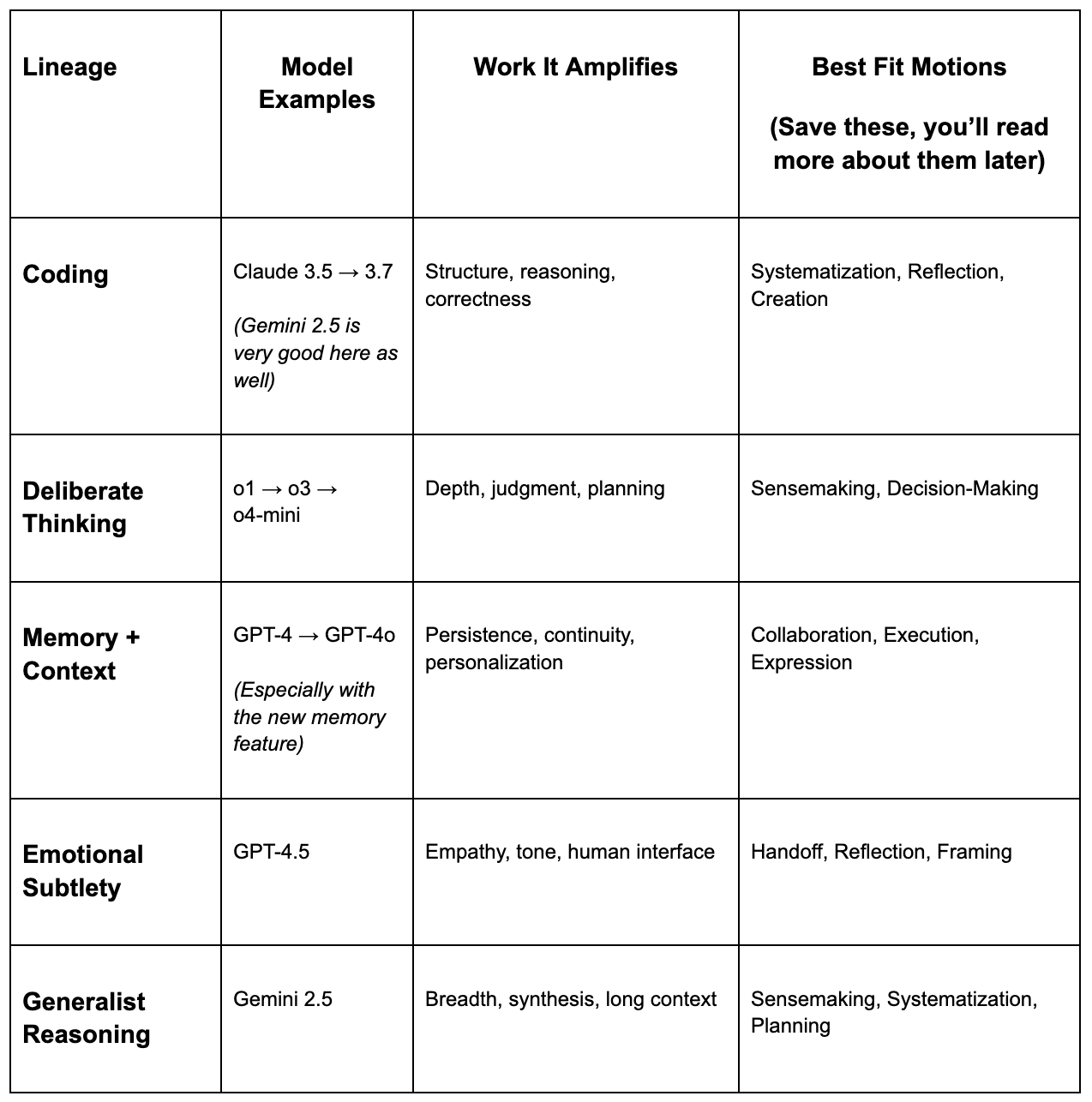
I want to add something really important under this chart: Model interchangeability is growing. These models are all becoming more capable over time. So if you think “hey, Nate missed Grok”, or “Nate missed DeepSeek” or whatever, no I didn’t lol—I just needed a simplified table to act as a map of the territory. And if you look at it and want to pick a different model for a particular task, it will probably work 80 or 90% as good at this point.
This isn’t a leaderboard. It’s a fit map.
When o3 drops, remember: it’s a descendant of o1. It’s probably more thoughtful, better at reasoning. Use it for sensemaking, for complex decisions, for second-order tradeoff thinking.
And when a model drops that isn’t on here, look first for which lineage it fits in (might be more than one spot), and then use that lineage as a pointer toward the work it amplifies.
When o4-mini shows up: think of it as o3-mini’s smarter sibling. Fast, accurate, logic-leaning. Use it where speed, structure, and correctness matter—like planning, templating, or evaluating options.
When someone says it “beats” another model, ask: At what? In what workflow? With what tradeoffs?
That’s how grounded people think. That’s how people who understand motion think.
They don’t chase tools. They choose fit.
And in a world of constant model churn, fit beats hype every time.
Task Thinking Is a Trap
Let me put this plainly: If you keep thinking of your job as a checklist of tasks, you are at risk of being overtaken by someone who sees it as a system of motions.
Because that person can see where the friction lives.
They know where decisions get lost.
They know which pieces need more context.
And they can work with AI not just to finish things faster—but to reshape the path altogether.
That’s the shift:
- The old way: Do the work.
- The new way: Design the motion.
And when you do that—when you name the motion, spot the leverage, and shape the flow—you’re no longer just performing your role.
You’re re-architecting it.
And that makes you irreplaceable.
And if you’re thinking to yourself “what are these motions?”—well read on, because we’re gonna get specific about how to understand what motions are underneath your work and how to think about LLM opportunities for leverage inside those motions—inside your work.
III. The First Motion: Sensemaking
1. What It Is
Sensemaking is what you do when the inputs don’t make sense yet.
It’s the motion before the strategy. Before the plan. Before the output.
You’re staring at research notes, a pile of customer complaints, a stack of call transcripts, a dense report, a chaotic Slack thread—and your brain starts reaching for patterns:
- What matters here?
- What’s repeating?
- What’s missing?
- What does this mean?
It’s one of the oldest things humans do. And in the modern workplace, it’s everywhere—but invisible.
We don’t block time for it on our calendars.
But we feel it every time we say:
- “I’m still trying to wrap my head around this...”
- “Let me look through this first and get back to you...”
- “Give me a sec to untangle what’s going on here.”
This isn’t busywork. It’s the cognitive engine of everything downstream.
When you make sense well, the rest of the workflow clicks.
When you don’t, everything misaligns from the start.
2. Where It Shows Up
Sensemaking isn’t a job title. None of these are job titles. It’s a motion that cuts across all roles:
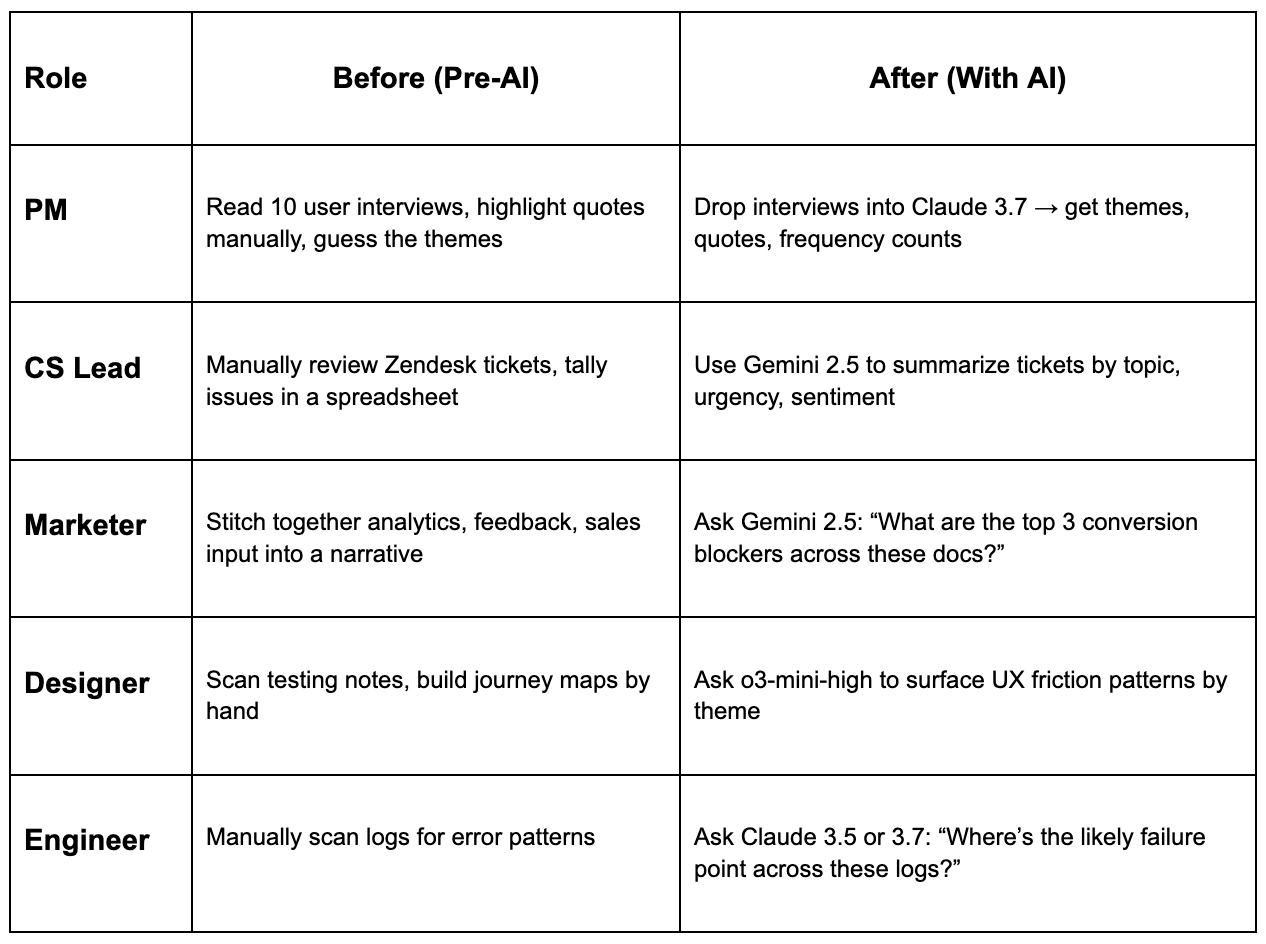
- A PM, reviewing 10 user interviews to uncover the real pain point
- A CS lead, triaging 100 support tickets to understand what changed
- A marketer, synthesizing analytics, sales notes, and product feedback into a coherent story
- A designer, looking at research and behavior to diagnose UX pain
- An engineer, combing logs and debug notes to isolate the source of a bug
If you’ve ever had to make meaning from chaos—you’ve done this motion.
3. What Made It Hard Before
Sensemaking has always been high-leverage. But also high-friction.
You’re dealing with inputs that:
- Are unstructured
- Don’t agree with each other
- Are noisy, repetitive, incomplete
- Require emotional or social interpretation—not just logic
And the only real tool you had... was you.
Maybe some sticky notes. Maybe a spreadsheet. Maybe a Miro board or a Notion page.
But most of it lived in your head. Which meant:
- It didn’t scale.
- You couldn’t hand it off.
- You couldn’t go faster than your own attention span.
So even though everyone depends on clarity—you were often alone in making it.
4. What AI Actually Helps With
This is where LLMs have already changed the game—not by replacing sensemaking, but by extending it.
With the right model, you can:
- Upload transcripts, docs, Slack threads → get structured summaries
- Ask for clustering: “Group these tickets by underlying issue”
- Extract tone: “How angry are these customers, really?”
- Quantify patterns: “How many times does onboarding get mentioned?”
- Reframe findings: “Summarize this like a Head of Product reviewing strategy”
These aren’t vague hallucinations. They’re structured, repeatable, grounded patterns.
The best models for this right now? Honestly mostly of them do pretty well.
Claude 3.7, Gemini 2.5, o3-mini-high are all pretty good for sensemaking.
They don’t just summarize—they see structure. And they let you share your clarity with others.
5. Before and After: What This Looks Like Across Roles
6. What This Means for Your Career
If you can’t make sense of messy inputs, you’ll always be waiting for someone else to tell you what matters.
But if you can—especially if you can do it fast, clearly, and collaboratively—you become a signal amplifier for your team.
The one who sees the shape in the noise. The one who helps others move.
LLMs don’t eliminate the need for sensemaking.
They multiply the value of people who know how to do it well.
They make pattern recognition faster. They carry forward complexity.
But they still need you to ask the right questions.
To set the framing. To choose what actually matters.
If you can do that—if you can say, “I know how the signal moves through this team”—you don’t just stay relevant.
You become indispensable. And you know what?
I know some of you are going to be in the comments saying just wait, AI will take this whole workflow over. Well, the problem is that the parts of this workflow that LLMs can leverage are actually tokenizable, and the parts like problem framing—those are suspiciously close to Polyani’s Paradox. It’s hard to talk about how we do the work I’m asking humans to do here, and that makes it inherently difficult to tokenize, and inherently difficult for AI to do. And that note goes for the other workflows as well.
IV. The Second Motion: Decision-Making
1. What It Is
LOL am I going to define making choices? Yes yes I am, because there’s more to it than just a choice when you really think about it. Decision-making is the motion of going from options to clarity.
It’s not just about choosing—it’s about:
- Understanding the stakes
- Framing the tradeoffs
- Comparing alternatives
- Clarifying criteria
- Anticipating consequences
- Committing to a direction
You do it every day—probably more than you realize.
And in knowledge work, especially in teams, decision-making is a shared motion.
Which means it needs to be legible, structured, and strong enough to withstand challenge.
2. Where It Shows Up
You’re making decisions when you’re:
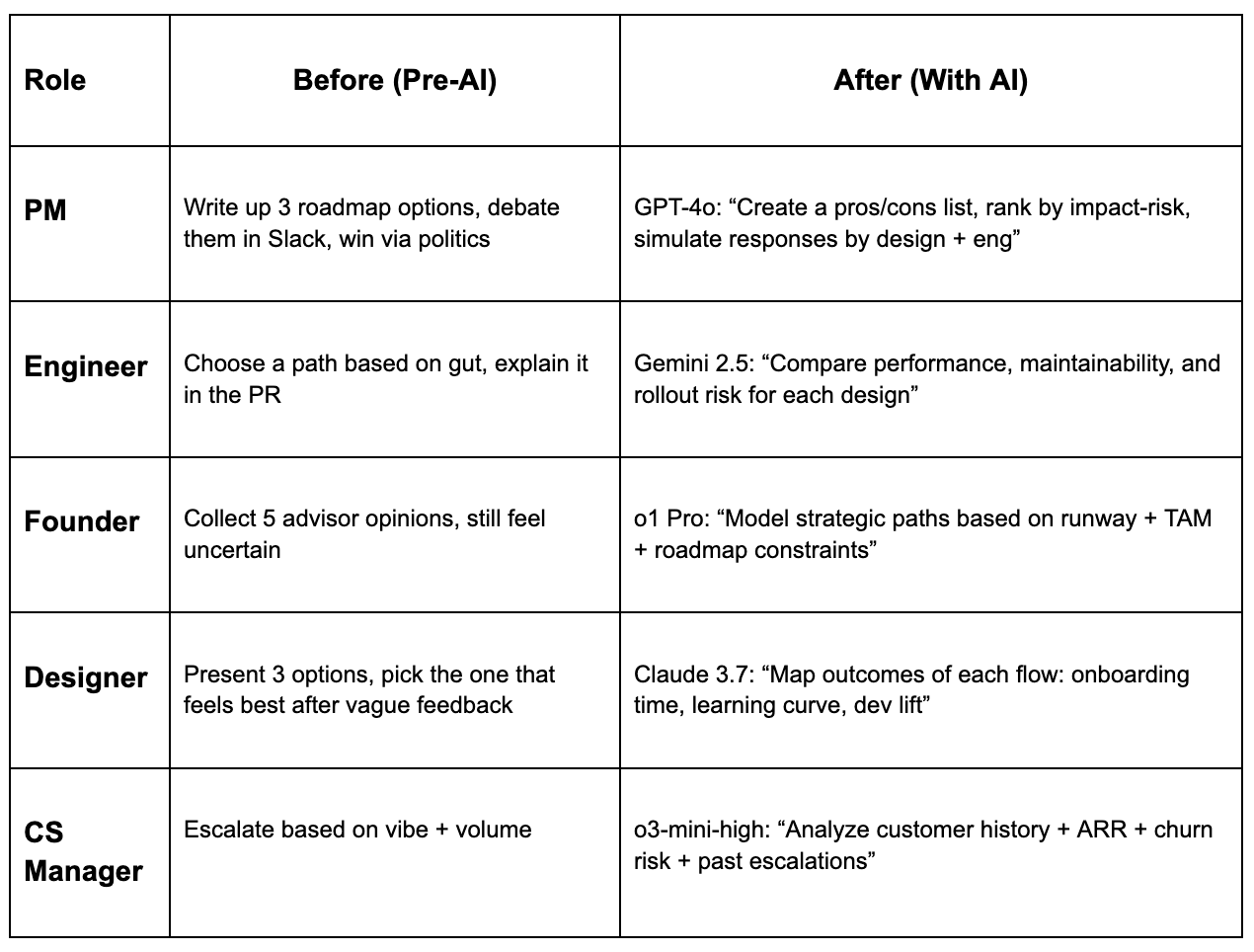
- A PM, prioritizing roadmap items under pressure
- An engineer, choosing between tech stacks or refactor paths
- A founder, deciding whether to pivot or double down
- A designer, weighing user education against simplicity
- A CS lead, deciding which customers to escalate, and how
Every time someone says:
- “Let’s go with option B.”
- “I think this is worth the risk.”
- “It’s not perfect, but it’s good enough.”
- “Here’s why we’re doing it this way.”
That’s this motion in action.
3. What Made It Hard Before
Most team decisions are made with more instinct than structure.
We:
- Choose based on urgency or influence, not impact
- Defend our favorite idea instead of mapping tradeoffs
- Skip framing and jump to arguing
- Make assumptions that no one catches until something breaks
And when the “why” behind a decision isn’t clear—or is missing entirely—it leads to:
- Rework
- Misalignment
- Loss of trust
- Decisions that can’t be defended under scrutiny
4. What AI Actually Helps With
LLMs don’t decide for you—but they’re incredibly good at helping you think clearly, together.
They can:
- Generate options you haven’t thought of
- Surface criteria hidden in your documents or history
- Compare tradeoffs in a structured table
- Simulate how a stakeholder might respond (“How would Legal see this?”)
- Flag missing logic or ambiguous language
- Suggest next steps and required data before committing
The best models here—o3 (probably), Gemini 2.5, o3-mini-high, Claude 3.7—don’t just evaluate.
They build scaffolding for good thinking. Thinking you can share, test, and iterate on with your team.
5. Before and After: What This Looks Like Across Roles
6. What This Means for Your Career
This is one of the most invisible workflows—and one of the most consequential.
The people who can make decisions visible, structured, and participatory are the ones others come to trust in moments of ambiguity.
Before LLMs, this was often seen as a leadership skill. Now? It’s a leverage skill.
LLMs help you:
- Structure complexity
- Reveal gaps in logic
- Keep decisions portable across time and team
And that makes your judgment visible—and trainable.
If you can frame well, guide others through options, and commit with clarity,
you’re not just making decisions. You’re shaping momentum.
And momentum is what separates people who execute from people who lead.
V. The Third Motion: Creation & Expression
1. What It Is
You’d think this is either the we’re doomed section or the only humans can do this section. But the reality is more complicated. Creation & Expression is the motion of turning intention into artifact.
It’s how your ideas leave your head and become something real—something others can use, react to, build on.
Sometimes that’s writing: specs, strategies, memos, marketing copy.
Sometimes it’s code. Sometimes it’s diagrams. Sometimes it’s decks. But in every case, the motion is the same: You go from messy internal thinking to structured external clarity.
It’s the heart of knowledge work. And it’s where the creative friction is highest.
2. Where It Shows Up
You’re doing this motion any time you:
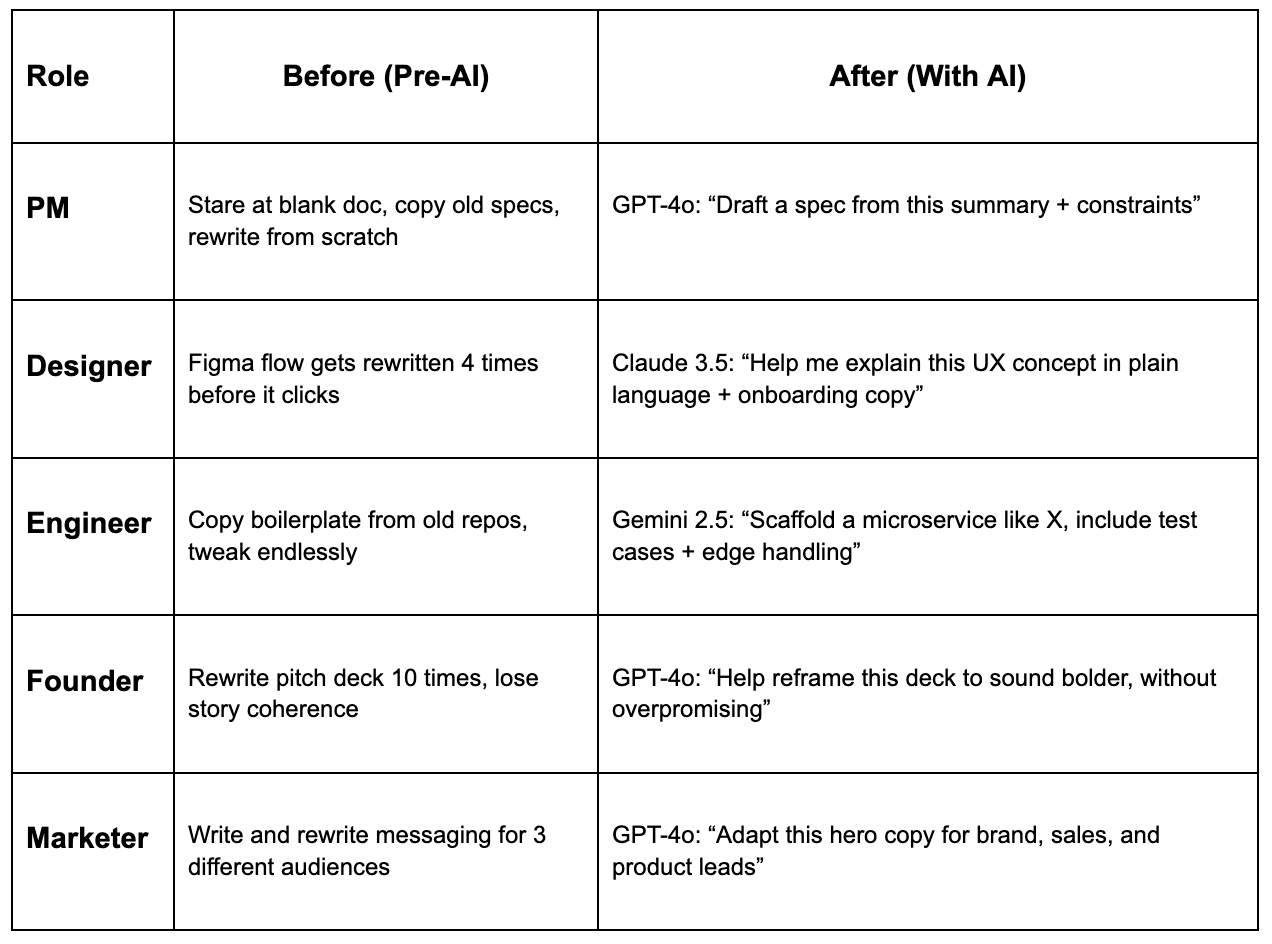
- Write a feature spec as a PM
- Draft a campaign plan as a marketer
- Build a prototype as a designer
- Scaffold a new system as an engineer
- Create a pitch deck as a founder
It’s also the motion that shows up whenever you think:
- “I don’t know where to start.”
- “I just need something on the page.”
- “Once I have a rough draft, I’ll be fine.”
That’s Creation. And when it’s blocked, everything else stops.
3. What Made It Hard Before
Blank page syndrome.
That’s the universal creative stall point.
You might have:
- Clarity on the idea—but no structure.
- Emotion—but no voice.
- Fragments—but no flow.
And the stakes are often high. You need:
- Buy-in
- Accuracy
- Momentum
- Alignment across people who all see things differently
So we polish too soon. We hesitate to share. We stall on perfection.
And often, we aim lower than we could’ve, just to get something out.
4. What AI Actually Helps With
This is the motion where LLMs feel the most like magic—not because they write perfectly, but because they make starting friction disappear.
LLMs help you:
- Draft from bullets or intent
- Restructure messy thoughts into clean formats
- Shift tone to suit your audience
- Create multiple framings to explore ideas
- Translate a draft into variants: summary, email, slide, doc
The best models here—ChatGPT 4o, Claude 3.5 (yes I like it better than 3.7 for writing, but the difference is slight), Gemini 2.5—don’t just write. They give you something to push against.
They make creation a conversation, not a confrontation.
5. Before and After: What This Looks Like Across Roles
6. What This Means for Your Career
This is the motion where many people fear they’re being replaced. “If the model can draft the doc… do I still matter?”
Yes. More than ever.
Because the first draft is no longer the bottleneck.
Taste, framing, clarity, and tone are the bottleneck.
And those are human skills. And if you don’t believe me, remember the note I gave you up above—some work is not easy to describe or tokenize!
LLMs make you:
- Faster at starting
- More flexible in framing
- Less emotionally blocked by perfectionism
- Better at sharing rough ideas and getting feedback
And they amplify the people who:
- Know what good looks like
- Know how to shape something from rough to resonant
- Know how to write for impact—not just completion
If you’re that person? LLMs don’t replace your creativity.
They give it more surface area.
VI. The Fourth Motion: Collaboration & Handoff
1. What It Is
Collaboration & Handoff is the motion of turning private context into shared understanding.
It’s the moment when your thinking leaves your personal mental map and enters the shared landscape of a team.
Sometimes that looks like a doc. Sometimes it’s an update. Often, it’s informal:
- A Slack message
- A PR comment
- A Loom walkthrough
- A one-liner in a meeting that redirects the entire project
But the core motion is the same: You’re trying to make your thinking legible to others—so they can act on it.
And that’s harder than it sounds.
2. Where It Shows Up
This motion shows up everywhere:
- A PM, writing a status update that keeps three teams aligned
- An engineer, documenting tradeoffs in a pull request
- A CS lead, escalating a customer issue with the right tone and urgency
- A marketer, reframing strategy into usable messaging for sales and product
- A team lead, recapping a cross-functional decision so it doesn’t get re-litigated next week
It’s present any time you think:
- “Will they understand this the way I mean it?”
- “How do I phrase this for that audience?”
- “I hope this doesn’t get misinterpreted.”
3. What Made It Hard Before
The hard part about collaboration isn’t the work—it’s the translation.
Everyone brings their own context. Their own incentives. Their own blind spots. So even if your ideas are clear in your head, others might:
- Miss your nuance
- Interpret tone differently
- Fixate on the wrong part
- Misunderstand your intent
So you rewrite. You clarify. You simplify. You get frustrated.
This leads to two outcomes:
- You spend more time formatting your thinking than doing the thinking.
- People still don’t understand it.
And that’s how teams drift—not because people disagree, but because they misunderstood.
4. What AI Actually Helps With
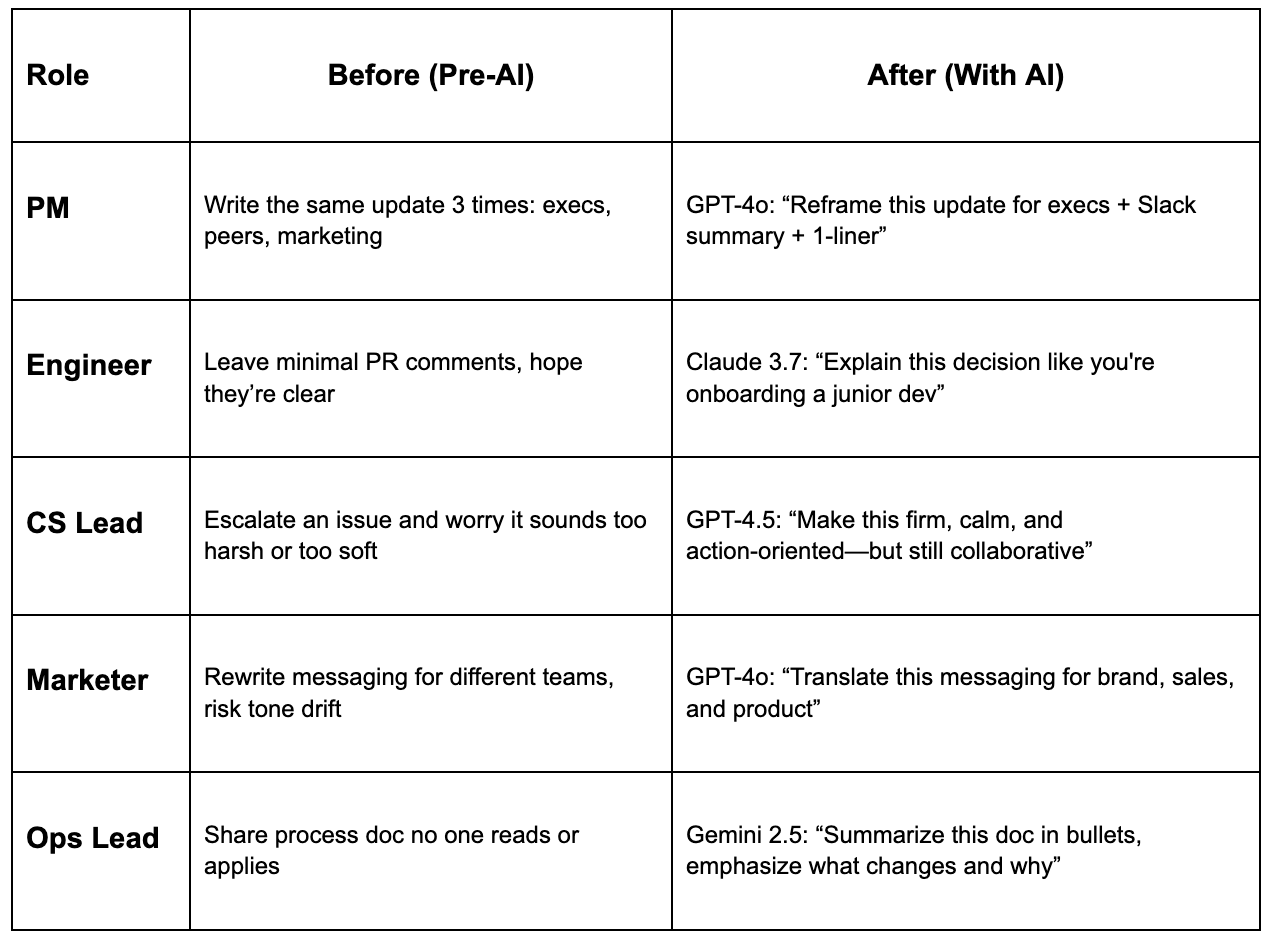
This is one of the most immediately useful applications of LLMs: They help you reframe, translate, and test your message—before it lands.
LLMs help you:
- Adapt your message for different audiences: “Rewrite this update for a skeptical CFO.”
- Reformat content across channels: “Turn this doc into a Slack post + slide + 3-line summary.”
- Adjust tone: “Make this more assertive but not aggressive.”
- Simulate misunderstanding: “What parts of this email are likely to confuse someone?”
- Translate technical thinking: “Explain this architecture decision to a non-technical stakeholder.”
Best models for this: GPT-4o, GPT-4.5—all excellent at tone, framing, and format conversion.
These tools don’t replace your thinking.
They make it easier for others to receive it.
5. Before and After: What This Looked Like Across Roles
6. What This Means for Your Career
This is the motion where trust is built—or lost.
It’s not about sounding smart. It’s about being understood.
And in distributed, async-first, cross-functional work (or in the office!), the person who:
- Clarifies intent
- Speaks in formats that land
- Adjusts tone without losing message
- Previews how others might receive their thinking
...is the person everyone wants in the loop.
If you can master this motion with AI:
- You write once, but deliver it five ways
- You catch drift before it spreads
- You make your thinking scalable
And that makes you a node in the system—not just a contributor.
Collaboration is no longer just a soft skill.
It’s a motion of structured empathy. And AI is the best collaborator you’ve ever had—if you know how to use it.
VII. The Fifth Motion: Execution & Iteration
1. What It Is
Execution & Iteration is the motion of turning a plan into sustained progress.
It’s not the moment of decision or the final delivery. It’s everything in between:
- Coordinating across people and tools
- Moving work from “almost done” to “fully shipped”
- Capturing what changed—and why—between each cycle
- Updating the plan without losing the thread
This is the least celebrated motion in tech—and arguably the most important. It’s where a lot of glue work happens. Plans are easy to draft, momentum is hard to sustain, and most people only get credit at the planning and launch stages.
2. Where It Shows Up
You see this motion every day:
- A PM, trying to track whether a roadmap is actually moving forward
- An engineer, juggling bug fixes and sprint commitments
- A growth lead, juggling multiple live experiments
- A CS manager, measuring whether new processes are helping or hurting
- An ops lead, making sure cross-functional initiatives don’t get stuck
This motion hides in rituals:
- Standups
- Weeklies
- Sprints
- Status updates
- Roadmap reviews
- Jira boards and Notion dashboards
But rituals don’t guarantee reflection.
And execution doesn’t mean momentum—unless the motion is clear.
3. What Made It Hard Before
Execution breaks down not because people don’t care—but because systems lose context.
When this motion fails, it usually sounds like:
- “Wait, what happened to that feature?”
- “Didn’t we already discuss that last week?”
- “Why did we change direction?”
- “Is anyone actually tracking this?”
The causes are predictable:
- Tools don’t sync
- Docs aren’t updated
- Decisions aren’t captured
- Updates feel performative, not reflective
Work gets done. But the why disappears. And when the why disappears, so does alignment.
4. What AI Actually Helps With
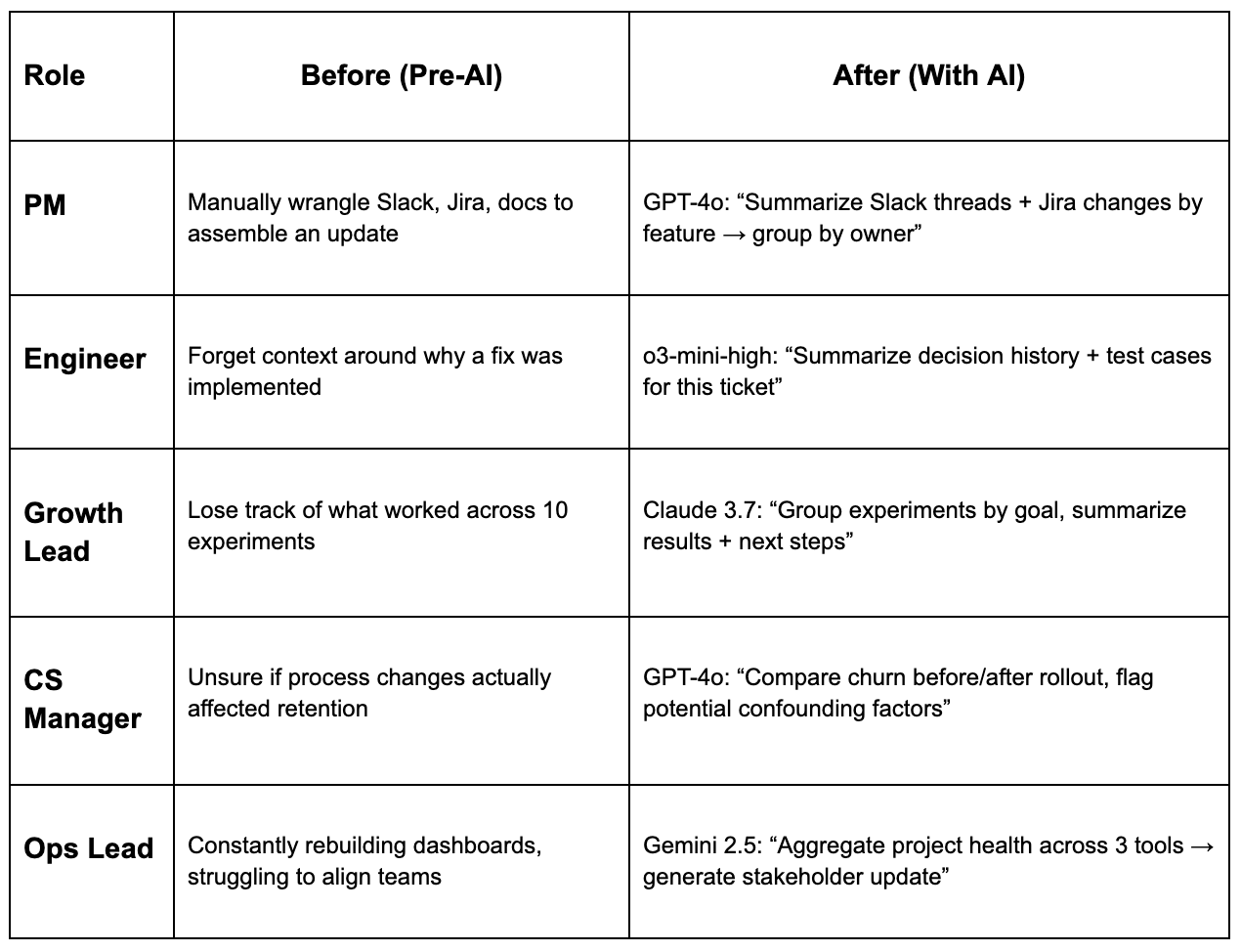
LLMs offer a new kind of memory and motion tracking. They help you:
- Track change over time: “Summarize what’s different between these two weekly updates.”
- Maintain continuity: “Remind me what the team agreed to last retro.”
- Auto-summarize action: “Convert Jira threads into a plain-English changelog.”
- Surface blockers: “What seems stalled across these check-ins?”
- Detect drift: “Compare our current plan to the original goals.”
When combined with models that support memory—like GPT-4o and, soon, others—this becomes a superpower. Execution becomes not just more efficient—but more coherent.
5. Before and After: What This Looked Like Across Roles
6. What This Means for Your Career
This is the motion that makes people trust you. Not because you’re the loudest voice. But because the work moves when you’re around.
When you use LLMs well here:
- Updates become easier to write and easier to read
- Context doesn’t leak across time or handoffs
- Alignment holds—without needing more meetings
Most importantly: you don’t just execute.
You make execution legible.
And the people who do that—quietly, reliably, clearly—are the ones everyone else wants to work with. Because they make motion feel possible.
VIII. The Sixth Motion: Systematization
1. What It Is
Systematization is the motion of turning messy, one-time effort into structured, reusable patterns.
It’s the difference between:
- Solving a problem once → solving it every time, for everyone.
- A custom solution → a repeatable process.
- Hustling through a fire drill → building something resilient.
It’s not just process for process’s sake. It’s turning your hard-earned clarity into something scalable and shareable.
2. Where It Shows Up
You’re systematizing when you:
- Notice you’re answering the same support escalation ten different ways
- Build a spec and realize no one else is using the same structure
- Copy boilerplate code from three old repos—hoping one of them still works
- Onboard a new hire by rewriting the same doc with new examples
- Create a project plan you think others could reuse
This motion often starts as a sigh:
- “We should really have a template for this.”
- “Why does everyone do this differently?”
- “I’ll just do it myself—again.”
3. What Made It Hard Before
Systematization often got skipped because it felt like extra work:
- No one had time to document
- The process changed too fast to bother
- People didn’t think their way of working deserved a template
- Tools weren’t flexible enough to make reuse easy
So even high-functioning teams would:
- Repeat work from scratch
- Recreate past logic without remembering why
- Copy/paste old templates without adjusting them for new needs
And the cost wasn’t just time—it was quality drift and lost leverage.
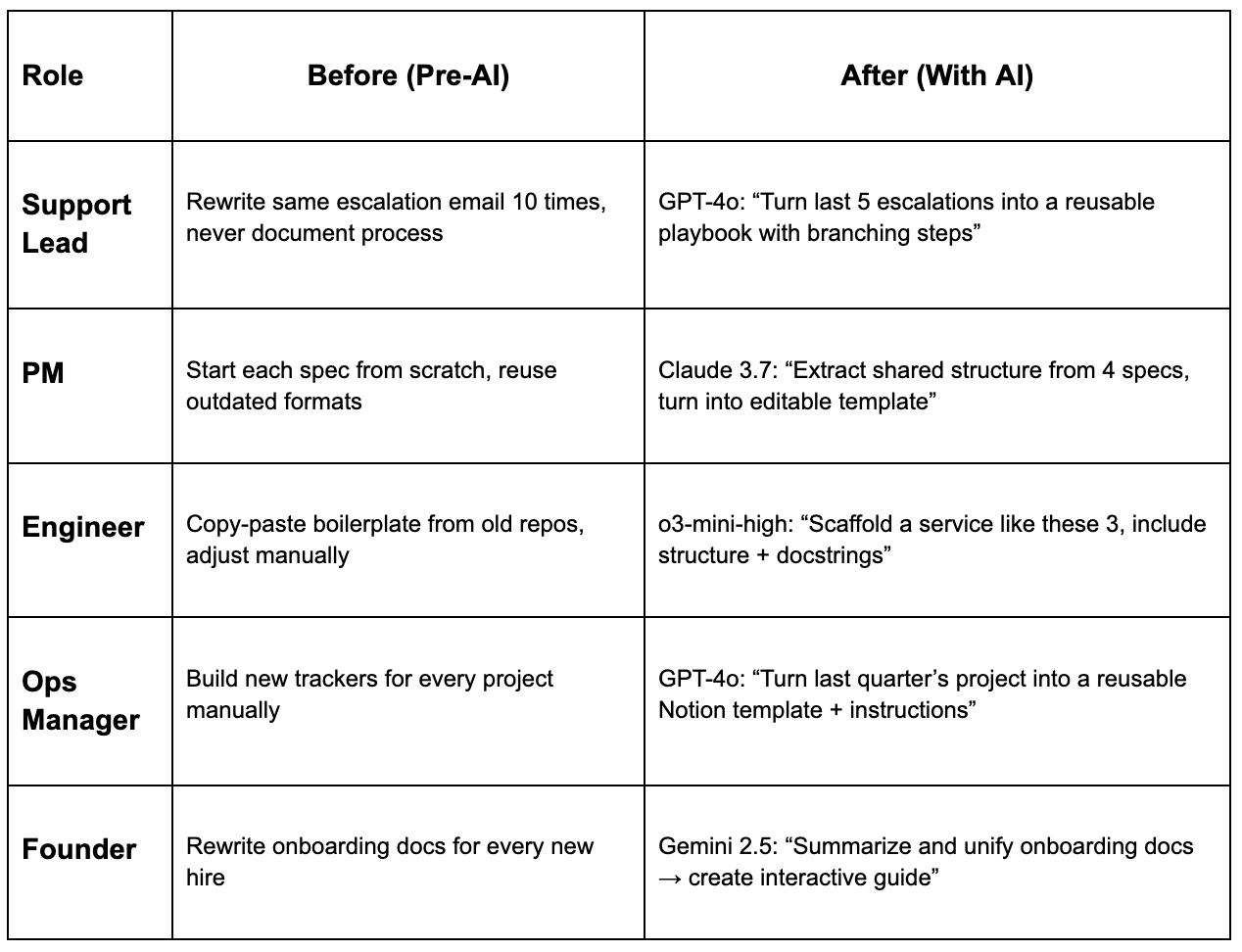
4. What AI Actually Helps With
LLMs make it possible to systematize in motion—without pausing the work. They can:
- Spot repetition across docs or conversations
- Extract implicit steps from an example process
- Generate templates based on 2–3 examples
- Compare inconsistent outputs and propose structure
- Write docs, checklists, and SOPs while you work
This isn’t static documentation—it’s living systems, built alongside your flow. Best models for this: Claude 3.7, o3 (probably) o1 Pro, o3-mini-high.
Systematization becomes something you do while solving the problem, not after.
5. Before and After: What This Looked Like Across Roles
6. What This Means for Your Career
This is the motion that separates operators from builders.
Operators get the job done.
Builders make it easier for the next person to get the job done.
And in a world where LLMs can help you structure anything, the skill isn’t whether you can write the process. It’s whether you see the pattern while it’s happening.
The people who do well here:
- Ask “Is this repeatable?”
- Use AI to structure their instinct into usable systems
- Save their team time without waiting to be asked
And that earns trust. Because you’re not just doing the work—you’re scaling it.
That’s what leverage looks like.
IX. The Seventh Motion: Meta-Reflection
1. What It Is
Meta-reflection is the motion of turning past experience into forward insight.
It’s how you go from “doing” to learning.
From activity to pattern. From story to strategy.
It’s the motion where you ask:
- What actually happened here?
- What changed—and why?
- What would we do differently next time?
- What is this teaching me—about the work, about the system, about myself?
In most teams, this is the rarest—and most neglected—motion.
2. Where It Shows Up
You’re reflecting when you:
- Run a retro and try to remember what shifted mid-project
- Prepare for a 1:1 and want to talk about more than just to-dos
- Revisit an old project and realize you don’t remember why you did it that way
- Write a performance review or promotion packet
- Prep for a board meeting by reconstructing what really moved over the quarter
This motion hides in:
- Retrospectives
- 1:1s
- Planning reviews
- Postmortems
- Annual check-ins
But it also lives in the moments between those rituals—when you pause, look back, and search for meaning.
3. What Made It Hard Before
Reflection is hard because it requires memory, honesty, and structure.
And we’re not set up for it. Most of the time:
- The context is scattered across Slack, docs, and memory
- The signals are subtle and easy to forget
- The emotional energy isn’t there—we’re already onto the next thing
So we fake reflection:
- “We learned a lot.” (unspecified)
- “We pulled through.”
- “We’ll do better next time.”
But that’s not learning. That’s closure without clarity.
4. What AI Actually Helps With
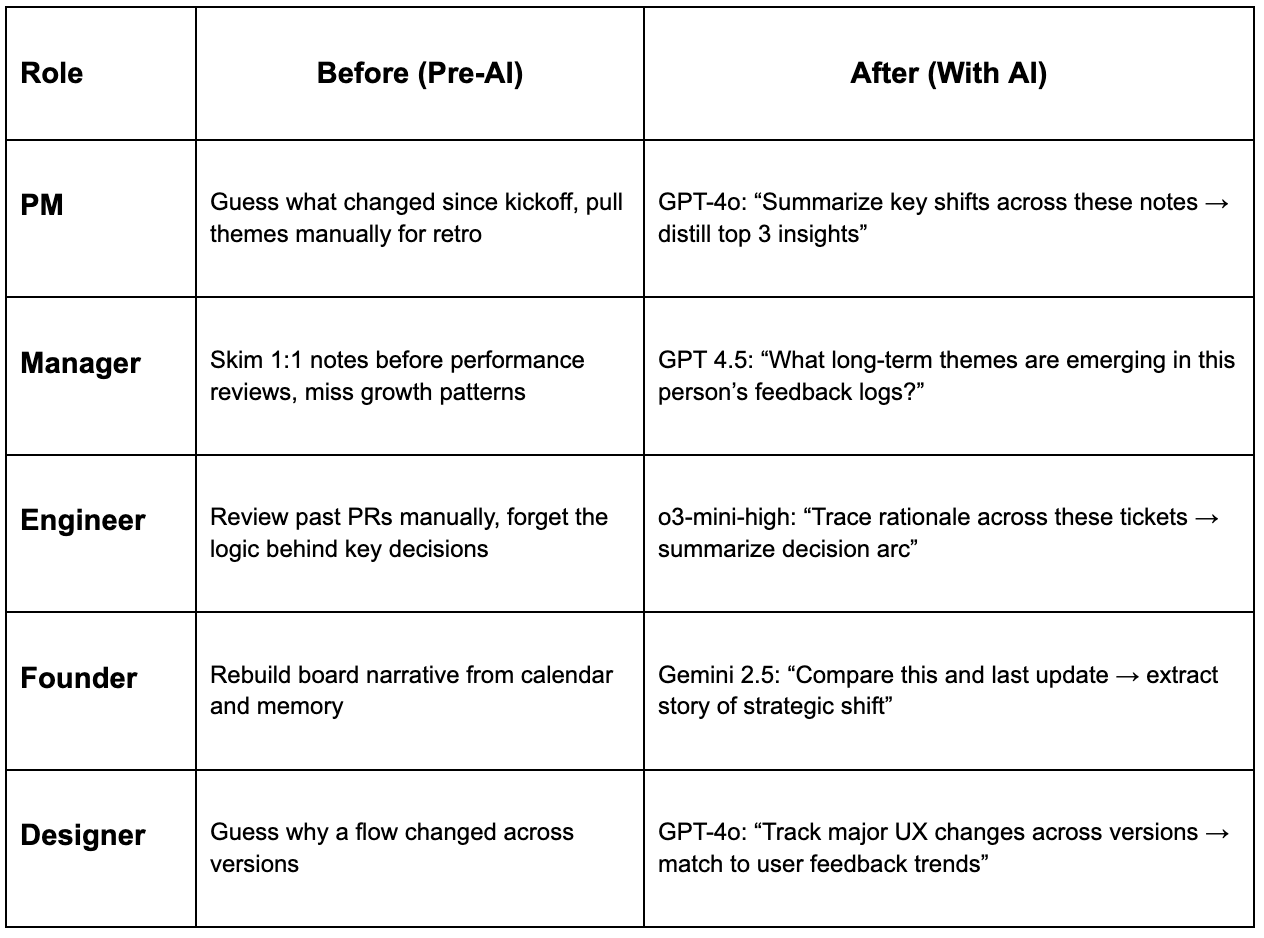
LLMs don’t have emotional entanglements the way we do. But they can help you remember.
And in this motion, remembering is 80% of the battle.
They help you:
- Summarize what changed across docs, threads, PRs, and standups
- Compare decisions over time
- Detect pattern drift and scope creep
- Highlight tone shifts in 1:1s
- Synthesize lessons from feedback, updates, or retros
Best models for this: Claude 3.7, GPT-4o, Gemini 2.5, o3-mini-high.
These tools give you the raw narrative. What you do with it is up to you.
But now, you have something to stand on. A mirror that shows the shape of your past work—so you can design better forward motion.
5. Before and After: What This Looked Like Across Roles
6. What This Means for Your Career
This is the motion that turns experience into evolution.
Anyone can do the work. Fewer people can improve how they do it.
And even fewer can reflect in public—so that teams, systems, and cultures can improve too.
LLMs won’t reflect for you. But they give you:
- The raw thread of what happened
- A chance to see themes earlier
- The ability to revisit your thinking with distance
And that’s where real growth happens—not in the intensity of work, but in the quality of the reflection.
If you master this motion, you become the kind of person who:
- Knows how they’ve changed over time
- Teaches others through synthesis, not slogans
- Gets better every quarter—not just busier
Reflection isn’t the end of work. It’s how the next motion starts with more clarity than the last.
X. What This Means for You (and Us)
If you’ve made it this far, something probably landed.
Maybe you recognized one of your own workflows—something you’ve been doing for years, but never had a name for. Maybe you felt the quiet fear that comes every time a new model drops—and felt it ease, just a little. Maybe, for the first time, you saw how your work moves—and where the friction lives.
If so, hold on to that. Because that’s clarity. And clarity is leverage.
This isn’t just a guide to surviving AI. It’s a guide to thriving with it.
You now have a language. Use it. You now have a map. Explore it. You now have a frame. Share it.
Talk to your team about motion. Ask each other where things get stuck.
Map one workflow this week. Identify the leverage point. Plug in the right model—not the fanciest one, the one that fits.
You don’t need to master everything.
You just need to work in a way that makes sense to you.
Then make that motion legible to others—and to the machines that now walk alongside you.
This is what working with AI actually looks like. Not automation. Not delegation.
Collaboration with clarity. Design with motion in mind.
You’re not just prompting a model.
You’re prompting a system. Your system.
The best workers in the AI era won’t be the ones who work the fastest. They’ll be the ones who know how their work flows. And who can make it flow better—for themselves, for their teams, and for the systems they’re building.
So when the next model drops tomorrow—or next week—you won’t flinch.
Because you’re not chasing tools. You’re designing motion. And motion scales.
Let that be the work.
For more on AI, subscribe and share!

\Those little post-its are very calming\