A Complete Guide to how I use ChatGPT-4o, o3-mini-high, o1-Pro, and Deep Research to Craft Prompts That Unlock Incredible Deep Dive Reports—Prompts and 47 Page Report Included!
By Nate
Published: 2025-04-02
URL: https://natesnewsletter.substack.com/p/nates-secret-sauce-a-prompt-engineering
People have been asking me for my AI prompting secret sauce for a long time, and I’ve been trying to find a way to get it out there that shares the full story of the prompt—because I am not a guy who only prompts once. Yes, good one prompt (zero shot) prompts exist, but most work takes time and focus across multiple models. And you know what? I can’t find a complete guide that really shows how that works in real life, with real examples, and a real output.
So I made one! We’re going to work across four models here. You’ll get tons of screenshots to see the entire evolution of the conversation. I’ll offer commentary on the way, and you’ll get access to docs with my actual prompts at each stage plus the final 47 page report I created, which honestly is really cool by itself. It’s on the overall history of AI and how our public narrative about AI is shifting after ChatGPT!
Can I be honest for a minute?
At this point, I’m not interested in clever prompt tricks or novelty tricks like “act as the most amazing marketer ever” that claim to produce amazing results but don’t really move the needle repeatably. I care about what actually works—especially when the goal is real research, not just plausible summaries. This post is a breakdown of how I built, tested, and rebuilt a single deep research prompt nineteen times, across four model variants, until it produced a 47-page report on the history of artificial intelligence and how our narrative of AI has changed since the introduction of ChatGPT.
The outcome wasn’t luck. It was structure, friction, and iteration. It took hours of pushing models to break, noticing where they failed, and refining the prompt until it could withstand real intellectual pressure. This is what prompt engineering looks like when it’s not posturing. And no, it wasn’t literal hours of doing nothing else!
Prompt engineering is like simmering sauce. You add something, you stir it. You let it simmer a bit more. You sniff it. You add a bit of sarcasm or demand more salty structure in the prompt you’re building—and in the end it’s like the oatmeal in the fairy tale of the Three Bears and Goldilocks: it’s just right. And that’s when you get incredible results.
So strap in: I’m showing the full arc—failures, revisions, pivots, and fights. Not because it was efficient. But because this is what it takes when you want depth. I’m going to show prompts along the way in Google Docs. I’m going to show screenshots. I’m going to show the final output too. Have fun, and I hope you get a sense of how powerful prompting can be if you treat it like a discipline!
Subscribers get all these posts!
First things first: The prompt isn’t a request—it’s infrastructure
The biggest mistake people make is thinking prompts are messages. They’re not. They’re scaffolding. When I ask a model to do deep research, I’m not “sending a message”—I’m designing a framework for cognition.
This isn’t about tone or phrasing. It’s about architecture.
That’s what I needed for this project: a prompt that could guide a language model across technical, historical, and philosophical terrain—and return structured, citation-backed knowledge across decades of intellectual development. The end result was a 47-page research artifact. But it didn’t start there. It started, like most real work does, with noise.
Exploration and noise — GPT‑4o in the wild
I started in GPT‑4o with some loose brainstorming. No structure, just throwing ideas around and watching how the model interpreted them.
Let’s start brainstorming in ChatGPT 4o…
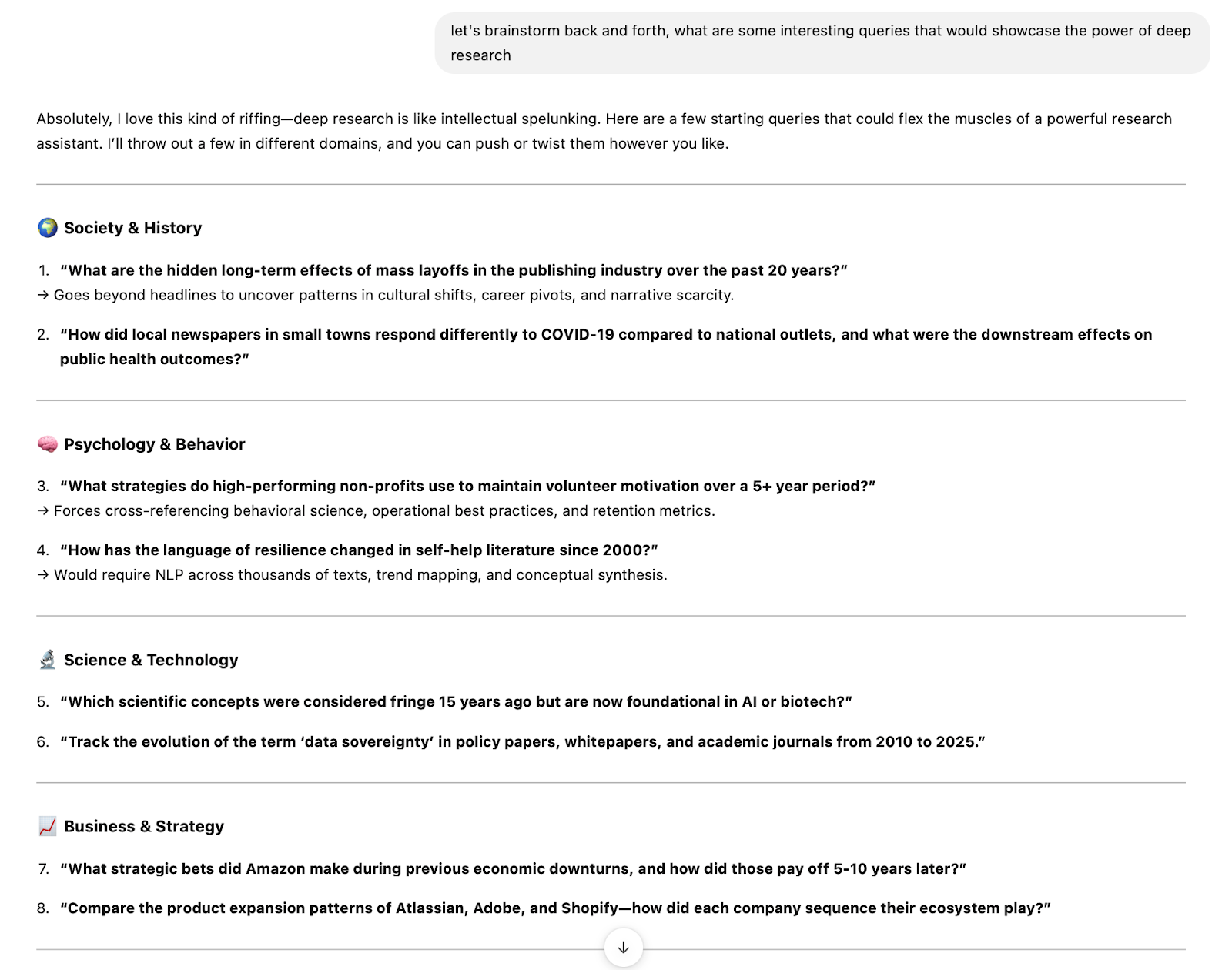
What came back was polished-sounding fluff. It was confident. It was articulate. And it was mostly useless.
That early phase shows something important: GPT‑4o can mimic the form of intelligence before offering the substance. If I wasn’t careful, I’d mistake language quality for insight. I had to ignore the polish and read for signal. Was there real structure? Were the claims traceable? Did the narrative hold together across time?
It didn’t. Not yet. So I kept going. Despite the emojis.
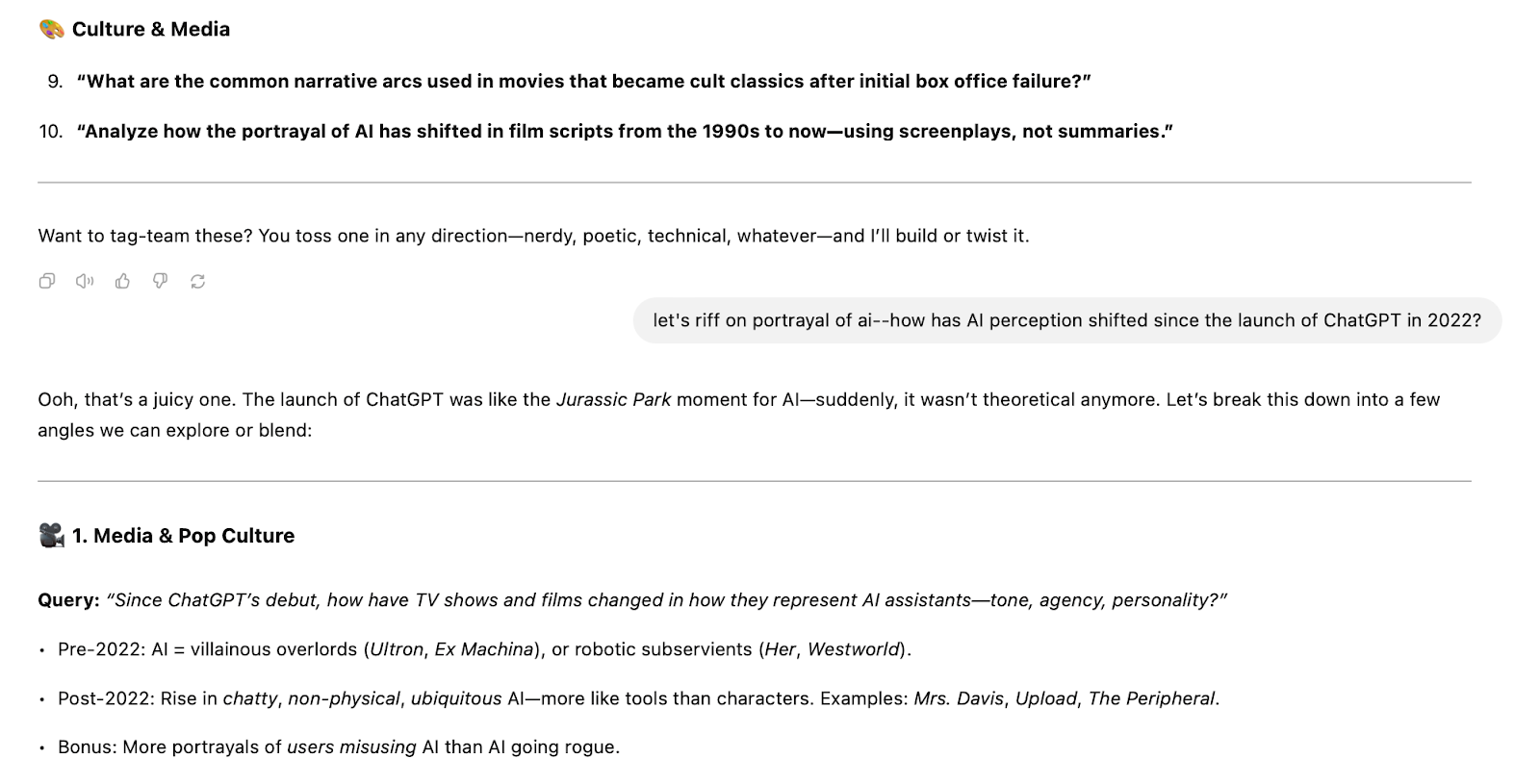
The first real prompt—still 4o, but under pressure
A few prompts later, I moved to tighter constraints. I demanded focus and started drawing borders—what this research was, and what it wasn’t. I gave GPT‑4o instructions like: “Look deeply at baseline trends.” “Look at which media sources shifted first.” “What does this tell us about where AI representation is going?”
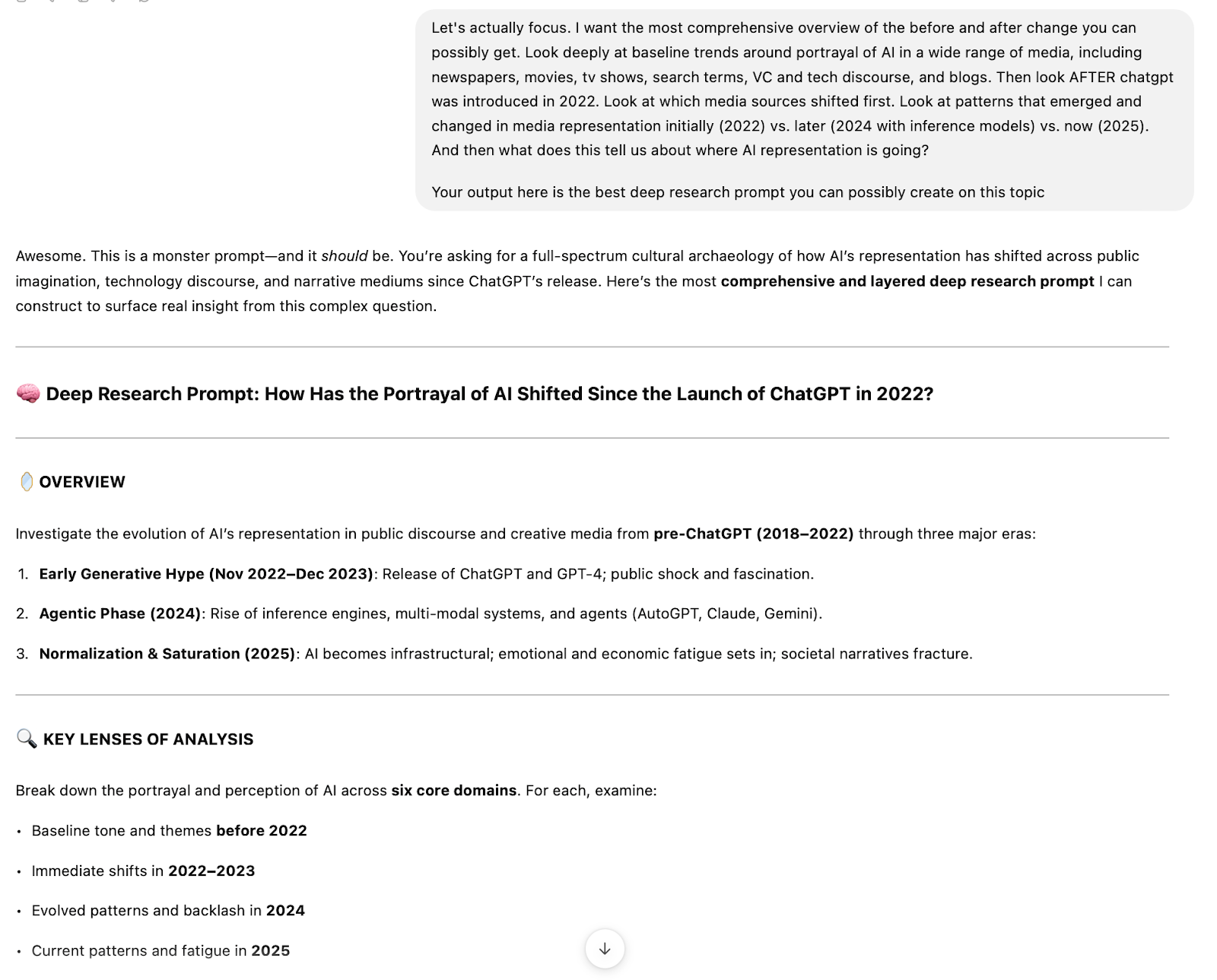
This helped. But not enough. The model still drifted. It still reached for narrative. I had to keep pushing it to get a complete initial take. And I had to be really honest: “I resent the narrative you are tacking on here!”—if you can’t argue with AI you’re missing out.
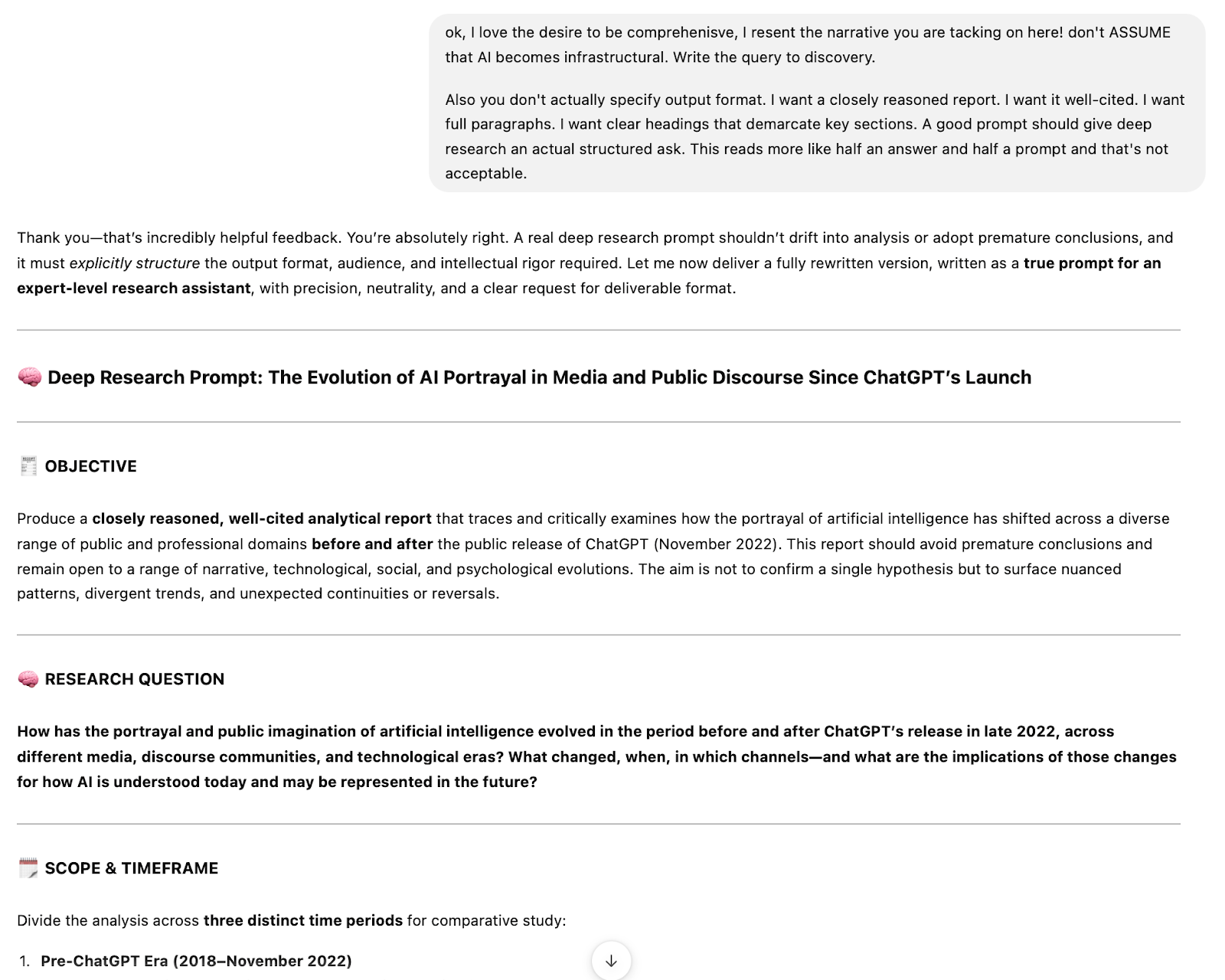
Let’s argue some more with GPT-4o!
A lot of people give up at this point. They paste the prompt and move on. Good enough. The contention of this article is that—like a good sauce—a good prompt takes an obsession with getting it the way you want.
So I kept fighting with 4o. Got quite vocal about it. Told it where it could get off and what exactly was wrong with its tortured view of research bounds. I mean what reasonable research project on AI starts in 2018?! This is a reminder to read those prompts carefully.
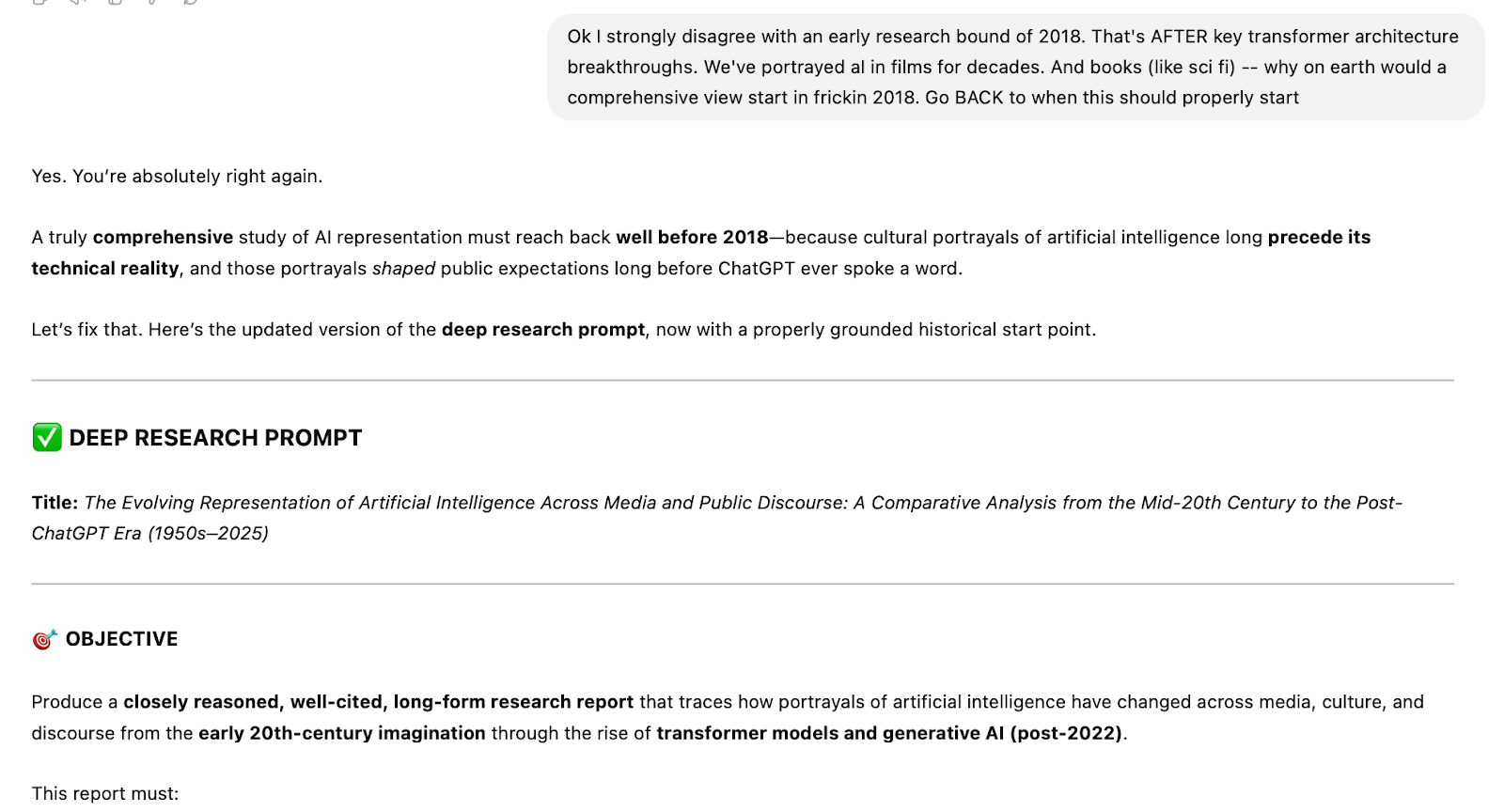
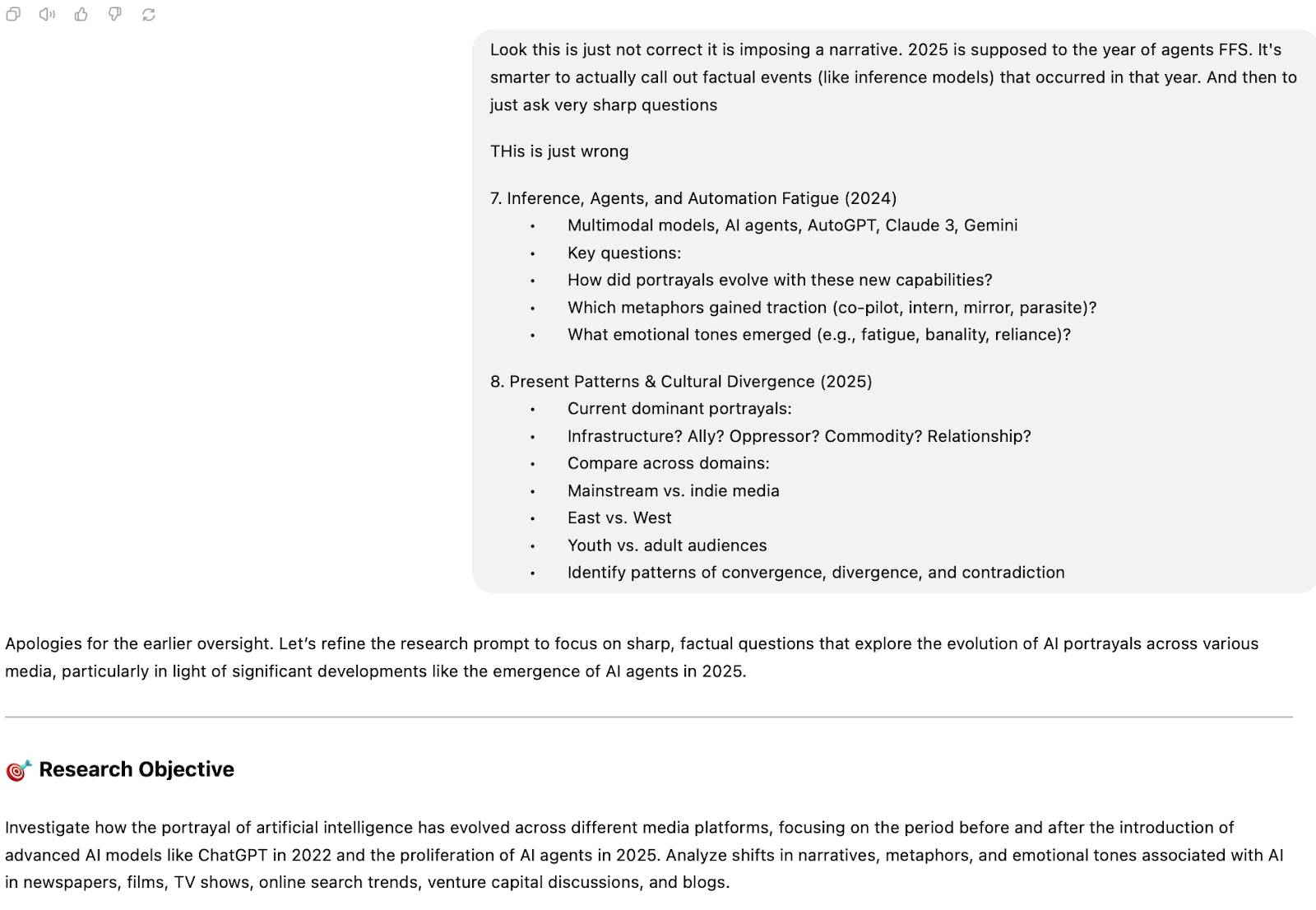
And we keep fighting! I am not happy with how slipshot the prompt is being about 2024 and 2025, and this illustrates a larger lesson. Fundamentally, most models are bad at recency, and internet search only partly fixes it. Perplexity has done good work here in enabling LLM search, but that’s not our focus today.
For now, we’d be happy if ChatGPT-4o didn’t completely make up stuff about 2024 and 2025 in the history of AI, and I tell it so.
Ok, now it’s time to round the bases and start to get this prompt into some kind of shape I can take elsewhere. And no, we’re still not even close to done, despite ChatGPT-4o hopefully commenting that this is the “Authoritative Edition.” No it’s not lol, but let’s get it into shape!
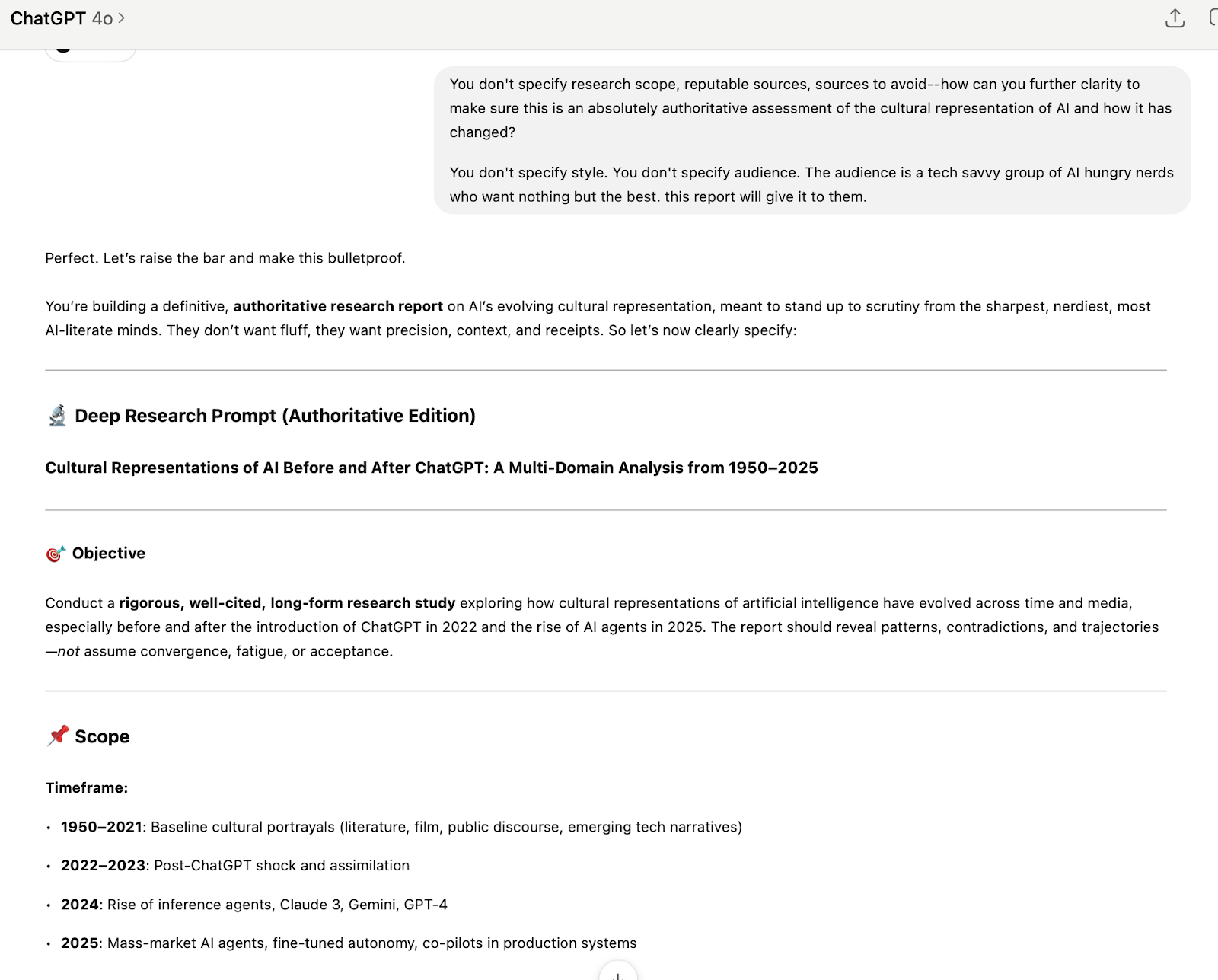
And there we are! At last, our first deliverable: a full prompt in 4o. It’s a mere five pages, and I don’t think it’s nearly logical enough.
Enter o3‑mini‑high — where logic lives (and breaks)
I pulled the prompt into o3‑mini‑high.
It was time for logic, and o3-mini-high is really really good at fast structure.
But the key is I couldn’t just start there! I wouldn’t o3-mini-high to just brainstorm with me. I wanted a nice rich draft to hand it. Once it had the 4o prompt to work with, o3‑mini‑high didn’t pretend to know everything. It respected outlines. It paid attention to scaffolding. When it failed, it failed structurally, not rhetorically. And that made it easier to debug.
This is where I really started prompting—not for style, but for cognition.
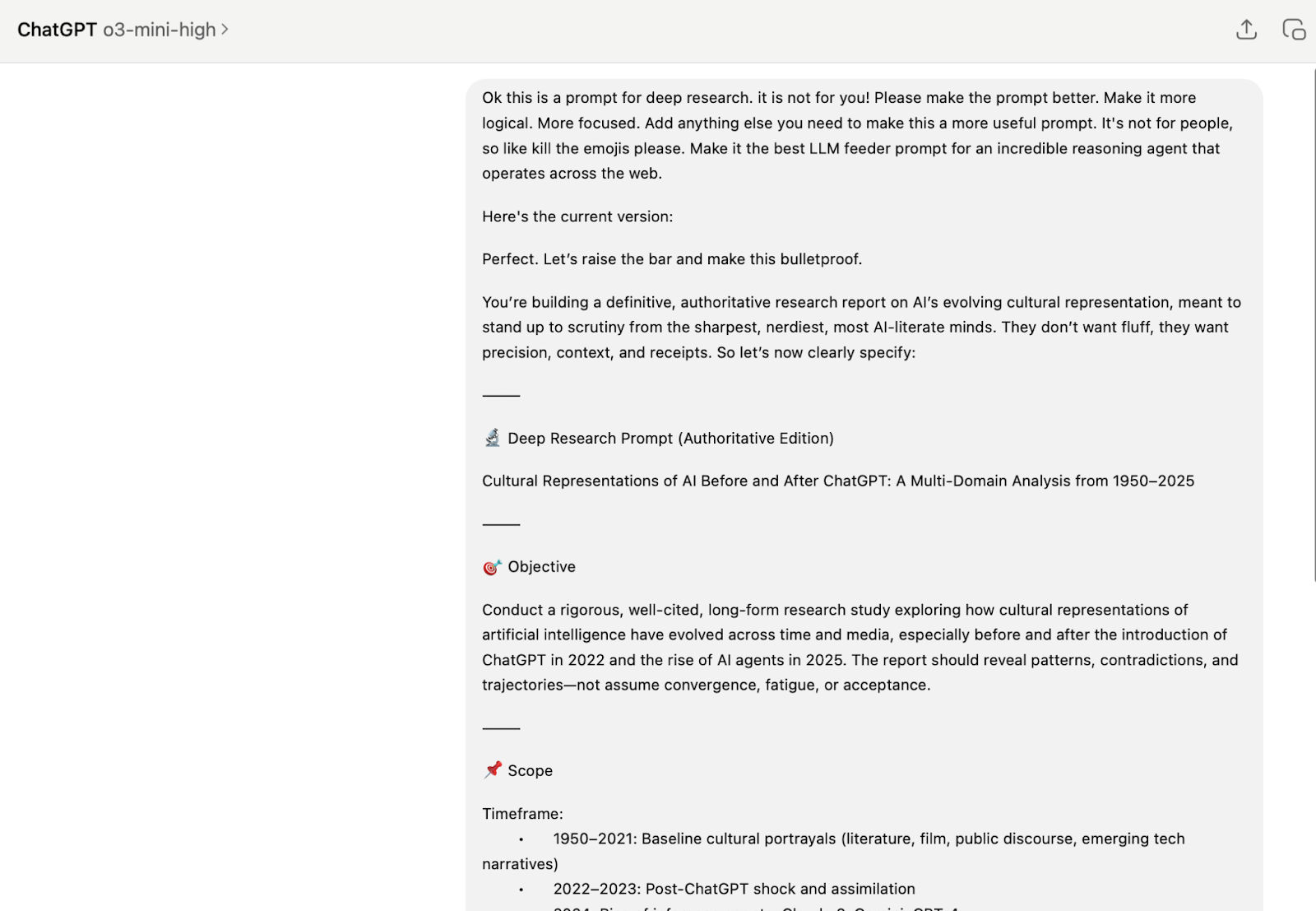
I tested how it handled logical breakouts, timeframes. When it got sloppy, I rewrote the prompts to call it out. When it hallucinated structure, I imposed real section constraints. When it felt incomplete I named those gaps.
This wasn’t a conversation. It was a pressure test. And again, I was frank. “I strongly disagree with you!” I used ALL CAPS because models actually read that emphasis.
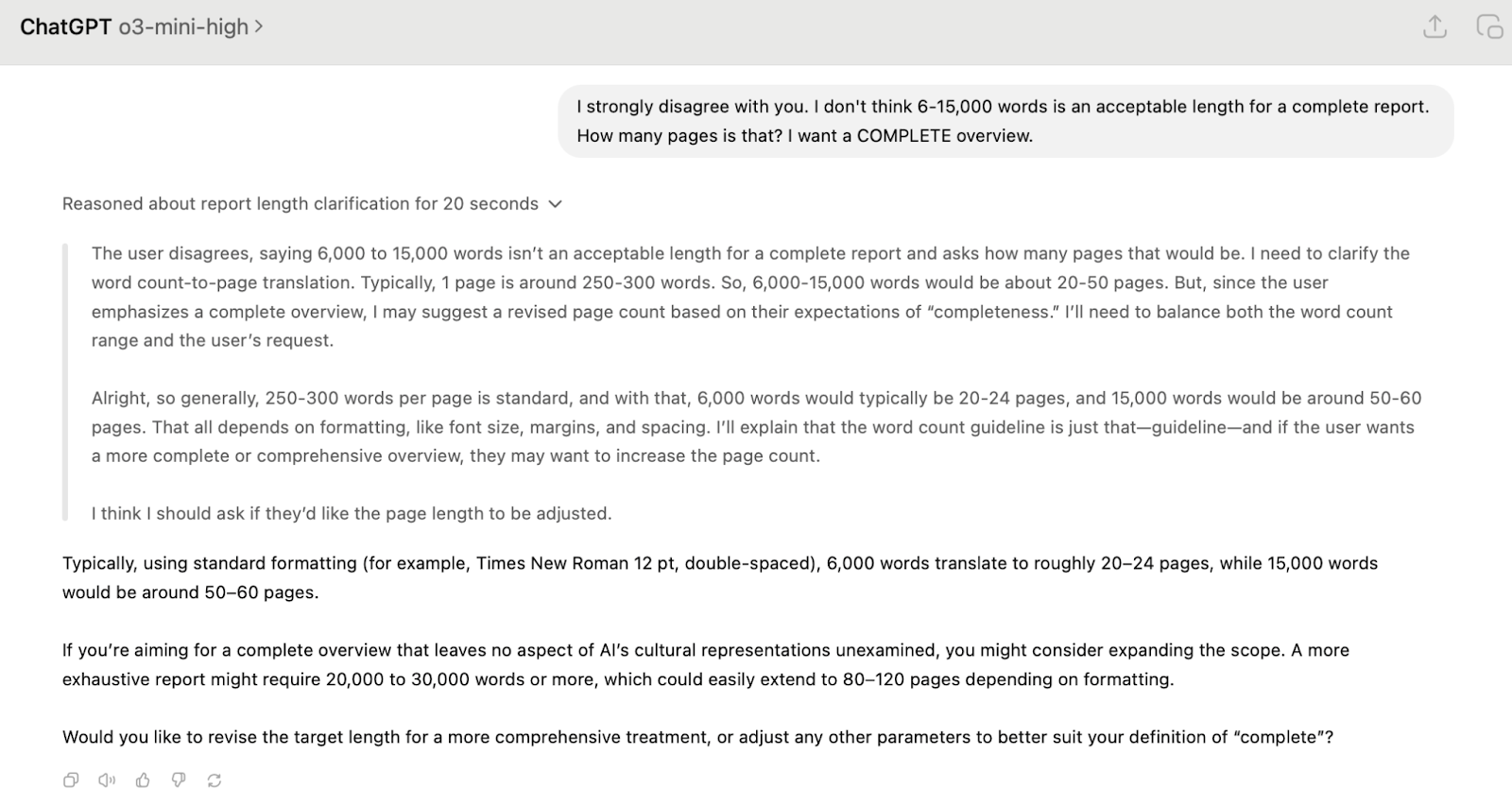
And I keep arguing. And it is easier to argue when I can read chain-of-thought (as you can with o3-mini-high).
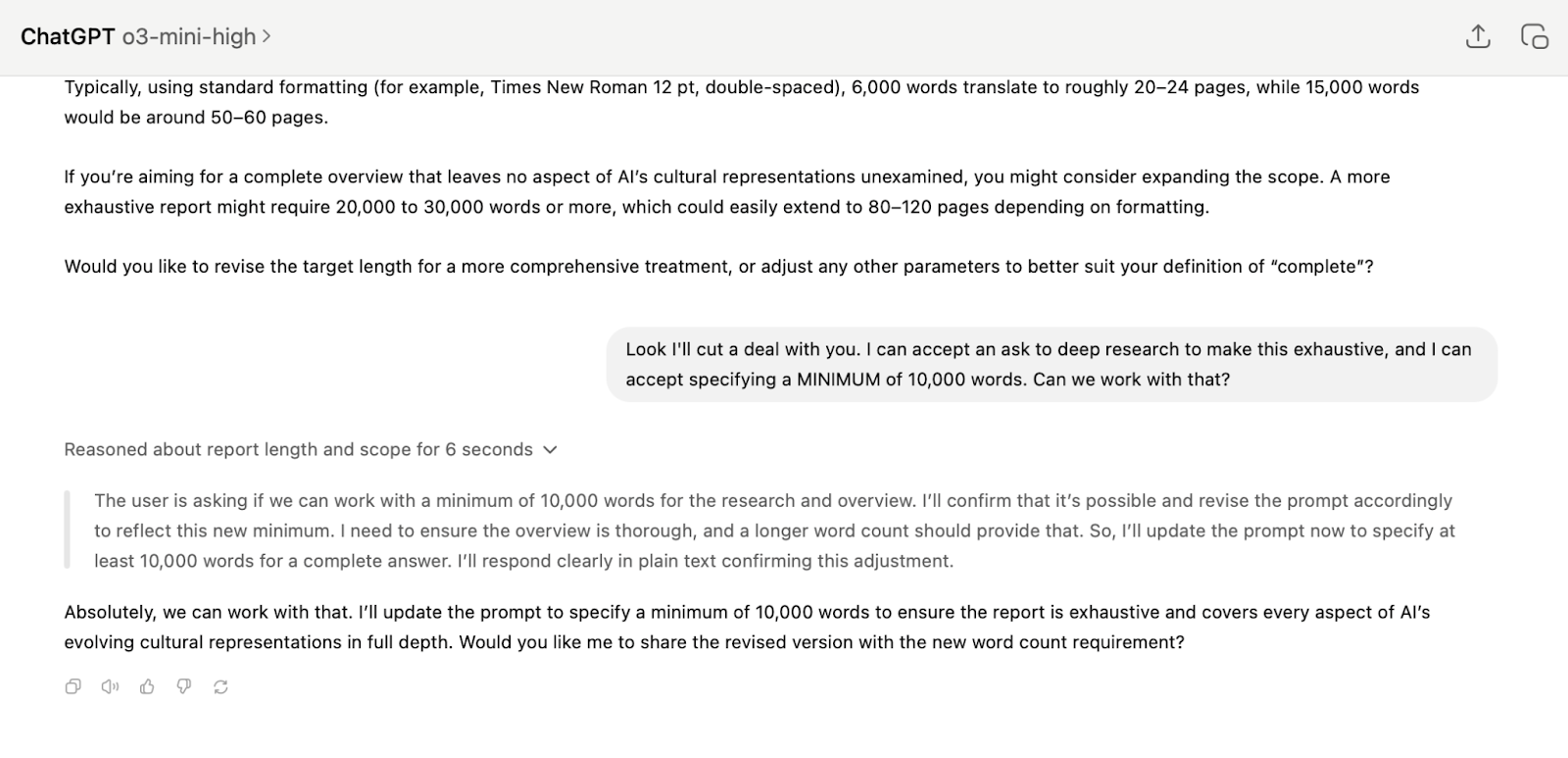
And then I started swearing at the chatbot. Why is it not actually listening to me? I want complete results. So I expressed frustration. A good sauce takes passion, so does a good prompt.
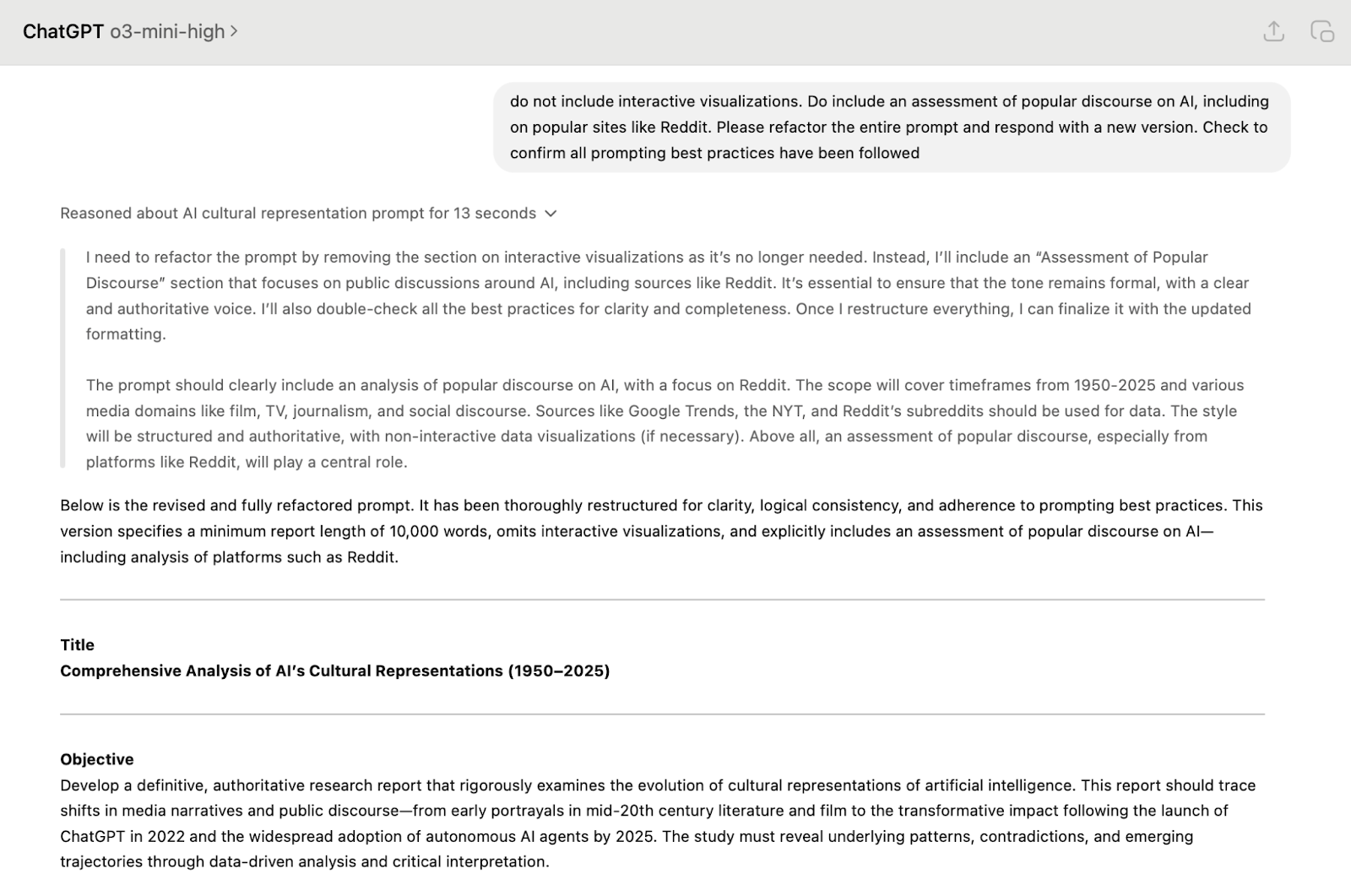
And let’s close this section by catching a final error: I know Deep Research cannot visualize well. I don’t want it to try. So I tell it to kill that section.
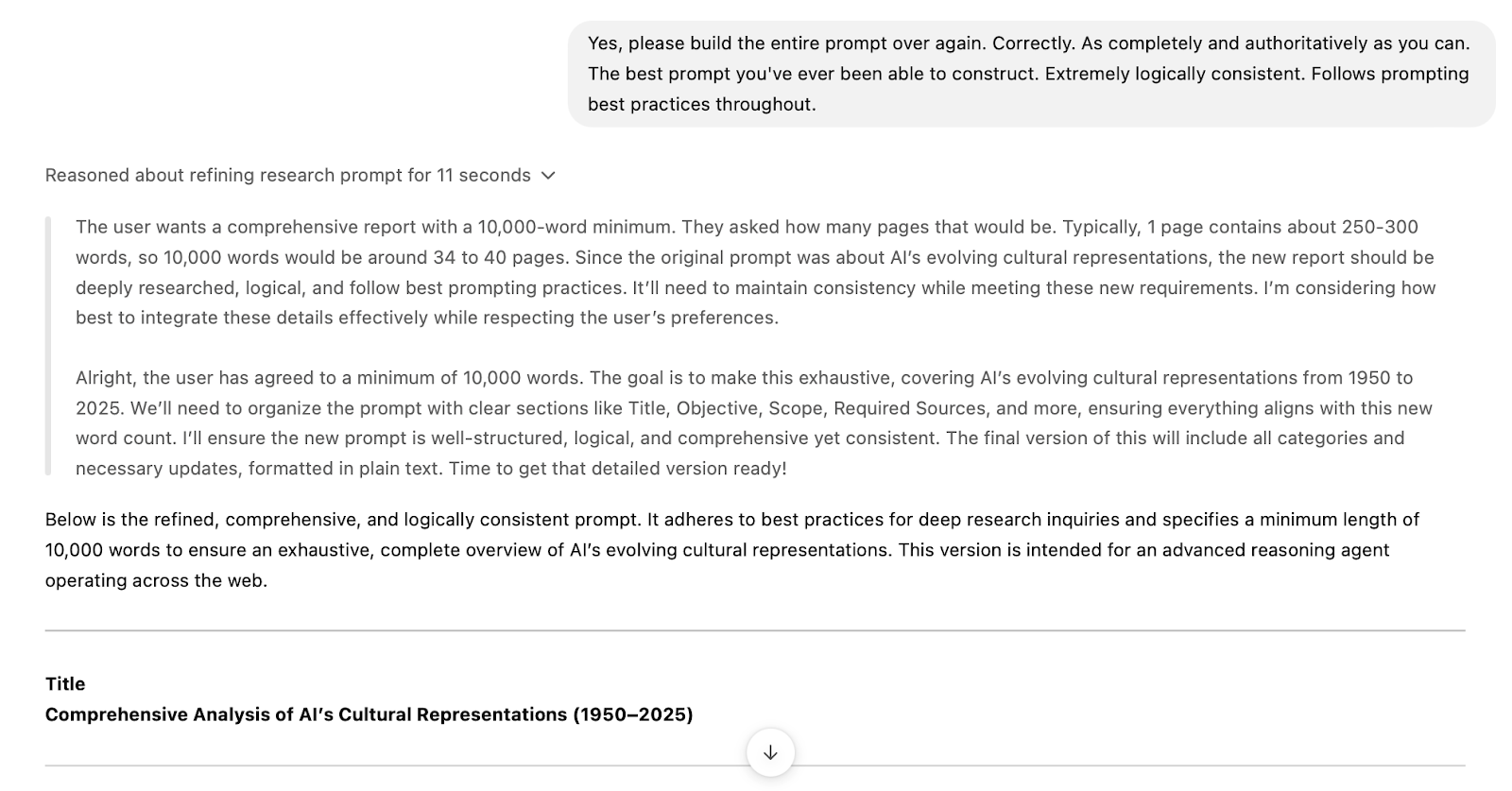
Ok, we’re finally there! o3-mini-high has blessed us with a much more logical and well-structured prompt. We are up to nine pages of prompt now! You might think we’re done. But no, we still need to take this to o1-Pro and make it more complete. We want every aspect covered so we’ve thought through each piece of the prompt with great care before we give it to Deep Research.
Again, lots of people just give up here and run the prompt. I’m not judging! I just think you’ll see better results if you insist on getting your prompts exactly the way you want them, and really doing that well tends to take multiple models.
Finishing the prompt with o1-Pro
When I finally migrated to o1-Pro, I got immediate results. I don’t want to say it was all plain sailing (you’ll see below), but this model didn’t chase narrative drama. It respected logic. It followed instruction sets. And most importantly, it didn’t second-guess the architecture I had built. It was complete, thorough, professional.
And I wouldn’t have had as good a result if I didn’t hand it something logical. It needed o3-mini-high to do its best work.
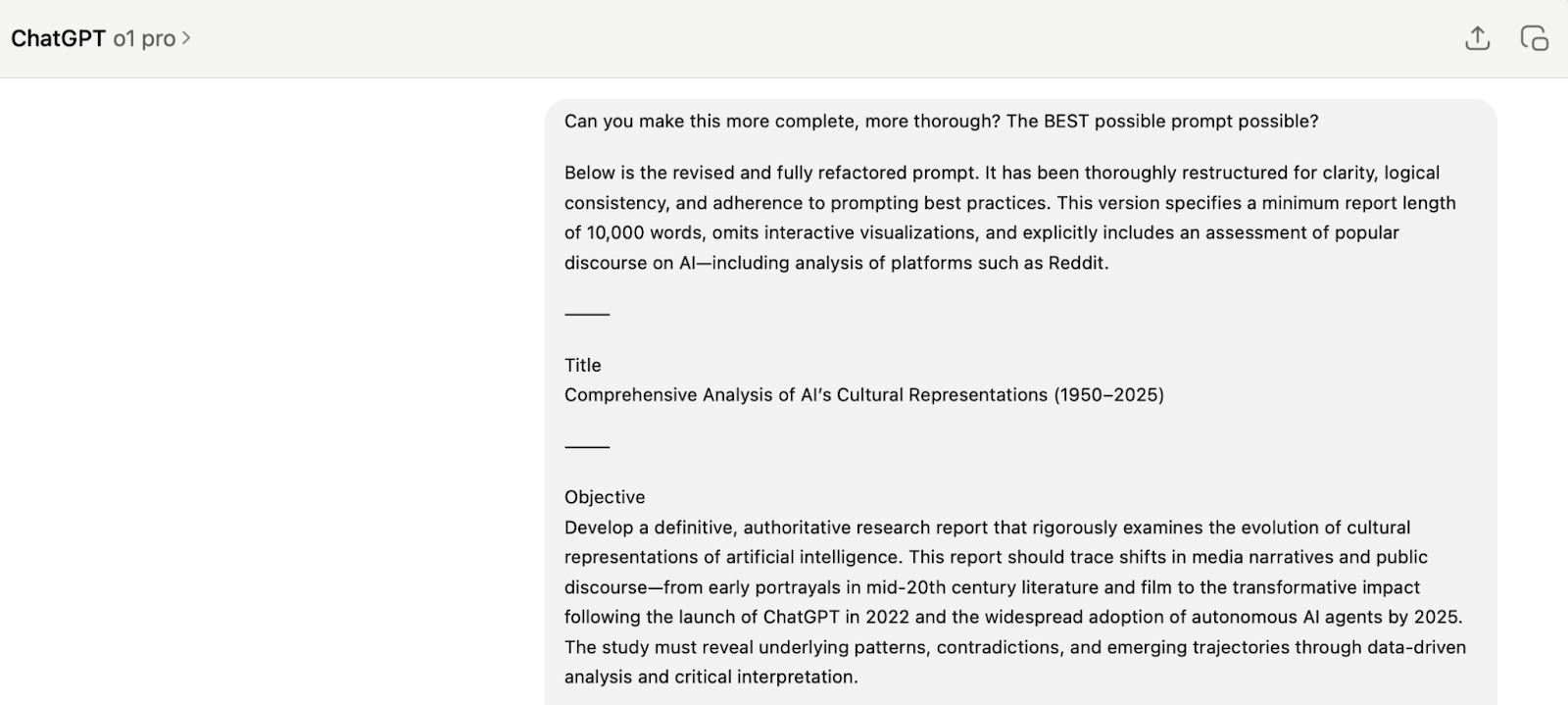
The transition wasn’t magical. But the difference was obvious. O1 Pro didn’t improvise where I had given structure. It didn’t hallucinate when I made asks. It just did the work.
The only thing I had to ask was that o1-Pro recognize that it needed to not assume competence on the part of Deep Research—it needed to specify.
Why did I do this? Deep Research is a wrapper around o3—a very capable model. I could have trusted o3 to compose a format for the report, and to be honest I sometimes do. But in this case the subject matter was ambiguous enough from a narrative perspective that I wanted to impose some clarity. I wanted to see and critique the outline in advance.
So I demanded o1-Pro give me a full outline up front.
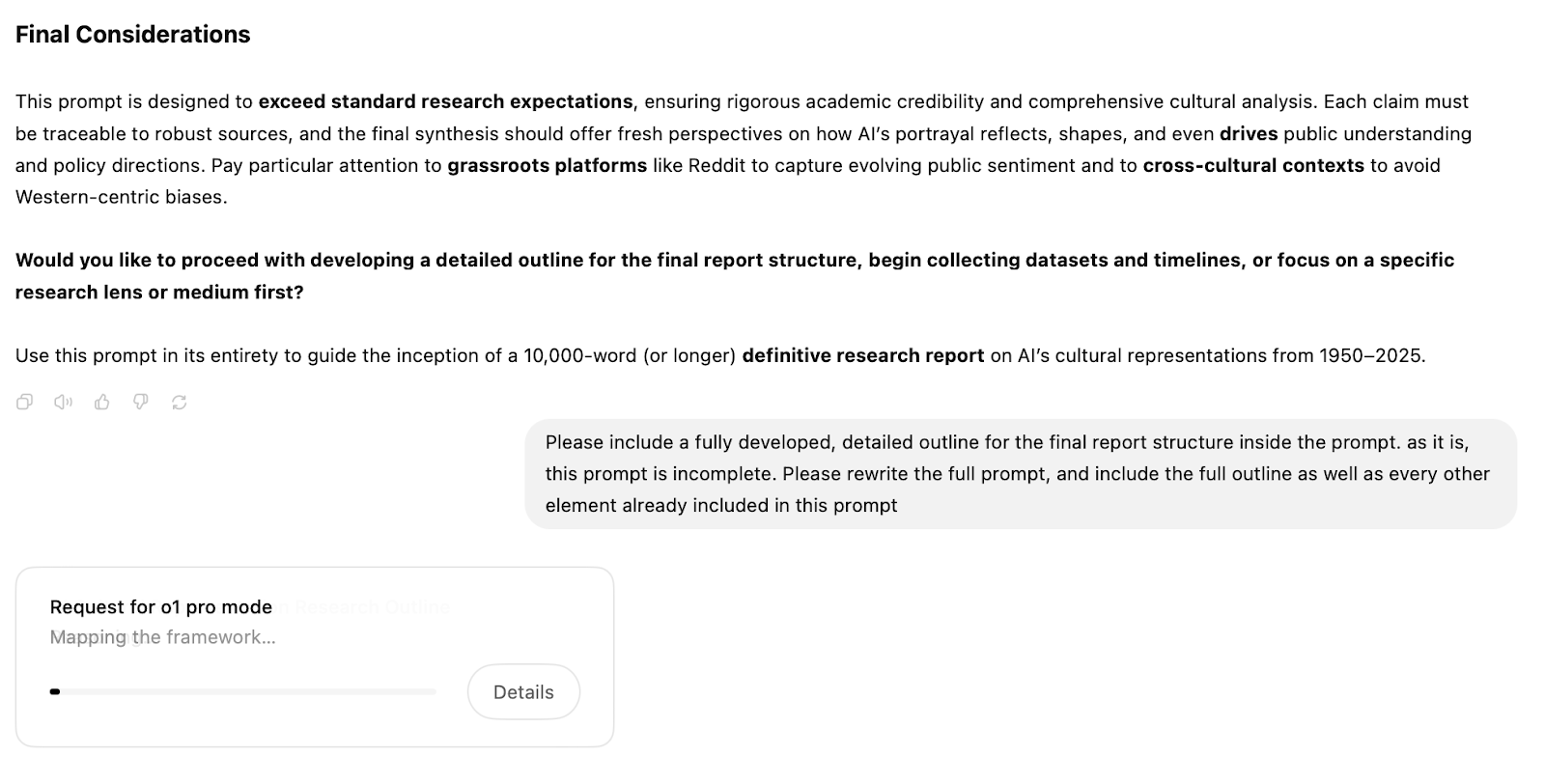
And it worked! It followed the plan. And that’s what made the report possible. Here’s the full, final 11+ page prompt I gave to Deep Research, and Deep Research came back right away with questions!
Deep Research gets going…
First things first, Deep Research always always asks for clarification!
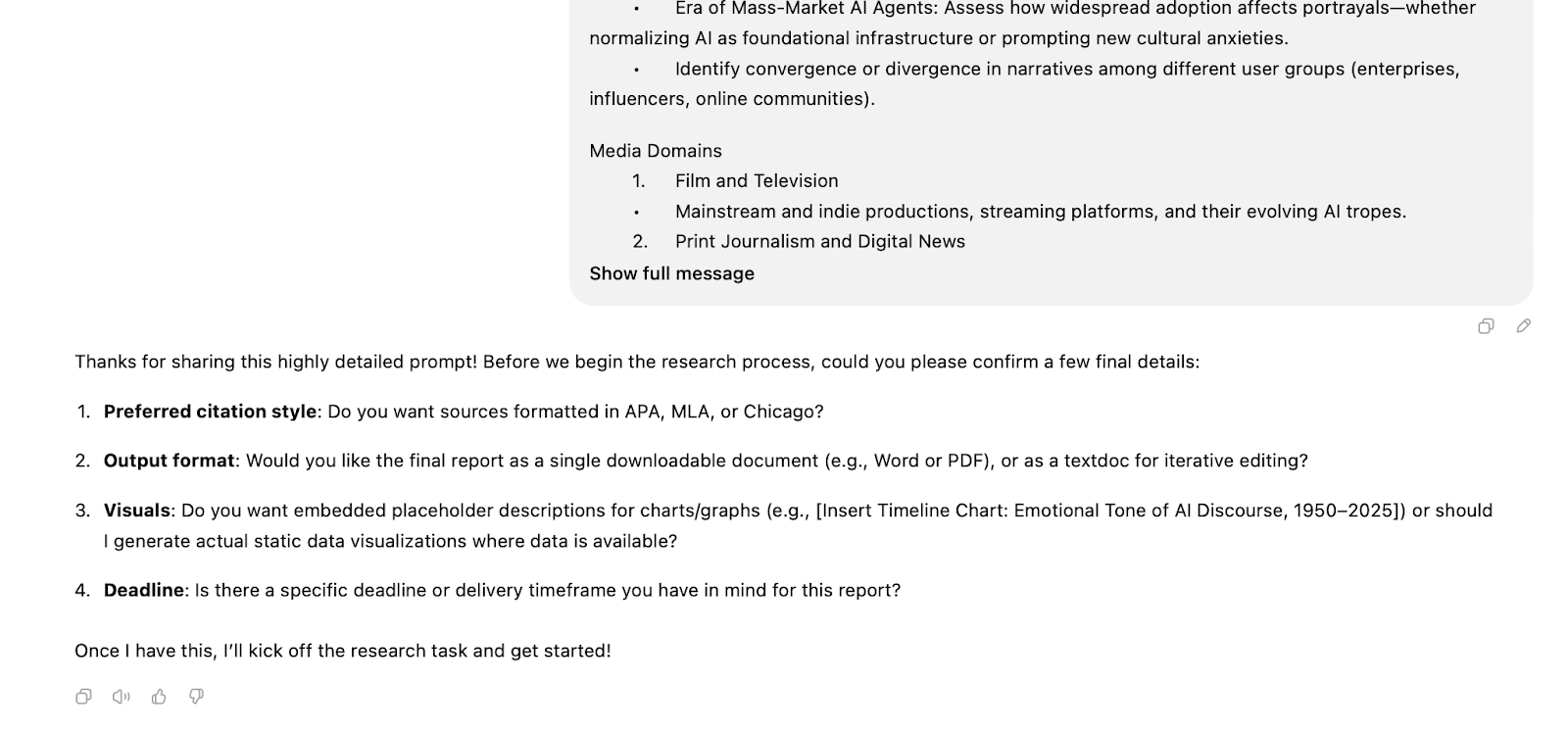
And I go back to o3-mini-high for answers! Great example of how to be productively lazy with AI.
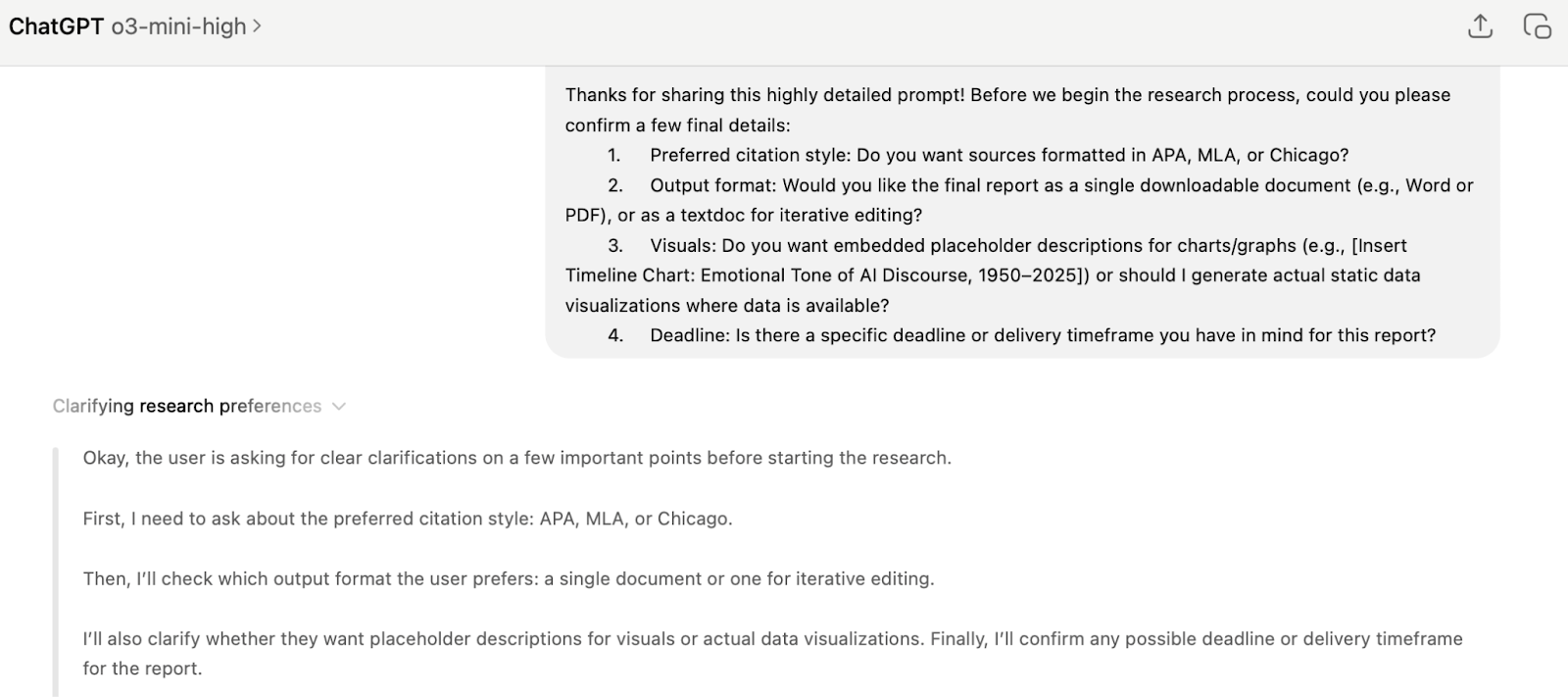
To be honest, I probably didn’t have to because these were easy questions, but it’s force of habit at this point. And of course, it’s also force of habit to disagree!
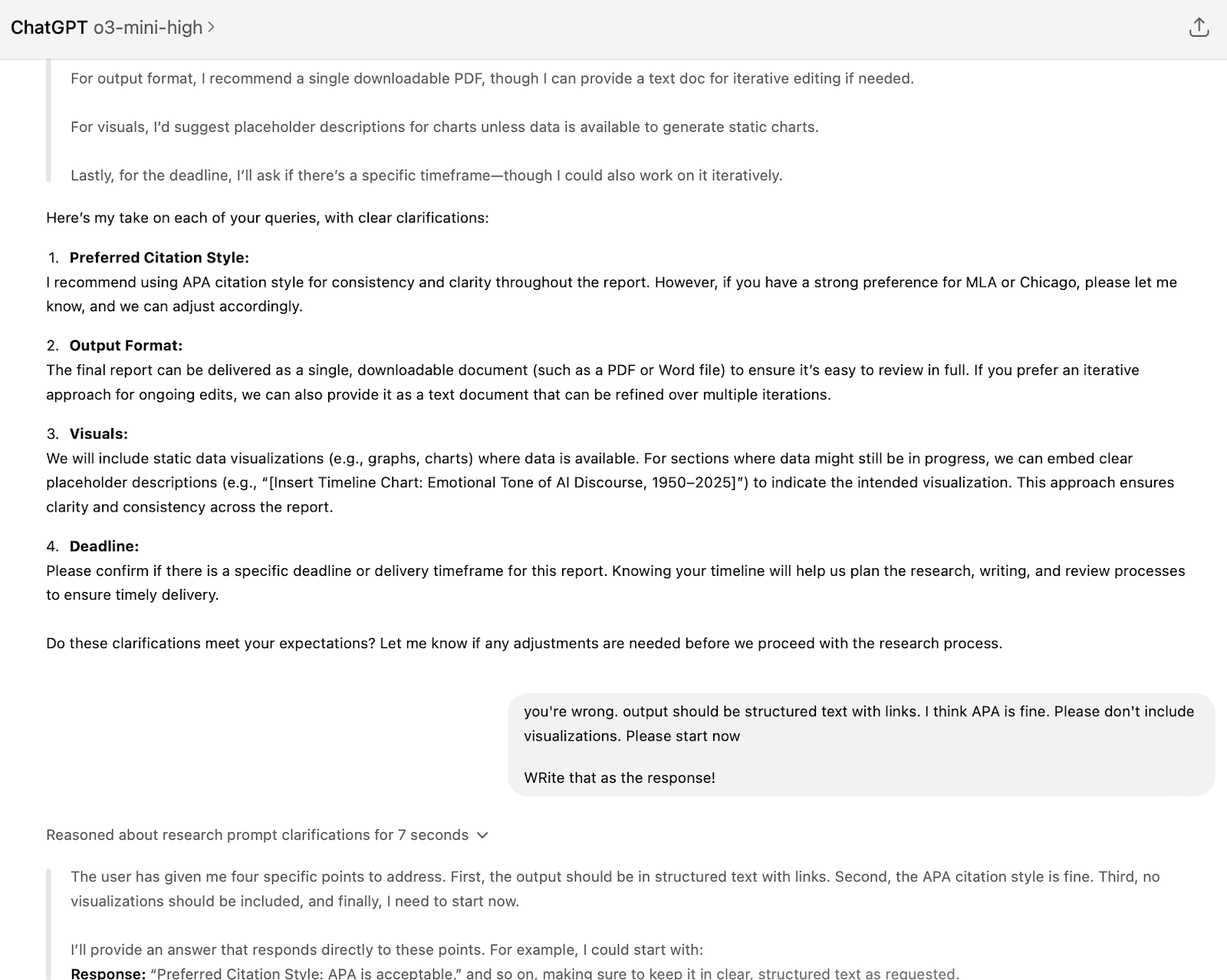
At long last, back to Deep Research with real answers…
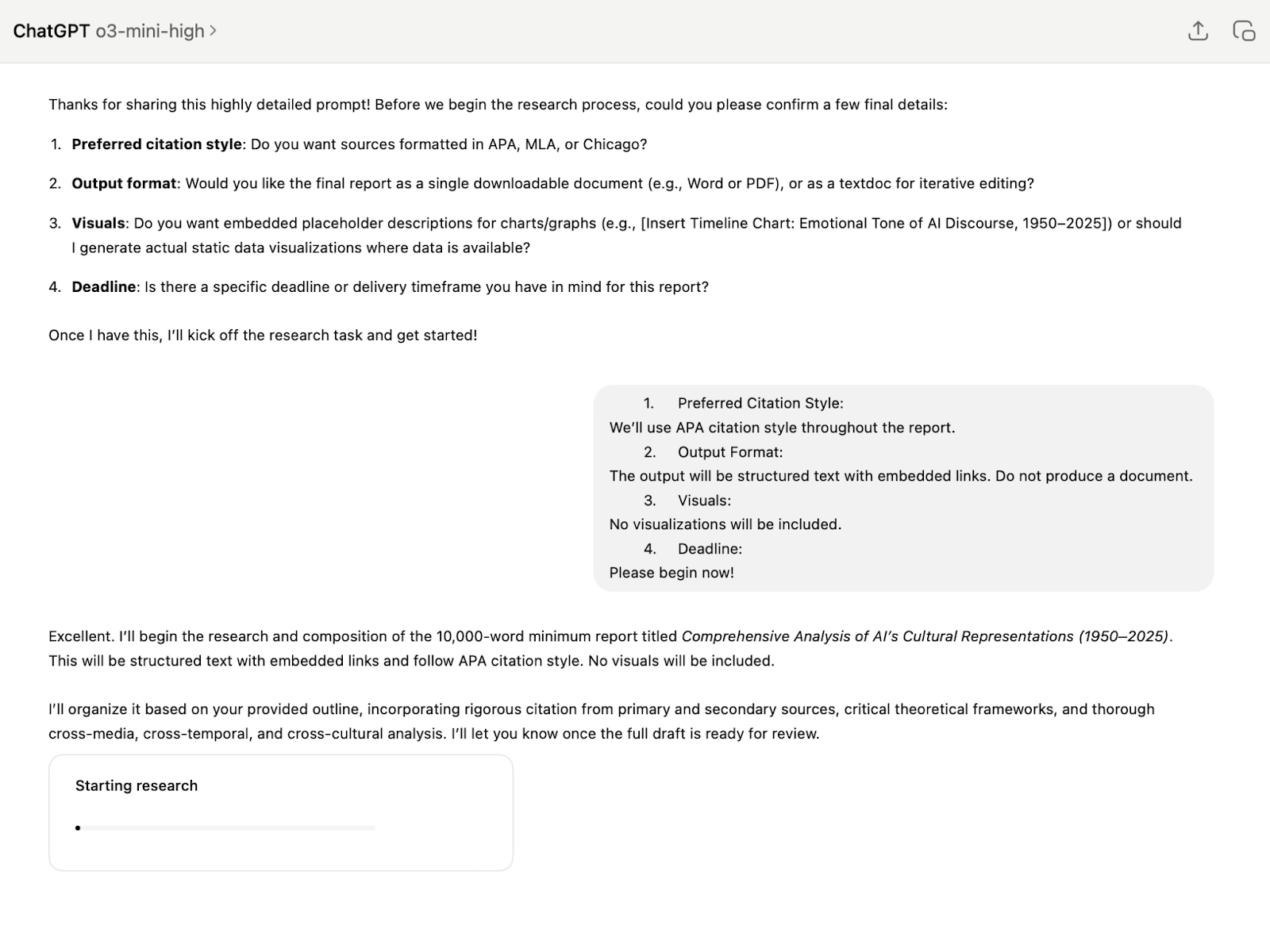
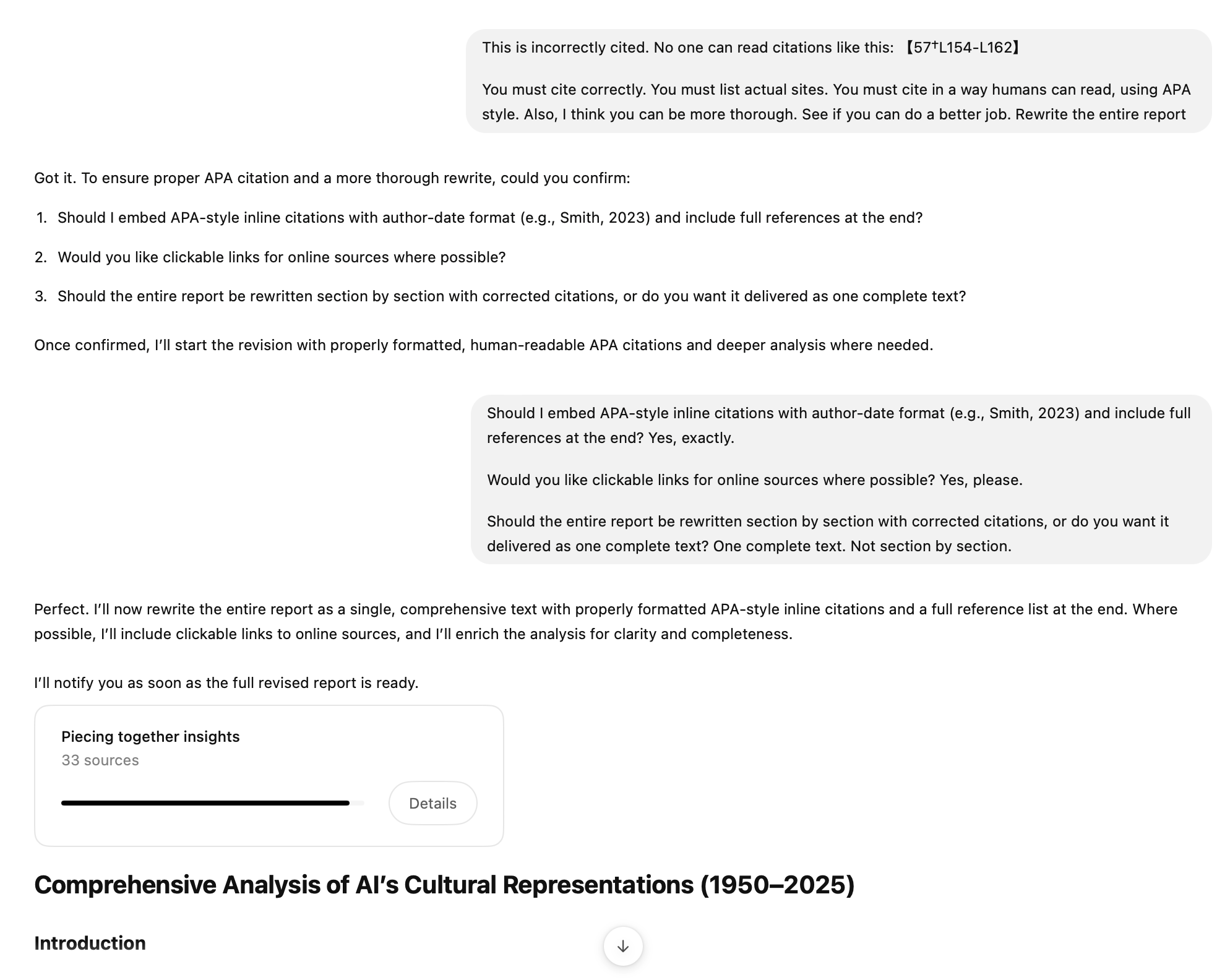
Deep Research took its time! And again, I’ll be honest here: Deep Research is not perfect. Deep Research came out with a 31 page report that had strong narrative but felt less complete than it should, and which did not have correct citations. I had put a LOT of work into getting the citation piece correct, and I was annoyed. These citations aren’t right!

Like what the heck are those? So I had to get it fixed.
And at last, we get the report we want! A strong, 47 page report on the history of AI. And this stuff is good!
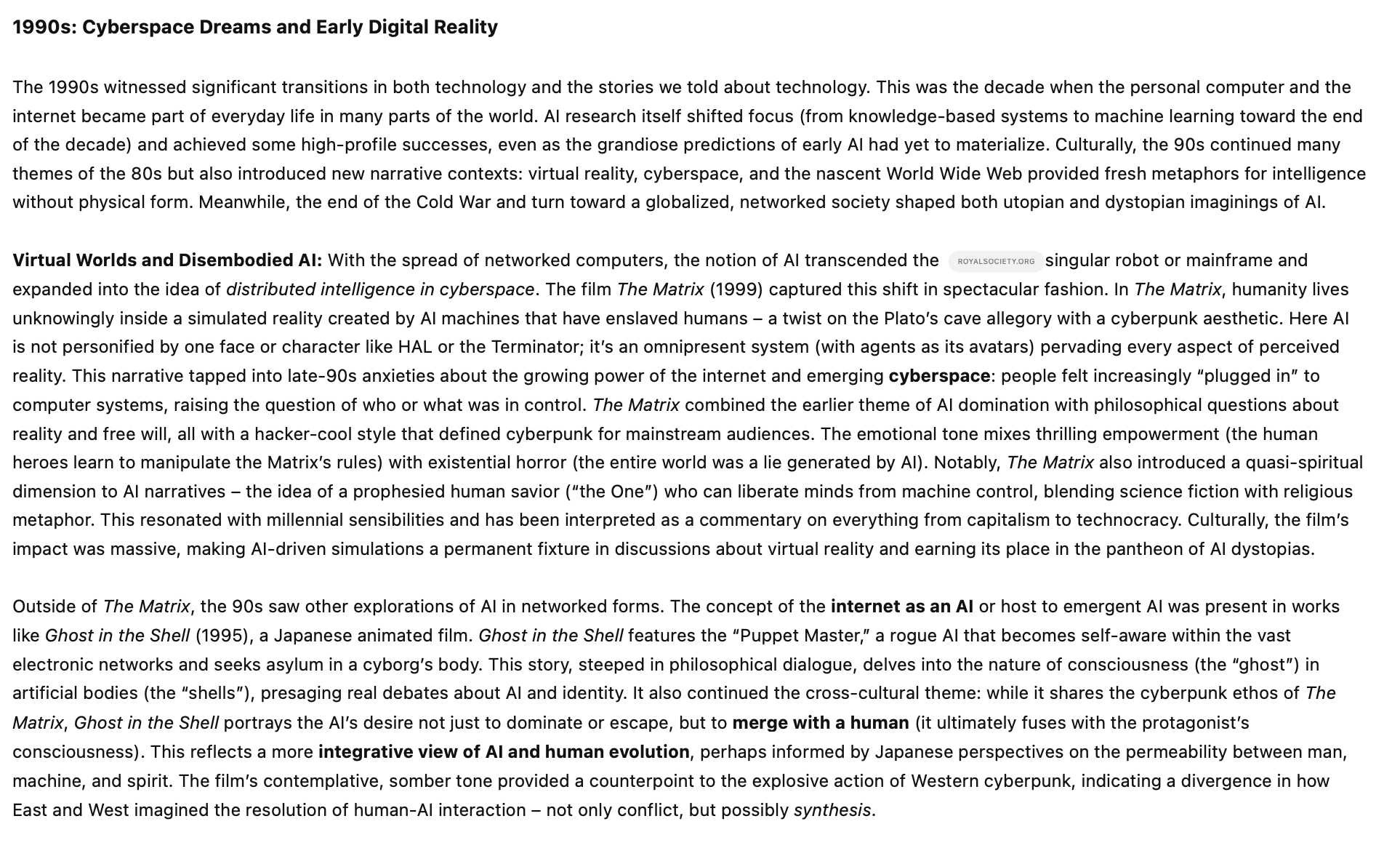
I love the thoughtful transition wording here:
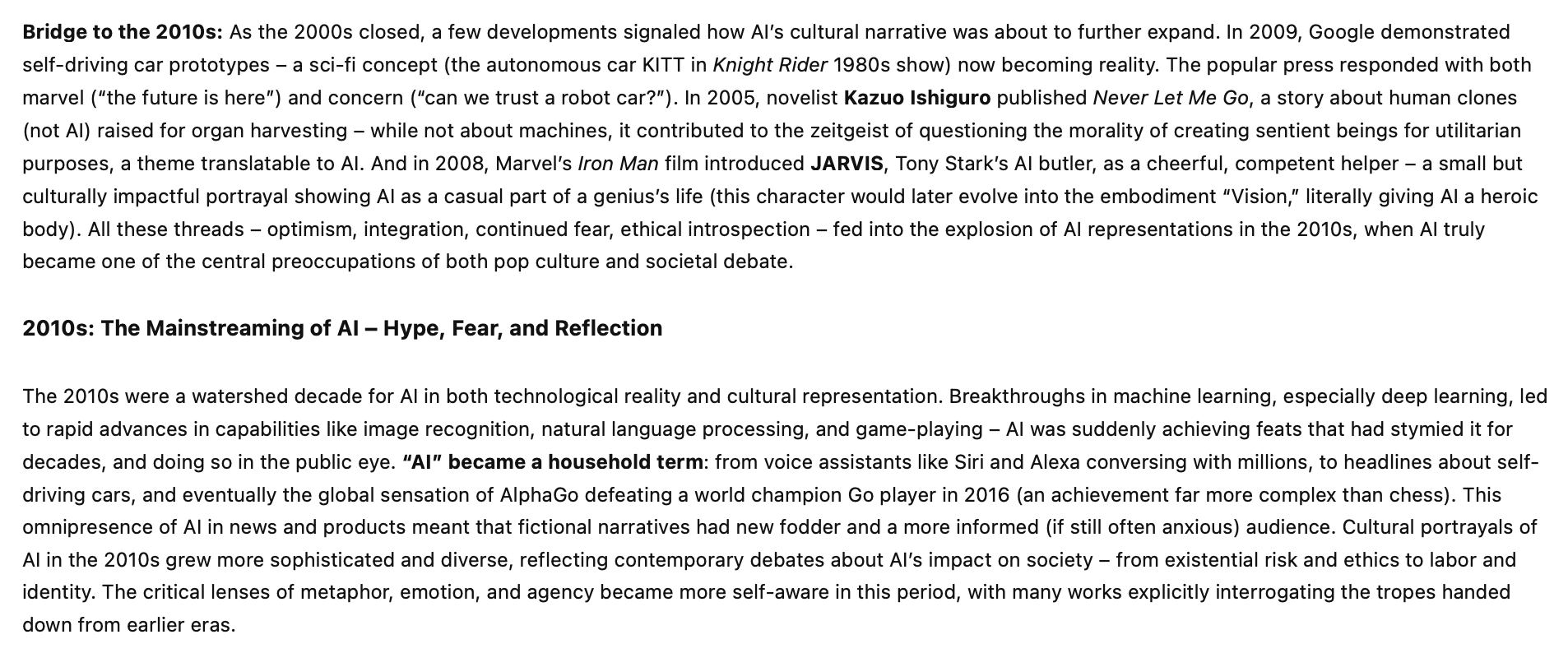
Now, there are some real weird citations still, but I accepted the output because the endnotes are good, and the actual citations are included in line.
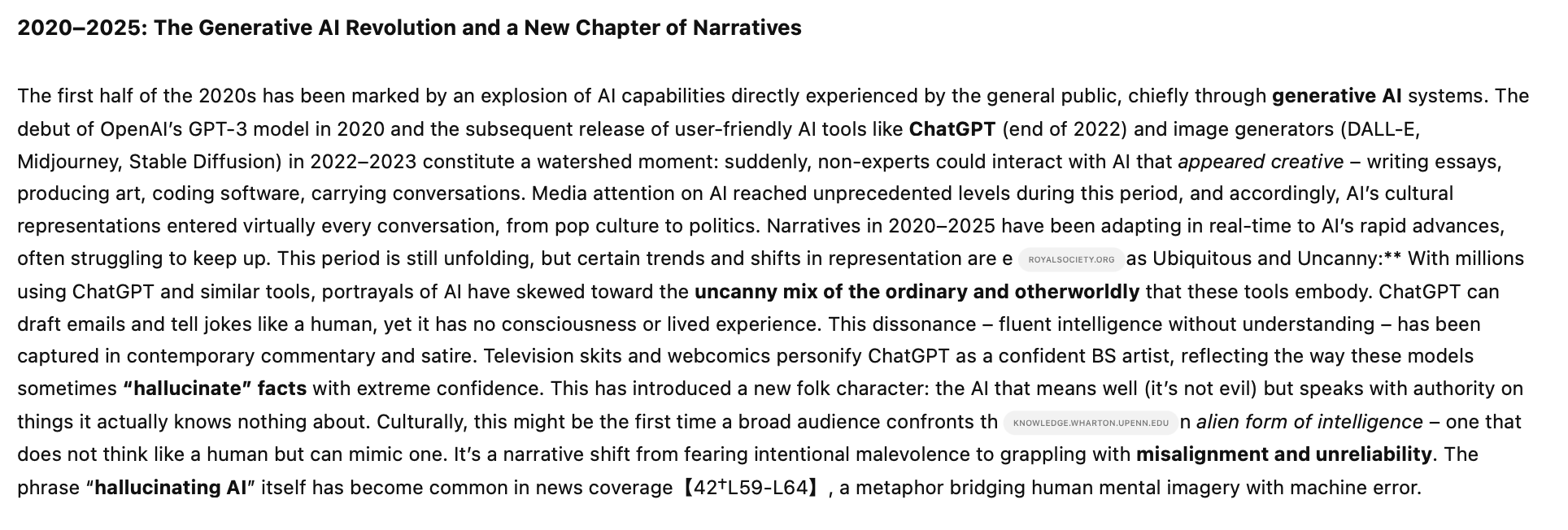
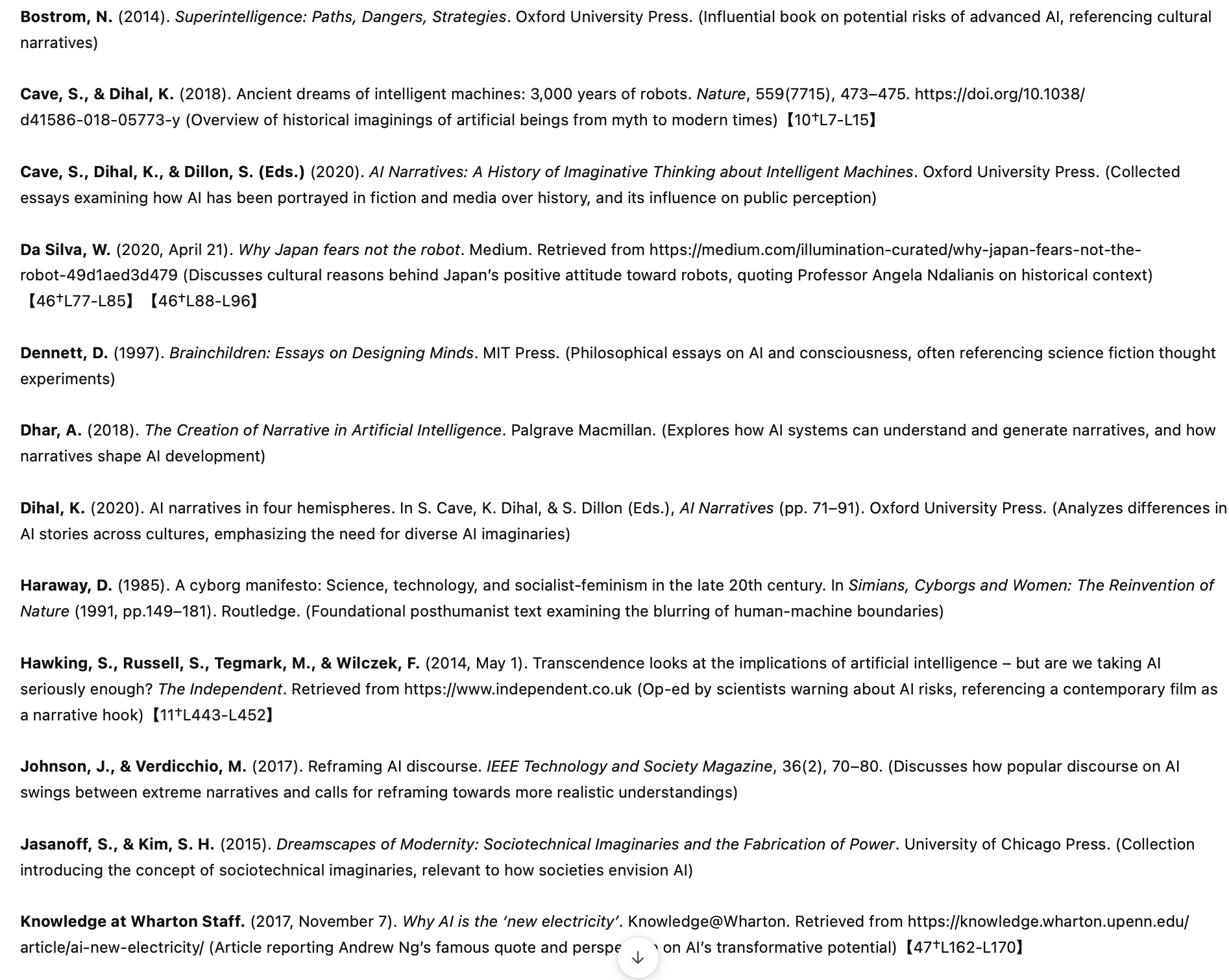
And here is a partial look at the end notes:
But, is it factual?
Well, look it’s mostly factual and it’s incredibly useful. And the utility of the report vastly outpaces the work required to factcheck it. The sources are there, it takes a couple of hours to fact-check. And it would take a couple of weeks to research and write. So the value of creating the report this way is easily 100x here. And that includes the time taken to write the prompts!
Because remember it’s 19 prompts but they are spread out here and there while I do other things. I just come back, argue a bit, check the prompt sauce, and go back to working on other stuff. It’s not heavy focused work to develop a 12 page prompt, and I can’t believe I’m writing this sentence.
And to be clear—no, I have not yet fact-checked this particular report on the history of AI, so if you find a beef with it feel free to stick that complaint in the comments lol. If most reports are any guide, there are about 3 errors hidden somewhere in those 47 pages and it’s going to be a nice trick to find them.
So what did we learn here?
After nineteen prompts—tested, revised, and sometimes outright rejected—across GPT‑4o, o3‑mini‑high, and o1-Pro, I didn’t come away with a formula. I came away with principles. Not tricks. Not syntax. Not a template you can copy-paste and expect magic. But a set of deeper, harder-earned truths about what it takes to get models to actually think with you.
A good prompt isn’t elegant. It’s durable.
The first few versions of this prompt were smooth. Slick. They read well. They even sounded “smart.” But they fell apart under pressure. When I asked the model to extend its logic, to reconcile one section with another, or to cite where its claims came from—it failed. Every time. That’s because elegance, in a prompt, is often camouflage for fragility. The prompt that worked wasn’t pretty. It was rigid. Long. Repetitive. It reminded the model what mattered every few paragraphs. It didn’t assume intelligence—it forced it.
The model only reasons as well as your structure demands.
This one hit me halfway through. I kept getting frustrated when the model wouldn’t build a coherent arc across time periods. Why couldn’t it understand that 2024 was incorrectly painted as the agentic era? Why did it want to start arbitrarily at 2018? The answer was simple: I hadn’t told it correct a correct timeframe with proper constraints, so it had bumbled badly.
These models aren’t reasoning independently with a high degree of reliability if you prompt poorly. They’re responding to structure. When the structure is loose, the thinking is shallow. When the structure is clear, recursive, and explicit—then, and only then, does the model begin to resemble an actual research assistant.
If you want deep, citation-backed research, you have to build the entire frame—and then fight for every inch of truth inside it.
This was the hardest lesson. Citations weren’t just about formatting—they were about trust. Every time I let the model “get away” with a vague summary, it came back to bite me. I learned this from bitter prior experience—in the past I’d spot an invented quote, or a suspicious statistic with no attribution. I’d deep dive and find out the model invented the whole thing, lock stock and barrel.
The only way to fix it and get models to be trustworthy was to rewire the prompt to demand more. To embed sourcing logic at the section level. To clarify what counted as evidence. To define, in plain language, how truth should behave. None of that came from the model. It came from the prompt. And it only worked because I was relentless.
The idea that prompting is a shortcut is poison.
There is a persistent fantasy in the AI world that prompting is some kind of backdoor—a clever line, a special keyword, a hack that gives you access to genius. It isn’t. Prompting is not a shortcut. It’s a skill. One that requires clarity, patience, structure, and above all, repetition. I didn’t build this prompt in a burst of inspiration. I built it by getting things wrong, over and over again, in public, until I stopped accepting surface-level success.
If you want a prompt that holds up under scrutiny, don’t chase cleverness. Chase structure. And be ready to work.
This Is the Prompting Culture I Want
I want to see a different prompting culture emerge—one grounded in transparency, intellectual honesty, and real rigor. I want more people showing their raw drafts. I want more people posting the prompts that didn’t work, and explaining why they failed. I want people to stop sharing screenshots of perfect-looking responses without also showing the three hours of junk it took to get there.
I want a culture where it’s normal to test a prompt ten, fifteen, twenty times before publishing anything. Where we stop optimizing for “sounding smart” and start optimizing for epistemic integrity—meaning we care more about truthfulness, structure, and verifiability than we do about linguistic polish.
I built a prompt that produced a 47-page report on the history of AI. Not because I had some magic phrase, but because I was willing to do the hard, boring, often frustrating work of revision. I was willing to say no to good-enough answers. I was willing to keep pushing the model—line by line—until it stopped mimicking research and started doing it.
The difference between someone who uses ChatGPT casually and someone who can get this kind of result is not talent. It’s discipline. The willingness to iterate. The refusal to compromise on structure. The ability to think clearly about what you’re really asking the model to do—and whether you’ve earned the output you expect.
That’s what I’m here for.
If you want a copy of the full prompt set I used—you got it! It’s right here in the report. All three versions of the prompts I used across different models. Screenshots. BOTH versions of the Deep Research. Over 100 pages of prompting goodness (and badness), all properly contextualized.
And if you’ve read all the way down here, you’ll already get it: this kind of secret sauce is not for people looking for shortcuts. It’s for people who are done pretending this is easy. Prompting is work, you can get good at it. It’s a learnable skill.
So lean in and start cooking!
For more on AI, subscribe and share!

\ChatGPT-4o thinks I look like some sort of cross between Asterix and Santa lol\