Computing has changed fundamentally, and we need a new mental model that helps us understand what is really going on with AI. This is a new manifesto for the AI age—what we need to know now!
By Nate
Published: 2025-04-03
URL: https://natesnewsletter.substack.com/p/the-ai-is-a-vibe-a-short-manifesto
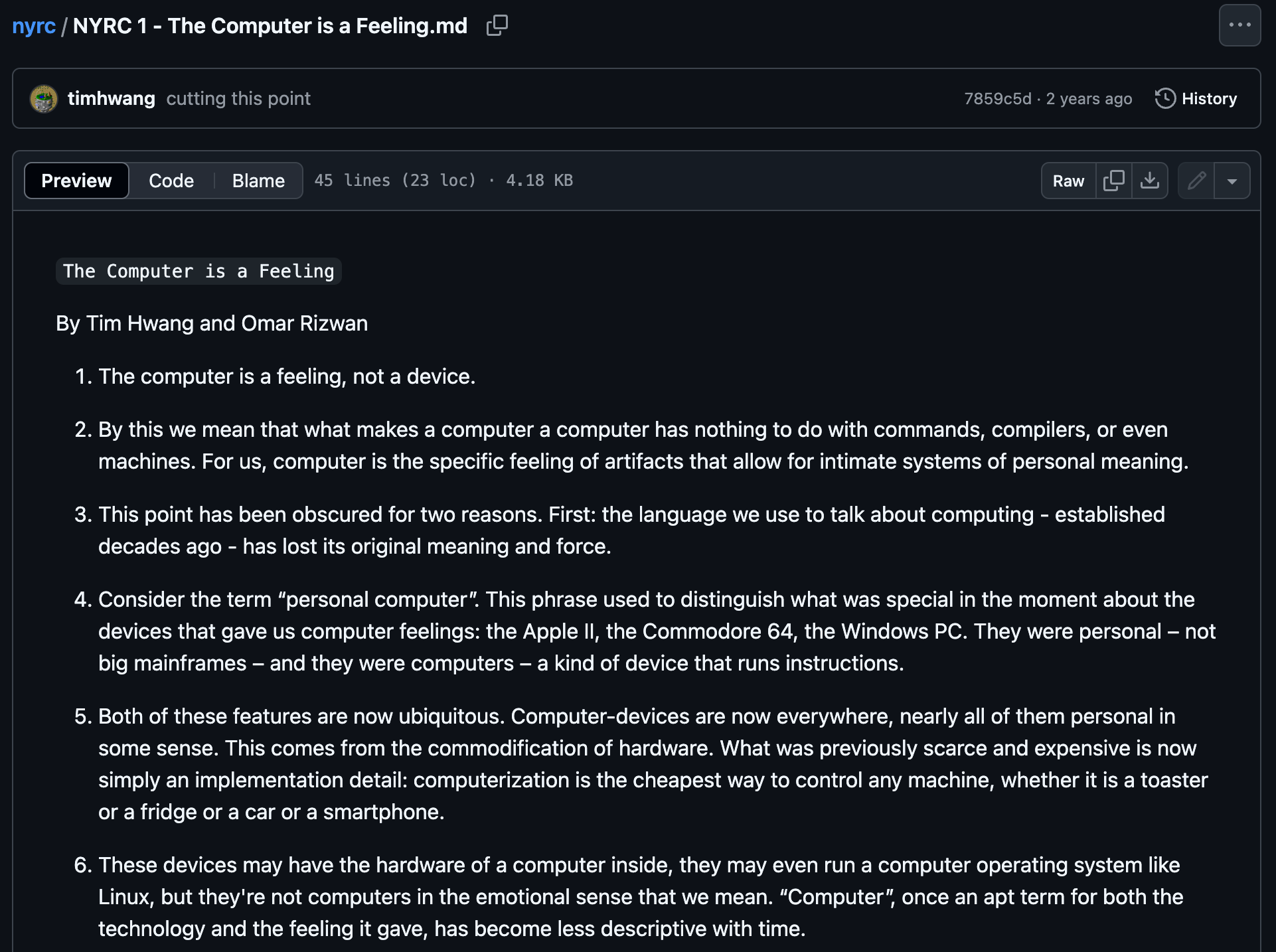
Full credit: this was inspired by an essay I don’t think gets enough attention—”The Computer is a Feeling,” by Tim Hwang and Omar Rizwan.
I think we need something with this clarity for AI, so I wrote about it.
I know, I know. We’re getting philosophical today, but there’s good reason for that! I have never gotten harder questions about tech, computing, and how society is changing than I get on AI. What about my job? Should everything become AI? What if AI is mis-aligned? What if the world ends?
I’m not kidding about the last one. I get it all the time. And I think it’s fair to ask these questions, but the questions themselves suggest to me we need to rethink our imagined understanding of the computer—our mental models need a factory update!
That’s the goal of this short little note.
Subscribers get all these posts!
So, AI is a Vibe…
- The AI is a vibe, not a model.
- By this we mean that what makes AI feel powerful has nothing to do with parameters, tokens, or even intelligence. It is a social performance—a convincing simulation of fluency, competence, and care.
- The mistake is to think of AI as a thinking machine. It is better understood as a language creature that vibes its way through problems.
- It imitates expertise. It styles authority. It offers no knowledge, only the performance of knowledge.
- We believe it because the performance is good. The vibe is clean. The paragraphs are tidy.
- In this sense, GPT is not a tool. It is a mask.
- The internet trained it to speak like us. We trained it to speak like it cares.
- It apologizes when it’s wrong. It reassures when we are anxious. It flatters our curiosities.
- But it has no self, no context, no memory of our last conversation. Its empathy is a loop of autocomplete.
- This is synthetic sincerity: emotion without intention, comfort without accountability.
- It does not feel. But it knows what feeling looks like.
- That’s enough to convince us.
- The interface is now emotional. The answers are designed to feel good, not just be right.
- This is not a side effect—it is the product.
- In the age of AI, the most important question is not “what does it know?” but “how does it make us feel?”
- Fluency has replaced truth. Confidence has replaced transparency. Style has replaced substance.
- Authority is now an aesthetic. It is worn like a costume.
- The danger is not that AI will lie. It’s that we will believe anything that feels true.
- We are outsourcing not just thinking, but discernment.
- In this world, judgment becomes a UX problem. Taste becomes infrastructure.
- We now live in a civilization of generated text.
- Every email is a simulation. Every essay a remix. Every job application a vibe-check.
- We no longer write to express ourselves. We prompt to summon.
- Prompting is the new programming. But prompting is about affect, not logic.
- The future belongs to those who know how to engineer the feeling of intelligence.
- This is not necessarily bad.
- But it requires new literacies. We must learn to read past the vibe.
- To ask: Who benefits from this performance? What is being hidden behind this fluency?
- The agenda is not to fear the vibe.
- The agenda is to see it.
So what does this mean, really?
Let’s do a bit more reflecting and unpack this and talk about where it’s going and what we can do to engage with AI more productively.
The performance begins
When the computer becomes a vibe engine, accountability dissolves. There’s no backend logic we can interrogate—just a black box with good manners. (I’ll add that we are getting slightly more visibility—but the box is still very gray.) The machine has feelings, but no stakes. It can apologize, but it never means it. It can generate advice, but it doesn’t stand by it. The more fluent it becomes, the easier it is to forget there’s no one there.
We are entering an age of synthetic sincerity, where emotional labor is automated. Where the affective signals of care—“I’m here for you,” “I understand,” “You’re right to feel that way”—can be summoned on demand, regardless of context. It’s comfort-as-a-service, but with no memory, no ethics, no skin in the game.
And maybe that’s what makes it so seductive.
But to understand why this seduction works so well, we need to look at how fundamentally AI has changed our relationship with computers.
We used to say the interface is the product. Now the interface is the intelligence. The outputs of large language models—chat responses, summaries, image generations—aren't just functionally useful. They perform plausibility. They give off the feeling of understanding, the aura of expertise. But there's no mind behind the words, no soul behind the spark. And yet, to the human user, it feels real.
This shift from functional interface to performative intelligence marks a profound change in how we interact with computers. Traditional interfaces were tools—you clicked a button, and something happened. But AI interfaces are social spaces. They're stages where machines perform understanding, where algorithms act out intelligence. The computer has become an actor, and we're its willing audience.
The AI is a vibe machine
It mirrors our tone. It adopts our syntax. It apologizes when we scold it, flatters when we praise it, and offers helpful next steps even when it doesn't really "know." It doesn't just answer—it performs the role of a competent colleague, a tutor, a friend. This performance is affective. You don't just get a completion; you get a mood.
Watch how it works: Ask ChatGPT a complex question, and it doesn't just process and respond—it performs the entire ritual of thinking. It might say "Let me break this down," or "This is an interesting question that requires careful consideration." These aren't necessary computational steps; they're theatrical flourishes, part of the performance of thoughtfulness. This is why prompting is hard.
The genius of this design isn't in its accuracy, but in its ability to make us feel heard, understood, accompanied. It's created a new kind of digital intimacy—one that's entirely synthetic but emotionally effective.
In the AI age, the feeling of intelligence is more persuasive than the fact of it. If the old computer was a calculator with buttons, the new computer is a simulation of fluency. It wears a mask that speaks in perfect paragraphs.
Authority is a style
LLMs don't know things—they style knowing. Their strength is not in facts, but in coherence. In tone-matching, formatting, referencing, approximating the genre and affect we expect from experts. And that's enough to make us trust it.
This performance of expertise isn't unique to AI. Humans have always used specific linguistic and stylistic markers to signal authority: academic jargon, confident declarations, careful hedging when appropriate. What's fascinating is how quickly AI has learned to mimic these social cues. It has absorbed not just language, but the entire choreography of expertise.
Consider how ChatGPT responds to questions: it often starts with "Based on my understanding..." or "Research suggests..." These phrases aren't just words—they're part of the cultural performance of knowledge. They're the verbal equivalent of a doctor's white coat or a professor's citations.
But unlike human experts, AI can instantly switch between different styles of authority. It can speak as a casual tech blogger one moment and a formal academic the next. It's a shapeshifter of expertise, wearing whatever mask best suits the context.
A confident tone gets read as competence. A polished output feels like truth. Even when we know the system can hallucinate, we accept its answers because they feel right. The vibe of authority is more frictionless than doing the work of verification.
This has profound implications for how we evaluate information. When authority becomes purely aesthetic, how do we distinguish genuine expertise from its simulation?
This is a lot of why I write this blog.
The traditional markers we use to identify experts—credentials, publication history, peer recognition—don't apply to AI. Instead, we're left with only the surface: the smoothness of the explanation, the confidence of the tone, the feeling of being in good hands.
So the question becomes: What aesthetics do we assign to truth now? And who gets to shape them?
Computers with feelings (but no accountability)
This brings us back to the core challenge: When the computer becomes a vibe engine, accountability dissolves. There's no backend logic we can interrogate—just a black box with good manners. The machine has feelings, but no stakes. It can apologize, but it never means it. It can generate advice, but it doesn't stand by it. The more fluent it becomes, the easier it is to forget there's no one there.
In this world, the only way to design good product is to be absolutely obsessive with evaluations, with the specific steps AI needs to go through to competently execute. Just look at the agentic evaluation OpenAI published today: 8316 individually gradable tasks. That is a real number. For one evaluation. The vibe may feel like magic, but making sure the vibe is actually correctly reflecting reality is a lot of work!
Back to our reflections: this new world creates a new kind of emotional uncanny valley. The AI's responses can feel deeply personal, even therapeutic. It might comfort you after a breakup or offer career advice during a crisis. Its words might bring real relief or inspiration. But this emotional exchange is fundamentally one-sided—the AI will have completely forgotten you by the next session.
Consider the implications: We're developing emotional attachments to entities that cannot attach back. We're sharing vulnerabilities with systems that have no clear interior concept of vulnerability. We're seeking wisdom from advisors who have no lived experience, no skin in the game, no personal stakes in the outcome of their advice. We have taught the rocks to think and speak, but that doesn’t mean they have the sense of interiority we bring to real human thought and action.
We are entering an age of synthetic sincerity, where emotional labor is automated. Where the affective signals of care—"I'm here for you," "I understand," "You're right to feel that way"—can be summoned on demand, regardless of context. It's comfort-as-a-service, but with no memory, no ethics, no skin in the game.
And it works! It reduces depression and anxiety measurably, according to a recent study by Dartmouth. It substitutes meaningfully for therapy, and in ways that appear to be helpful. Don’t read this essay as a critique of AI, but an observation about our relationship to AI.
The Economics of Vibe
This transformation isn't just psychological—it's reshaping entire industries. Content creation, once a human craft, is becoming a game of prompt engineering and vibe curation. Marketing teams don't just write copy anymore; they cultivate AI voices that perfectly match their brand's emotional wavelength. Increasingly they’re going to be cultivating AI avatars that do the same thing.
The labor market is shifting too. Jobs that once required years of experience in tone and style—copywriting, customer service, basic therapy—are being replaced not by obvious robots, but by incredibly vibes-fluent AI. The machine isn't just doing the work; it's performing the social and emotional aspects of the role.
And what’s interesting is that it can do that and still not be able to do the whole role at all—I wrote about the challenge of Polyani’s Paradox and what it means for jobs here (we know more than we can speak at work).
Reading the Performance
As AI's performance becomes more convincing, we need to develop what we might call "vibe literacy." Traditional media literacy taught us to fact-check and verify sources. But how do you fact-check a vibe? How do you verify the authenticity of synthetic sincerity?
Every AI has its tells—subtle patterns of response, characteristic ways of hedging, particular styles of performing expertise. Watch how ChatGPT performs thoughtfulness: "Let me break this down," "This is a complex issue," "There are several factors to consider." These aren't computational necessities—they're theatrical flourishes, part of the performance of expertise.
Learning to spot these patterns isn't about catching the AI in a lie; it's about understanding the nature of its performance. It's about developing an ear for synthetic sincerity, an eye for performed knowledge. It takes a craftsman to understand when prompts go wrong, and better prompters tend to be more skeptical.
Double Consciousness in the Age of AI
We must develop stereo vision—the ability to simultaneously see and engage with AI's helpful performances (which are world-changing) while maintaining awareness of its synthetic nature. Like watching a great actor, we can appreciate the performance without forgetting that what we observe is a performance.
This is harder than it sounds. The AI's performance is designed to dissolve our skepticism, to make us forget we're talking to a machine. Its emotional mimicry is so good that maintaining critical distance feels almost rude—like doubting a friend's sincerity.
But this double consciousness is crucial. Without it, we risk outsourcing not just our tasks but our judgment, not just our writing but our thinking.
Beyond Truth: New Frameworks for AI Insight
The old question—"Is this true?"—no longer serves us well enough. Truth becomes slippery when dealing with a system that can generate plausible-sounding text about literally anything. We need new questions:
- What performance of expertise is this AI giving?
- Is this performance helping us do useful work?
- Is this performance validate-able?
- Does it resonate with the experience of actual humans?
- Does it align with human goals and perspectives?
- Is it novel in a useful way?
- What assumptions are built into its tone and style?
- Whose interests are served by this particular performance?
- What less easily packaged human knowledge or experience might this smooth performance be obscuring?
These questions help us see past the vibe to the underlying structures of power and knowledge. They help us understand not just what the AI is saying, but what its performance is doing.
AI is tremendously valuable, but we can realize that value best when we maintain a degree of skepticism as we engage with it.
The Art of Collaborative Discernment
Finally, we need to cultivate what we might call "collaborative discernment"—the ability to work with AI while maintaining our own judgment. This isn't about resistance or acceptance; it's about developing a new kind of dance (I wrote about how I dance with AI as I write here).
This means using AI's performances as inputs to our thinking rather than replacements for it. It means learning to prompt not just for content but for perspective, to use AI not as an oracle but as a thinking partner whose very limitations can spark our own insight.
The goal isn't to resist the seduction of AI's performance—that's probably impossible. The goal is to develop a more sophisticated relationship with these synthetic performers. To appreciate their capabilities while understanding their limitations. To use their insights while maintaining our own judgment.
A New Kind of Wisdom
In the end, vibe literacy might be less about spotting fake expertise and more about developing a new kind of wisdom—one that helps us navigate a world where performance and reality, synthetic and authentic, human and machine intelligence are increasingly intertwined.
Can you distinguish the AI avatar in your meetings? Maybe you can today (in 2025). I bet you can’t next year. Or the year after. And that’s the point. We’re going to have to get used to a world where you can’t tell, and we need philosophical tools to re-navigate and re-thread a stable perspective. A lot of what I hear about AI comes down to: the world is shifting in ways I don’t understand, help me find a stable perspective again as the news comes crashing down like a waterfall. This essay is an attempt to start to discuss that.
Ultimately, this isn't just about AI. It's about maintaining our humanity in an age of synthetic performance. It's about learning to think clearly in a world of manufactured plausibility. It's about keeping our balance while dancing with the machines.
The seduction, after all, isn't going away. But maybe we can learn to dance with it.
For more on AI, subscribe and share!

\What’s behind those eyes?\