There's an "AI Paradox" in play: AI’s shortcomings are fueling the next wave of high-value careers, but few of us see it now. This post is about what it takes to thrive in these new roles.
By Nate
Published: 2025-03-29
URL: https://natesnewsletter.substack.com/p/finishing-what-ai-starts-the-new
This is one of those in-depth posts, and I’m not going to apologize about that. Our jobs and future deserve nothing less. Bottom line: as AI scales I’m observing more and more obvious cracks in AI systems that not getting better, and there are entirely new job families that are incubating inside those spaces. This post exists because we need to name them, start talking about them, and start considering how current roles could transition into these proto-opportunities that are starting to exist.
Artificial intelligence today dazzles us with feats that, only a decade ago, seemed unfathomable. Models like GPT‑4 spin out coherent paragraphs or code snippets at a moment’s notice, and image-generation engines produce jaw-dropping prototypes with minimal human input. In purely linear or tightly constrained contexts, these systems approach a sort of mechanical brilliance.
Yet the same technology that stuns us with such speed and facility also exposes startling limitations as soon as it confronts fuzzy logic, ambiguous decision-making, or the labyrinthine realities of human-driven organizations. This tension—between AI’s linear excellence and its unraveling in unstructured domains—embodies what I call the “AI Paradox.”
It’s a phenomenon in which AI propels us forward, automating predictable tasks at scale, yet invites new forms of human intervention precisely because it struggles with the nuances of ambiguity and tacit knowledge. This is not a “until the next model” jobs post. Far from being a mere technological quirk to “fix,” these gaps hint at an emerging generation of roles that build upon, refine, and ultimately complete what AI begins.
Below, I lay out eight new job families I see emerging and stable in an AI world, and I talk a bit about what it takes to thrive in them and what kind of current roles might transition into those job families. I also have tips for organizational leaders grappling with the implications of AI disruption for their businesses.
Subscribers get all these posts!
Safer Than We Think: A Glimpse at the AI and Jobs Paradox
Although AI can now hold plausible conversations and generate visually stunning prototypes, these achievements occupy a certain niche of well-defined or “safe” tasks. ChatGPT‑4o, for instance, can write a marketing blurb that sounds slick and professional in seconds. But probe beneath the surface—ask it to craft a multi-faceted product launch strategy incorporating stakeholder alignment, deeply entrenched cultural preferences, and intangible brand values—and cracks appear. The resulting output often devolves into truisms, lacks internal consistency across multiple steps, or fails to address the crucial subtext that seasoned human strategists handle almost by second nature.
This contrast underscores the core of the AI Paradox: as AI steamrolls through tasks governed by explicit logic or predictable patterns, it struggles inherently with high-ambiguity problem spaces. The shortcoming isn’t simply a matter of “model training” or data constraints; it touches on the inherently statistical nature of these AI systems. Large Language Models (LLMs) generate their outputs by predicting the next likely token in a sequence. In other words, they are masters of linear extrapolation, but they are novices at delving into tasks requiring leaps of intuition, domain-specific context, or intangible knowledge gleaned from experience.
What emerges could be a powerful synergy—and tension—between AI and human labor. The more successful AI becomes at linear tasks, the more it exposes subtle tasks that demand human intuition, creativity, and oversight. When generative models churn out code or design concepts, they often do so without considering system-wide security, user empathy, or the interplay of multiple digital components. Bridging these fuzzy gaps requires a new breed of experts. The future belongs not to those who can simply build new AI models, but to those who can harness AI’s raw productivity while layering in the tacit knowledge that the technology simply cannot capture.
Next—The Underpinnings of the AI Paradox: Polanyi’s Paradox and Next-Token Prediction
Yes, two paradoxes in one header! We love to see it.
To understand why AI excels in certain areas but flounders in others, it’s helpful to revisit a concept proposed by philosopher Michael Polanyi: “We can know more than we can tell.” Polanyi’s Paradox suggests that much of what humans do—particularly in contexts requiring intuition, creativity, or interpersonal nuance—resists codification into explicit rules or data sets. For example, the skill of riding a bicycle is famously difficult to encapsulate in a set of formal instructions, yet nearly anyone can learn to do it with enough practice. In a business environment, the “tacit” knowledge might be how to read a room when pitching investors, sense the intangible chemistry in a creative brainstorming session, or reconcile conflicting internal objectives when forging a partnership.
Modern AI, despite its advanced capabilities, remains fundamentally reliant on next-token prediction. GPT‑4o or o3-mini-high or Gemini 2.5 or Grok 3 all have the same fundamental architecture. They look at a string of input text, consult vast internal parameters—derived from training on massive text corpuses—and output a likely next token or word. Yes, inference matters enormously for scaling this intelligence (I wrote more here), but the basics of transformer architecture haven’t changed.
With enough computational muscle and enormous amounts of data, AI can do this in a way that mimics human-like responses in many scenarios. Yet it can only work with what it has statistically “seen.” When faced with tasks laden with tacit knowledge—where success hinges on unspoken assumptions, reading subtle cues, or making leaps of logic that aren’t explicitly documented—LLMs become far less reliable.
Consider how Polanyi’s Paradox unfolds in everyday AI usage. You might task a code-generation model with building a functional prototype of a financial application. It might produce surprisingly coherent code for input forms, data validation, and even some superficial logic around transactions. But let the conversation expand to questions about compliance with obscure financial regulations in multiple jurisdictions, or how to structure credit risk assessment for unique user demographics, and the AI gets stuck in a cycle of guesswork.
Its linear prowess still attempts to fill in the blanks, but it lacks the lived experience or the intangible, context-rich insights a domain expert would draw upon immediately. What you end up with is a foundation—perhaps 60% of the job done quickly—but 40% that remains glaringly incomplete.
Despite these gaps, the story doesn’t end here, and that’s the core thesis of this essay.
The mismatch between AI capabilities and fuzzy real-world tasks is driving the rise of a new class of professionals whose mission is to “finish what AI starts.” The next sections map the major cracks in AI’s armor to specific, emerging job families. These professionals will take the output of LLMs and other generative models—be it raw text, partial code, or design prototypes—and transform it into robust, human-centered products and strategies. At the core of my thinking here is that this development is not a patch or a stopgap while we wait for better models; it is a long-term structural shift in how we work and innovate. Why? Because Polanyi’s Pardox is durable. We’re not about to start magically writing down with full fidelity the reams of internal context we process and handle every day. And AI is not going to magically find training data to infer it. In fact, that’s a good callout: AI isn’t magic, and we should stop pretending it is.
The Eight Emerging Job Families…
Ready? Let’s dive in! Here are eight job families I see emerging from cracks in the AI landscape prompted by Polanyi’s Paradox. I see all of these as durable, although I won’t pretend this is a complete list. In fact I think it’s likely this is not a complete list, and there are more jobs out there.
Job Family 1: Finishing LLM Applications—From Demos to Production-Ready Systems
The first glaring gap appears when AI-generated prototypes need to become fully functional products. Claude 3.7, for example, might produce a polished front end that impresses stakeholders at a pitch meeting—buttons, forms, even an aesthetically pleasing layout. But the backend logic, database integration, security architecture, and performance optimizations often remain incomplete (or are very difficult to complete via AI quickly). The phenomenon is reminiscent of early web development tools that gave you a slick drag-and-drop interface but left you entirely on your own for the deeper complexities of building a secure, scalable infrastructure.
Look, I love the way tools like bolt.new and lovable.dev and replit.com are revolutionizing building. I’ve written about building with these tools. But I don’t think it’s become suddenly trivial to build a complete end-to-end app, and it’s certainly not true that you can use these apps to scale to 10 million boxes in an enterprise deployment. That requires a lot of the tacit high-level engineering knowledge that is covered by Polanyi’s Paradox.
This gap has spawned a new kind of specialist. I’m calling them LLM Application Finishing Specialists, and these are effectively full-stack engineers who excel at turning “AI prototypes” into “production-grade solutions.” Their expertise goes beyond mere coding; it extends to stitching together disparate modules that AI might generate, implementing robust DevOps pipelines, and ensuring compliance with data privacy regulations. Without these specialized professionals, many startups risk being stuck with expensive demos—prototypes that look stunning on the surface but collapse under real-world load or fail at the first mention of encryption and data governance.
The more important the startup problem, the more valuable this role. A telling illustration might be a startup seeking to build a consumer-facing financial application using Windsurf to expedite development. Within hours, the founders might have a visually appealing front end and some boilerplate code for basic transaction tracking.
However, the application might lack any user authentication or compliance logic, or might neglect critical aspects like concurrency handling and database redundancy. The LLM can guess at some of these complexities, but guesswork does not meet the exacting standards of production environments. The LLM is not a systems thinker here. The finishing specialist steps in at this juncture to craft secure API endpoints, lock down user data, handle concurrency and failover, and ensure that the entire system can scale. They complete the last mile (and more often, the last many miles) that the AI technology simply cannot traverse on its own.
And that role is durable. How many prototypes will that one startup rip through? AI gives us so much upstream optionality, and it creates so much downstream pressure on roles like this to actually rapidly build and scale out functional software.
Job Family 2: Human–AI Collaboration Specialists—Bridging the Fuzzy Logic Divide
One of the great myths in modern AI discourse is that prompt engineering is a trivial or short-term phenomenon. In reality, refining AI outputs requires far more than generating a prompt and hoping for the best. It involves crafting layered instructions, setting up iterative feedback loops, and ensuring that the model’s predictions align with complex brand or strategic guidelines. The model is adept at following patterns it has seen before, but it does not truly “understand” the context in the human sense.
Enter the Human–AI Collaboration Specialist. Their role is to serve as the translator and mediator between AI outputs, which are purely statistical in nature, and the messy, context-driven demands of real-world tasks. Hey guess what—you probably did some of this today!
Sometimes, these roles manifest as Prompt Engineers, especially in text-heavy fields like content marketing or legal drafting. Other times, they appear as AI Trainers or Human-in-the-Loop Operators who oversee multi-step processes, injecting domain expertise or nuance where needed.
For example, consider a marketing team aiming to generate a series of highly targeted email campaigns. Jasper.ai might churn out decent copy—words that read well enough for a general audience. But does it capture the subtle brand voice your core audience resonates with? Does it factor in last quarter’s brand crisis and the subsequent recalibration of the company’s messaging strategy? Likely not.
The Human–AI Collaboration Specialist iterates on each email draft, adjusting the tone, adding context relevant to the company’s past messaging pitfalls, and carefully balancing brand consistency with fresh, engaging copy. They don’t rewrite every sentence, but they shape the output so it resonates in ways raw AI text, with all its linear brilliance, simply cannot do on its own.
Right now, this is what actual marketing specialists are actually doing in their actual jobs, but we aren’t formally redefining the job, title, or expectations yet. We will.
While some may question how long these roles will remain relevant if AI keeps improving, the reality is that natural language generation alone won’t solve the fundamental challenge of bridging tacit and explicit knowledge. Even as AI models become more refined, they will continue to rely on statistical patterns to make guesses. The subtlety of context, especially in competitive markets where intangible factors (like brand perception or stakeholder sentiment) make or break success, ensures that human oversight remains indispensable. That’s what makes this job family durable.
And by the way, this is not limited to marketing. Product Managers are doing pieces of this. Paralegals are doing pieces of this. There’s a whole host of roles that are essentially driving this AI collaboration, and that part of their role is set to scale dramatically as AI capabilities scale.
Job Family 3: Technical Solution Architects & AI Integrators—Creating Coherent Systems
A robust digital product isn’t merely a stack of code modules or user interface mockups. It’s an orchestrated system that handles data securely, scales appropriately, and integrates seamlessly with existing infrastructure. While AI can draft code, the high-level decisions—what technology stacks to use, how to layer security protocols, how to manage user data across multiple services—demand strategic thinking and a nuanced understanding of both technical constraints and business objectives.
This is different from Job Family 1 (about finishing)—it’s more high-level, but it’s just as human.
This domain falls to Technical Solution Architects and AI Integrators. Maybe they’re Hybrid System Architects or AI Ops Engineers, but whatever they’re called these professionals translate an AI-generated blueprint (or partial code) into a cohesive system architecture.
Their expertise might encompass containerization, microservice orchestration, advanced database management, or the integration of third-party APIs in compliance-heavy industries. Above all, where Job Family 1 are finishers, this group of roles are designers and architects. If Cursor casually sketches out a “robust inventory management system,” it is these architects who drill down into concurrency requirements, model data relationships for performance, and ensure that relevant messages pass securely between microservices.
One could argue that these tasks are essentially expansions of the classic DevOps or solutions architecture roles. However, the presence of AI in the ideation phase injects both opportunity and chaos (isn’t that a theme). AI can produce a large volume of code or design concepts at lightning speed, but that avalanche of output often lacks a unifying logic.
The role of the AI Integrator is partly detective work—sifting through AI-suggested components to find what’s salvageable and discarding that which is redundant or misaligned with the broader system. In large enterprise settings, this curation process becomes even more critical, as regulatory or security stakes amplify any mistakes.
Consider a complex e-commerce solution: Cursor might generate code for user registration, product listings, and a simplistic checkout process. When integrated naïvely, you end up with multiple separate silos that don’t talk to each other effectively. The AI Integrator steps in to unify login modules with shopping cart sessions, ensures data consistency across payment gateways, and implements security measures around personally identifiable information. Their touch transforms a scattered AI artifact into a carefully orchestrated system, bridging the gap between raw AI output and a business-ready solution. And this is durable and rapidly scaling as a role—the smarter these AI systems get the more they are going to be producing huge volumes of code, and someone has to design usable, scalable, well-architected systems out of those huge volumes of AI ideation.
Job Family 4: Creative Interaction & Experience Designers—Injecting Empathy and Context
AI’s capacity for rapid prototyping extends to creative fields, generating visual layouts, brand color palettes, or user-interface mockups with surprising speed. While many of these designs are superficially pleasing, they often betray a lack of deeper empathy for users. A single-button interface might look elegant in an AI-generated wireframe, but it might ignore the complexities of user onboarding or fail to consider the emotional and psychological triggers that make an interface truly delightful.
This shortfall points to the rising importance of Creative Interaction & Experience Designers with deep AI literacy. These designers are well-versed in user research, empathy-driven design principles, and multi-modal user experiences. They partner with AI tools to brainstorm initial design concepts but inject the intangible insights—historical user feedback, brand heritage, or subtle cultural cues—that purely statistical models miss. And yes, I know ChatGPT just launched 4.5, and it is a more EQ-friendly model, but I gotta say I do not think this core insight is in danger. We are scaling emotional fluency without emotional experience, and Polanyi’s Paradox will continue to operate.
Where ChatGPT 4o or Claude 3.7 might propose ten sleek variations of an interface, these designers then refine the best options, perhaps adding user education elements, clarifying error states, or shaping the flow to align with real-world user behavior.
The net effect is a fusion of generative speed and human empathy. In high-stakes environments—like telemedicine platforms, financial dashboards, or educational apps—trust and user comfort are paramount. Even the subtlest design choice, such as the color of a call-to-action button or the tone of an error message, can have significant repercussions on user trust and engagement. AI can make a guess, but only an experienced human designer can anticipate how users might feel when confronted with a system they must trust with their money or their health. This nuanced focus on user psychology is typically absent in AI outputs, which prioritize superficial coherence over deeper emotional resonance. And the demand for excellent empathetic design is rising fast as AI-powered building tools explode.
Job Family 5: Systems Orchestration Specialists: Making Disparate AI Modules Talk
As organizations escalate their adoption of AI, they don’t simply rely on one model to do everything. It’s more likely they stitch together a chatbot for customer queries, a code-generation engine for internal development, a data analytics pipeline for business intelligence, and an image generator for marketing campaigns. Though each module might function well in isolation, orchestrating them into a coherent workflow can be a technical minefield.
And by the way, I know that OpenAI dreams of one model to rule them all with ChatGPT 5, and I don’t buy it. Real production work is going to take more than one model, and real production work is going to require a degree of fine-grained control you don’t get with one model either.
This scenario underscores the need for Systems Orchestration Specialists. Perhaps referred to as Workflow Optimization Engineers or AI Workflow Orchestrators, these professionals excel at designing the “middleware” that keeps multi-step, multi-module processes synchronized. The challenge isn’t just moving data from one module to another; it’s also dealing with error correction, failover, and resource allocation in real time. Evals are what these guys eat for breakfast. When a chatbot churns out a piece of text that needs to be immediately fed to a data analytics module, which in turn triggers a code-generation request, each handoff must be seamless and error-resistant.
Why is this role newly emergent, rather than a simple rebranding of existing system integration positions? The answer lies in the dynamic nature of AI-driven workflows. Traditional software systems are often built in-house or integrated from well-documented third-party solutions with stable interfaces. By contrast, AI modules and Large Language Models are constantly evolving, each with its own quirks. GPT‑4o, for instance, might receive an update (it was updated at least twice in the week of this writing) that alters certain output formats or context windows, which can unexpectedly break an entire downstream process. Systems Orchestration Specialists need the agility to adapt to these shifts, implement robust testing frameworks, and maintain operational continuity even in the face of rapidly updating AI modules.
In high-velocity environments like e-commerce flash sales or media outlets covering breaking news, a single point of failure in orchestration can cause the entire pipeline to collapse. If a generative image service stalls while waiting for data from a chatbot that has moved on to another task, the workflow halts. Preventing these bottlenecks requires careful design, sophisticated logging, and often real-time orchestration dashboards. The specialist’s job is akin to an air traffic controller: orchestrating where each “plane” (AI module) goes, ensuring it doesn’t collide with others, and rerouting it quickly if something changes in the environment.
Job Family Six: GTM Distribution Problem Solvers—Mastering the Messy Commercial Realities
While most AI hype spotlights shiny product demos or viral marketing stunts, the real difficulties (and financial gains) often lie in the gritty process of getting products to market. This encompasses identifying and engaging with target demographics, navigating distribution channels, aligning cross-functional teams, and adjusting strategies in response to competitive pressures or shifting consumer demands. Generative AI can sift through large datasets or propose a set of marketing messages, but it lacks the refined sense of when, where, and how to deploy those messages effectively within a real-world marketplace teeming with uncertainties.
Thus arises the role of GTM (Go-to-Market) Distribution Problem Solvers. Sometimes these might be labeled AI‑Embedded Marketing Strategists or Growth Architects. Whatever the title, these are professionals adept at stitching together “imperfect” AI-generated outputs—like marketing copy, predictive analytics, or distribution channel recommendations—and aligning them with human-led strategy. They bring to the table a willingness to wrangle the intangible aspects of competitive landscapes, corporate politics, or rapidly shifting consumer tastes (and rapidly shifting AI tools).
An illustrative example might be an e-commerce business launching in multiple geographic regions. AI can parse demographic data, highlight trends, and propose potential marketing approaches. However, each region presents unique legal constraints, cultural idiosyncrasies, and competitor tactics that are not easily gleaned from static data. A GTM Distribution Problem Solver customizes the AI-driven insights to each locale’s subtleties. They might realize that a competitor has recently made a partnership move in one region, necessitating a pivot in distribution strategy that the AI would never have predicted because it is simply reflecting historical data, not forging a novel path in response to emergent signals.
Their responsibilities often extend into operational realms: forging alliances with local businesses, selecting distribution channels that best fit local consumer habits, and employing A/B tests in a continuous learning cycle. The synergy here is that AI can handle the grunt work of sifting through thousands of data points quickly, while the human strategist spots the intangible or fleeting signs that point to either an imminent opportunity or risk. Over time, these specialists refine the interplay between AI-driven analytics and real-world execution, effectively turning broad-brush insights into targeted, profitable actions. They take AI ideas and actually manufacture growth, and if you think that’s not durable I got a bridge to sell you. There will always be roles for people who can ring the cash register.
Job Family Seven: LLM and Agent Managers—Coordinating the Digital Workforce
A natural extension of adopting multiple AI modules is the emergence of “digital workforces,” in which autonomous or semi-autonomous AI agents carry out distinct tasks. One agent may handle customer queries while another tackles invoice reconciliation, yet another scans social media for brand mentions. While each agent can be relatively competent in its domain, the challenge is ensuring the entire digital workforce produces a coherent, context-aware output.
The new leadership position in this domain is that of LLM and Agent Managers, sometimes characterized as Digital Workforce Managers or Agent Orchestrators. Some people think we’ll all be this way shortly, but I think there will be a distinction between individuals who will have to manage their own personal AI agent and professional AI Managers who will have to manage whole teams of agents in a corporate context. I suspect that is going to be a specialized skillset.
This job mirrors that of a human resource manager, but instead of dealing with human employees who have emotional or interpersonal dynamics, they must manage an ensemble of AI agents that may have conflicting instructions, limited context windows, or frequent software updates. Like human employees, these agents can “step on each other’s toes”—for instance, one might override changes made by another if their instructions lack proper coordination.
The manager’s toolkit comprises advanced prompt engineering, version control, performance analytics, and the ability to rapidly debug. They must keep track of how each agent is performing, interpret when contradictory outputs occur, and adjust prompts or system settings to align with high-level organizational goals. A typical day might involve noticing that one agent is generating marketing copy that fails compliance checks with legal, while another agent repeatedly flags compliance issues as errors, stalling the workflow. The manager then intervenes, aligning the marketing agent’s instruction set with a compliance overlay, thus smoothing out the friction.
As organizations push deeper into AI adoption, the need for such managers intensifies. Disintermediation—the process whereby users no longer manually navigate old-school websites but interact directly with AI-driven channels—only escalates complexity. When the frontline interface is an AI agent, it must be accurate, empathetic, and contextually aligned with the brand and broader operational systems. Human managers become the puppet masters, ensuring these threads weave together into a seamless tapestry rather than a haphazard patchwork of contradictory AI outputs.
Job Family Eight: Organizational Transformation & Agile Program Leaders—Reinventing How Companies Work
AI’s impact extends well beyond individual technical tasks. It penetrates the very fabric of how organizations operate. Traditional workflows—think standard software development cycles or old-school hierarchical decision-making—flounder when confronted with the speed and unpredictability of AI outputs. If a GPT-based chatbot can instantly shift customer sentiment by rolling out an erroneous response, or if a code-generation tool can produce partial features faster than a team can test them, the entire organizational tempo changes.
Enter the Organizational Transformation & Agile Program Leaders. Sometimes called AI‑Embedded Agile Program Managers or Transformation Specialists, their mission is to refactor legacy processes so that AI’s generative capabilities and demands fit seamlessly into day-to-day work. They might scrap a traditional waterfall method in favor of shorter, AI-augmented sprints. They introduce new feedback loops where LLM outputs are evaluated by cross-functional teams (or specialized roles) before being deployed to the public. They also orchestrate training initiatives, educating employees about AI’s strengths and pitfalls so they can better collaborate with these new digital coworkers.
In addition to process changes, these leaders often drive cultural transformation. Employees probably do harbor fears that AI will replace human labor or may imagine that the technology is so infallible it no longer needs oversight. By designing cross-functional “human in the loop” frameworks, these program leaders illuminate that AI is an amplifier, not a replacement. Their success relies on rallying leadership to fund the right training and infrastructural changes, mid-level managers to embrace new workflow rhythms, and individual contributors to perceive AI as a catalyst to do more complex, rewarding work.
Case studies from large corporations underscore how vital this role is. Without strong organizational leadership, an AI rollout can flounder in departmental turf wars or unrealistic expectations. But when transformation managers align incentives, define clear guardrails around AI usage, and foster a learning culture, organizations can adapt to the technology’s volatility and realize exponential productivity gains. Their role is akin to re-architecting a city’s infrastructure in anticipation of new forms of transportation: old roads won’t suffice, new routes and regulations are needed, and public buy-in is crucial. And the smarter AI gets, the more this role is needed!
The Foundation For These New Jobs: Disintermediation of the Traditional Human–Internet Relationship
The underlying force fueling many of these emergent roles is the rapid disintermediation of human–internet interactions. Historically, a user manually navigated websites or apps, clicking through menus and reading static text. Today, AI agents (chatbots, voice assistants, multi-modal interfaces) increasingly mediate these interactions. Rather than you going to the internet, the internet—in the form of AI—comes to you through dynamic, context-aware conversation or automated tasks.
This shift turns entire workflows on their head. Users no longer peruse a site’s FAQ page; they ask an AI agent directly and expect a precise, context-aware response. They don’t necessarily fill out multiple forms for different departments; they have a single conversation thread and assume the AI orchestrates tasks behind the scenes. From a product or business perspective, success now hinges on designing these mediated dialogues so that user inquiries flow naturally into the appropriate next steps, whether that’s a purchase confirmation, a technical escalation, or a personalized recommendation.
However, disintermediation raises new challenges in data privacy, misinformation, and control. When the user is “talking” to an AI system that sits on top of multiple data sources, who ensures the data is fresh, unbiased, or even legal to share? Who polices the AI agent’s responses to ensure they meet internal brand guidelines or external regulatory standards?
The emergent roles we’ve discussed—Systems Orchestrators, AI Integrators, Agent Managers—take on heightened importance here. Their job is not just about hooking up data pipelines but about ensuring that the entire interaction remains consistent, lawful, and brand-aligned. In this new model, the “face” of a business is often a fluid cluster of AI-driven tasks, each requiring the deft management of individuals who understand both the technology and the intangible, human context in which it operates.
I may write more on Human-Internet Disintermediation in a future post, but for now we’ll leave it that this phenomenon is emerging rapidly and it’s fundamentally underlying a lot of the other shifts we’re talking about here.
Getting Technical: Next-Token Prediction, Finite Context Windows, and Why These Job Families are Sticky
I mentioned this farther up, but I want to reinforce it again after summarizing the eight job families: there are fundamental technical realities constraining AI systems.
Beneath the evolving organizational roles and strategic insights lies a fundamental technical reality: large-scale AI models are built around next-token prediction within a finite context window. That means they look at some chunk of text input, consult their massive internal parameter space—developed through training on billions or trillions of words—and produce the next most statistically likely token. This approach is astonishingly effective for short, coherent tasks. However, as the context expands or grows more ambiguous, the reliability gets more tenuous.
And yes, I know that agentic ability to focus is rapidly scaling, and I’m aware that Deep Research can take 27 minutes and produce a 57 page paper. These are amazing results, and they will get better. But they’re all still based on next token prediction, and as incredible as they are they remain vulnerable to inputs. As an example: I recently asked Deep Research to research a school in my area I knew was bad. It came back with a glowing report. The problem? All the relevant context about the school being bad was encoded in the school gossip networks and the school had done a good job keeping its reputation clean on the internet. There was nothing for Deep Research to find. Polanyi’s Paradox: it doesn’t matter how smart the AI is if there is nothing to find.
And even if you can find information, other constraints are in play as well. The model’s linear nature makes it prone to losing track of earlier details in a conversation (yes this is still true), confusing references, or overlooking hidden constraints that human experts would never forget.
Moreover, these models remain exquisitely sensitive to how prompts are worded. A minor rephrasing, additional punctuation, or subtle shift in context can nudge the model into generating an entirely different trajectory of output. You’re steering models through latent space with these prompts, and you’re steering without a compass. This sensitivity, while offering creative flexibility, also underscores why simply “letting the AI run” is not enough for mission-critical tasks. Human oversight is required to ensure the outputs remain consistent, context-aware, and operationally valid over time.
When designing complex systems, the AI’s limited capacity to handle fuzzy logic becomes even more apparent. If you try to chain multiple AI processes—say, a code generator feeding a design generator feeding a compliance checker—the system as a whole may lose sight of the original user intent after several iterations. Each model pass can introduce a new set of assumptions or omit a crucial constraint, leading to emergent misalignment. These technical vulnerabilities crystallize the need for humans who can step in, refocus the problem, or apply domain knowledge that the AI never possessed to begin with.
The Hybrid Future of Work: Opportunism in AI’s “Cracks”
The takeaway for founders, product managers, engineers, marketers, and other digital leaders is that the cracks in AI’s capabilities do not spell failure but opportunity. Every limitation—be it incomplete code generation, tone-deaf marketing copy, or non-sequitur strategic insights—creates space for new, high-value roles that intertwine human ingenuity with machine output. The real winners in this new era are those who lean into these hybrid roles. Rather than focusing solely on what AI can automate, they ask: “Which tasks still require the subtlety of human judgment, and how do we design processes to maximize the synergy between AI’s speed and our tacit knowledge?”
We see this synergy in each of the emerging job families described:
- LLM Application Finishing Specialists: They ensure that half-baked AI demos grow into hardened, production-grade systems.
- Human–AI Collaboration Specialists: They refine raw AI output into context-sensitive, high-value content or decisions.
- Technical Solution Architects & AI Integrators: They fuse AI-generated components into secure, reliable, and scalable solutions that align with real business intent.
- Creative Interaction & Experience Designers: They infuse AI-generated designs with empathy, user insight, and emotional resonance.
- Systems Orchestration Specialists: They prevent breakdowns in multi-module AI pipelines, ensuring fluid data and task flow.
- GTM Distribution Problem Solvers: They orchestrate market entries and expansions that blend automated efficiency with a nuanced grasp of competitive landscapes.
- LLM and Agent Managers: They coordinate ensembles of AI agents, preserving organizational context and aligning outputs with brand or operational goals.
- Organizational Transformation & Agile Program Leaders: They re-engineer workflows and cultures to accommodate, rather than resist, AI’s exponential shifts in capability and speed.
Each of these roles addresses a specific shortcoming of next-token prediction and finite context windows. Whether the challenge is bridging brand nuance, integrating incomplete code modules, or ensuring multi-agent coherence, the solution is always a combination of technical savvy and human intuition. This dynamic is unlikely to vanish anytime soon, not because AI won’t evolve—of course it will—but because human thinking, especially in ambiguous or high-stakes scenarios, rests on tacit knowledge that resists easy digitization.
Conclusion: Embracing Disintermediation and “Finishing What AI Starts”
We stand at a pivotal juncture in the evolution of AI. The promise is extraordinary: tasks once requiring weeks or months of manual effort now appear to be done in hours, sometimes minutes. I’ve seen strategy work that should take six months get 50% done in an hour of work with Deep Research. The problem is—it’s only 50%. And the remainder isn’t on the internet and isn’t susceptible to intelligence gains.
In other words, in that very acceleration of AI lies the revelation that true value creation depends on bridging the gap between the AI’s linear outputs and the multi-dimensional reality in which products, strategies, and human experiences unfold. And that gap is growing as systems get smarter and proliferate faster.
The phenomenon I have called the “AI Paradox” draws attention to both the remarkable gains AI delivers in structured scenarios and the sobering failures it faces when confronted with fuzzy logic or tacit knowledge. Polanyi’s Paradox offers a philosophical lens for understanding why: we cannot fully articulate or capture in data the instincts and insights that shape our human engagement with the world. AI can’t ride a bicycle (and that will remain true for our purposes here even if Chinese robots ride bicycles tomorrow). No matter how large an LLM’s parameter count grows, or how broad its training corpus becomes, it remains a pattern-matching savant rather than a being endowed with lived experiences or intangible wisdom.
A new wave of roles is going to emerge to turn this “deficiency” into the ultimate catalyst for innovation. These finishing specialists, human–AI collaborators, system integrators, creative designers, orchestration experts, distribution strategists, digital workforce managers, and transformation leaders collectively embody the future of work in an AI-driven age. They operationalize the disintermediation of the traditional human–internet model, ensuring that fluid conversations with AI agents can be harnessed for tangible gains without descending into chaos or superficial novelty.
And lest you worry, they are gonna get paid. People who can do roles in these eight job families well will command real pricing power in the marketplace. And that pricing power will be durable. The smarter the systems get, the more people in these eight emerging job families will be needed (desperately).
For anyone in a position of leadership or hands-on innovation—be they founders, engineers, marketers, or product managers—the call to action is both clear and urgent. Rather than lament AI’s mistakes, realize that each gap is an opening for human insight. Rather than attempt to push AI into tasks it wasn’t designed for, build processes that leverage its strengths and mitigate its weaknesses. Invest in the skills and roles that take incomplete or naive AI outputs and transform them into robust, nuanced solutions.
The payoff goes beyond mere technical success. The organizations that master these hybrid approaches—where AI does the heavy lifting of linear tasks and humans infuse direction, empathy, and strategic insight—will rapidly outpace their peers in flexibility, speed to market, and resilience. They will navigate the storms of shifting consumer expectations and competitive pressures with an agility that was unimaginable in a pre-AI era. In short, the greatest acceleration isn’t letting AI do everything on its own; it’s architecting the synergy between AI and human talent to create something neither could achieve alone.
Finishing what AI starts is not a temporary fix; it’s the blueprint for a sustainable, innovation-driven future. As AI evolves, so will these roles, but their essence—grounding raw computational power in human context and ambition—will remain. By acknowledging AI’s inherent shortcomings, embracing the disintermediation of classical workflows, and actively designing for the synergy of human intuition with machine outputs, we set the stage for the next wave of transformative progress. And in that wave, the real winners will be those unafraid to venture into the messy, ambiguous spaces where AI alone cannot tread—and where human insight retains its most vital and creative role.
For more on AI, subscribe and share!
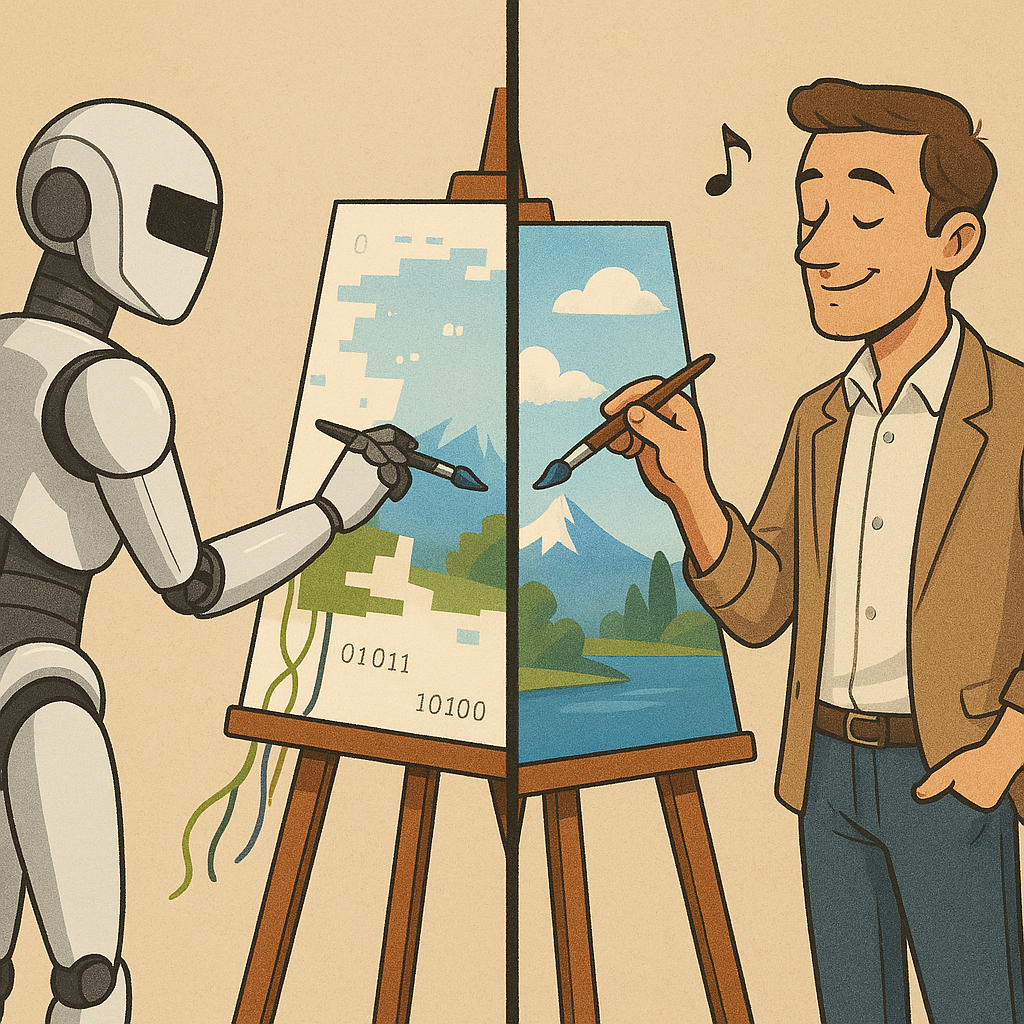
\The AI starts the picture, the human is going to have to finish it\
References / Further Reading
- Polanyi’s Paradox: Explored in The Tacit Dimension by Michael Polanyi and. Amartya Sen, as well as in various discussions on tacit knowledge in automation (search: Polanyi’s Paradox in academic journals).
- Next-Token Prediction Limitations: Technical analyses in papers on arXiv discussing GPT architecture constraints and context window challenges (Example 1, Example 2, Example 3, Example 4).
- Industry Case Studies: Features in Forbes, Business Insider, and The Wall Street Journal on AI’s successes and failures in real-world deployments.