While dictators manipulate Trump, the world is moving on without us.
By William Kristol
Published: 2026-11-19
URL: https://www.thebulwark.com/p/the-worst-throuple-on-the-planet-trump-xi-putin-trilateral-summit
One week before the midterms, we asked in these pages: “How Do You Solve a Problem Like Elon Musk?” James Talarico had better beat Ken Paxton in Texas, Andrew argued, or Democrats might be staring down the barrel of Elon dropping a half-billion in GOP support spending every two years until the nation sank into the sea.
And wouldn’t you know it: Talarico did win, and Elon sure seems appropriately jaded about the whole thing. “I feel pretty foolish about having spent so much money and not seeing much for it,” he said at a New York Times event yesterday. “It certainly shows that American elections are not just about money, you know? . . . Probably if I could rewind the clock I would have spent less.” So that’s one mission accomplished. Happy Thursday.
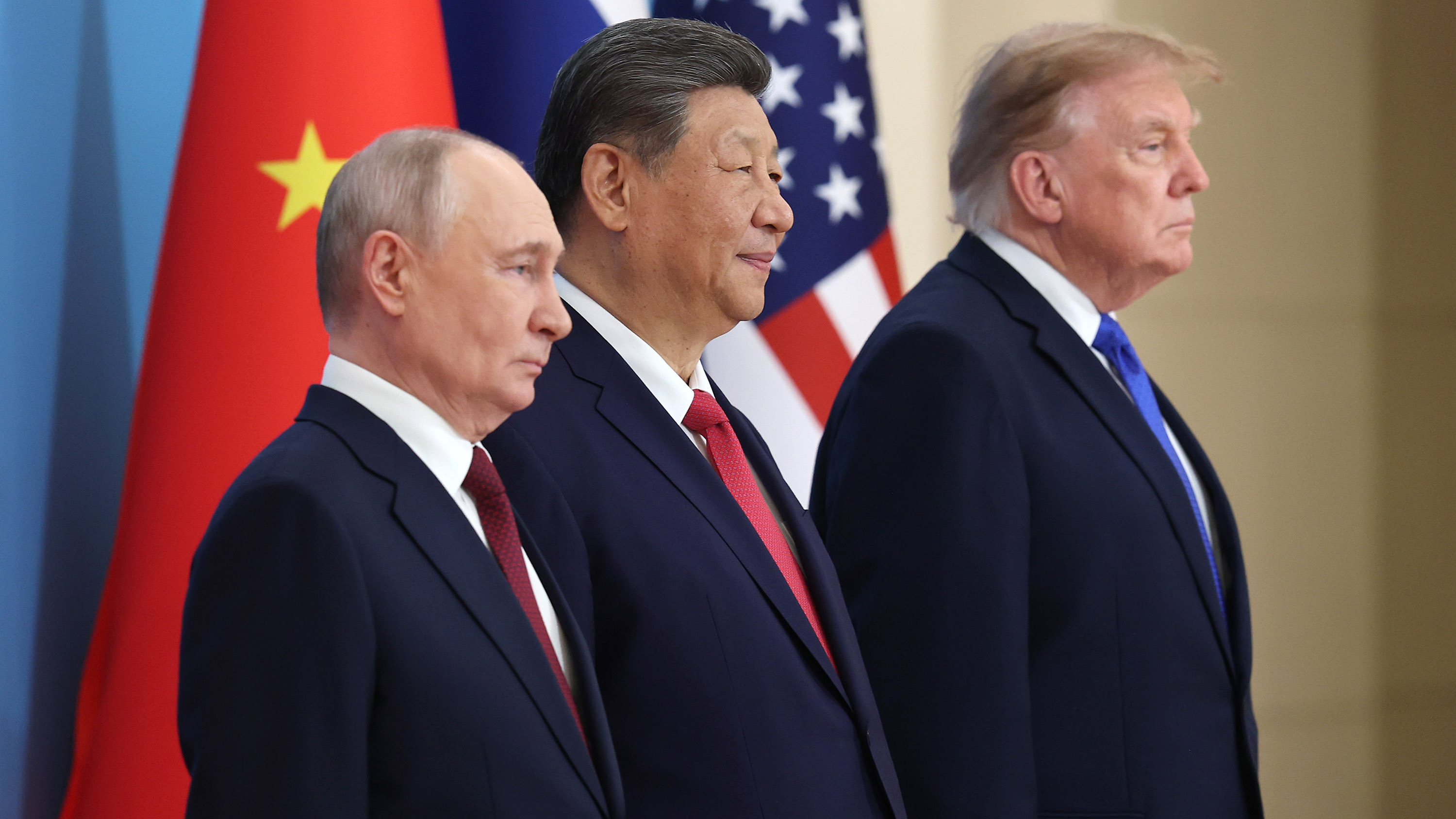
\President Donald Trump, Chinese President Xi Jinping, and Russian President Vladimir Putin arrive for a trilateral meeting at Kylin Villa on November 19, 2026 in Shenzhen, China. (Photo by Win McNamee/Getty Images)\
The Spectacle in Shenzhen
by William Kristol
I don’t know much about throuples.
Actually—let mehastento correct that statement. For the record: I know nothing about throuples. Nothing at all. Nada. Zip. Zilch.
Okay, glad to clear that up.
But my sense—an uninformed one, I hasten to remind you—is that they often don’t end well. I vaguely recall seeing something about that on Hacks. (I believe it was season four, episodes five and six, not that I was paying close attention.)
Joining a throuple is probably a bad idea. Joining a growing, thriving pro-democracy community is a great idea.
Anyway, what of the Trump–Xi–Putin hook-up we’ve just witnessed in Shenzhen?
It seems to have produced one unambiguously happy camper: Vladimir Putin. The brutal aggressor, ostracized by civilized nations after February 24, 2022, has been welcomed in from the cold by the two leading world powers, and at least nominally elevated to be part of a throuple on the world stage. So he comes out of it cheerful.
As for Xi Jinping, the photo op at Shenzhen was no skin off his back. He went along with Trump’s wish to continue his pet project of rehabilitating Putin, so Trump owes him. Putin’s rehabilitation also makes China’s close relationship with Russia less of a problem for Xi. If Putin’s joining them for the photo op helps to further erode any distinction in people’s minds between dictatorship and democracy, between the free world and the unfree, that’s in Xi’s interest as well. And Xi staged it all so he was its big man, its preeminent figure. So Xi may not have been excited by the threesome, but he’s fine with it.
As for Donald Trump? I suppose he’s pleased. He got to say “we are really making history,” even though no real history was being made. And while he looked ridiculous to all who had the eyes to see, Trump is already a figure of such low standing in the world and at home that I suppose yesterday can’t do his reputation any more harm.
Still, he is still president of the United States. When he embarrasses himself, he does, to some degree at least, embarrass us.
The first post I saw on X when I opened my laptop this morning was from the British commentator Marina Purkiss. Commenting on a video of Trump walking into his meeting with Putin with a big smile, pointing at Putin, and saying “He’s my friend,” she lamented: “America, how far you have fallen . . .”
It’s a fair comment. As an American I could try to respond that America did its best to repudiate Trump two weeks ago. So that while Trump can always personally plumb new lows, perhaps he doesn’t really speak for America? And I could also point out that the summit will likely be of very little practical consequence.
Still, Trump is the American president. And images and symbolism matter.
The spectacle at Shenzhen in a way encapsulates the challenge of the next two years. How do we limit any further damage Trump can do to our nation? How do we stop Trump from dragging the country even further down to his level?
It’s a task for all of us. For Congress, obviously. For the states. For our major civic and private institutions, as well. And for the American people, though they did their best to send an unambiguous message on November 3. But they can continue to express their opinions over the next two years in rallies and demonstrations and civic action, and also as they choose which candidates to support, in both parties, in 2028.
We may be stuck with Trump for the next two years. But we have to try right now, as a nation, to move beyond him as much as possible. We have to do our best to act in the spirit of the judgment the American people expressed two weeks ago. And then yesterday’s distasteful spectacle at Shenzhen will fade into history, an unlamented memory of a contemptible administration.
Moving On Without Us
by Andrew Egger
On yesterday’s Command Post, Lt. Gen. Mark Hertling and I talked about how strange it was that Donald Trump seemed to have so few geostrategic goals for today’s meeting with Xi Jinping and Vladimir Putin. He could have tried to advance negotiations with Xi about a way out of the AI arms race—or, barring that, called Xi to account about China’s flouting and evading U.S. export controls on advanced AI chips—but he didn’t. The issue went unmentioned.
And he could have gone in planning to hold Putin to account for the war in Ukraine—but he seemed uninterested in doing so. (Weeks ago, he suggested he didn’t even think the topic would come up. Today, he mentioned his interest in “resolving” the war ahead of the meeting, but it went unmentioned in the leaders’ joint declaration afterward.)
Instead, Trump was content to do a bit more work building out what JVL has described as the world’s new and improved “Axis of Evil,” the countries with the world’s largest nuclear arsenals presenting a united front against other nations nipping at their heels. The three countries, they agreed, would continue to build out their fossil-fuel infrastructures and would jointly work to dismantle organizations like the International Criminal Court, which has indicted Putin for war crimes.
They would also work together to crack down on other smaller powers that might want nukes, which are only fit for the lords of the earth. (The three nations also said it would probably be important for them to talk about slimming down their own nuclear arsenals—at some indeterminate point down the road, presumably some time after China has finished its current breakneck nuclear building spree.)
Going into moments like this, we Trump critics always wince and brace ourselves for remarkable new American concessions or diplomatic gifts to some of the world’s worst autocrats. There was plenty of that on display, with Trump grip-and-grinning with Xi and Putin like they were his best friends in the world.
But there’s another danger we shouldn’t lose sight of. While Trump spends these summits in gormless chitchat with his dictator buddies about how mean the press is to Great Men, other countries are moving to reshape the world without us.
China in particular seems eager to play both sides of the table. Xi is happy to be Trump’s buddy in Axis-of-Evil matters today, but he knows that a future American administration might once again try to rally the world to isolate China’s authoritarian government and economy. So he’s staying busy, not just buttering up Trump, but continuing to build China out as every other country’s most invaluable and irreplaceable trading partner.
And even democratic countries that might once have been sympathetic to the idea of isolating China, and which would have thrown in with a serious American effort to do so, are increasingly giving up the idea of carrying on such an effort alone. Yesterday, Canadian Prime Minister Mark Carney announced yet another thaw in the steadily improving Canada–China trade relationship, pulling down tariffs on another $400 million in Canadian exports and easing import controls on Chinese steel and aluminum.
“Canada and China have recalibrated our relationship to the benefit of citizens in both countries,” Carney said in a statement. “Canada is building our strength at home and diversifying our relationships abroad so that we have the freedom to live our lives as we choose.”
It’s bad enough that Trump is eager to spend his time palling around with dictators. It’s even worse that, as the world rewires itself around America rather than through it, that’s all he seems to want to do.
AROUND THE BULWARK
- Fox News Host Unloads on JD Vance in Stunning On-Air Attack… The anti-JD Vance movement has found an unlikely home, TIM MILLER discovered: Brian Kilmeade’s corner of the Fox Universe.
- Don’t Just Assume Dems Will Lose Their 2026 Gains Next Time… Some party insiders fear their majority comes with a two-year lease. Others think Democrats have a chance to make the House their home, reports LAUREN EGAN in The Opposition.
- Trump Won This District by 17 Points… Then CYRIL JEFFERSON pulled off the impossible. He joins TIM MILLER to discuss his stunning upset.
- Markwayne Mullin Grilled Over FAA Chaos, ICE Deaths and Football Game Flight… On Capitol Hill yesterday, the DHS Sec’y struggled to convince Congress of his competency, while Kash Patel skipped out. ANDREW EGGER and WILL SALETAN break it down.
- Welcome to Reporter and The Spy… A formal announcement for our newest show featuring MICHAEL WEISS and MARC POLYMEROPOULOS.
- SAVE THE DATE: Our next Founders Town Hall is December 9.
QUICK HITS
BAAJA BLAST: It’s one of the strangest ironies of 2026: In a year paralyzed by partisanship in which Congress did close to nothing, a couple really useful pieces of bipartisan make-government-work-again legislation somehow defied gravity and made it through Congress intact. The first was the 21st Century ROAD to Housing Act, a housing-policy bill hashed out by Sens. Elizabeth Warren and Tim Scott that became law this summer. And the second is the Bipartisan American Affordability and Jobs Act (BAAJA), a permitting-reform bill that overcame last-minute progressive resistance to pass a major logistical hurdle in the Senate yesterday, 65–31.
The United States needs to build a lot in the years ahead: new housing, new energy infrastructure, new everything. But one major barrier to that work is a federal permitting process that nearly everyone understands is a bad joke, burying every new would-be project beneath an astonishing burden of regulatory compliance work, environmental impact studies, and general red tape. If it’s passed, BAAJA should go a long way toward easing such bureaucratic bottlenecks.
“I worked in the White House when we passed the [Inflation Reduction Act],” said former Biden climate policy staffer Jane Flegal, now a senior fellow at the center-left Searchlight Institute. “If we had a bill like this in place first, it would have been game-changing. We invested hundreds of billions to put clean energy on sale, then watched projects get stuck in interconnection queues, permitting delays, and fights over who pays for transmission. The money was not the binding constraint; the ability to build was.”
BAAJA’s passage isn’t yet assured, nor is its seamless implementation: Donald Trump, who barely pays attention to legislation his administration is supporting and can sometimes throw a wrench in the gears at the last minute, said earlier this month that he “won’t approve” the wind-power provisions that are a key part of the bill. Still, it’s an encouraging step in the right direction.
WHITE HOUSE TO DEMS: DROP DEAD: Earlier this week, we mentioned that Democrats preparing to take committee gavels in the new Congress next year are already sending records-preservation requests and other investigative demands to various Trump-connected figures. Yesterday, the White House blew them off—for now.
“Ranking Member requests in the 119th Congress do not trigger any obligation to ‘accommodate . . . the needs of conflicting branches,’” White House Counsel Will Scharf wrote in a letter to Democratic lawmakers obtained by Politico. “Although some of you may (or may not) become a Chair in the 120th Congress, that does not mean that requests from the 119th Congress carry over.” Scharf’s letter also charged that Democrats’ requests “drip with an animus or pettiness revealing that the purpose of these letters is not legitimate oversight but to harass and aggrandize.”
This is not a minor clerical fight, but more evidence that the White House plans to fight Democratic congressional oversight at every turn. We’ve already seen whistleblower reports this month claiming that officials at the Interior Department have been destroying various documents related to likely future congressional oversight. (The department denies the reports.) Meanwhile, Scharf sent a government-wide memo this week ordering all executive-branch employees to obtain permission from the White House before agreeing to speak to any congressional committee. And Scharf has threatened criminal investigations against Democratic investigators who, in his view, “seek to abuse the legislative process to intimidate and to interfere with the lawful functioning of government.”
CHEAP SHOTS