JD Vance and Elon Musk want out of Trump.
By Jonathan V. Last
Published: 2026-11-19
URL: https://www.thebulwark.com/p/the-two-biggest-rats-are-jumping-ship-elon-musk-jd-vance-donald-trump
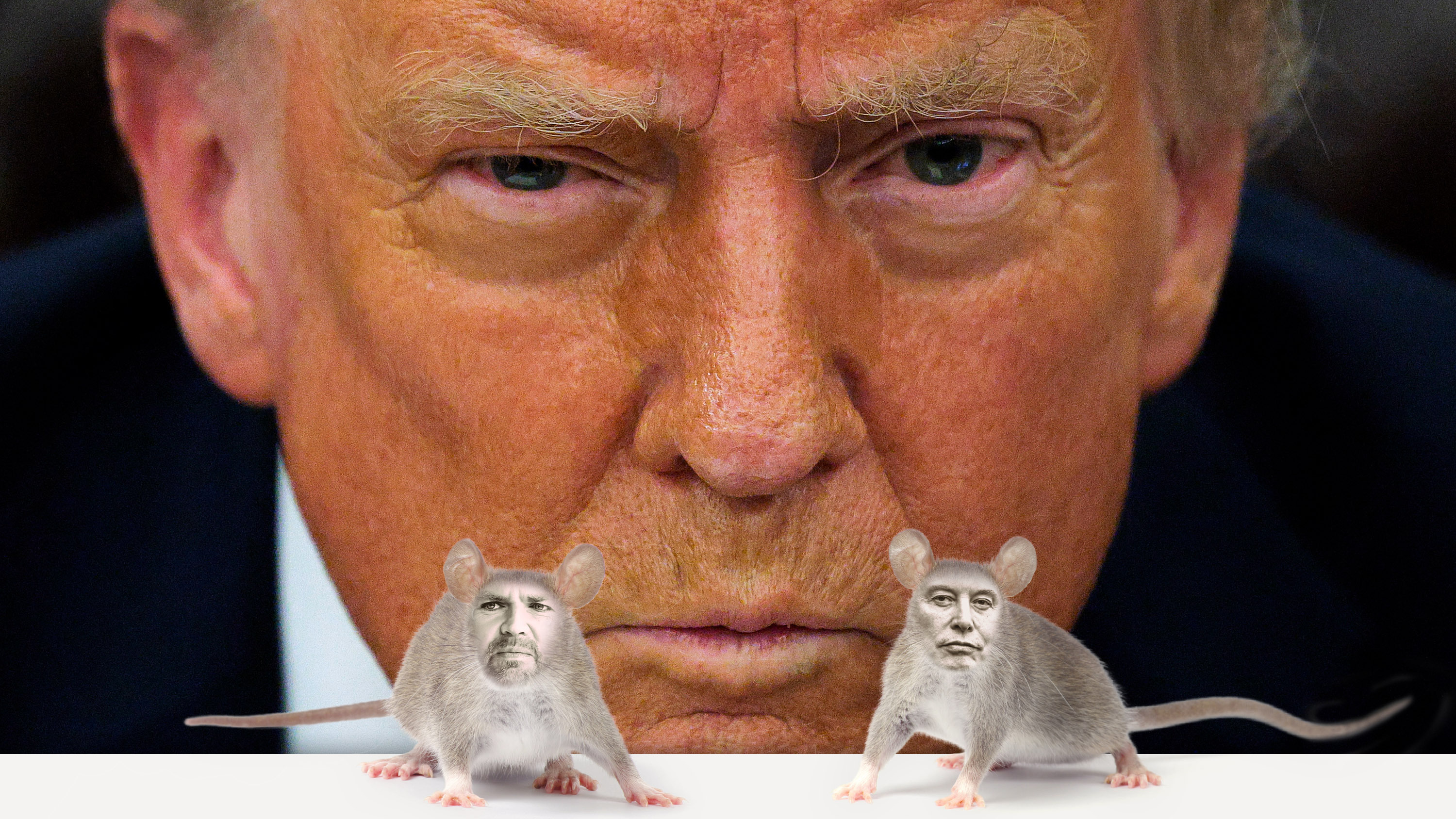
\(Photo illustration by Sarah Rogers/The Bulwark| Photos: Getty, Shutterstock)\
1. Dark MAGA
Yesterday, Elon Musk—the genius inventor, the greatest mind of our time—admitted to an oopsie.
Appearing via video for an interview with Andrew Ross Sorkin, Musk explained that he’s a moderate. That he thinks Gina Hinojosa will be a moderate governor. That it’s good for Democrats to control Congress. That he’s not MAGA. That he doesn’t even know what MAGA means.
No, really. Here are some quotes.
On Gov.-elect Hinojosa: “The new governor actually, I think, is going to be quite moderate. I don’t think she’s sort of a far-left governor. And based on everything I’ve heard about her, I think things will be fine in Texas with Gina as governor.”
- Musk contributed $5.5 million to Greg Abbott’s campaign. Probably because he thought Gina would be fine as governor.
On split control of government: “I do think that it’s good to have some balance of power, not have the, as a general rule, not have the presidency, Senate, and House all be of the same party. So my goal, and I did mention this on X, was that I think we want to have at least one of either the presidency, the House, or the Senate be of the other party.”
- Musk spent at least $446 million on Republican candidates during a midterm election in which Republicans held the presidency, the House, and the Senate. He appears to have spent zero dollars ($0.00) in support of Democratic candidates. Even though he thinks it’s “good” to have divided government.
- In 2024 he spent $290 million to get Republicans unified control of government.
On MAGA:
I’m ideologically quite moderate, although I don’t think I have any kind of extreme political views. . . .
I mean, I’m not MAGA. Well, at least I’m not—I’m not sure what MAGA means, but if that means sort of blind adherence to a set of policies by the Republican party, then I certainly don’t have that.
“I’m not sure what MAGA means” says the guy in the MAGA hat who spoke at the MAGA rallies, claimed he was “dark, gothic MAGA,” then worked for the MAGA president, and then spent half a billion dollars trying to get MAGA candidates elected.
That you, bro?
Guys: Most of what we do is free, but I want to keep growing. I want The Bulwark to be big and independent. Because the bigger we get, the more cool stuff we can build together.
2. JD
Meanwhile, JD Vance showed his hand during an interview on Monday with Laura Ingraham in which he subtly suggested that Donald Trump’s second term has been a failure because Trump hasn’t delivered True MAGA. Here are some relevant passages.
On who is to blame for Iran:
“We told the American people we would do no more forever wars. Yes, the president felt he had to destroy the nuclear program.”
- JD isn’t saying we had to destroy the nuclear program. He says “the president felt” we had to destroy the nuclear program. Pretty big difference.
“When the president makes a decision, he is owed a cabinet that helps implement that decision.”
- Not: I agree with the president’s decision. Just I owe it to him to help implement whatever he decides. Yikes.
On the timeline for ending the war:
“We are not going to allow this to become a ten- or fifteen-year commitment or frankly even a two-year commitment. Despite the fact that a lot of neoconservatives and a lot of other people want us to stay there forever, we’re not going to stay there forever. We promised we wouldn’t. And I have full confidence the president will get us out of this thing with great results for the American people.”
- Vance is setting a deadline of February 2028 for Trump to be out of the Gulf and saying—explicitly—that it’s up to Trump to get that done.
Why Democrats won: This is the big one, and it appears to have been cut from the broadcast portion of the interview, but is still in Fox social media clips.
I think that the people who look at 2026 and they say ‘That’s a rejection of what Donald Trump ran on.’ No, no, no. So many times, Laura—the Democrats in 2026, they were running on some of the very same themes that Donald Trump ran on in 2024. It shows the political power of it.
The line of logic here is unavoidable. Vance says Trump’s 2024 campaign issues were correct—but Trump’s administration has not delivered on them. He’s positioning himself to run in 2028 not on “Let’s keep the good times rolling” but “True MAGA has never been tried.” The stump speech writes itself:
Donald Trump is a great man. I served him loyally and you’ll never get me to say a bad word about him. But there were forces that prevented us from accomplishing what we set out to do. The Israelis got us into that war. The Democrats took control of Congress. Vance 2028 is about fulfilling the promise of Trump 2024.
Could this line possibly work?
I dunno. Probably not. But as stupid as it is, it’s less dumb than “I’m not sure what MAGA means.”
I’m interested in more proximate questions today:
- What are the other ways Republicans will attempt to manage the fallout of 2026?
- How will Trump respond to this maneuvering?
- Does that dynamic—positioning and response—incentivize other Republicans to attempt their own maneuvers?
- Or does the wider Republican system freeze and try to manage the end of Trump by burying its collective head in the sand and hoping for the best? Which, by coincidence, is how it managed the rise of Trump.
I’d like to hear your thoughts on this. Game it out for me. Let’s all look around the corners today.
Be part of the conversation in the best comments section on the planet. Feel what it’s like to be part of a genuine community. Build the independent media we need.
3. Bikes
Worse on Purpose is one of my favorite newsletters. It focuses on how economic incentives can create bad outcomes both for consumers and for the companies that serve them. Take the example of bicycle manufacturing:
When a company hands its manufacturing to someone else, the knowledge of how to innovate goes with it. Over time, a company that has outsourced loses the ability to improve its own products. The companies that now do the making take up that responsibility.
Schwinn is a textbook example. In the late 1970s, the most prominent name in American cycling began paying a Taiwanese company called Giant to build its bikes. By the mid-1980s, Giant was making the majority of Schwinn’s catalog. By 1987, a former Schwinn executive was running Giant’s new US arm. Schwinn went bankrupt in 1992. Today, Giant is the world’s largest bicycle company, and the Schwinn name belongs to Pon, a Dutch holding company. . . .
In 1977, Giant’s Tony Lo signed a deal to build bikes for Schwinn.
In October 1980, Schwinn’s Chicago workers went on strike. Over the next five months, Giant shipped Schwinn about 80,000 bikes, according to Crain’s, a business news outlet in Chicago. In 1981 Schwinn opened a non-union plant in Greenville, Mississippi. It never turned a profit and closed in 1991. The Chicago plant had closed in 1983.
The economics behind the move were simple. Richard Schwinn, of the founding family, estimated that the American-made parts for one Schwinn Varsity cost about $70. A Taiwanese maker charged about $70 for the whole bike. Chicago spent the import’s entire price before paying anyone to assemble or paint it. For Schwinn, moving production to Taiwan was seemingly the rational choice.
So the work moved. By the mid-1980s Giant made more than two-thirds of Schwinn’s bikes, and Schwinn accounted for 75% of Giant’s orders. Ed Schwinn, who ran the company, later handed Giant about four-fifths of Schwinn’s production without taking any stake in Giant.
The people moved with the work. Bill Austin joined Schwinn as an executive vice president in 1979. Giant’s US business launched in 1987 under his leadership, and he became its president. Jay Townley, another Schwinn vice president, later ran Giant USA as well.
In 1987 Schwinn tried to reduce its dependence on Giant by signing with China Bicycle Company in Shenzhen. Giant’s founder, King Liu, told the New York Times: “We were terrified.” Giant responded by building its own brand in Europe and the US. By the late 1980s it was selling cheaper Giant bikes to American dealers, in direct competition with Schwinn.
Schwinn’s share of the US market fell from about 12% in 1979 to about 5% in 1992. It filed for bankruptcy that October.