Haley Stevens’s stunning defection, a fundraising surge, and a possible Senate majority in the balance.
By Jonathan Cohn
Published: 2026-11-02
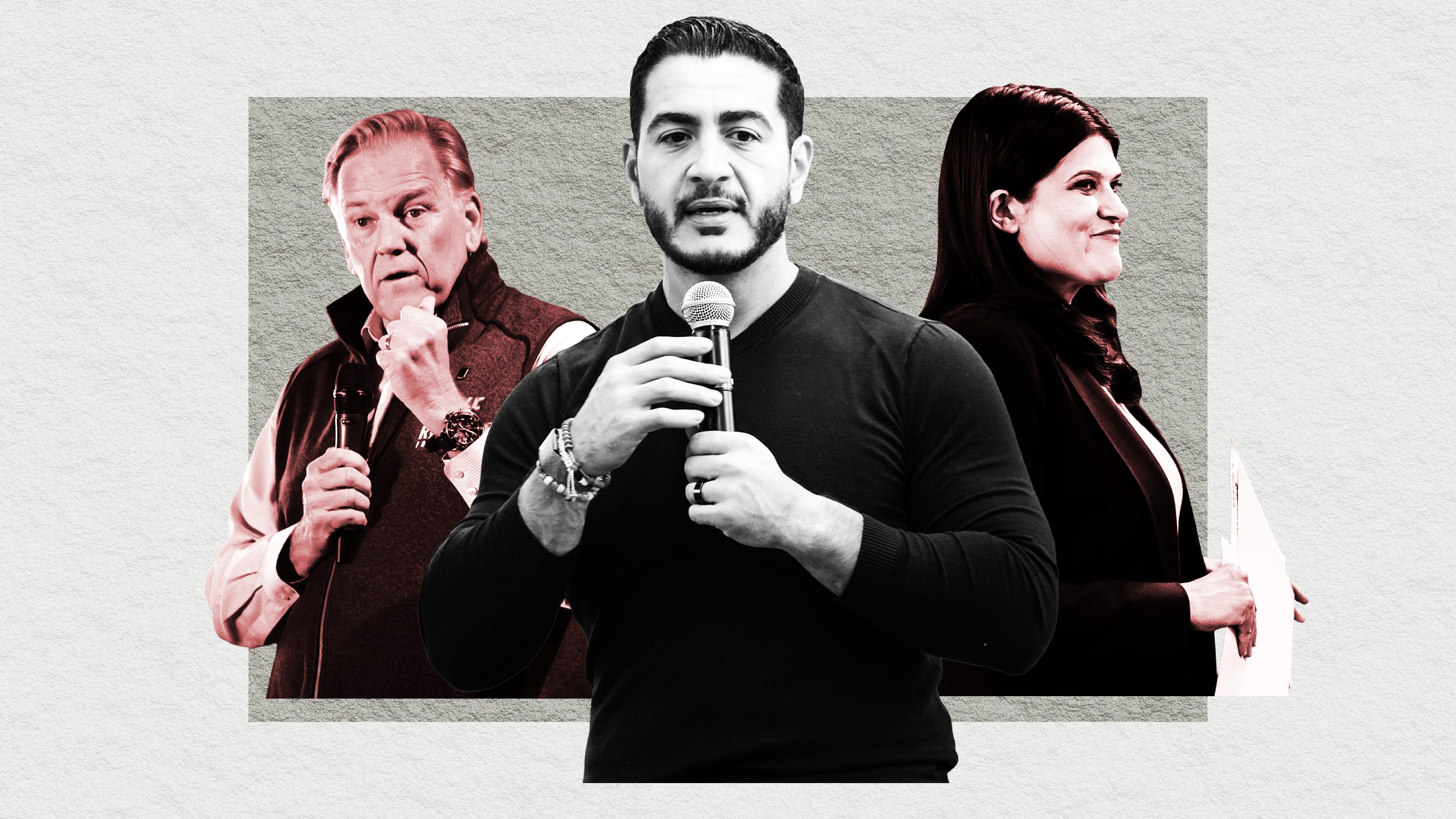 (Photo illustration by Bill Kuchman/The Bulwark | Photos: Getty, Shutterstock)
*Detroit, Michigan
*ABDUL EL-SAYED STOOD on the steps of a small brick church, staring at the dozens of cameras and microphones pointed in his direction—and strangely defiant in what was shaping up to be the worst day of his U.S. Senate campaign.
It was early Sunday afternoon, just hours after his onetime rival for the Democratic nomination, Rep. Haley Stevens, had announced she was endorsing Republican nominee Mike Rogers. Just to make things worse, Stevens had announced her endorsement by joining Rogers at a large black community church, making a play for voters that El-Sayed had lost to Stevens in the primary and that he was struggling to win over fully in the general.
The church where El-Sayed appeared was also a black congregation. The whole point of the day’s “Souls to the Polls” event was to rally those still-skeptical black voters. And to do that, El-Sayed had brought key supporters including James Clyburn, the senior House Democrat and civil rights veteran who had endorsed Stevens in the primary.
Now, after Stevens’s bombshell, attention wouldn’t be on Clyburn’s support, or El-Sayed’s proposals for black Michiganders. All anyone seemed to care about was the rift between El-Sayed and Stevens. Amid the bustle, El-Sayed refused to concede the rhetorical ground, reacting instead as he always does when he doesn’t like the question: He challenged the assembled reporters to ask something different.
“None of this matters—guys, guys, guys,” El-Sayed said, trying to shush the crushing mob of reporters that left poor Don Lemon standing in a shrub.
“There’s a family—you can go like fifteen minutes that way, or fifteen minutes that way, or fifteen minutes that way,” he said, pointing left, right, and straight ahead. “And there are families who are preparing to send their kids to schools tomorrow that look like they did fifty years ago. They’re worried about what they’re going to feed their kids for lunch. They’re worried that if one of their kids gets sick, they’re not going to be able to pay the bills. Those are the things that matter.”
The gambit did not work. After two futile attempts to solicit questions about something other than the Stevens saga, Roxie Richner—El-Sayed’s 24-year-old communications director—declared the press conference over. El-Sayed and the assembled dignitaries retreated back into the church for the proceedings, in what looked like a prelude to bigger defeats.
And maybe it was. The Rogers campaign has shown signs of life in just the last two weeks, for the first time attracting modest crowds to its events. Rogers himself has seemed more at ease in his speeches and interviews, having finally gotten some practice after dodging scrutiny while running uncontested in his party’s primaries.
Meanwhile, ads attacking El-Sayed as too extreme are saturating the airwaves and internet, and filling Michiganders’ mailboxes. Many tap unabashedly into anti-Arab or anti-Muslim bigotry.
But by Sunday evening, there were signs that El-Sayed might get through the Stevens fiasco just fine, or maybe even in a stronger position. It was a scenario that El-Sayed advisers and supporters had suggested after news of the Stevens endorsement broke, and it hadn’t seemed especially plausible until a loud, furious chorus of her fellow Democrats started denouncing her. Later came word from the El-Sayed campaign that it had raised $2.4 million in the hours following the Stevens news and the publication of the final New York Times/Siena poll, historically among the most reliable, showing El-Sayed ahead by 11 points.
And then later in the evening, Stevens went on CNN to talk about her Rogers endorsement—in a performance even her longtime allies described as a train wreck.
It was a wild twist to a wild day, following a wild few days that showcased both the promise and the peril of El-Sayed’s candidacy, on which not just Michigan’s Senate seat but a potential Democratic majority could depend.
Enjoy on-the-ground reporting and serious honest analysis by joining The Bulwark.
STEVENS HAD MOSTLY VANISHED from the news until last week, and she had not been on the campaign trail stumping for fellow Democrats, either. Her absence was conspicuous, given that the third Democratic candidate from the primary, Mallory McMorrow, was making regular and enthusiastic appearances. But it also made sense given how heated the primary between El-Sayed and Stevens had become by the end, and the ongoing controversies over the subjects that had most divided them: El-Sayed’s position and rhetoric on issues tied to Israel.
The issue flared up again last week, following a series of events—including the appearance on October 23 of an anti-Rogers ad almost impossible not to see as antisemitic. The ad was not put out by El-Sayed’s campaign, but by a PAC started by left-wing commentator Cenk Uygur. That’s when Stevens’s fiancé, a lawyer and disability advocate named Jason Turkish with a record of donations to pro-Israel candidates of both parties, announced he was endorsing Rogers because he found El-Sayed’s views so objectionable. Turkish did so at a meeting of the Republican Jewish Coalition in Oakland County, the Democratic-leaning northern Detroit suburb with a large Jewish population.
Stevens told friends and her political contacts that she wasn’t abandoning El-Sayed, then went on CNN to say so publicly—although, when she did, she qualified her endorsement by saying he needed to say more to denounce antisemitic rhetoric, presaging a day of ambiguity and indecision from Stevens. Party leaders, including Michigan’s veteran House Democrat Debbie Dingell, intervened at that point, eyeing Clyburn’s coming visit as a chance for El-Sayed and Stevens to appear jointly and demonstrate party unity.
Exactly who said what to whom at this point remains unclear. But the public sequence went something like this: Stevens released a statement confirming she would be appearing with El-Sayed but calling on him to “apologize” for statements linking Israel to affordability concerns in Michigan, and to “take down” an ad his own campaign put out that included a brief clip of Tucker Carlson. In reply, El-Sayed put out a statement making clear he wasn’t about to relitigate a primary he had already won. And then plans for the joint appearance went poof.
El-Sayed’s statement referenced the tens of millions of dollars that AIPAC had spent against him on Stevens’s behalf during the primary, in what party officials and consultants told each other—and in some cases, me directly—was an unnecessary escalation. But already it was Stevens’s behavior drawing the most scrutiny from fellow Democrats—including McMorrow, who in a CNN interview of her own said, “I have no idea what the hell Haley Stevens is doing.”
By this point, speculation about Stevens’s plans was circulating widely in political circles, especially after Rogers and Donald Trump praised Stevens on social media. When multiple reporters and pols reached out to her, the message back remained the same as late as Sunday morning: Stevens was still on Team Abdul. Which is why all of those contacts were shocked to see Stevens show up at church with Rogers, and even more shocked to see a social media post from Stevens endorsing him. In a handheld video recorded in the seat of a car, Stevens noted that El-Sayed did not want her to campaign with him.
In my conversations with smart political folks in the state, it’s clear that the political danger from the Stevens endorsement was less about Jewish voters, who comprise a small portion of Michigan voters and had likely either made up their minds or aren’t going to be swayed by what Stevens says. Rather, the worry was about the potentially much larger universe of black voters still hesitant about El-Sayed—whether because of Metro Detroit’s history of tense black-Arab relations, the lingering impact of attack ads on El-Sayed that targeted black voters during the primaries, or a larger general antipathy toward more left-wing politicians.
I found evidence of that black hesitation toward El-Sayed inside the church while talking to Gloria Jones, 77, a retired nurse who said she appreciated El-Sayed’s background in public health, and the way “he speaks freely and frankly” without “beating around the bush.” But while she described herself and her husband as strong supporters of the candidate, she acknowledged she knew quite a few neighbors who weren’t.
“It’s not a big difference, not a lot of people, but it’s more than usual,” she said.
CLYBURN ACKNOWLEDGED the gap too when I caught up with him after the proceedings, and he said he was “disappointed” with Stevens, calling her theatrics a “distraction” and adding, “I just hate to see this come about because it’s not who I knew her to be.” Then Clyburn reiterated his own endorsement of El-Sayed, citing his support for expanding access to housing and health care, and his determination to stand up to Trump.
“Anybody who is going to be a ‘yes man’ for this administration should not get the endorsement of any Democrat and should not get a single vote from any African American,” Clyburn said.
Tyrone Carter, a veteran state legislator and black politician from Detroit, also acknowledged the hesitancy some black voters feel about El-Sayed, pointing to the history of tension between the black and Arab communities. But he also said he didn’t think Stevens’s endorsement would ultimately matter, given how many people had already voted early or made up their minds—and the possibility that it might even persuade some uncertain voters to back El-Sayed, because they would see Stevens’s actions as a betrayal.
“What it does to people who were on Team Stevens, as I was, is that it comes off as a sore loser,” Carter told me.
Stevens’s congressional staff seemed to agree with Carter. They resigned en masse following her endorsement of Rogers, and former advisers criticized her openly—including Joetta Appiah, who had served as her campaign spokesperson.1
“Haley Stevens is walking back on everything her campaign stood for,” Appiah told me via text. “Michiganders deserve better, and they need to stay focused on what matters, which is electing Abdul.”
EL-SAYED’S CHURCH EVENT went so long, between the media scrum and lengthy speeches that included multiple local and national leaders, that his campaign scrubbed plans for a walk to the polls. Instead, he went straight to the next planned event, at a local food pantry, and then for a final “knock out the vote” rally in nearby Southfield. A primetime appearance on MS NOW followed, in which El-Sayed was even more disciplined than he had been outside the church—repeating that he saw the controversy as a distraction and was focused on kitchen-table issues for Michiganders.
But that wasn’t the cable interview that had everybody talking. Instead, it was Haley Stevens’s interview with Anderson Cooper on CNN. Over the course of fifteen minutes she gave rambling, halting explanations for why she had decided to endorse Rogers—suggesting, at one point, her endorsement didn’t matter because she represented just one vote—and refusing repeatedly to answer Cooper’s question about how and when she changed her mind.
“Anderson,” Stevens finally said, “that is nice editorializing and nice bits of information about what’s going on. . . . I had an opportunity to go to a church service and have a prayerful moment. It was Sunday. It was very beautiful. It was about friendship, of which I have many incredible friends in the Democratic party, and I care a lot about them.”
The performance did nothing to raise her credibility, while raising lots of questions—in private texts, some of them to me, and then aired on social media—about her mental well-being. Among those concerned was Dingell, who appeared immediately after Stevens on CNN and seemed visibly startled by what she had seen.2 “That was one of the most painful interviews I have ever watched,” Dingell told Cooper. “I have been worried about her all last week. She’s a human being. I’ve had multiple conversations with her.”
Concern for Stevens’s well-being was all over social media, including a post from her longtime friend Jordan Acker, a University of Michigan Regent, who said he found her actions inexplicable. “It is painful to watch someone you care about go through something like this. It is even more painful to worry about the influence of those closest to her,” Acker went on to say, referring to Stevens’s fiancé, Jason Turkish.
“I’ve heard serious concerns about his [Turkish’s] treatment of Haley’s staff, friends, and allies,” Acker tweeted. “My own experiences have only deepened those concerns.”
Dingell reiterated her own worries to me on Sunday night, calling the previous twenty-four hours “one of the hardest days of my career.” And she said she had become genuinely concerned about the rhetoric used in the campaign generally—and the fears she described hearing from members of the Arab, Jewish, and black communities alike.
But she said she was even more committed to electing the Democratic ticket, including El-Sayed, whom she has been promoting ever since the conclusion of the primary (in which she remained neutral). And she said she was struck by the reactions she saw on Sunday during events at a union hall and a local NAACP meeting.
“People are angry,” she said. “This might just backfire.”
PLENTY OF DEMOCRATIC OFFICIALS and strategists wondered in recent days whether the whole conflict might have been avoidable if, somewhere along the way, El-Sayed had made more public gestures to embrace Stevens, even if they were purely cosmetic. Or if he had been clearer and more vocal in his condemnations of rhetoric like the controversial ad, rather than always wrapping it in language about how much he hates being asked to “renounce” and “condemn” things or why he sees the whole issue as a distraction.3
But that is not who El-Sayed is. He likes to say he believes in “radical honesty,” portraying himself as a politician who won’t bend from his principles, in a way that supporters find inspiring and critics find self-righteous.
At his last event Sunday night, a canvassing launch inside a union hall, El-Sayed was hoarse but still on message and invoking one of his favorite speech lines: “It shouldn’t be this hard.”
It’s a reference to the financial struggles Americans face, not the political difficulty of candidates running for office. But this campaign didn’t have to be this hard, either—not in a year when conditions nationally are as favorable to Democrats as they’ve been in recent memory, and not when his opponent is a generic Republican congressman-turned-corporate-strategist who already lost once.
It’s entirely possible that an equally generic Democrat would be cruising to victory right now, as would one who didn’t have to overcome anti-Arab or anti-Muslim sentiments. The final vote count may suggest as much, though it could also suggest something like the opposite: That his ability to inspire young voters, present as a political outsider, and rally Michigan’s Arab community made this election a lot easier than conventional wisdom holds.
Either way, it is clear that El-Sayed has sometimes chosen to do things the hard way, because that’s his personality. And that his positions on everything from health care to energy to Israel have put him on the opposite side of some powerful lobbies now spending literally tens of millions of dollars against him. Which means that while some of his campaign difficulties are surely self-inflicted, some are a product of what he’s trying to do—for better or worse, or maybe both, depending on what you believe.
Update (November 2, 2026, 8:50 p.m. EST): Tonight, more than twenty former campaign staffers (one named, the rest anonymous) released an open letter recalling Stevens’s past criticism of Rogers as a “corrupt career politician who would blindly rubber-stamp Donald Trump’s chaos.” They write: “It’s infuriating to watch her become the very thing she once condemned.”2
Dingell told Anderson—and me—she had not realized CNN had booked her to appear immediately afterwards.3
El-Sayed’s campaign did make a point of distancing him from the controversial ad last week, but he was still being asked by reporters for more explicit statements condemning the ad as recently as yesterday.