The blood-and-soil extremists have donors, institutions, administration ties—and plenty of friends in MAGA.
By Cathy Young
Published: 2026-09-18
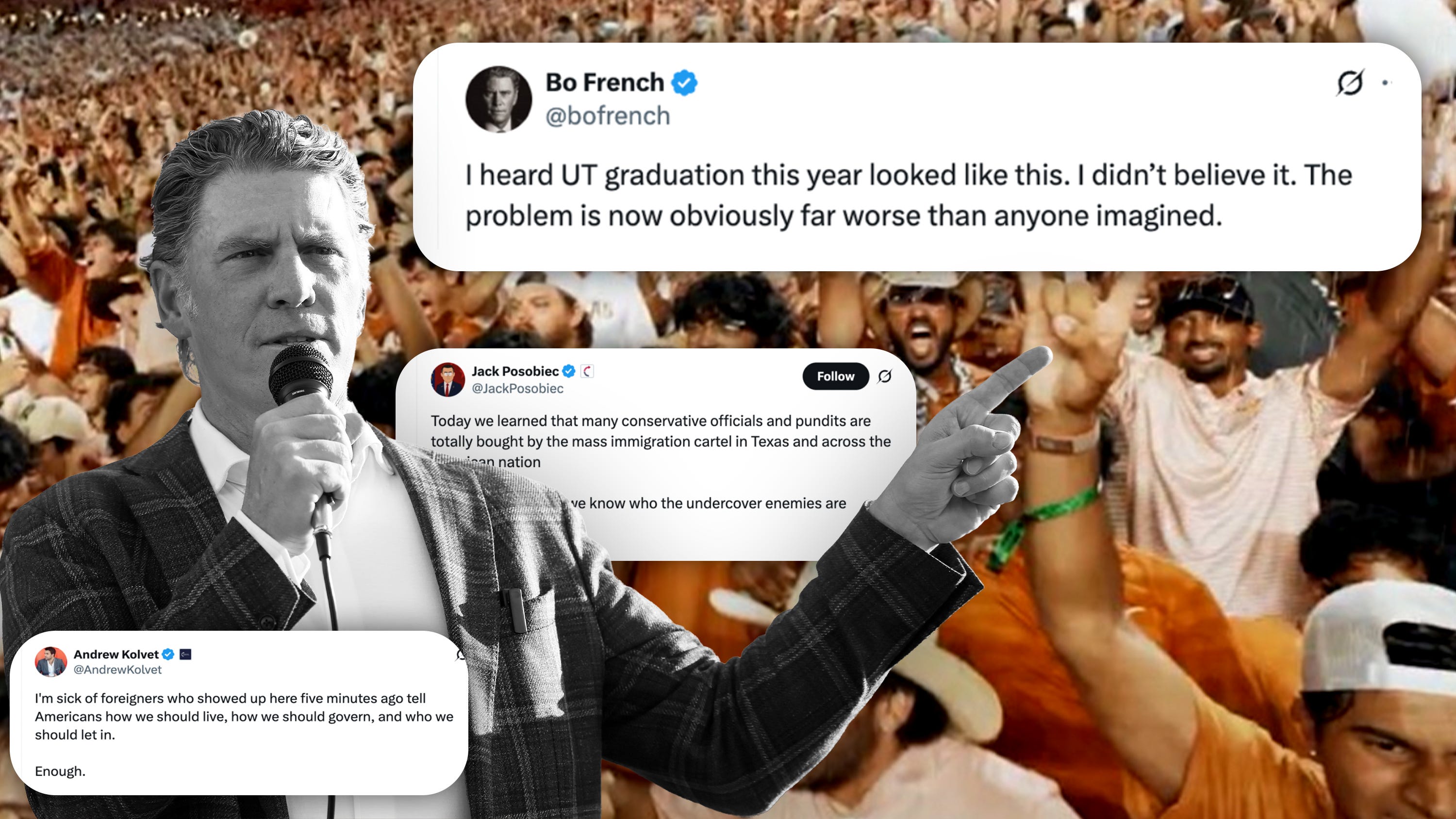 (Photo illustration by Sarah Rogers/The Bulwark | Photos: Getty, X.com)
THE ISSUE OF WHITE NATIONALISM on the right and its infiltration of the Republican party burst out into the open in mainstream conservative discourse this week. First, on Sunday, Bo French, the GOP nominee for Texas Railroad Commissioner, expressed his dismay at a photo of mostly South Asian and black young people having fun at a University of Texas football game. His post went viral on X.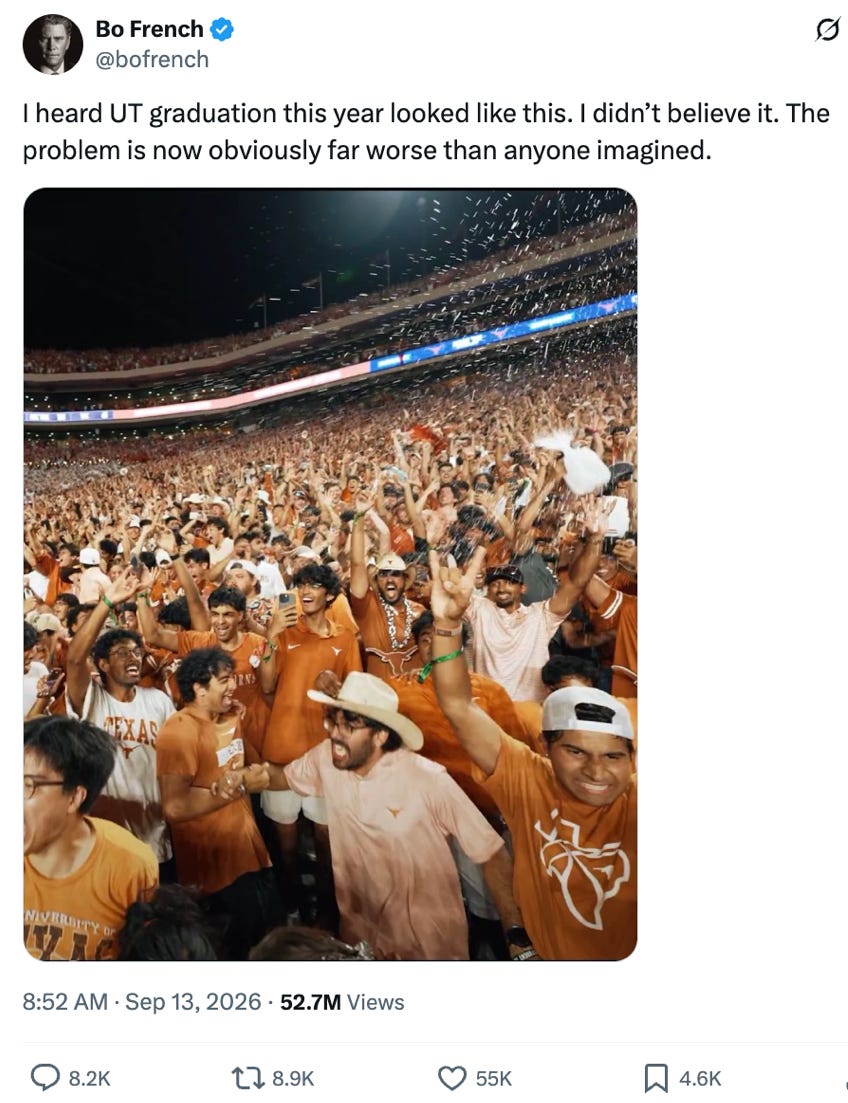
Texas Republicans scrambled to do damage control, with some, such as Sen. John Cornyn, openly disavowing French’s racism. Former George W. Bush adviser Karl Rove even declared he would vote for a Democrat—French’s opponent Jon Rosenthal—for only the second time in his life and the first since 1994. (Gov. Greg Abbott distanced himself more cautiously, saying that “that is not my message” and extolling football as a force for unity before pivoting to anti-immigration rhetoric.)
Many conservative commentators were also appalled.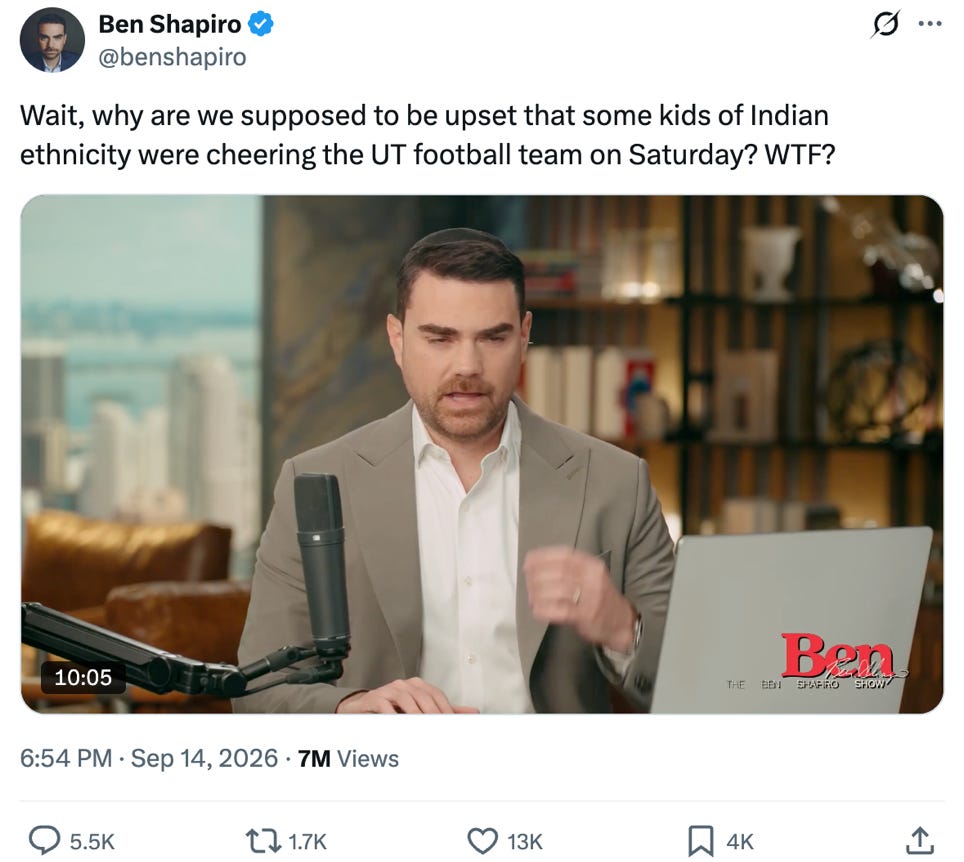
But French also found prominent supporters on the right, including Federalist CEO Sean Davis, Blaze Media’s John Doyle, and Turning Point USA show host Jack Posobiec.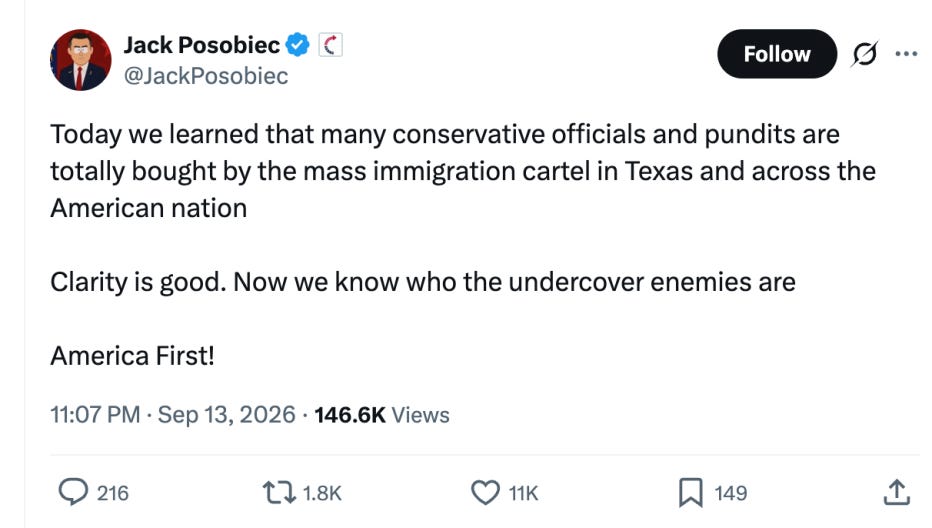
Others, like TPUSA spokesman Andrew Kolvet, did not back French openly but unmistakably weighed in on the nativist side: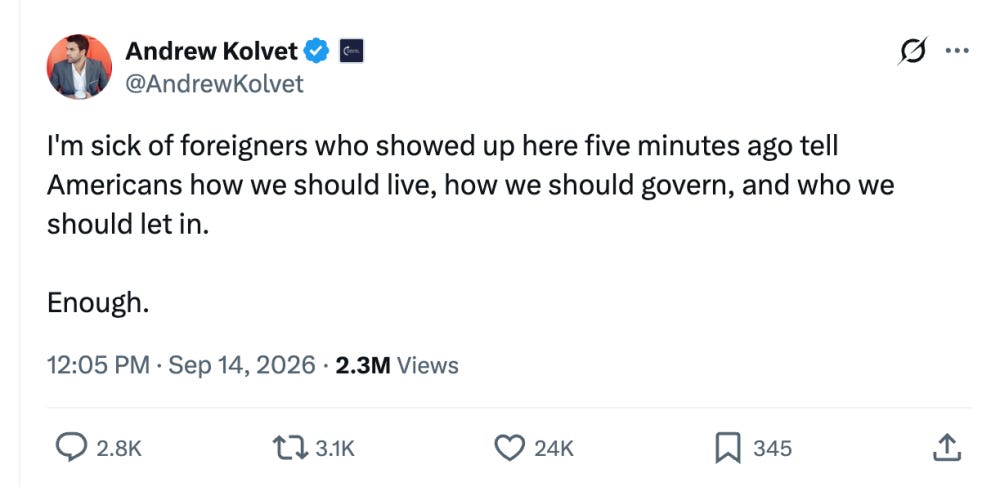
And, of course, reactions on X quickly devolved into predictable racist garbage.
THREE DAYS LATER, the conversation about nativist bigotry in right-wing ranks got another big jolt from a long Substack article by radio host Erick Erickson examining—let’s not mince words here—fascist infiltration on the right. (It’s all the more significant because Erickson himself is a former “Never Trumper” I’d now describe as soft MAGA.)
The focus of Erickson’s piece is a radical far-right network connected to shampoo tycoon-turned-blogger Charles Haywood, an unabashed proponent of authoritarianism and plain, uncut fascism. Haywood is a fan of Nazi-adjacent German jurist Carl Schmitt and has kind words for dictators like Francisco Franco and Augusto Pinochet; he has also outlined his views in a febrile manifesto. While he calls his ideology “Foundationalism,” it is blatantly hostile to the actual American Founding: Its core idea is a rejection of “autonomic liberalism,” i.e., the Enlightenment vision of human emancipation.1
Haywood’s utopia features an authoritarian state that would, among other things, promote virtue and Christianity as well as traditional sex roles enforced through a combination of social and legal pressures. (Never mind women’s suffrage: Haywood makes it clear that democratic franchise will not exist at all in his ideal state, which will be ruled either by a “limited dictatorship” or by an “aristocratic” elite.) This manifesto also calls for the deportation not only of all illegal immigrants but also of “legal immigrants of the past several decades not culturally compatible”—which is rather amusing, seeing as Haywood’s ideas are not very culturally compatible with America as it has existed at any point since 1775. The X xenophobes, his true people, are particularly offended by the notion that newly minted Americans “on day one” should consider themselves entitled to express opinions on American political conflicts; but I would venture a guess that the majority of the people being targeted with these sentiments have more American values than Haywood does.
Political rants published on the blogs of cranks: They’re less than a dime a dozen. But Haywood, it turns out, is a big donor to the Claremont Institute, where he has a seat on a publication committee—and where several people in influential positions are members of his “fraternal order,” a networking group that limits its membership to heterosexual Christian men. (Scott Yenor, whose appointment to a high-level post at the Heritage Foundation caused some controversy late last year because of his extreme comments about women, marriage, and gay rights, reportedly also played “a central role in founding” this network.)
And there’s more: Haywood’s personal foundation, writes Erickson, “is a recurring funder of American Moment, the staffing pipeline founded in 2021 with [Vice President JD] Vance’s support, which exists to place young conservatives in administration jobs.”
Much of the information in Erickson’s post had been reported before, but he put it all together in a compelling way. He also rightly connects the rise of Claremont-style fascism with the parallel rise of the “groypers,” the more brashly racist, antisemitic and misogynistic movement associated with the repugnant Nick Fuentes. As Erickson puts it:
I do not think Haywood, his compatriots, and Fuentes are coordinating. I think something worse is true. These are two separate projects, with separate donors and separate audiences, converging on the same destination, and the institutions of the right are absorbing both without resistance. One works by throwing money around to shape boards, publication committees, and institutions. The other works by radicalizing 19-year-olds on livestreams and then placing them in field offices. They arrive at the same place, which is a country where your ancestry determines your standing, and the state decides what your family is for.
Meanwhile, National Review has chimed in on the French situation with an editorial slamming the candidate’s “repulsive online attack on Indian Americans” (though the piece paused to dutifully concede that “too much immigration” can be disruptive even when the immigrants are successful and law-abiding). This is a welcome intervention, but the obvious problem is that Bo French-ism—so to speak—runs, as Erickson shows, far wider and deeper than one candidate for state office. For that matter, French’s racism and xenophobia were on display long before last Sunday: Just in July, he issued calls to “round up” and deport all Muslims and Chinese Americans. Texas GOP officials met these unabashedly racist provocations with resounding silence.
WHAT MEANINGFUL DAYLIGHT is there between Bo French and leading voices from the Trump administration itself? French has called for the deportation of 100 million people who “don’t share our values” and “shouldn’t be here”; a meme depicting the idyllic tranquility of “America after 100 million deportations” was shared by the official account of the Department of Homeland Security on New Year’s Eve, with the comment, “The peace of a nation no longer besieged by the third world.” We now know that 100 million deportations was a target seriously envisioned by Greg Bovino, Border Patrol “commander at large” until January; he recently upped his estimate of deportable illegals to 107 million. And Stephen Miller, Donald Trump’s deputy chief of staff, has long been fixated on the supposed evils of “Third World” immigration. In a Fox News rant last December, Miller declared that the 1965 decision to abolish stringent quotas limiting non-European immigration amounted to “the single largest experiment on a society, on a civilization that had ever been conducted in human history—not just the 76 million immigrants that were brought in, largely from the Third World, but their descendants too.”
And there is, of course, JD Vance—who, as Erickson pointed out in his post, has consistently refused to disavow the “groypers.” (True, last year he finally condemned racist slurs against Second Lady Usha Vance, who has an Indian background, but with far less vitriol than he employs when denouncing Democrats.) And one may recall that Vance’s speech at the 2024 Republican convention contained a controversial passage in which a tribute to his family’s legacy, symbolized by a family cemetery plot in Eastern Kentucky, turned into a vehicle for a soft blood-and-soil nationalism—that is, the notion that true Americanness is measured by generations of American ancestors while immigrants are here as perpetual guests. That’s the concept of “legacy Americans” or “heritage Americans,” now firmly ensconced in right-wing discourse.
AS MANY PEOPLE HAVE NOTED, blood-and-soil nationalism is pernicious everywhere but is especially absurd in America, a country built by refugees, settlers and immigrants (and by enslaved people brought here and forced to live and work against their will). The absurdity of the down-home Herrenvolk position is illustrated by the fact that some of its most vocal proponents are descended from immigrants, and it isn’t a long descent. To pick just one example, Stephen Miller’s great-grandfather arrived at Ellis Island in 1903. (“I have watched with dismay and increasing horror as my nephew, an educated man who is well aware of his heritage, has become the architect of immigration policies that repudiate the very foundation of our family’s life in this country,” Miller’s uncle, David Glosser, wrote in Politico during the first Trump administration.) Not surprisingly, the “Heritage Americans” themselves can’t agree on just how far you have to go back to lay claim to the title: Pre-Founding? Pre-Civil War? Pre-1965? One “How American are you?” chart circulated on the right grades Americanness from A, for “colonial old stock,” to D for post-1965 arrivals. (People who have shared it include, hilariously or perhaps pathetically, Jack Posobiec, whose immigrant wife scores a D; while Posobiec’s own lineage is unknown, his ancestors were likely part of the “Ellis Islanders” wave, which gets a C.)
One can argue about what kind of nation the Founding Fathers envisioned and whether they would have thought it could assimilate Indians. (Jefferson was quite explicit about his view that protections for religious freedom should extend to “Jew and the Gentile, the Christian and Mahometan, the Hindoo, and infidel of every denomination”; John Jay, on the other hand, wanted a “wall of brass” to exclude Catholics from public office, and even proposed denying them property and civil rights unless they rejected papal authority, though he did not seek to exclude them from the country completely.) The fact remains that the federal government imposed no restrictions on entry into the United States until 1875; while naturalization was limited in 1790 to “free white person[s] . . . of good character,” local courts had broad latitude in deciding who counted as white, and U.S.-born children of noncitizen residents were generally presumed to have U.S. citizenship even before the Fourteenth Amendment.
Nativist attempts to invoke great figures from American history in support of a blood-and-soil vision are almost invariably dishonest. Last May, past Claremont Institute fellow and Federalist contributor Brianna Lyman cited Abraham Lincoln’s 1838 Lyceum Address, in which the future president movingly evoked memories of the Revolutionary War generation as a foundation for the preservation of America’s free political institutions (against the backdrop of slavery and mob violence, arguing that such lawlessness threatened America’s free institutions). But while Lincoln spoke of “gratitude to our fathers,” his point was that the “living history” connecting Americans to that generation was now almost entirely gone and the defense of liberty would have to come from “cold, calculating, unimpassioned reason,” not personal passions. And in a speech in Chicago twenty years later during his Senate campaign, Lincoln was explicit about the fact that the American heritage of freedom also belonged to the foreign-born and to the descendants of those who had settled in the United States after the Founding—a number he estimated at “perhaps half our people”:
If they look back through this history to trace their connection with those days by blood, they find they have none . . . but when they look through that old Declaration of Independence they find that those old men say that “We hold these truths to be self-evident, that all men are created equal,” and then they feel that that moral sentiment taught in that day evidences their relation to those men, that it is the father of all moral principle in them, and that they have a right to claim it as though they were blood of the blood, and flesh of the flesh of the men who wrote that Declaration, and so they are. That is the electric cord in that Declaration that links the hearts of patriotic and liberty-loving men together, that will link those patriotic hearts as long as the love of freedom exists in the minds of men throughout the world. [Emphasis added.]
Yes, Lincoln mentioned “German, Irish, French and Scandinavian” immigrants, not Chinese or Indian ones (or Polish or Belarusian ones, for that matter). But he was talking about the factual reality of who was coming to the United States, not making a racialist point. One thing we know for sure is that Lincoln held the nativists of his time, the “Know-Nothings,” in utter contempt: If they had their way, he wrote in a withering passage in an 1855 letter, the Declaration of Independence would read, “all men are created equal, except negroes, and foreigners, and Catholics.” He also added that if such views triumphed, he would emigrate to a place like Russia, “where despotism can be taken pure, and without the base alloy of hypocracy [sic].”
While Stephen Miller may babble about an unprecedented “experiment” in immigration in post-1965 America, the reality is that the foreign-born population share in the United States today is only slightly higher than it was when Lincoln wrote those lines (about 14.8 percent today vs. 13.2 percent then). It is also at about the same level it was in 1890, when the Stephen Millers of that time viewed immigrants from the “slums of Europe” with the same dehumanizing bigotry that their ideological descendants view Latinos and Asians.
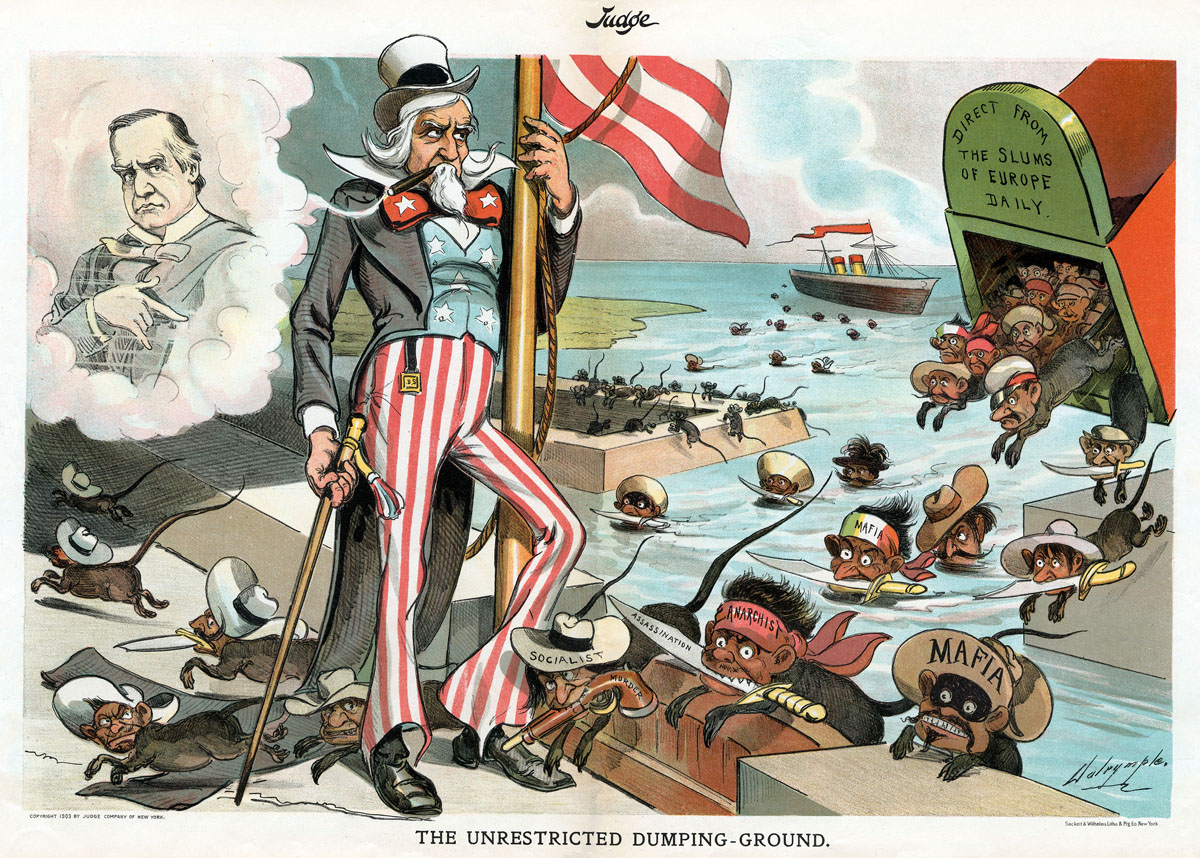
Commenting on the rise of xenophobia in 1855, Lincoln wrote, “Our progress in degeneracy appears to me to be pretty rapid.” One can only imagine his reaction to Bo French or Charles Haywood.
To leave a comment, join Bulwark+1
“Foundationalism” also has no meaningful relation to the epistemic paradigm.