The NYC mayor is challenging a cruel new policy that could punish families for feeding their children.
By Adrian Carrasquillo
Published: 2026-09-18
URL: https://www.thebulwark.com/p/its-zohran-mamdani-vs-donald-trump-on-immigration-public-charge
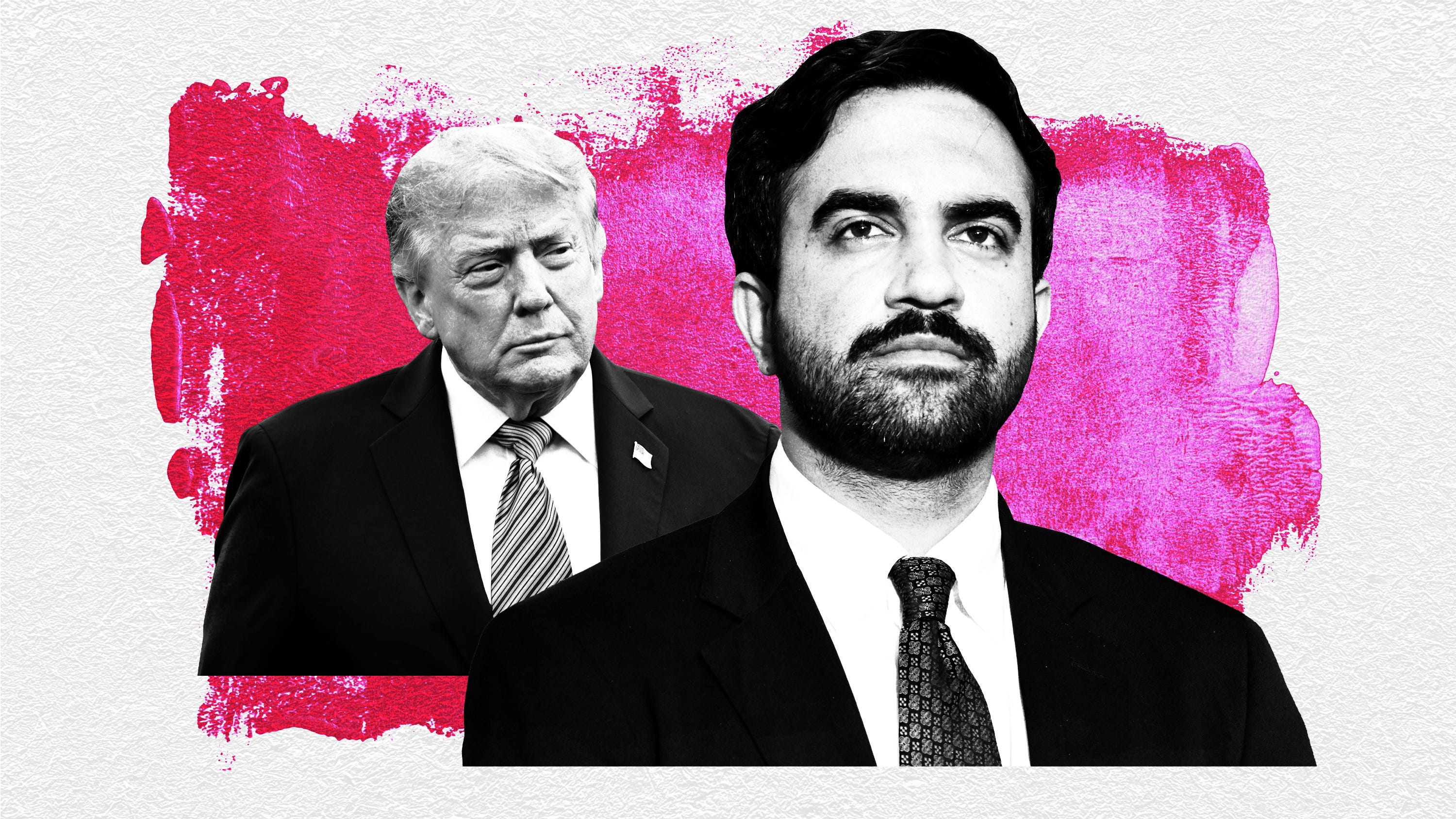 (Photo illustration by Bill Kuchman/The Bulwark | Photos: Getty, Shutterstock)
THE TRUMP–MAMDANI BROMANCE is officially over.
The unlikely bonhomie between the president and New York City’s mayor seemed destined to decay. But what ultimately killed it wasn’t a public social media spat or even an election. It involved the redefinition of a law on the books since the 1880s whose consequences could be devastating for immigrants and U.S. citizens alike.
In hindsight, it’s surprising the two men ever got along—even if only for the cameras. When Zohran Mamdani delivered his victory speech last year, he called Donald Trump a “despot,” promising that the city would respond to authoritarianism with the “strength it fears, not the appeasement it craves.”
“After all, if anyone can show a nation betrayed by Donald Trump how to defeat him, it is the city that gave rise to him,” the new mayor said.
The animosity went both ways. Before Mamdani’s election, Trump called him a Communist, said he should be denaturalized, arrested, and deported, and threatened to withhold federal funding from and send federal troops into the city should he win.
Then something strange happened.
Two weeks after Mamdani’s win last November, the two New Yorkers held a chummy Oval Office photo op. During a private meeting, Mamdani reportedly pushed Trump to support a historic housing project backed by federal grants. As the cameras snapped photos, Trump said Mamdani would make a great mayor, and Mamdani described their shared commitment to the city.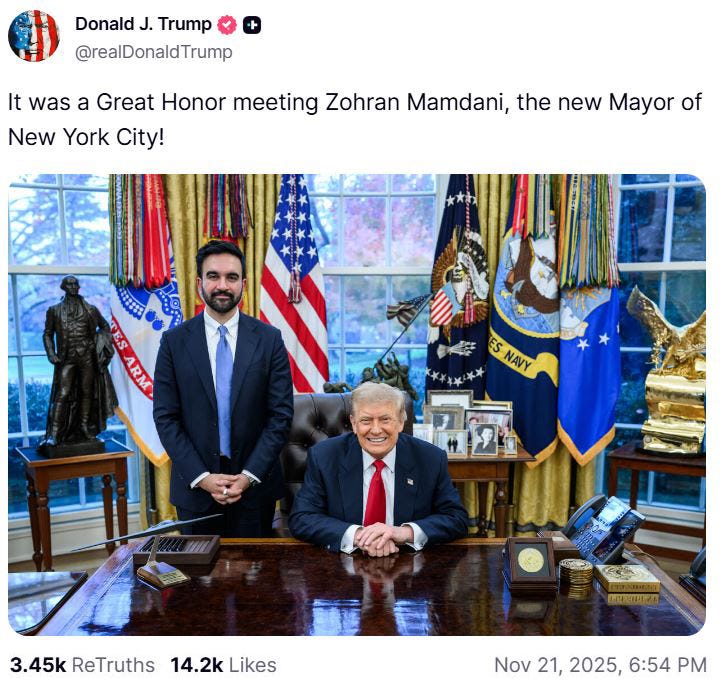
Ten months later, the vibes have shifted: With ICE operations growing in New York, Mamdani announced this week that both the city and New York state were joining a coalition of twenty-two states and cities, including Chicago, Seattle, and San Francisco, to sue the federal government over an immigration-related rules change.
The change involves something called “public charge”—in the sense of ‘a charge upon the public.’ It’s a statutory category that immigration officials can use to reject a person’s application for a green card, a visa, or entry into the United States, if it seems like the person might be a burden or a liability to the public.
The Biden administration in 2022 set out a new rule for how Citizenship and Immigration Services would make such decisions. Under the new approach, officials were to mostly focus on whether potential immigrants would be dependent on cash-assistance programs like Temporary Assistance for Needy Families or Supplemental Security Income.
Late last year, the Trump administration announced it would rescind the Biden-era rule, replacing it with . . . nothing. The change, which goes into effect today, reverts to the vague statutory concepts the Biden administration had tried to clarify and instructs USCIS to factor in many benefits previously not considered when judging whether people should be categorized as public charges.
More vagueness around what constitutes a public charge (and casting a wider net for benefits that could make someone a public charge) means USCIS and consular officers have greater discretion to deny visa or green card applications. Which is, of course, the point.
The change is one of the many examples of the Trump administration’s tried-and-true approach of bureaucratic cruelty. The administration claims these laws and policies will curb illegal immigration, but in reality they will hurt legal immigrants as well as permanent residents and U.S. citizens, including children.
The lawsuit brought by New York City and others alleges that the new rule violates the Administrative Procedure Act because the Trump administration “fail[ed] to reasonably explain [its] drastic change in position, speculating without supporting evidence” that there was a problem with the 2022 rule.
The practical impact of the Trump administration policy is that it significantly expands how immigrants and mixed-status families can be punished for using public benefits by creating ambiguity. The Department of Homeland Security refuses to define what constitutes a public charge, but says its officers will make subjective determinations based on what benefits are used and the “totality of circumstances.” This totality will “include any benefits for which there is a means-test,” Brookings explains, “including but not limited to Medicaid, the Children’s Health Insurance Program, SNAP, housing assistance, Head Start and child care, school meals, WIC benefits, refundable tax credits.”
In short, immigration officers will be able to use virtually any public benefits received by a person for any period of time as evidence against that person’s immigration application—even if they were benefits used by a family member, which includes U.S. citizens.
If power is being used cruelly, the least a free society can do is refuse to let it happen unseen. Our coverage of the Trump administration’s abuses is made possible by the support of our Bulwark+ members. We would love for you to become a member, and join the side you’re already on.
“A Chilling Effect”
Mamdani and the coalition suing the Trump administration say fears and confusion over accepting public benefits will lead some immigrants to disenroll from programs that serve them, and others not to enroll in the first place, even if they’re eligible.
Speaking at a press conference on Monday, Mamdani said the data is clear that “denying people services does not erase their need, it compounds it,” and that the Trump administration was seeking to make “hungry New Yorkers hungrier” and “poor New Yorkers poorer.”
“The toll of this new rule cannot be overstated,” Mamdani added. “It is estimated that up to 4 million people from across the country could unenroll from their health care alone, including up to 1.8 million children. None of this is abstract. People could die.”
Mamdani said shutting off the valve of public benefits for these people could lead to a 10.6 percent increase in the rate of premature death in immigrant communities within five years. He cited studies by the city’s Department of Health and Mental Hygiene.
Perversely, as a Brookings report notes, Mamdani’s warnings echo the federal Department of Homeland Security’s own projections. DHS has calculated that an annual reduction of $13.05 billion in federal and state transfer payments “attributable to disenrollment or nonparticipation” in Medicaid, the Children’s Health Insurance Program, the Supplemental Nutrition Assistance Program, Temporary Assistance for Needy Families, Supplemental Security Income, Federal Rental Assistance, the WIC Program, and others, will result in “an estimated 1.3 million persons disenrolling or not enrolling.” Less welfare and fewer immigrants: the MAGA dream.
Mamdani’s office agrees that people will disenroll from those programs—but doesn’t think that’s something to celebrate: The practical effect of people in need taking themselves out of receiving public health care benefits, staffers from the mayor’s office told me, is they are more likely to end up in a city emergency room, leading to high costs the city eats. Meaning after people forgo benefits, New York will actually end up paying more for their care, not less because of the move, hurting the city’s economy.
This is not the first time Trump has sought to expand the public charge rule. When he first attempted to do so back in 2019, New York led the opposition, eventually winning in court. But experts say the Trump administration has gone much further this time around.
Murad Awawdeh, the executive director of the New York Immigration Coalition who stood next to Mamdani at the press conference, said that while the lawsuit seeks to stop the public charge rule again, he is skeptical that the courts will act fast enough.
“They don’t have to deny a single application to make this work. They just need to make you scared enough to stop feeding your kids,” Awawdeh told me. “A hungry child is not a border-enforcement strategy. Telling immigrant families that using a food program can cost you your potential green card is not immigration policy: It’s using starvation as leverage. No one should have to choose between a child’s doctor and their own future.”
NO ONE REASONABLY EXPECTED that the Trump-Mamdani relationship would remain in a state of peace. But it’s notable that the first area of real friction is on immigration. It could be a sign of things to come.
Sources in Mamdani’s orbit have previously suggested that it doesn’t benefit New Yorkers for the mayor to goad the president, risking Trump sending federal troops and agents to the city as he’s done in Chicago, Los Angeles, and Minneapolis (though perhaps that approach has gone out of favor among Trump’s advisers after the killings in Minnesota). But they also note that Mamdani has repeatedly called Trump a “fascist,” and they argue that standing up to Trump with these types of lawsuits is an effective way to combat MAGA cruelty.
“This lawsuit he filed really is taking the Trump administration to the streets and demanding they pull back the rule or strike it down,” said Awawdeh. “There are many tools in the toolbox he can use, and taking the administration to court is one of them.”
“He’s not just talking into the void,” a top New York City Democratic organizer who isn’t authorized to speak publicly told me. “Legal action is a smart way to attack Trump instead of poking the bear for no reason.”
Mamdani may end up providing a positive model for a Democratic party casting around for a path forward on immigration. While the Trump White House brainstorms ways to make America as anti-immigrant as possible, the democratic socialist mayor has laid out a pro-immigrant vision.
After signing an executive order in February requiring an audit of how city agencies interact with federal immigration authorities, Mamdani released the findings in May and adopted a set of recommendations. These include new NYPD protocols that require 911 calls related to immigration or immigration enforcement to involve police leadership and its legal department; updated guidance at the Department of Health and at hospitals for when ICE brings someone in for care; and tighter rules at the Department of Social Services regarding access to city property—a move driven by incidents of unauthorized ICE entry last year.
Perhaps the most significant change has been the expansion of the city’s budget for immigrant legal services to a record $153 million, Mamdani’s office told me. The expanded budget was buttressed by a $7.25 million New York state investment in legal services for 1,400 unaccompanied immigrant children facing deportation, including more than 250 who are currently detained, a move the mayor announced last month alongside New York Gov. Kathy Hochul and Attorney General Letitia James.
Mamdani has also expanded Know Your Rights outreach in dozens of languages, strengthened the firewall between city agencies and federal immigration enforcement, and launched a Spanish-language WhatsApp channel and Instagram account to convey information to native Spanish speakers.
The Democratic organizer told me this is a sweet spot for Mamdani, where politics and personal passion align: “He himself is an immigrant and fighting on public charge works in a way that attacking Trump on other domestic issues doesn’t.”