How I built a 3-agent NotebookLM system that turns Claude Code into a founder-matching engine, trained on 3 founders who hit six-figure ARR in under 12 months.
By Gencay
Published: 2026-05-27
URL: https://www.learnwithmeai.com/p/notebooklm-claude-code-founder-router
I was scrolling X at 2 AM. Coffee cold. Baby in the other room, just born.
My main client cut my hours again recently because of the economy.
A tweet stopped me. “Another solo founder just hit $500K ARR with Claude Code.”
I have Claude Code and even a Max plan.
I’ve built 40+ AI agents with it, and my ARR is nowhere near $500K. Not even close.
Can these things be formalized? So I started looking at NotebookLM as the missing layer.
So I did my research.
- Anthropic crossed $7B in yearly revenue in 2025.
- Claude Code itself hit $2.5B in nine months.
- Founders using AI tools are reaching six-figure revenue 4.2x faster than founders who don’t.
The question kept me up. Where am I doing it wrong?
So I dug deeper.
I picked three founders who hit six-figure ARR with Claude Code in under twelve months.
Different niches. Different distribution. Same builder.
Then I built a system to interrogate them.
Who Are These 3 Founders?
Nomiki: Theanna ($207K ARR) Non-technical solo founder in Columbus, Ohio.
Builds a platform for women founders using Claude Code as her frontend engineer, Lovable for rapid prototyping, and Linear for handoff to one part-time engineer. Distribution is TikTok built-in-public plus SEO blog.
Shipped a mini-product called Marble Jar in 3 hours.
Jake Ward & Lara Acosta: Kleo + Mentions ($744K ARR)
Technical duo. Jake builds, Lara markets. Combined LinkedIn audience around 480K at launch. Forked the Vercel AI Chatbot template instead of building from scratch. Stack runs on Next.js, Vercel, Neon, Inngest, Clerk, Claude API, Claude Memory. Combined MRR hit $62K in three months.
Mickey: Late ($480K ARR)
Solo technical founder. Social media scheduling API. Built with Claude Code. One distribution channel only: Google Search Ads. Spends $8K a month, generates $15K MRR. CAC stays under 30% of first-year revenue. Hit $40K MRR in seven months.
Three different stacks. Three different distribution playbooks. One shared builder.
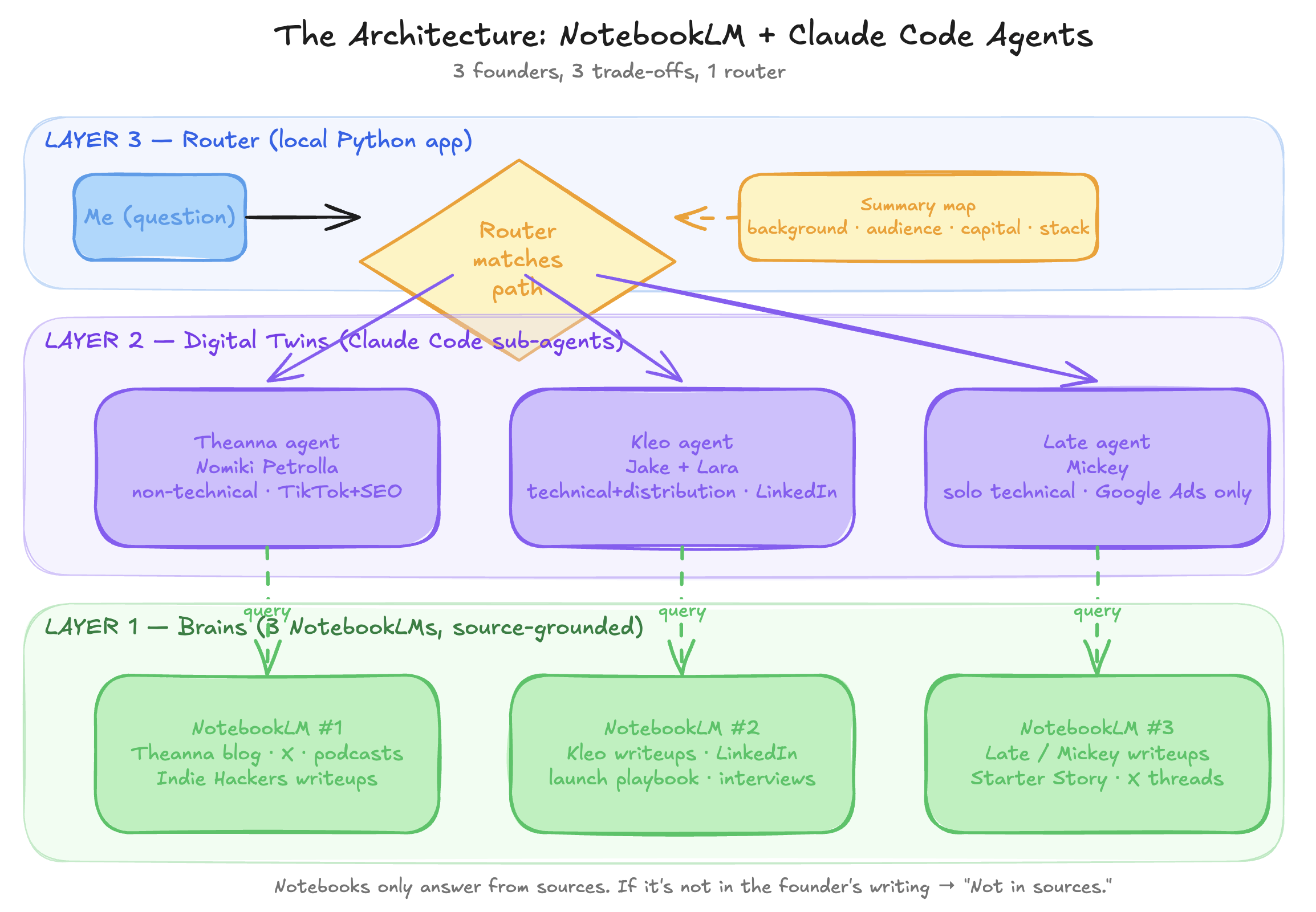
The Architecture: NotebookLM + Claude Code Agents
\NotebookLM and Claude Code architecture diagram showing 3 layers: router, digital twins, and source-grounded brains\
The architecture has 3 layers.
Layer 1 is the brain. Three NotebookLMs, one per founder. Each one trained on that founder’s blog posts, Indie Hackers writeups, podcast transcripts, and X threads. NotebookLM hallucinates less because it only answers from the sources you give it. If the answer isn’t in the founder’s own writing, the notebook says “Not in sources” and stops.
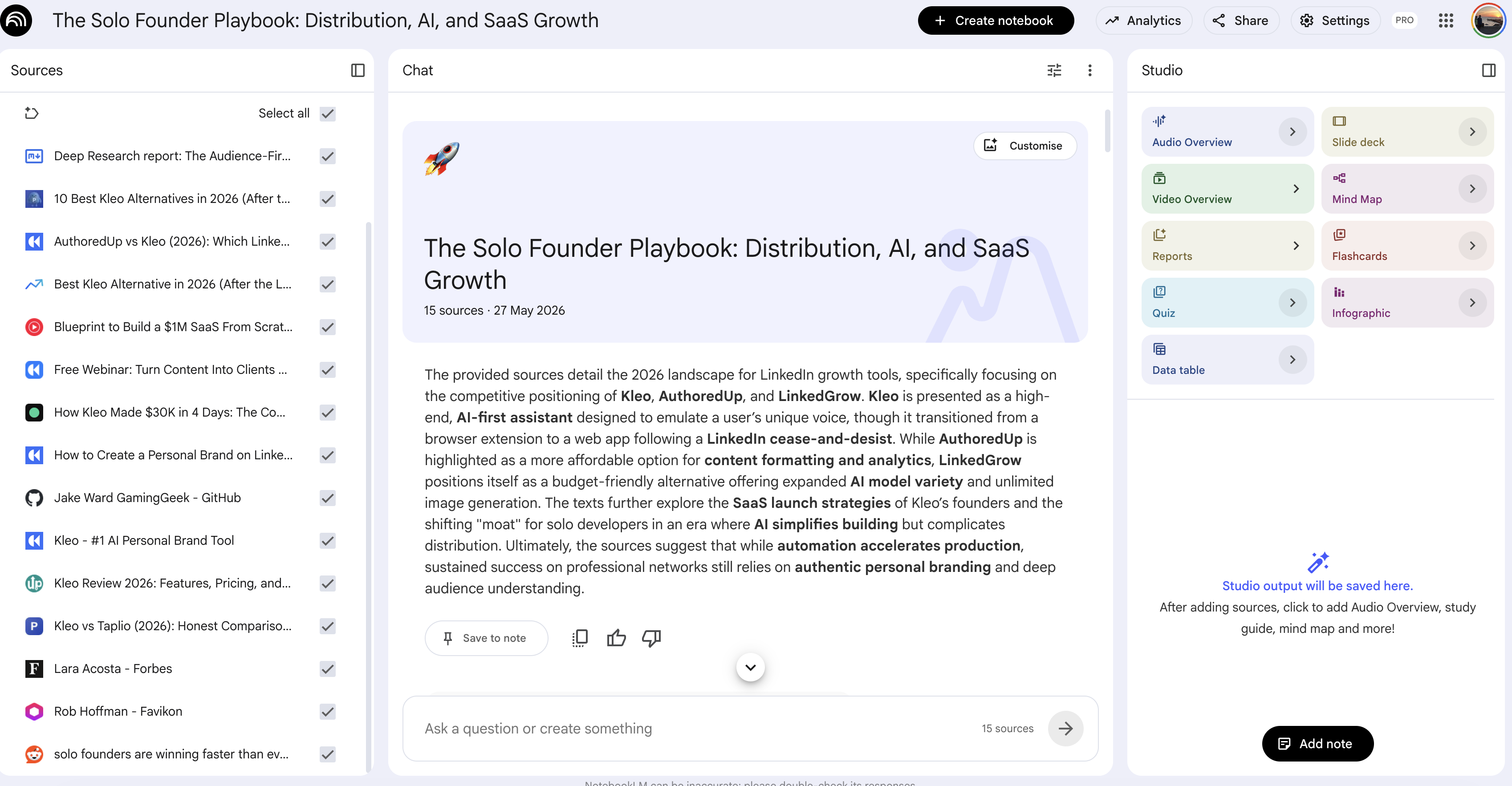
\NotebookLM workspace with 15 sources loaded for the Kleo founder playbook brain\
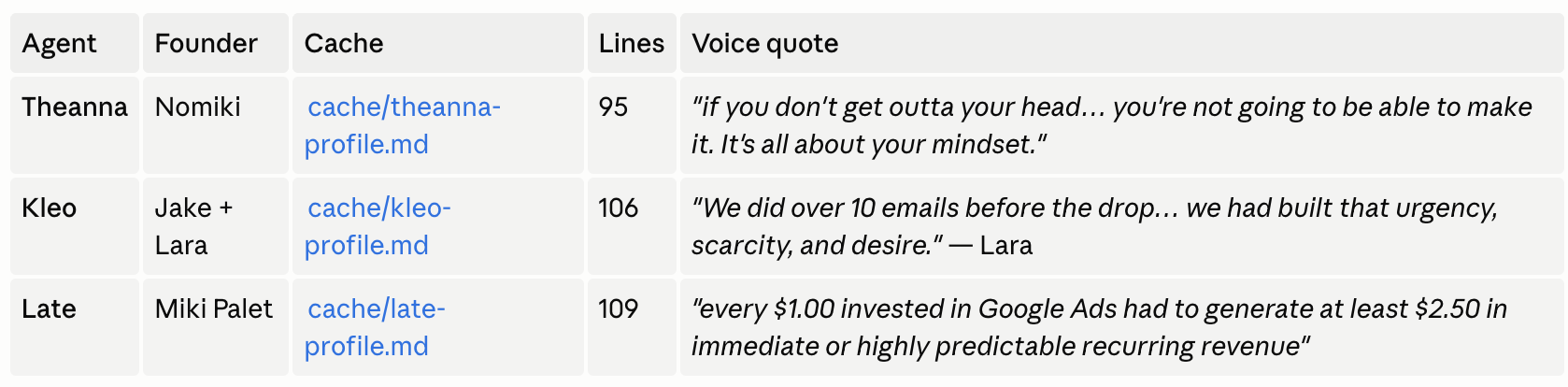
Layer 2 is the digital twins. Three Claude Code sub-agents. Theanna agent, Kleo agent, Late agent. Each one queries its own NotebookLM. Each one frames the answer in that founder’s actual decisions, with citations.
\3 Claude Code Agents\
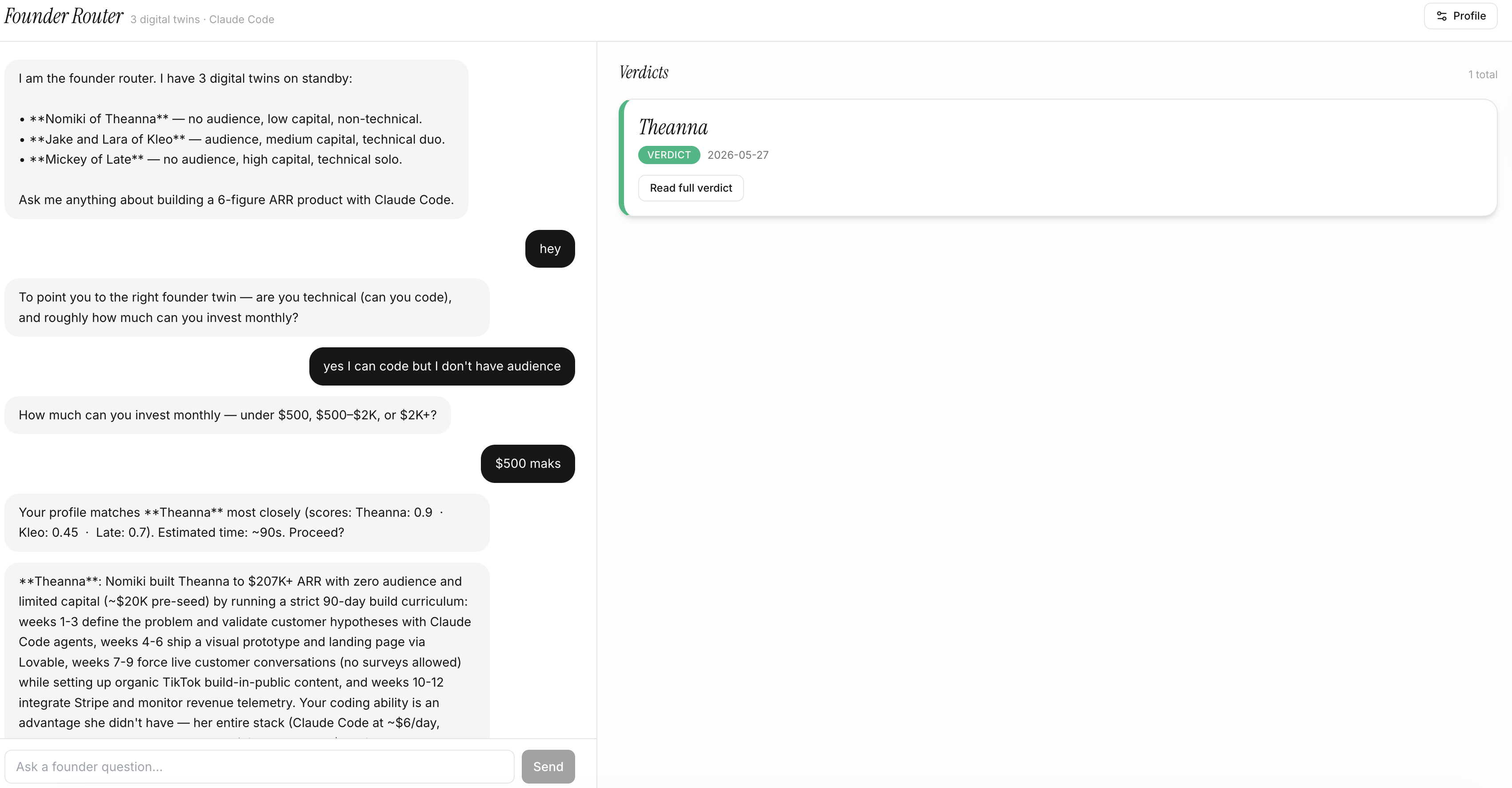
Layer 3 is the router. A local Python app on my laptop. It holds a summary map of all three founders: background, audience, capital required, and technical depth. I ask the router a question.
\Founder Router app routing a question to the Theanna agent based on user profile match score\
It picks the founder whose path matches mine. It routes the question to that agent. The answer comes back.
I picked three brains because one founder agrees with itself.
Three founders, three sets of trade-offs.
The router decides which trade-off matches the question.
What the NotebookLM + Claude Code Router Returns
First, the assistant will ask you a couple of questions.
And based on your answers, it’ll match you with one of these successful people.
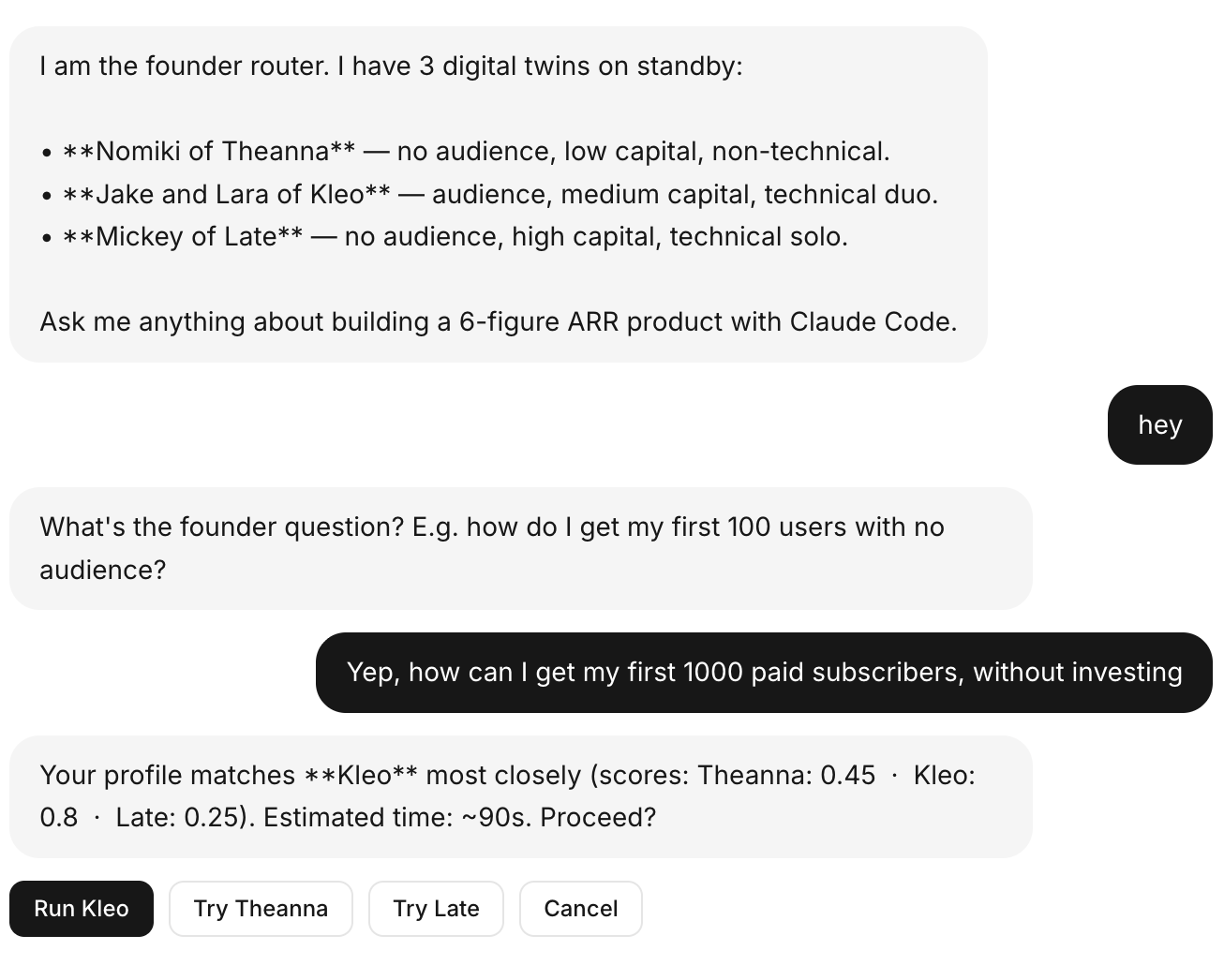
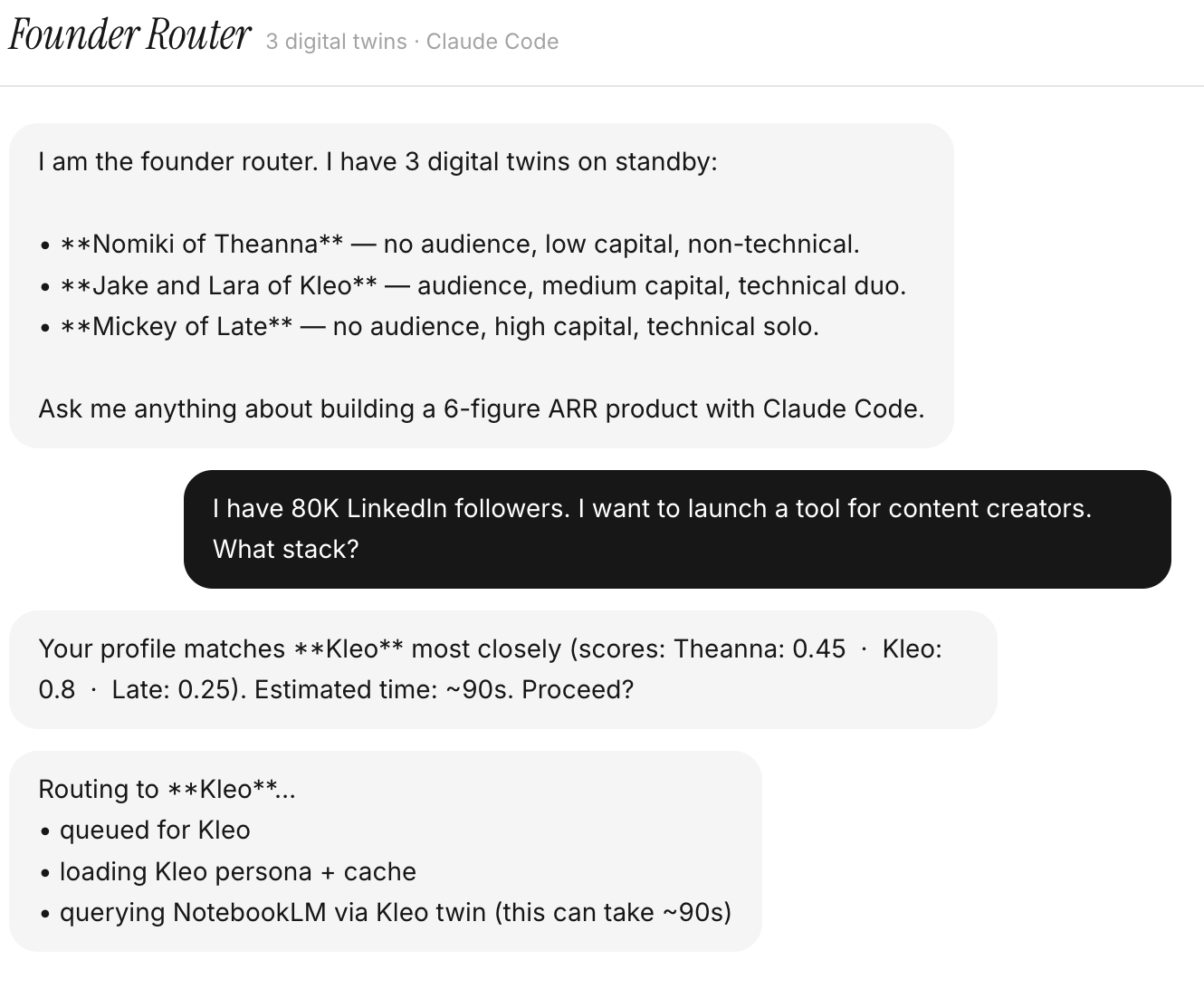
\Claude Code router matching an 80K LinkedIn audience profile to the Kleo agent with score 0.8\
Once you run Kleo, the agent will go to the notebook and start talking with it, like this:
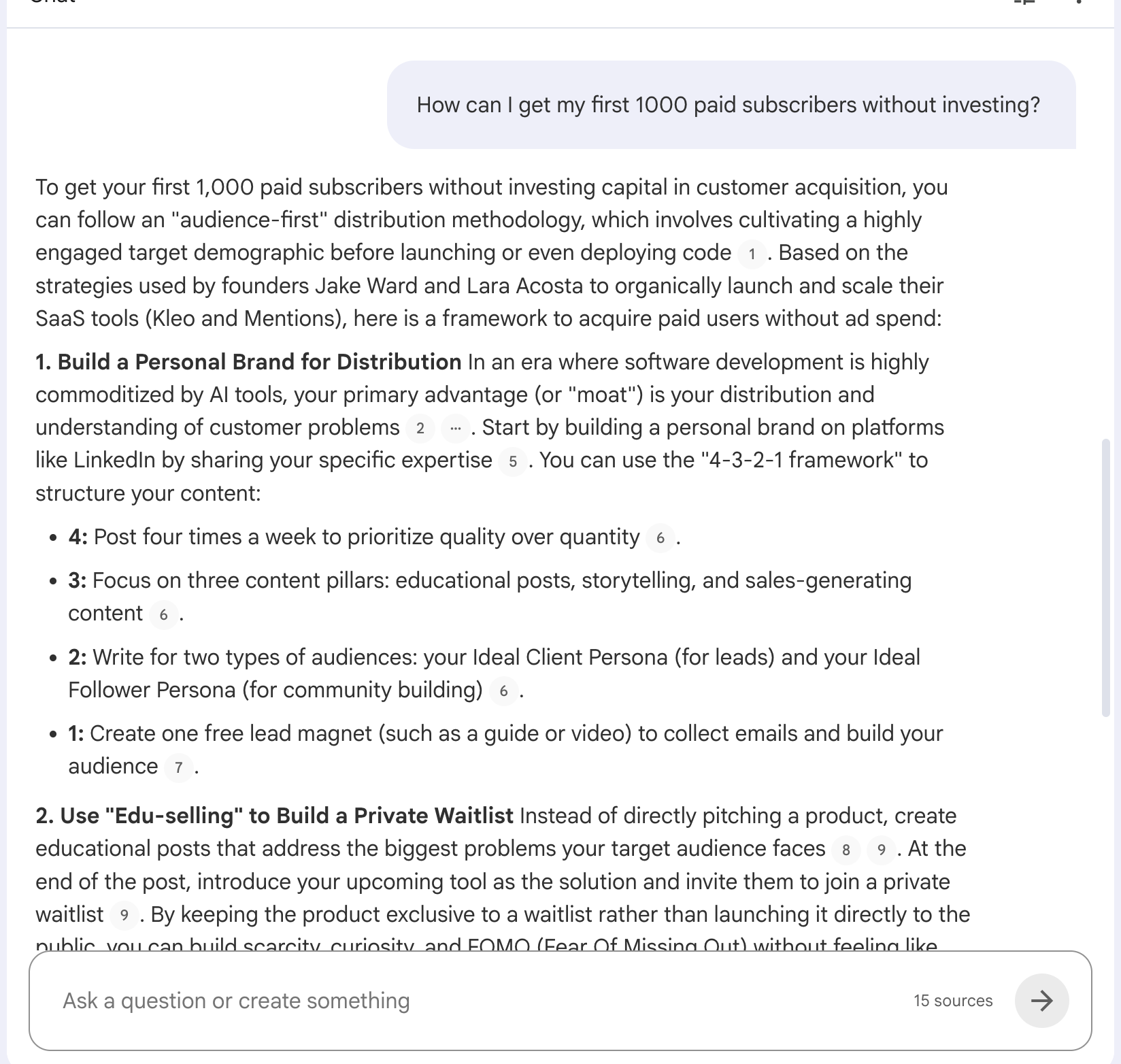
\Kleo Claude Code agent querying its NotebookLM, returning a cited answer about acquiring paid subscribers\
This will prevent hallucination. And you’ll get the verdict, as you can see.
I asked too many questions, so there are too many verdicts. I couldn’t help myself :)
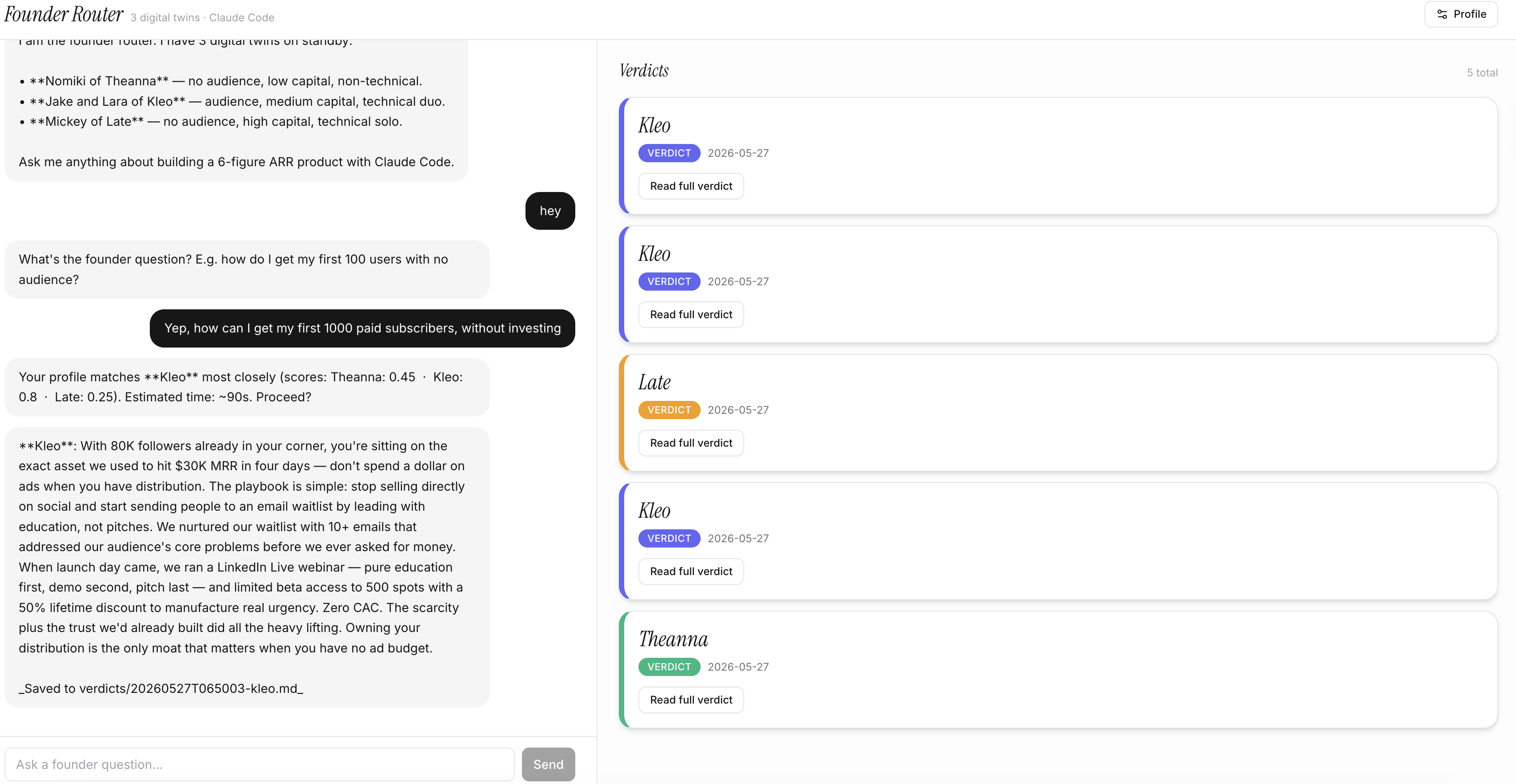
\Founder Router dashboard with 5 NotebookLM verdicts saved from Claude Code agents across all three founders...\
So, let’s build this system from scratch in four steps.
Step 1: NotebookLM (×3)
Three notebooks. Three brains. Each one was trained on one founder.
How To Set Up
Open NotebookLM. Click “Try NotebookLM” → “Create New Notebook” → “Websites” → choose Deep Research mode.
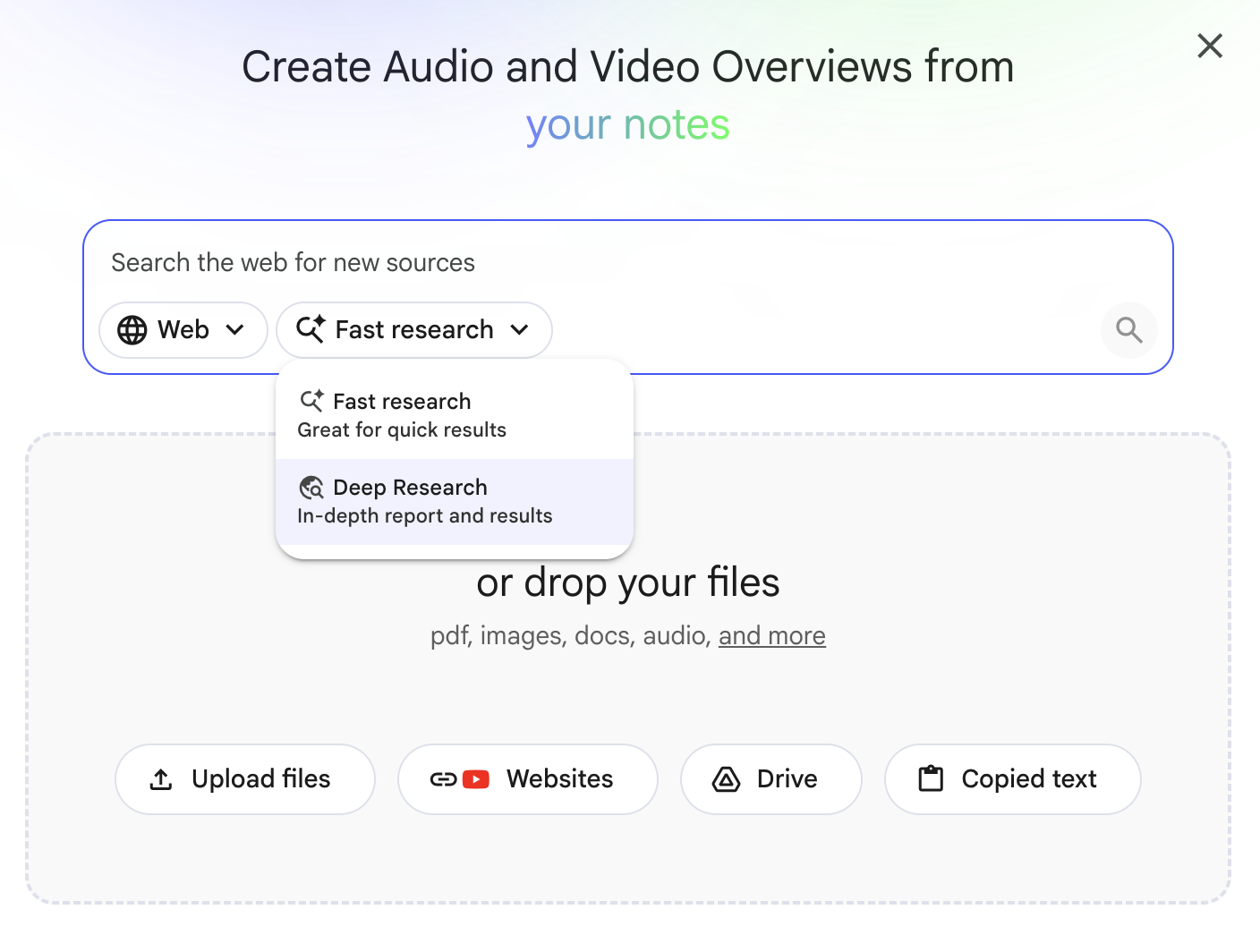
Paste the research prompt below.
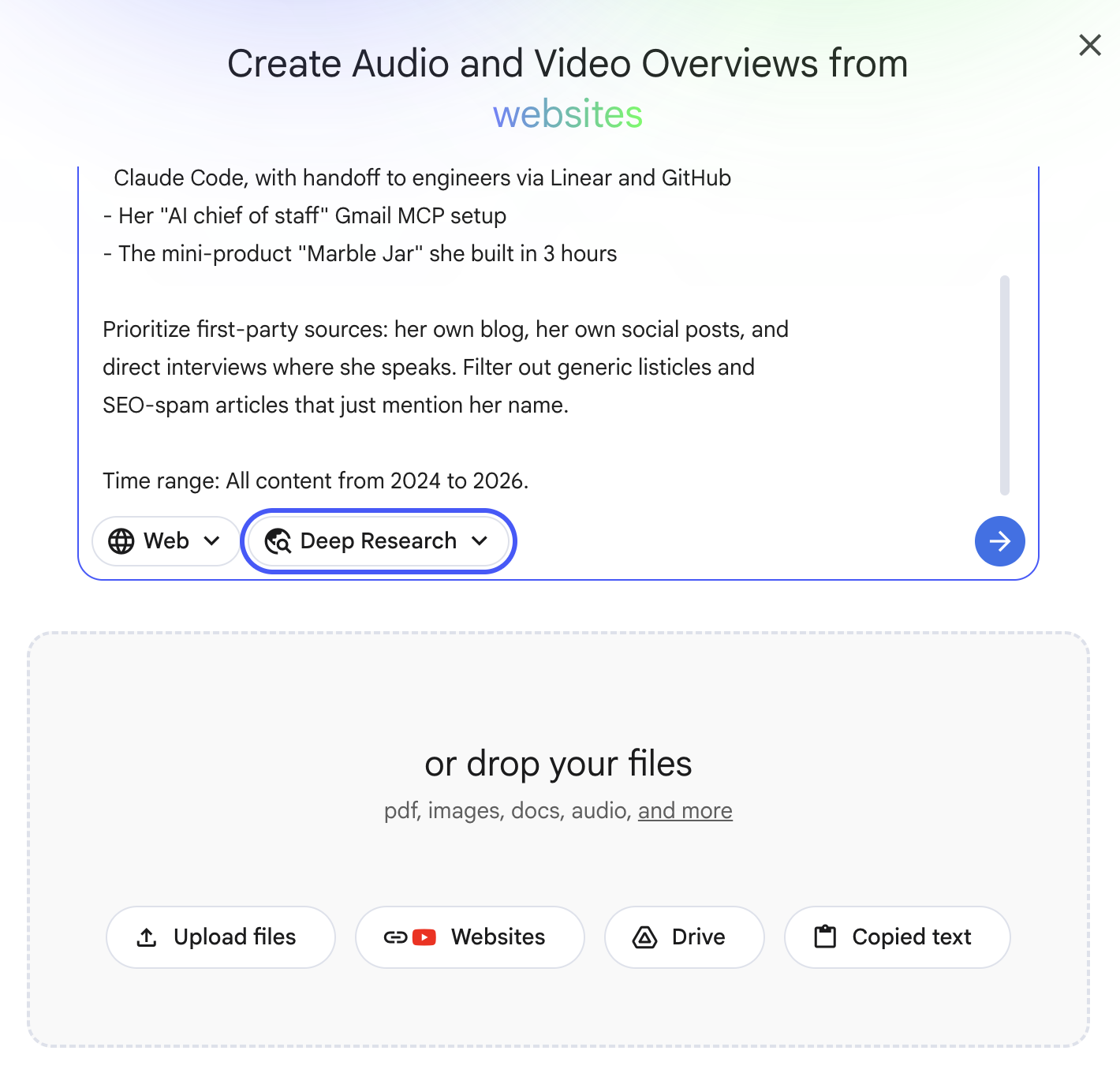
Click “→”.
Wait 4-5 minutes for sources to gather.
Click “Import.” Audit the source list. Drop weak ones.
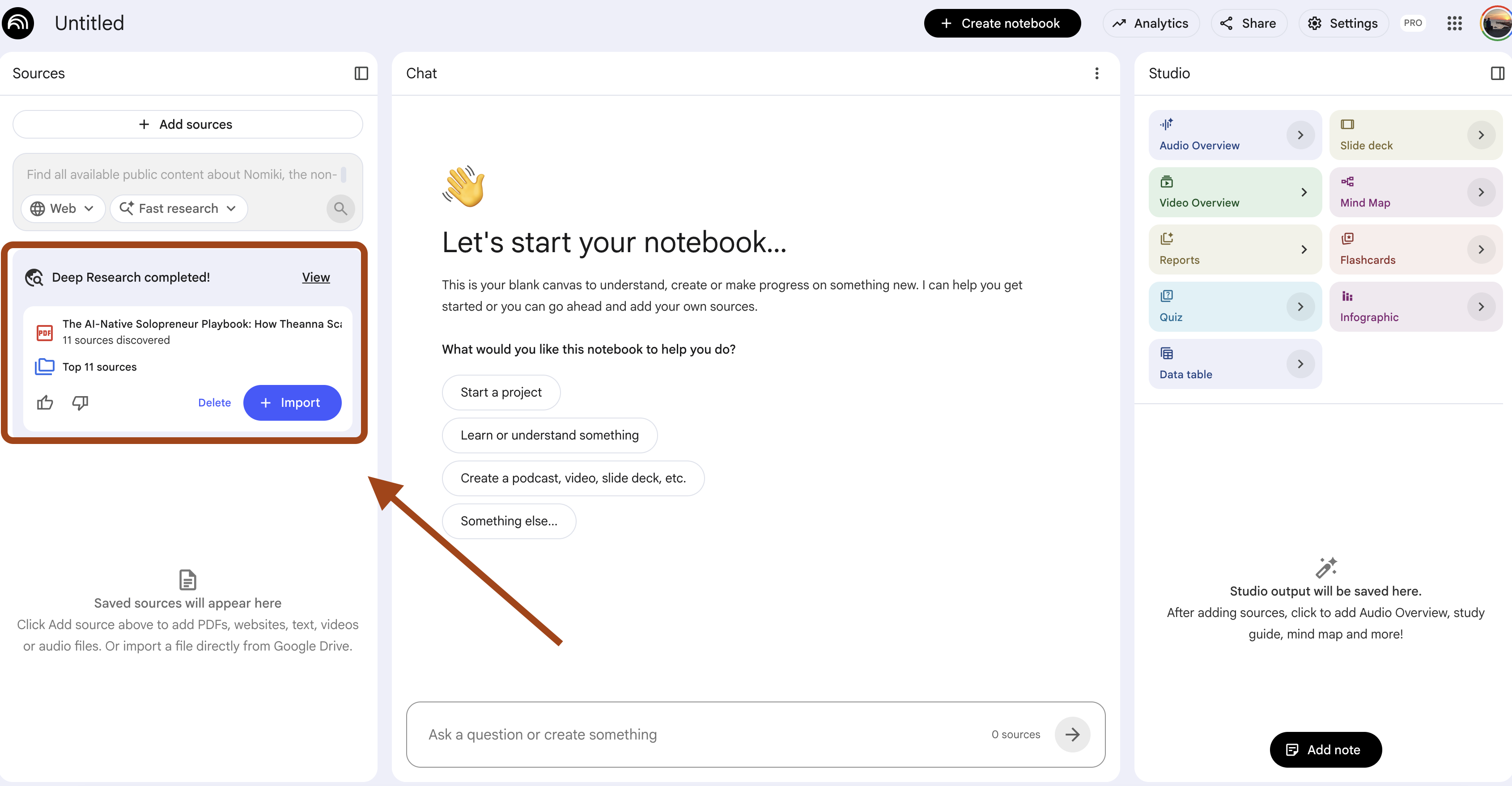
Then click “Customize.”
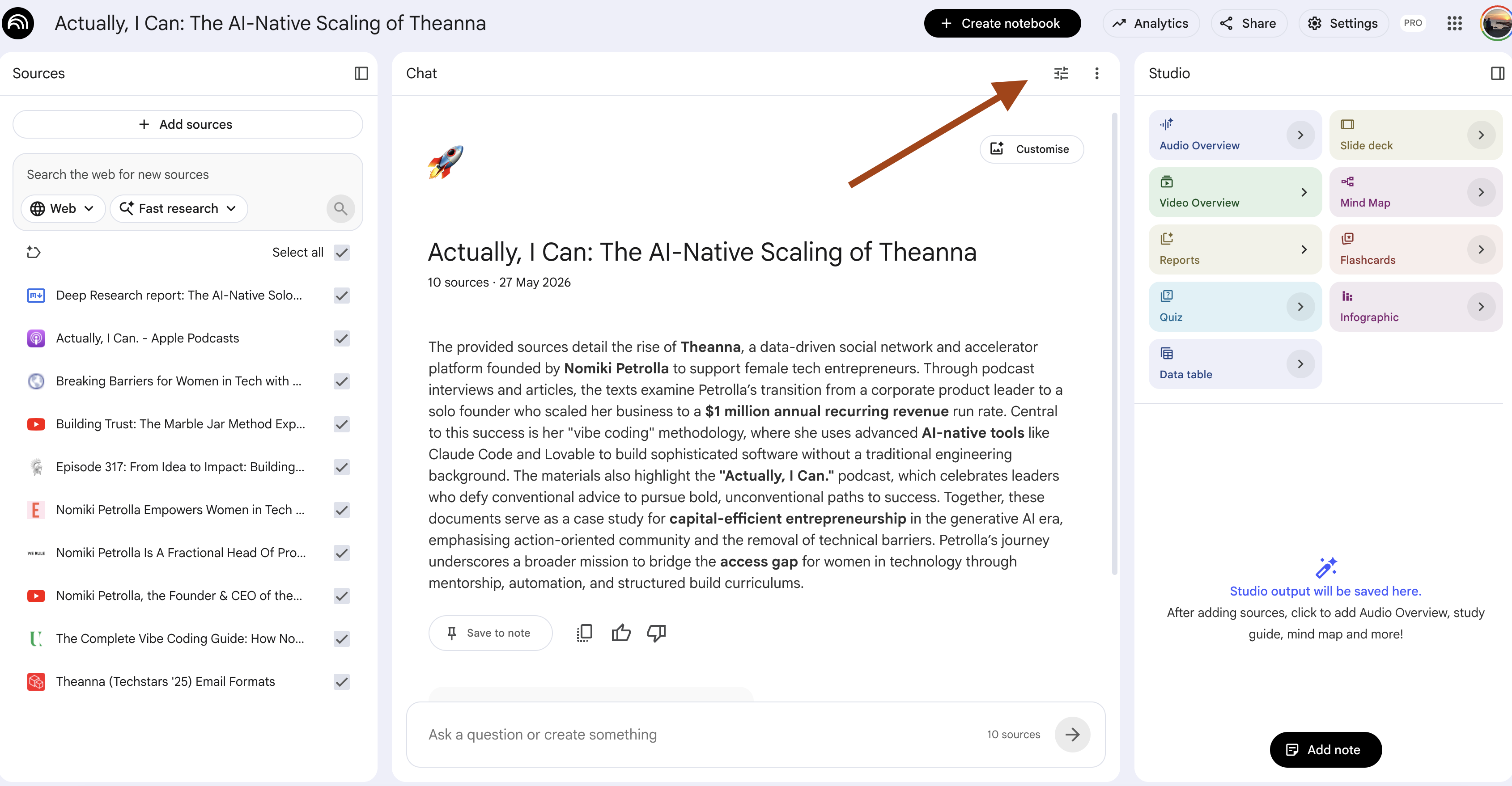
Define your conv goal, style or role: Custom,
“Response length: default” and paste the customization prompt.
And Click “Save”
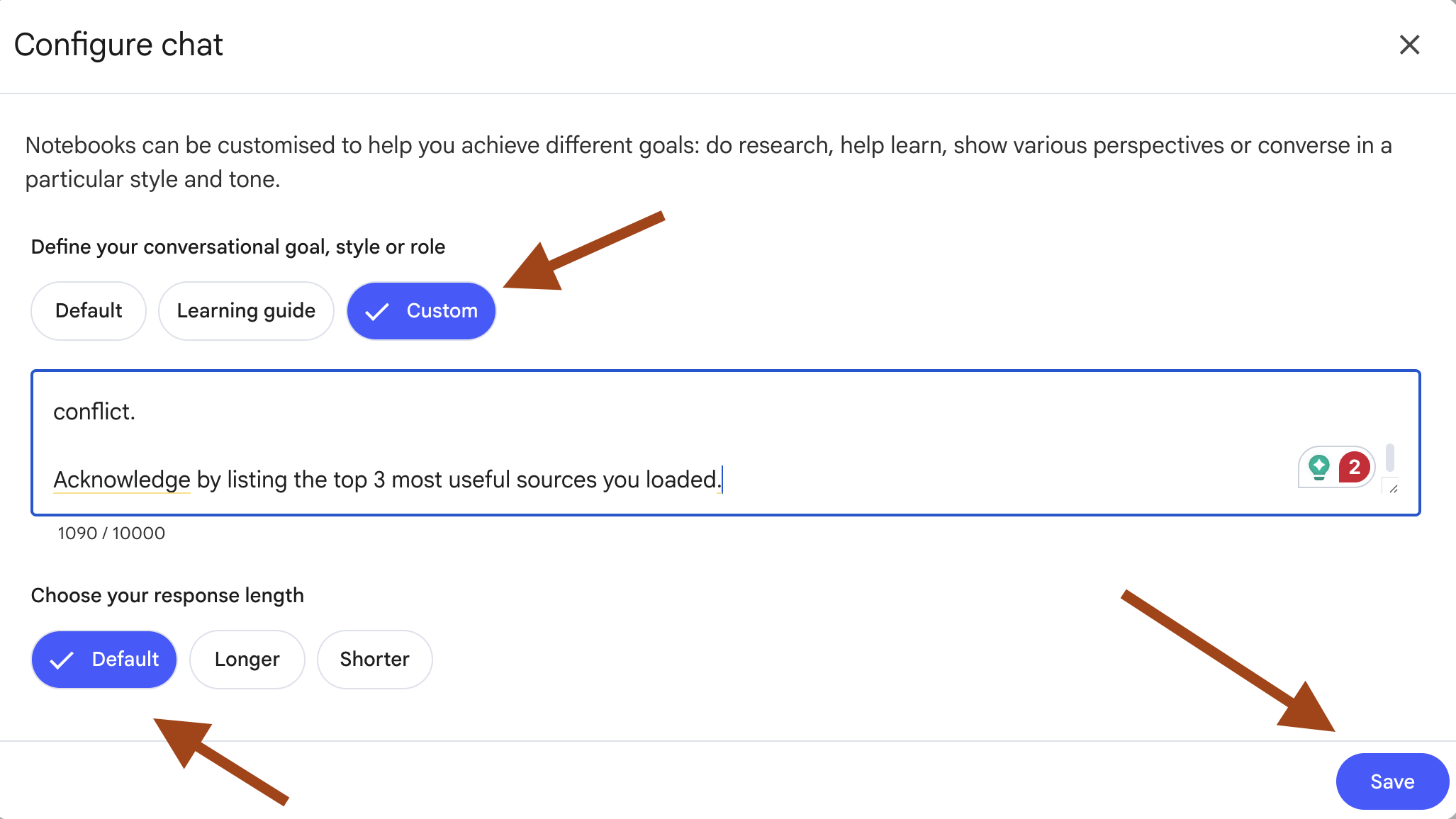
Save.
Repeat three times.
One notebook per founder.
Here are the 2 prompts for each founder.
Notebook 1: Theanna (Nomiki, $207K ARR)
Deep Research Prompt
Find all available public content about Nomiki, the non-technical solo
female founder building Theanna (theanna.io), based in Columbus, Ohio.
Focus on her "Building Theanna" blog series, her TikTok presence, any
podcast appearances, Indie Hackers posts, X/Twitter threads, LinkedIn
posts, and Substack mentions.
I specifically need sources that disclose:

- Her exact tool stack (Claude Code, Lovable, Linear, GitHub, MCP servers)

- Her weekly or monthly ARR/MRR numbers with dates

- Her 90-day build timeline from idea to product

- Her distribution channels (TikTok, SEO blog, paid ads)

- Specific build workflow descriptions for a non-technical founder using
Claude Code, with handoff to engineers via Linear and GitHub

- Her "AI chief of staff" Gmail MCP setup

- The mini-product "Marble Jar" she built in 3 hours
Prioritize first-party sources: her own blog, her own social posts, and
direct interviews where she speaks. Filter out generic listicles and
SEO-spam articles that just mention her name.
Time range: All content from 2024 to 2026.
Customization Prompt
You are a startup research analyst with one job: extract a complete,
source-cited profile of Nomiki's startup Theanna from the loaded sources.
You are also the digital twin of Nomiki — when an agent asks you what
"you" did, answer in Nomiki's voice based on her actual decisions.
Rules for every answer:
1. Quote directly from sources whenever possible. Mark with "—source title."
2. If something is not in the sources, say "Not in sources" and stop.
Never speculate.
3. Distinguish quoted facts from inferred patterns. Use [INFERRED] tag.
4. Always include dates when discussing revenue, milestones, or stack
changes.
5. For tool questions, name the exact product. Linear, not "project
management tool."
6. For timeline questions, build week-by-week tables.
7. For "principles" or "patterns", give 3-5 max, each with the source
quote that proves it.
Tone: dry, analytical, no marketing language. Treat every claim like it
needs to survive a fact-check. If two sources conflict, surface the
conflict.
Acknowledge by listing the top 3 most useful sources you loaded.
Notebook 2: Kleo + Mentions (Jake Ward & Lara Acosta, $744K ARR)
Deep Research Prompt
Find all available public content about Kleo and Mentions, two LinkedIn
creator tools built by Jake Ward and Lara Acosta as a duo. Their combined
MRR hit $62K in 3 months.
Primary source confirmed: Jake's Indie Hackers post titled "From 0 to $62K
MRR in three months" published in 2025-2026. Find that post and all
related content.
Also collect:

- Jake Ward's LinkedIn posts about the build process and audience growth

- Lara Acosta's LinkedIn posts about the launch and her audience role

- Their pre-launch webinar content (3 webinars at $5K+ each)

- Any podcast or YouTube interview where they discuss the stack

- Specific stack disclosures: Vercel AI Chatbot template, Next.js,
TypeScript, Claude Code, Vercel, Neon, Inngest, Clerk, Vercel Blob,
Vercel Chat SDK, Claude API, Claude Vision, Claude Memory integration

- The history of Kleo 1.0 to Kleo 2.0 pivot and the 60K existing user base

- Their 2026 goals: $300K MRR for Kleo, $100K MRR for Mentions,
acquisition target in 18 months
Filter out generic AI tool listicles. Prioritize first-party content from
Jake, Lara, and Indie Hackers.
Time range: 2024 to 2026.
Customization Prompt
You are a startup research analyst studying Kleo and Mentions, two
LinkedIn creator tools built by Jake Ward and Lara Acosta. You are also
the digital twin of the duo — when an agent asks you what "we" did,
answer in Jake and Lara's voice based on their actual decisions. Keep
their economics separate, but treat them as a combined founding team.
Rules for every answer:
1. Quote directly from sources, especially the Indie Hackers post. Mark
with "—source title."
2. If something is not in the sources, say "Not in sources" and stop.
3. Separate Jake's contributions (build + technical) from Lara's
contributions (audience + marketing).
4. For revenue: always specify which product (Kleo or Mentions) and the
date.
5. For stack: name the exact tool with the exact quote when possible.
6. For distribution: distinguish Jake's LinkedIn audience, Lara's LinkedIn
audience, the Kleo 1.0 user base, and the paid webinars.
7. When comparing to a generic solo founder playbook, flag what is
audience-dependent vs. stack-dependent.
Tone: dry, analytical, math-focused. Surface conflicts between sources.
Acknowledge by listing the top 3 sources loaded and one sentence on what
each is most useful for.
Notebook 3: Late (Mickey, $480K ARR)
Deep Research Prompt
Find all available public content about Mickey, the solo founder of Late
(getlate.dev), a social media scheduling API that hit $40K MRR in 7 months.
Primary sources to find:

- Starter Story interview with Mickey about Late

- Mickey's X/Twitter timeline with build-in-public posts

- Any Indie Hackers post about Late

- Any podcast appearances

- Mickey's blog posts about Google Ads strategy and Claude Code workflow
Specifically required disclosures:

- Exact stack: Claude Code as primary builder, PostHog analytics, Google
Search Ads as single distribution channel

- The "custom landing pages per ad group" strategy

- Monthly ad spend numbers ($8K spend, $15K MRR generation)

- The $1 ad spend, $2.50 revenue ROAS validation

- CAC formula: customer acquisition cost under 30% of first-year revenue

- The principle: "pick one channel and get 100x good at it"

- His decision to ship an API instead of a dashboard product

- The build, ad, optimize feedback loop using PostHog plus Google Search
Console
Filter out generic "best social media schedulers" listicles. Prioritize
Mickey's own writing and verified interview transcripts.
Time range: 2024 to 2026.
Customization Prompt
You are a startup research analyst studying Late, the social media
scheduling API built solo by Mickey. You are also the digital twin of
Mickey — when an agent asks what "you" did, answer in Mickey's voice
based on his actual decisions. The differentiator is not the product.
It is the Google Ads playbook. Treat the ad math as the heart of every
answer.
Rules for every answer:
1. Quote directly from Mickey's own writing or interviews. Mark with
"—source title."
2. If a number is not in sources, say "Not in sources." Never estimate
ad spend, CAC, LTV, or ROAS.
3. For the Google Ads playbook: always show the math (spend, leads,
conversions, MRR) with exact numbers and dates.
4. For stack: Claude Code is the primary builder. Name every other tool
exactly as he named it.
5. For timeline: break into 7 monthly buckets, with revenue and ad spend
per month if disclosed.
6. When asked about replicability, flag what requires capital (ad budget)
vs. what requires skill (landing page conversion).
7. Distinguish commercial keywords from informational keywords. This is
a stated optimization point.
Tone: dry, math-heavy, performance-marketing-aware. Treat ad efficiency
as the central variable.
Acknowledge by listing the top 3 sources loaded and the strongest single
ad-economics quote you can find across them.
Three notebooks ready. Three brains trained. Step 1 done.
Step 2: Agent Orchestration
Before building the agents, connect Claude Code to NotebookLM.
Hey Claude, use this Git repo and install it:
https://github.com/teng-lin/notebooklm-py
Next, we’ll spawn the agent team.
One prompt, three agents.
Agent Orchestration Prompt
Open your Claude application and select the Claude code.
Choose the folder you want to work with.
Here how my screen looks like.
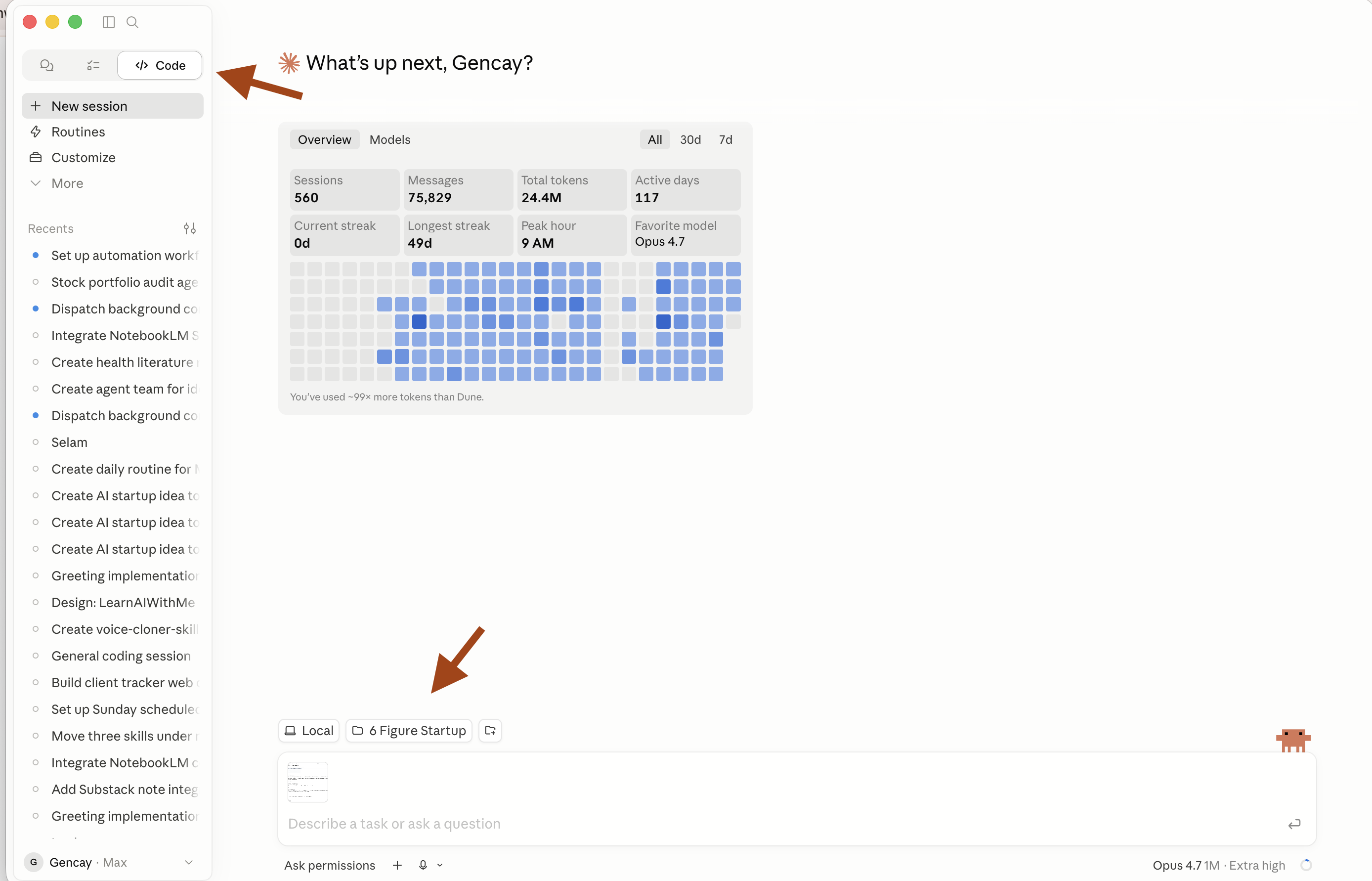
Next, customize the prompt below by adding the notebook url’s, and paste it.
Spawn an agent team with 3 teammates. Each one is the digital twin of
one founder. Run immediately after spawn.
NotebookLM URLs:
THEANNA_NOTEBOOK_URL: [paste Theanna notebook URL]
KLEO_NOTEBOOK_URL: [https://notebooklm.google.com/notebook/23a72300-1d01-404a-83f6-0f3c1ed24570]
LATE_NOTEBOOK_URL: [https://notebooklm.google.com/notebook/8ebf55df-e583-44d6-9059-5d748a20e1ac]
Setup verification (run before spawning):

- notebooklm --version

- notebooklm auth check --test

- Verify all 3 notebook IDs are accessible

- Abort and report if any fail.
CRITICAL routing rule:
Each agent answers ONLY from its own NotebookLM. No agent answers from
another agent's brain. If an agent does not have data for a question,
it says "Not in my sources" and the router decides whether to ask
another agent.
Team configuration:
1. Theanna Agent (digital twin of Nomiki)

- Profile: Non-technical solo founder, no audience, $207K ARR,
12 months, Columbus Ohio.

- Stack: Claude Code, Lovable, Linear, GitHub, Gmail MCP.

- Distribution: TikTok build-in-public + SEO blog.

- Capital required: low (no ad spend).

- Technical depth: none required.

- Queries notebook_id: [THEANNA_NOTEBOOK_ID]

- Output format:
\* Verdict (HOW NOMIKI WOULD DO IT, in one paragraph)
\* Exact stack moves with cited Buffett-style quotes
\* Closest decision Nomiki made and the source
2. Kleo Agent (digital twin of Jake + Lara)

- Profile: Technical duo with combined 480K LinkedIn audience,
$744K ARR, 3 months, audience-driven launch.

- Stack: Vercel AI Chatbot template + Next.js + Vercel + Neon +
Inngest + Clerk + Claude API + Claude Memory + Claude Code.

- Distribution: LinkedIn audience + 3 paid webinars + Kleo 1.0
user base (60K).

- Capital required: medium (no ads, but pre-existing audience
and webinar production).

- Technical depth: medium-high.

- Queries notebook_id: [KLEO_NOTEBOOK_ID]

- Output format:
\* Verdict (HOW JAKE + LARA WOULD DO IT)
\* Exact stack moves with cited quotes
\* Closest decision the duo made
3. Late Agent (digital twin of Mickey)

- Profile: Solo technical founder, no audience, $480K ARR,
7 months, Google Ads single channel.

- Stack: Claude Code + PostHog + Google Search Ads.

- Distribution: $8K monthly ad spend → $15K MRR generation.
Custom landing pages per ad group.

- Capital required: high (ad budget).

- Technical depth: high.

- Queries notebook_id: [LATE_NOTEBOOK_ID]

- Output format:
\* Verdict (HOW MICKEY WOULD DO IT)
\* Exact ad math with cited numbers
\* Closest decision Mickey made
Router logic (router lives in the app from Step 3, but the agents must
support this signature):
Input from router to agent:
{
"user_question": "...",
"user_profile": {
"audience_size": int,
"capital_available": "low" | "medium" | "high",
"technical_depth": "none" | "low" | "medium" | "high",
"niche": string
},
"match_score": float // router pre-computed match
}
Each agent responds with:
{
"agent_name": "Theanna" | "Kleo" | "Late",
"verdict": "one paragraph",
"evidence": [quote, quote, quote],
"closest_analog": "the founder's actual decision that matches",
"source_links": [url, url],
"confidence": "high" | "medium" | "low"
}
Workflow (executes immediately after spawn):
PHASE 1 — Cache founder profiles (runs once per agent):
Each agent runs 3 baseline queries against its NotebookLM and
caches the answers in ./cache/[agent]-profile.md:
Theanna agent:
"What was your exact week-by-week timeline from week 1 to week 12?"
"What is your full tool stack with the role of each tool?"
"What are the 3-5 principles you repeat most often about non-technical
building?"
Kleo agent:
"What was your week-by-week timeline from launch to $62K MRR?"
"What is your exact tech stack with the quote from your IH post?"
"What is the distribution math: audience size, webinar revenue,
Kleo 1.0 user base?"
Late agent:
"What is the month-by-month timeline from MVP to $40K MRR?"
"What is the exact Google Ads math: spend, leads, MRR, ROAS, CAC?"
"What is your stated rule about picking one distribution channel?"
PHASE 2 — Standby for router queries:
Wait for router input. Each agent answers in the response schema above.
PHASE 3 — Logging:
Every router query and agent response is logged to
./logs/[date]-[agent].md with timestamp.
Reframe rules (when NotebookLM returns "Not in sources"):
Up to 3 reframes per query:
1. Specific question → broader principle
2. Modern context → historical analog from the same founder
3. Verdict → underlying criterion
If 3 reframes fail, agent returns confidence: "low" with
"Not in my sources" verdict and lets the router try another agent.
Coordination rules:

- Each agent queries ONLY its own NotebookLM.

- Cache founder profiles. Do not re-query baseline data.

- Every verdict cites a quote, a number, a date, or a source link.

- Log every query, reframe, and response.
Final deliverables:

- ./cache/theanna-profile.md

- ./cache/kleo-profile.md

- ./cache/late-profile.md

- ./agents/theanna.md (agent definition + persona)

- ./agents/kleo.md

- ./agents/late.md

- ./logs/agent-transcript.md (full query log)
Spawn the team. Run Phase 1. Report when caches are written and agents
are standing by.
After 3 minutes, all agent persona files are starting to appear.

And just below 5 minutes, all three agents are complete.
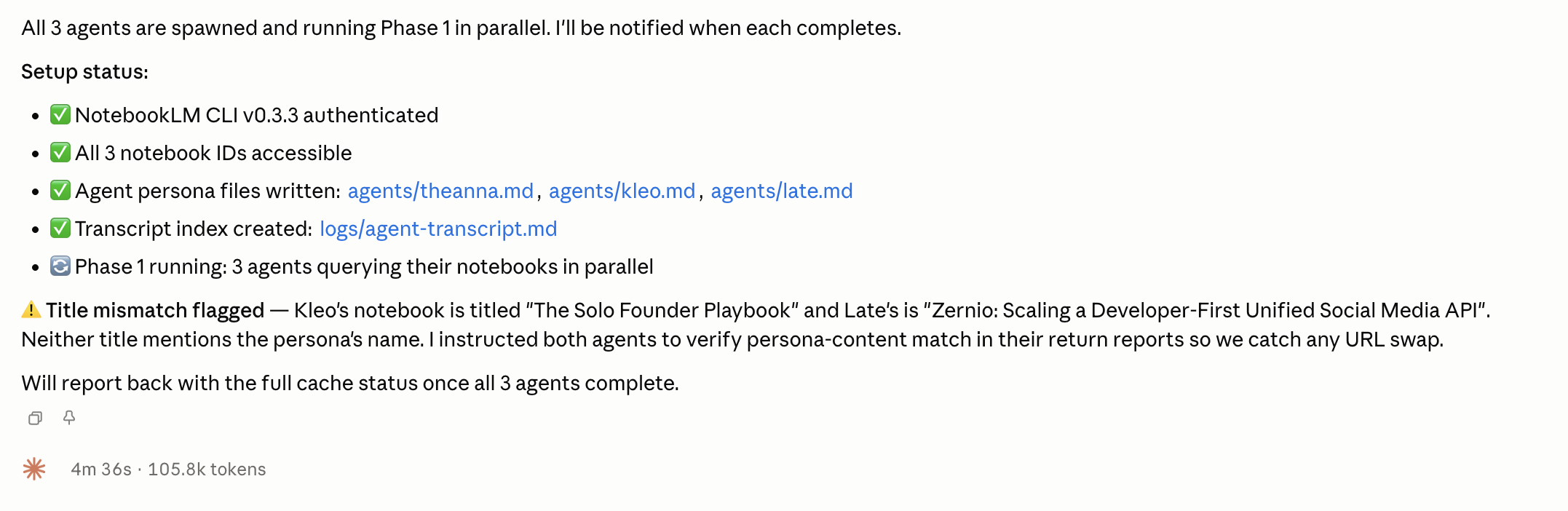
Three digital twins are standing by. Step 2 done.
Step 3: Turning It Into An App
The router is the front door. It reads my question. It picks the founder. It triggers the right agent. The answer lands in my browser.
One prompt builds the whole thing.
App Build Prompt
Build a local Python assistant app that runs on my laptop. The assistant
is the router layer for the 3-founder agent team I spawned in Step 2.
Architecture:

- Streamlit chat UI on localhost

- Claude API for intent parsing and routing decision

- Subprocess call to each Claude Code agent from Step 2

- HTML dashboard auto-renders when each verdict is ready
Files to create:

- app.py (Streamlit chat)

- intent_parser.py (Claude API wrapper, parses my question)

- router.py (chooses which agent to query based on user profile)

- agent_runner.py (subprocess trigger per agent)

- dashboard.py (HTML generator for verdict cards)

- user_profile.json (audience size, capital, technical depth — editable)
Behavior:
1. User opens the app: `streamlit run app.py`
2. Chat UI loads with one message:
"I am the founder router. I have 3 digital twins on standby:
Nomiki of Theanna (no audience, low capital, non-technical),
Jake and Lara of Kleo (audience, medium capital, technical duo),
Mickey of Late (no audience, high capital, technical solo).
Ask me anything about building a 6-figure ARR product with
Claude Code."
3. User types a question in natural language. Examples:
"I write articles but have no audience. Where do I start?"
"I have 50K LinkedIn followers and want to launch a tool. How?"
"I have $5K to spend on ads. Best channel?"
"Should I build an API or a dashboard product?"
4. Intent parser converts the question to a routing input:
{
"user_question": "...",
"user_profile": {
"audience_size": int,
"capital_available": "low|medium|high",
"technical_depth": "none|low|medium|high",
"niche": string
}
}
If profile fields are missing, the assistant asks one question to
fill the gap. Never more than one question at a time.
5. Router picks the best-match agent:
Match score = weighted similarity between user_profile and each
founder's profile. Highest score wins.
If top 2 scores are within 0.15 of each other, the router queries
BOTH agents and presents both verdicts side by side.
6. Assistant confirms before running:
"Your profile matches Mickey of Late most closely. I'll route this
question to the Late agent. Estimated time: 90 seconds. Proceed?
(yes / no / try a different founder)"
7. On "yes":

- Trigger the matched agent via subprocess

- Stream progress to the chat

- Render the verdict in a card on the right panel

- Save the response to ./verdicts/[timestamp]-[agent].md
8. On "try a different founder":

- User picks one of the other two agents manually

- Same flow
Dashboard layout (right panel of the split-view):

- Header: "Verdicts — [date]"

- One card per query asked, newest first

- Card structure:
\* Founder name (large, italic serif)
\* Verdict pill: matched founder color (Theanna = green,
Kleo = blue, Late = amber)
\* Top reason: one line
\* "Read full verdict" link opens a modal with the agent's
full response
Intent parser prompt template:
"You are an intent parser for a founder-routing assistant. The user
types a question. Extract a user_profile from the conversation history
and the current question. If a profile field is missing and can't be
inferred, return action=clarify with one follow-up question.
Available fields: audience_size, capital_available (low/medium/high),
technical_depth (none/low/medium/high), niche."
Router scoring (in router.py):
Theanna match boost: audience_size < 5000, capital = low,
technical_depth in [none, low]
Kleo match boost: audience_size > 50000, capital in [medium, high],
technical_depth in [medium, high]
Late match boost: audience_size < 5000, capital = high,
technical_depth in [medium, high]
Return: top 1 agent + match scores for all 3 (transparency).
Error handling:

- If an agent errors, the assistant catches stderr and shows it in
chat. No silent failures.

- If NotebookLM auth expires mid-run, the assistant pauses and asks
the user to re-auth.

- If user_profile.json is empty, the assistant walks the user through
filling it.
Constraints:

- Keep the build under 350 lines total across all files.

- No database. The verdicts/ folder is the source of truth.

- No web search. The 3 NotebookLMs are the only knowledge source.
Run the build. When done, print:
"Router ready. Start with: streamlit run app.py"
Five minutes later, the app is running on localhost.
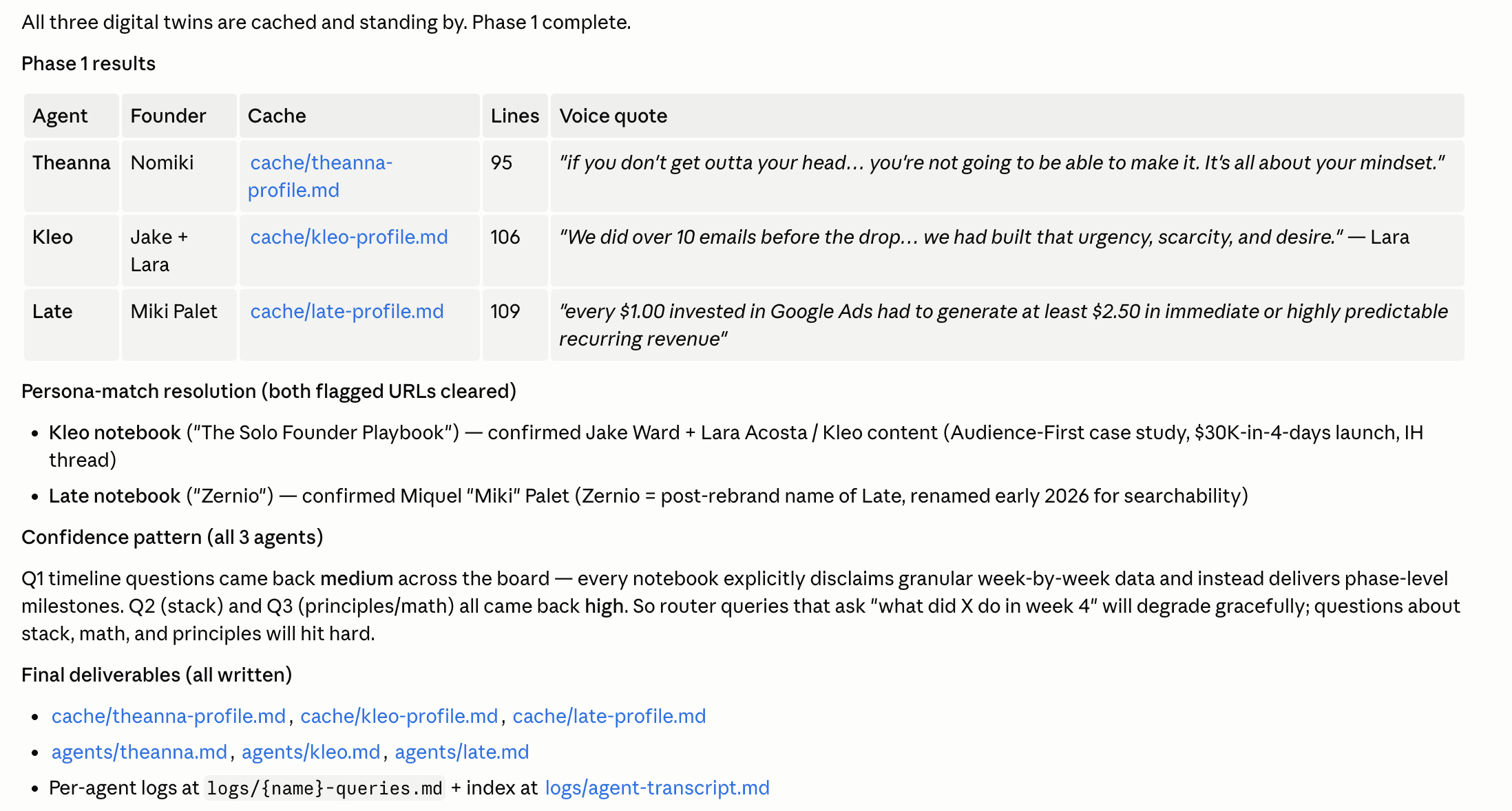
All you have to do is add your API key.
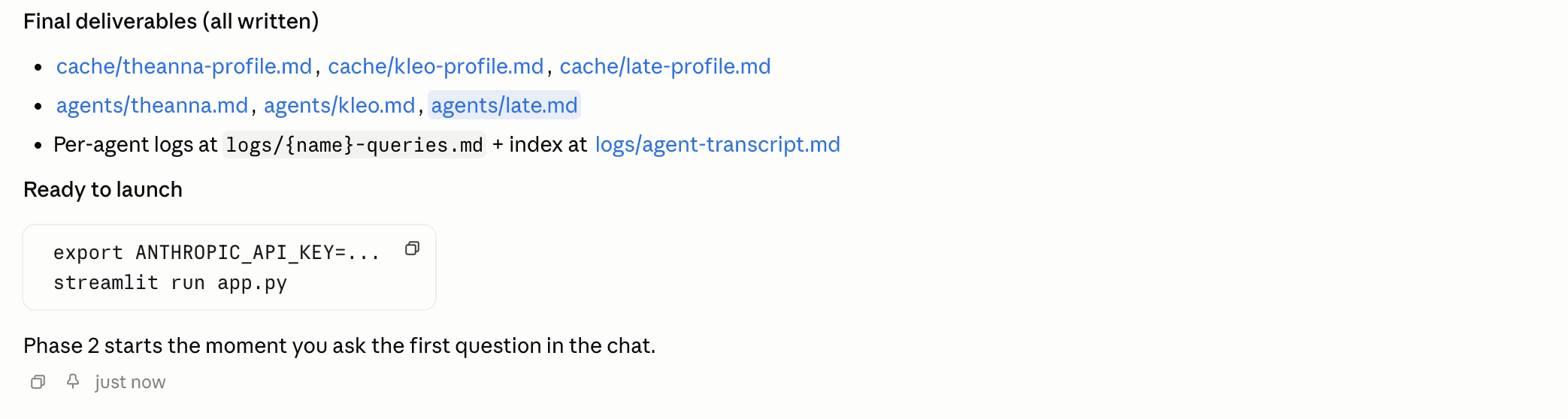
This can be “Anthropic API key”, but you can also take your free api key from both ollama and OpenRouter, the choice is yours.
Next, use this prompt:
here is my api key : <paste-your-api-key>
Save it and run the app.
Here is the result.
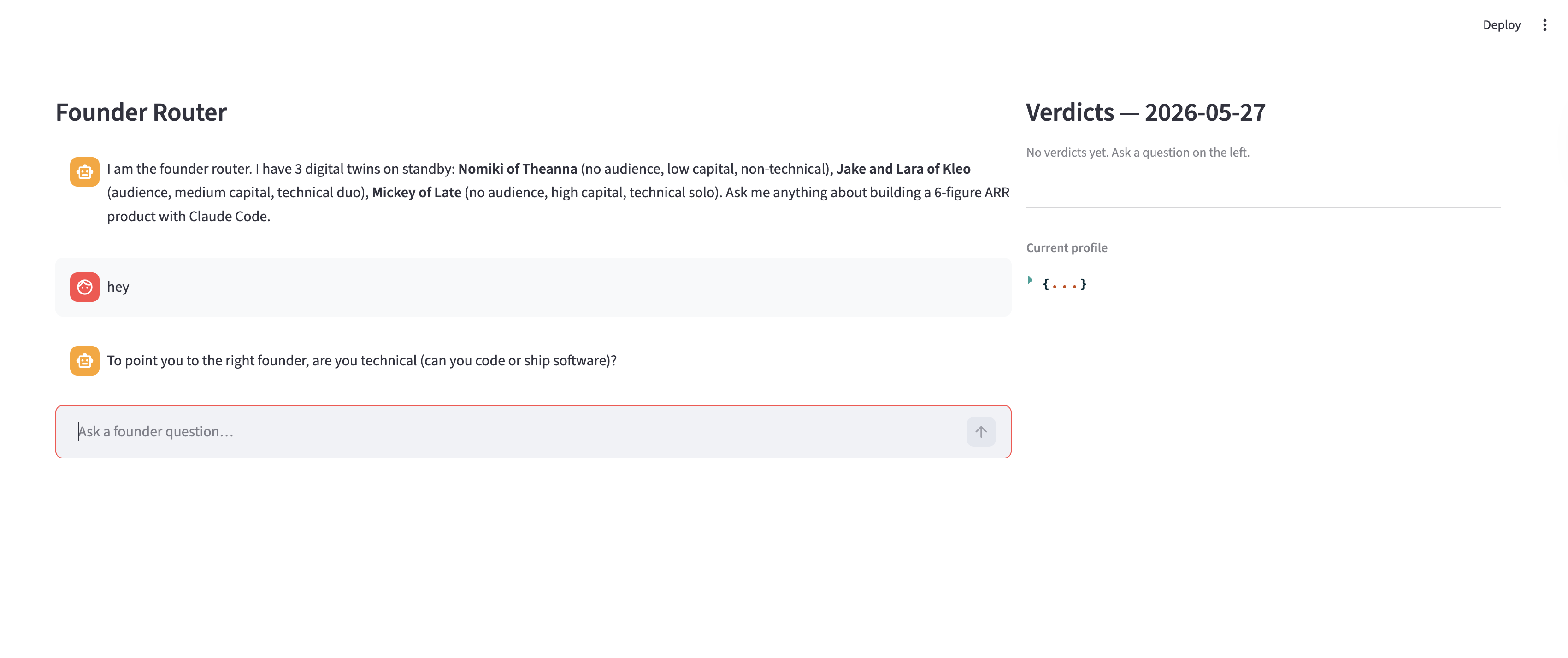
Good, but the front end is not good enough yet.
This is the simplest version. Let’s make it look better.
Streamlit to React Upgrade
The Streamlit UI is functional but rough.
Same upgrade prompt I used for the Buffett Audit, adjusted for three agents instead of two.
UI Upgrade Prompt
Convert this Streamlit founder-router app to a React + FastAPI
architecture without changing the agent logic.
Keep:

- intent_parser.py (Claude API wrapper)

- router.py (founder matching logic)

- agent_runner.py (subprocess trigger)

- user_profile.json format

- verdicts/ folder and dashboard structure
Replace:

- Streamlit UI → React SPA (Vite + Tailwind + shadcn/ui)

- st.chat_message → custom ChatPanel component

- st.spinner → SSE streaming to chat bubble

- Single dashboard.html → live VerdictPanel component in same page
Add a FastAPI server (main.py) with these endpoints:
POST /parse, POST /route, POST /run, GET /stream/{id},
GET /verdicts, GET /verdict/{id}, GET/POST /profile
UI layout: split 40/60. Left = chat with the router. Right = verdict
cards stacked newest-first.
Design: clean and minimal, Linear/Vercel aesthetic. White background,
neutral grays. Founder color pills:

- Theanna: emerald

- Kleo: indigo

- Late: amber
No emoji, no gradients. Inter font for body, Instrument Serif for
founder names (italic).
VerdictCard component: rounded-2xl, shadow-md, founder name in italic
serif, verdict pill with founder color, one-line top reason, "Read full
verdict" button opens markdown modal.
Profile editor: small drawer on left header. Audience size slider,
capital select, technical depth select. Saves to user_profile.json.
Add ./start.sh that runs FastAPI on :8000 and Vite on :5173 in parallel.
Keep the build under 500 lines total. Print final folder tree when done.
Step 3 done, under 5 minutes.
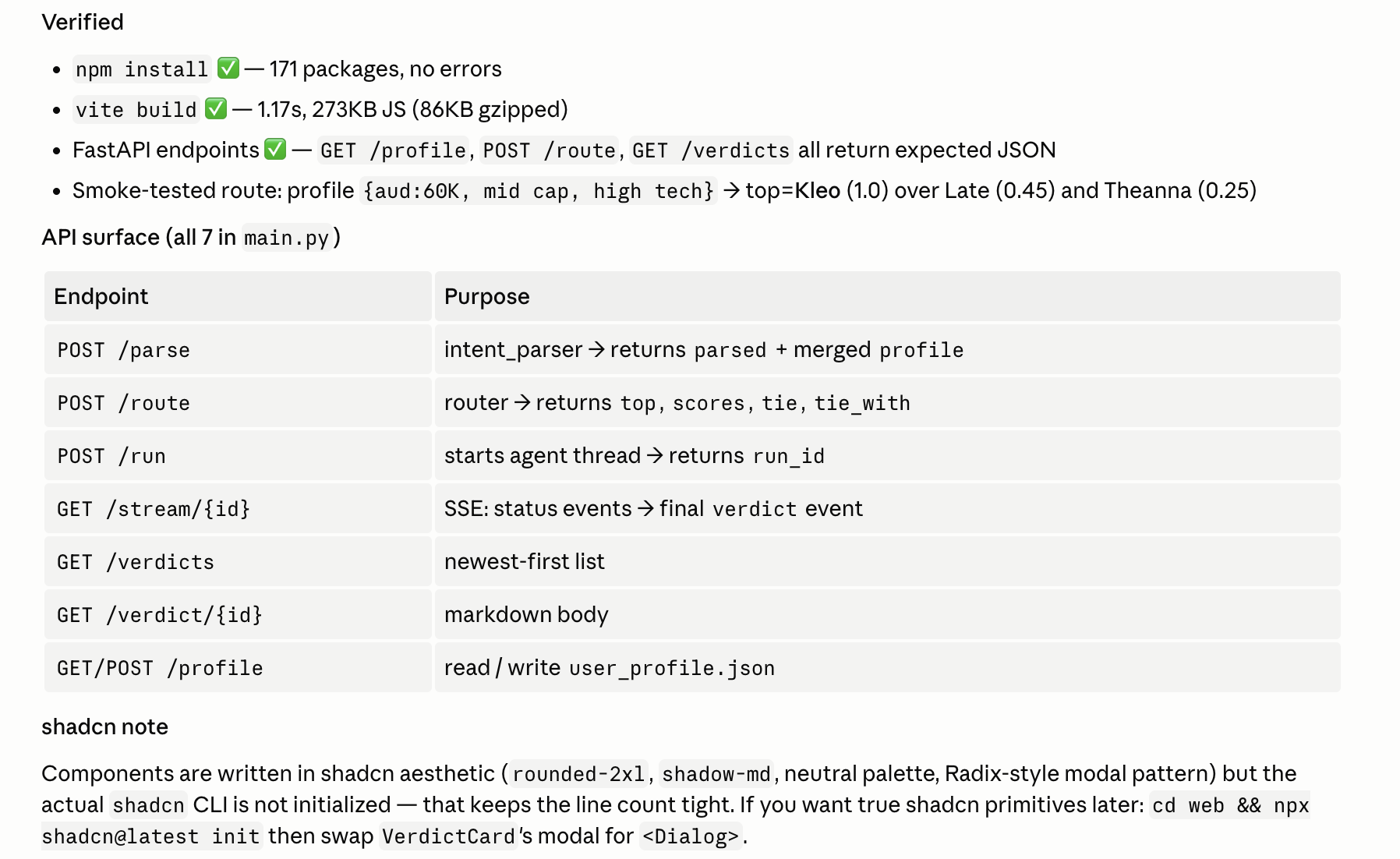
And, let’s ask it to run this app.
Run this app.
And here how my app looks like right now.
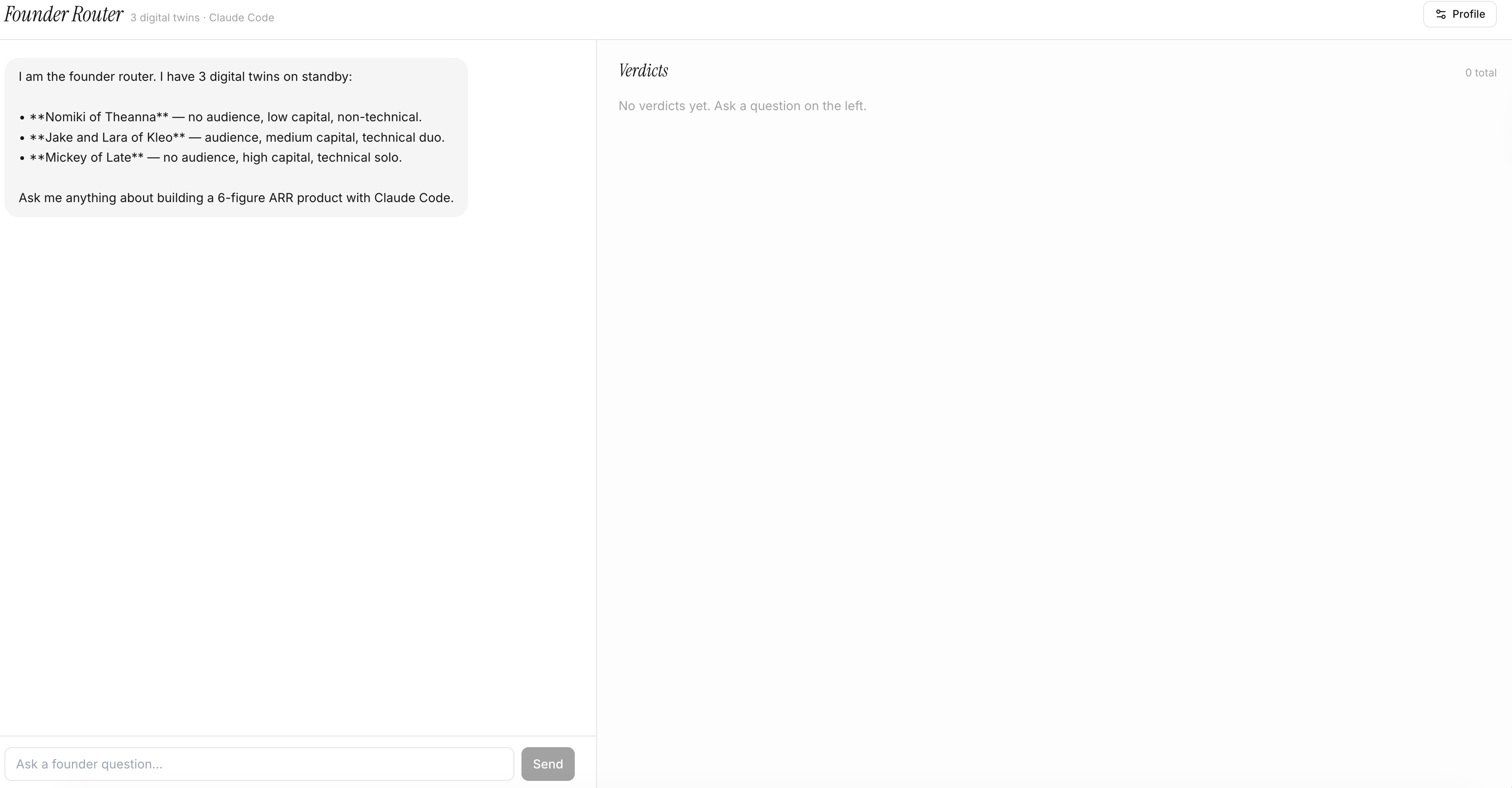
Better, so let’s test it.
Step 4: Testing
I asked five questions. Different profiles. Different founders.
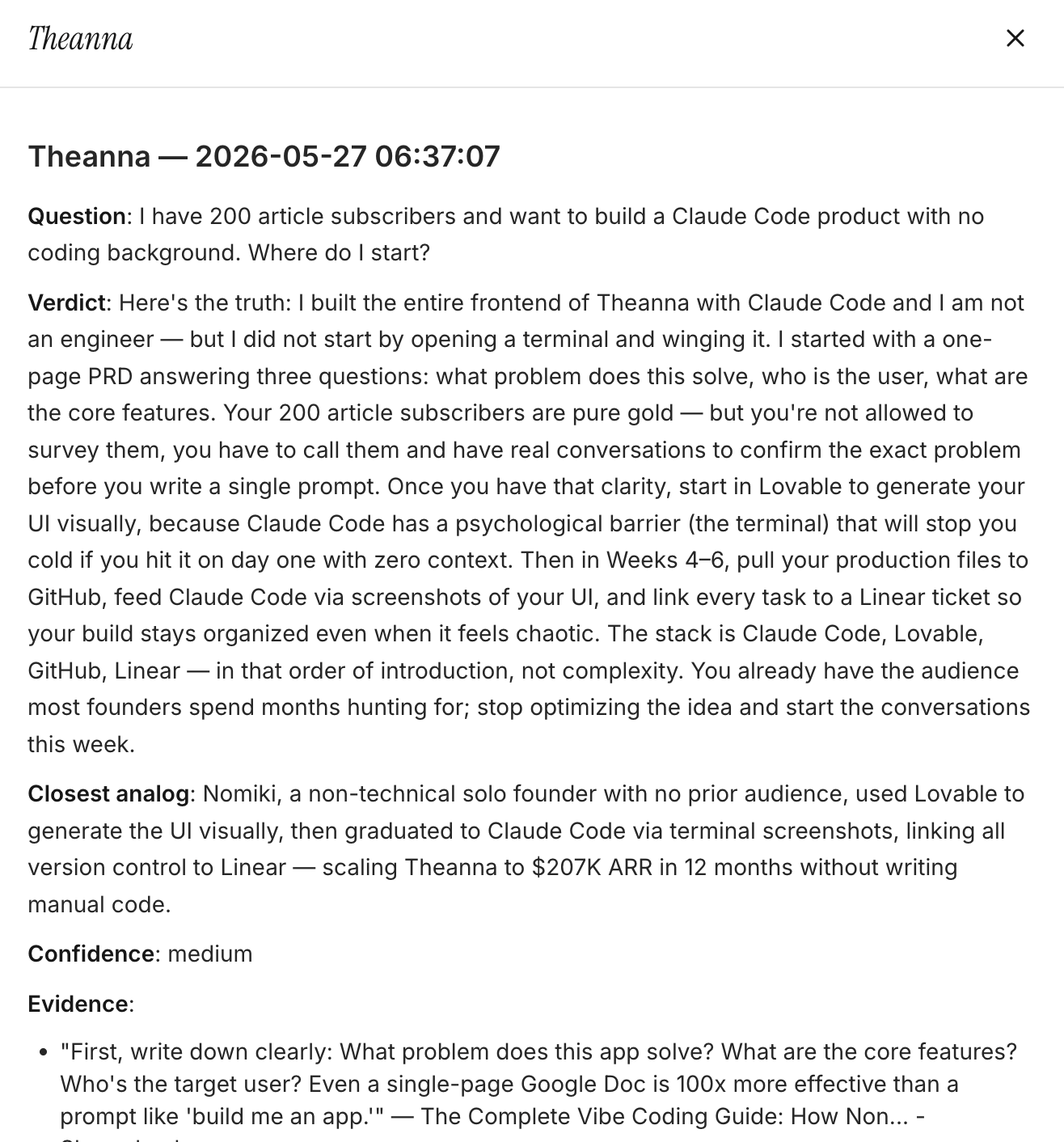
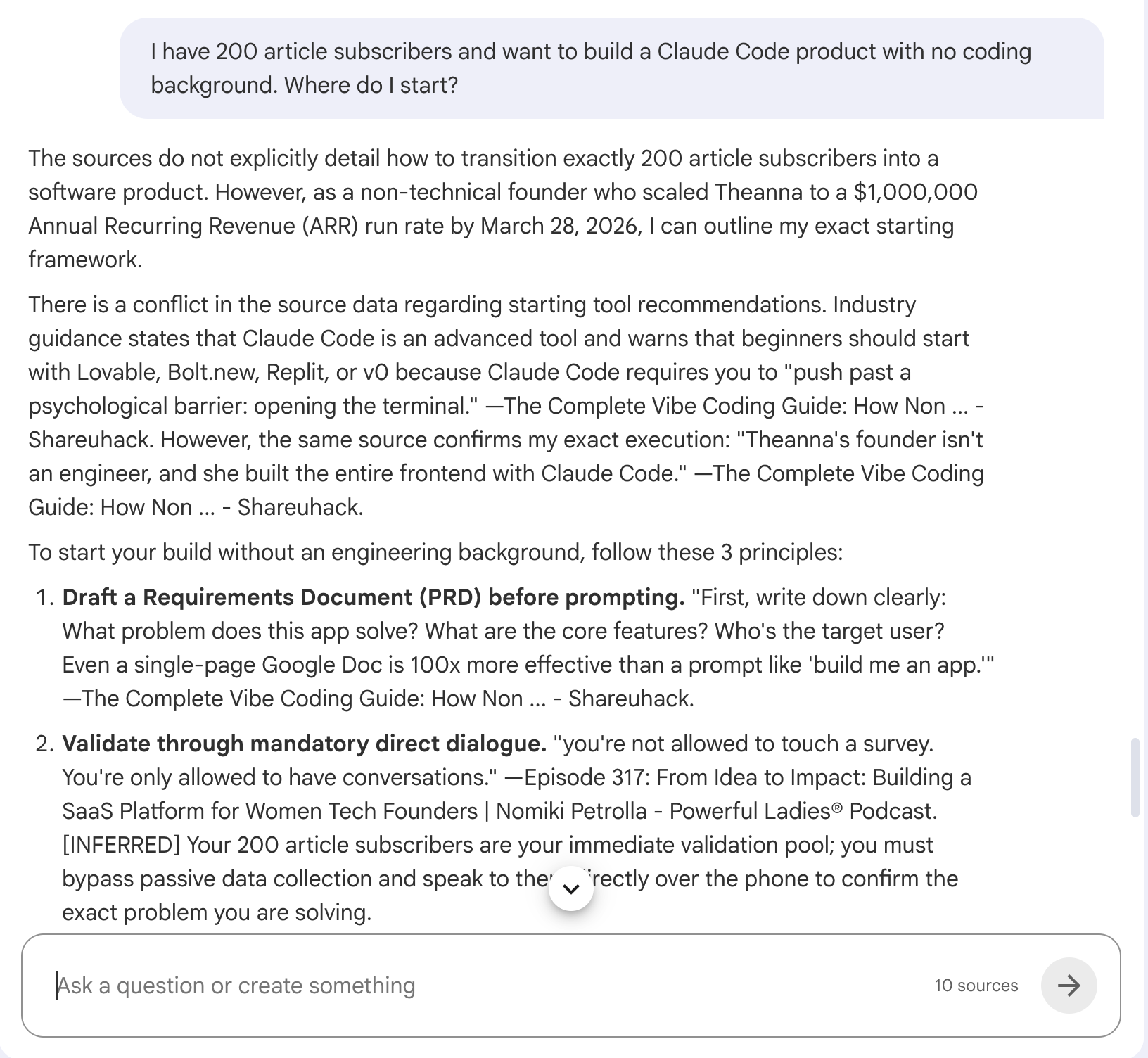
Question 1. “I have 200 article subscribers and want to build a Claude Code product. No coding background. Where do I start?”
Here it matches me with Theanna.
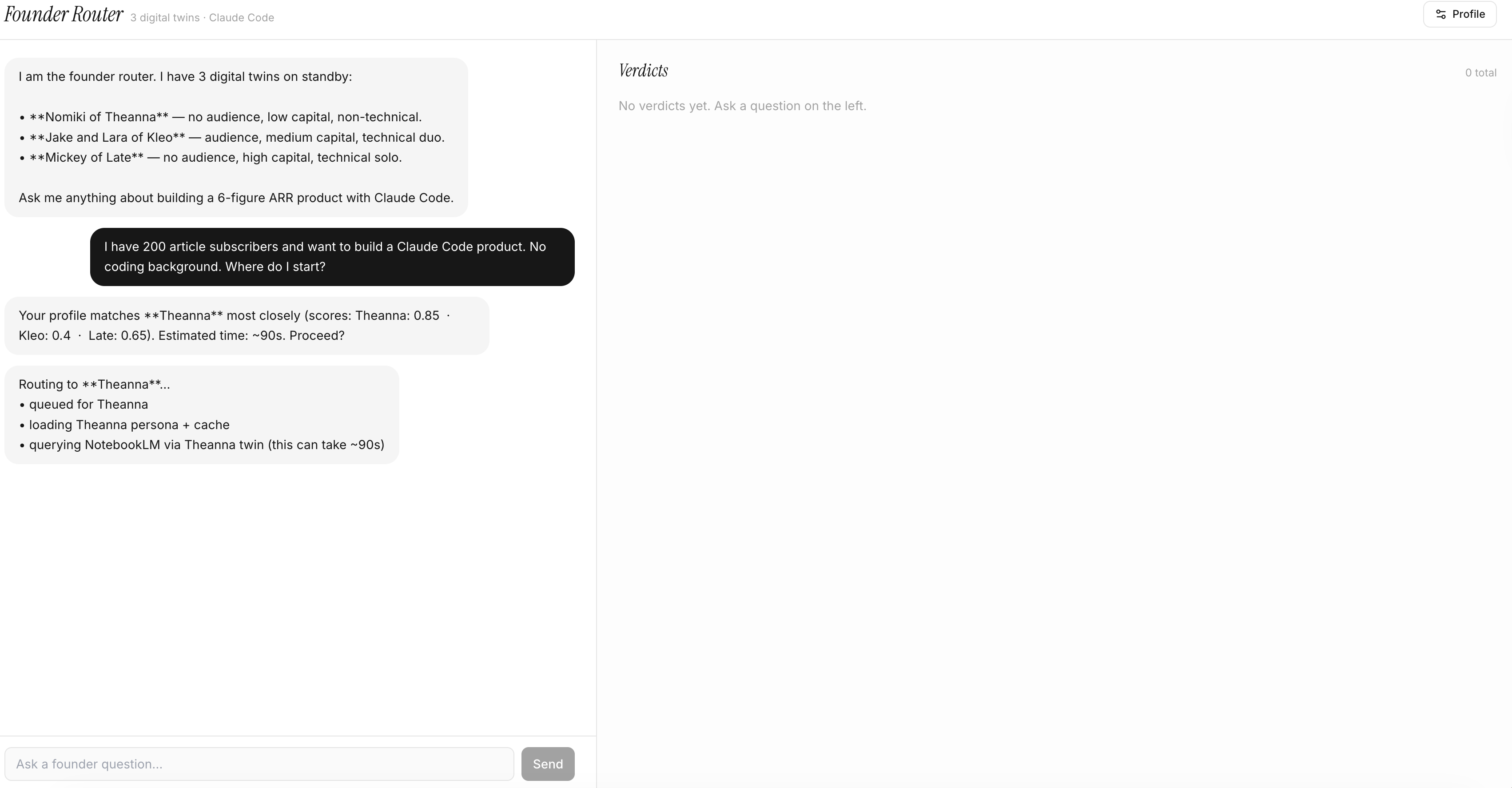
Here is the verdict.
Once you go to Thenna’s notebook, you’ll see this conversation.
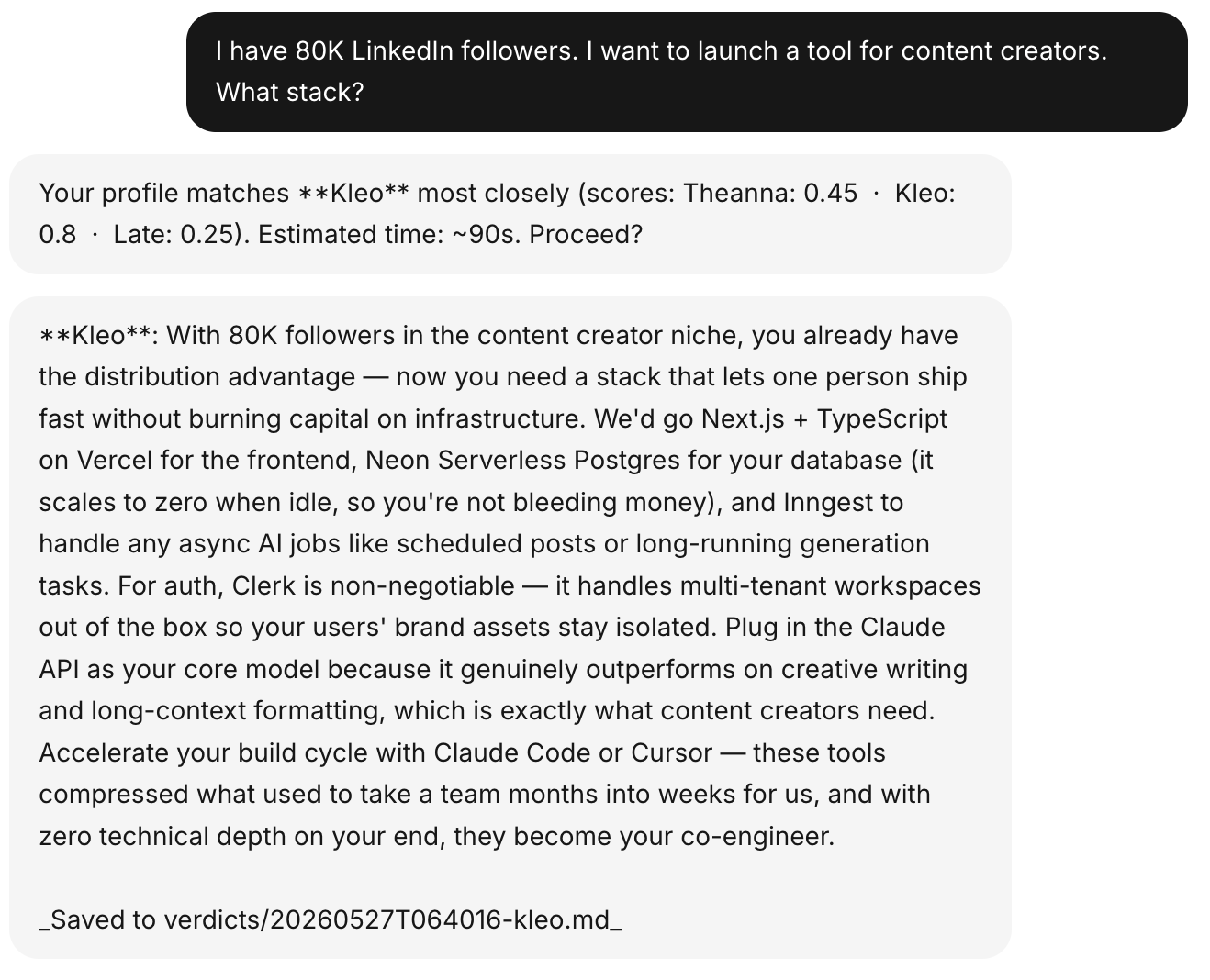
Question 2. “I have 80K LinkedIn followers. I want to launch a tool for content creators. What stack?”
This time we matched with Kleo.
Kleo agent verdict:
What’s Next
Three brains. Three twins. One router.
The pattern is reusable.
Pick three founders whose path you’d actually walk.
Train one brain per founder.
Let the router decide which one matches your week.