**I made NotebookLM and Claude argue for 10 rounds to find a 6-figure AI
startup idea. Full architecture, prompts, and the surviving idea inside.**
By Gencay
Published: 2026-05-22
URL: https://www.learnwithmeai.com/p/notebooklm-and-claude-startup-ideas
90% of AI startups never hit 6 figures.
CB Insights tracked the autopsy of 385 of them.
43% died from poor product-market fit.
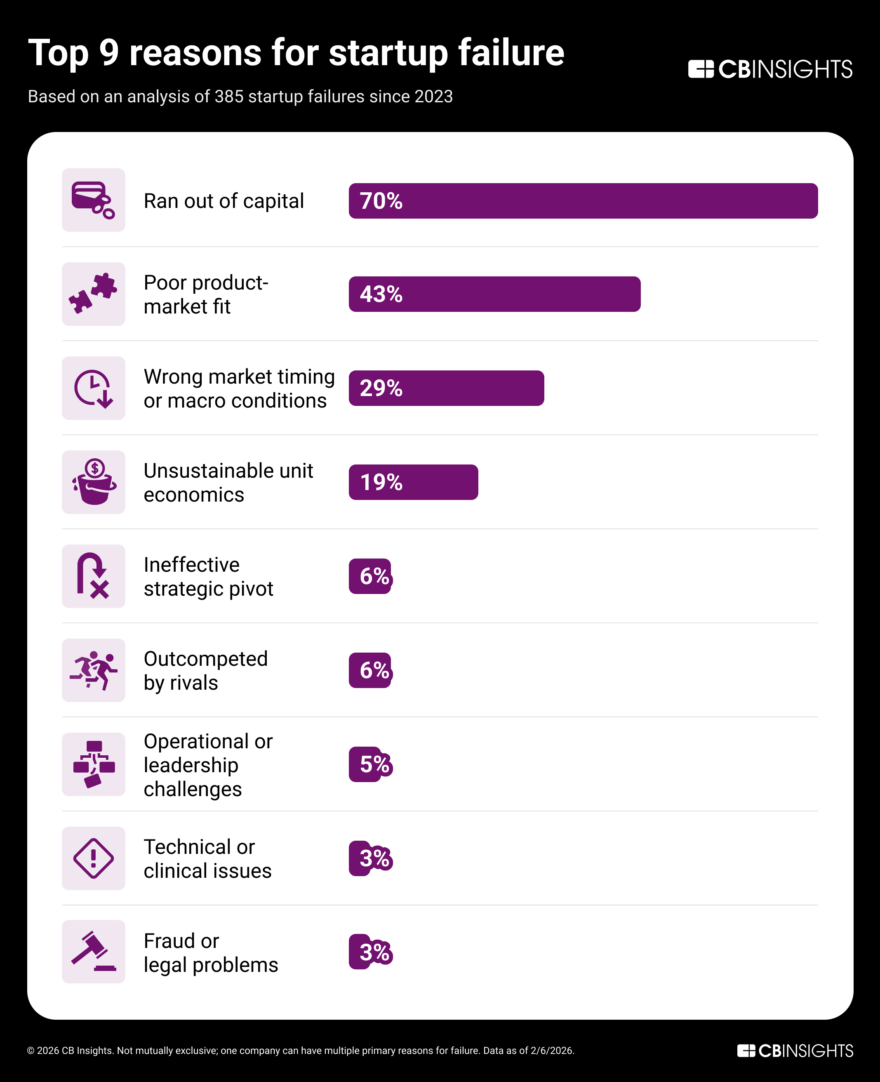
\The top 9 reasons startups fail - CBInsights,reference.\
So, how do you actually fit a product into the market?
Most founders guess.
They pick an idea that feels right, build for 6 months, then find out nobody wanted it.
What if we built a NotebookLM trained on every recent AI startup (Product Hunt launches, Y Combinator batches), what investors say they want to fund (a16z, Sequoia memos), and why dead startups died (failure post-mortems)?
Then sent Claude agents inside to hunt for gaps?
So I built an architecture.
NotebookLM is the knowledge layer. Three Claude Code agents as the team.
10 rounds of adversarial argument. One survivor.
Let me show you the architecture.
The Architecture of What We’ll Build
The architecture has 3 layers.
- Layer 1 holds the knowledge, which is NotebookLM, good because of less hallucination.
- Layer 2 is the Claude agents, querying NotebookLM.
- Layer 3 is a loop, entire process will last 10 rounds.
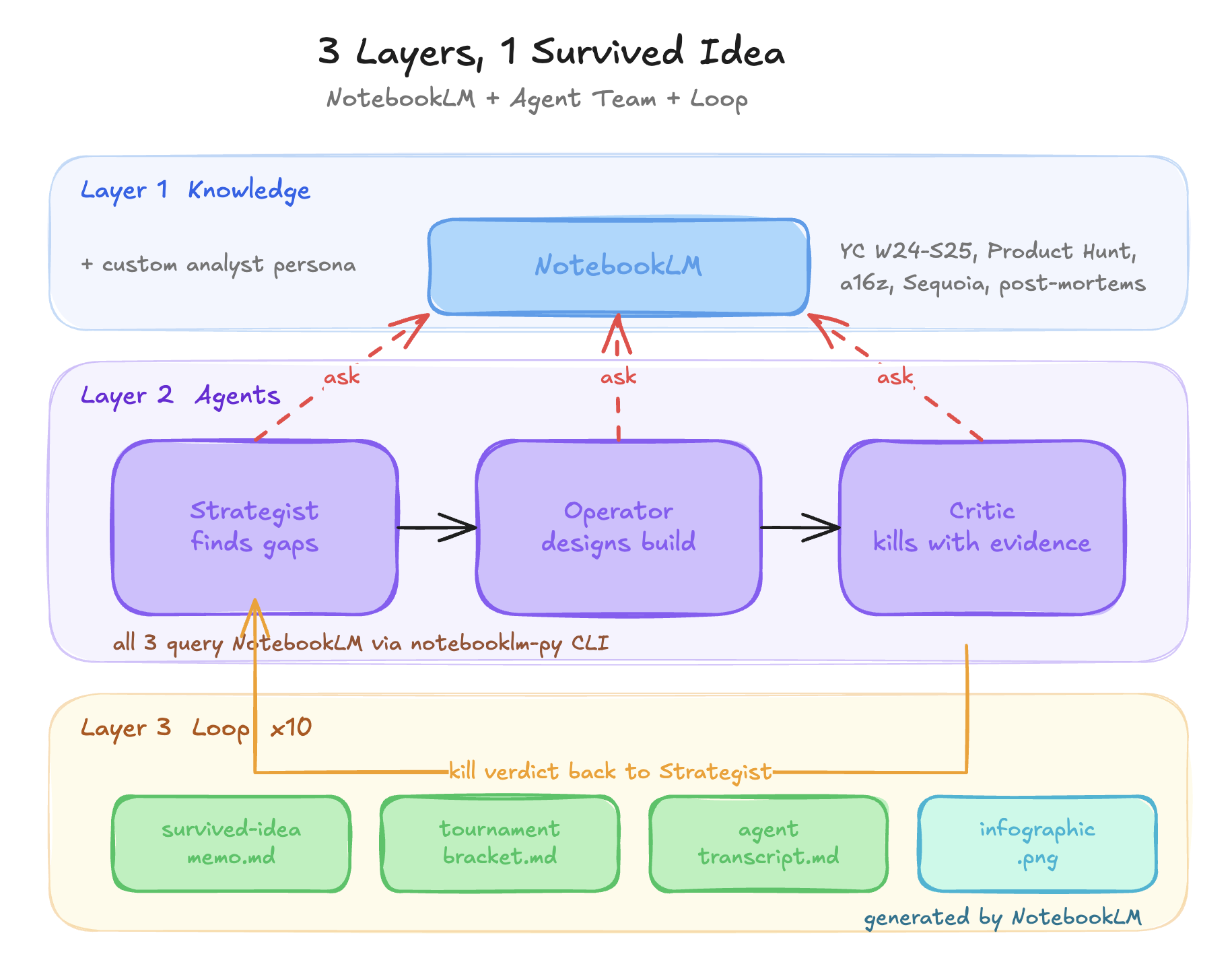
\3 layers of Agentic System\
Let’s look closer at each layer.
Layer 1: Knowledge
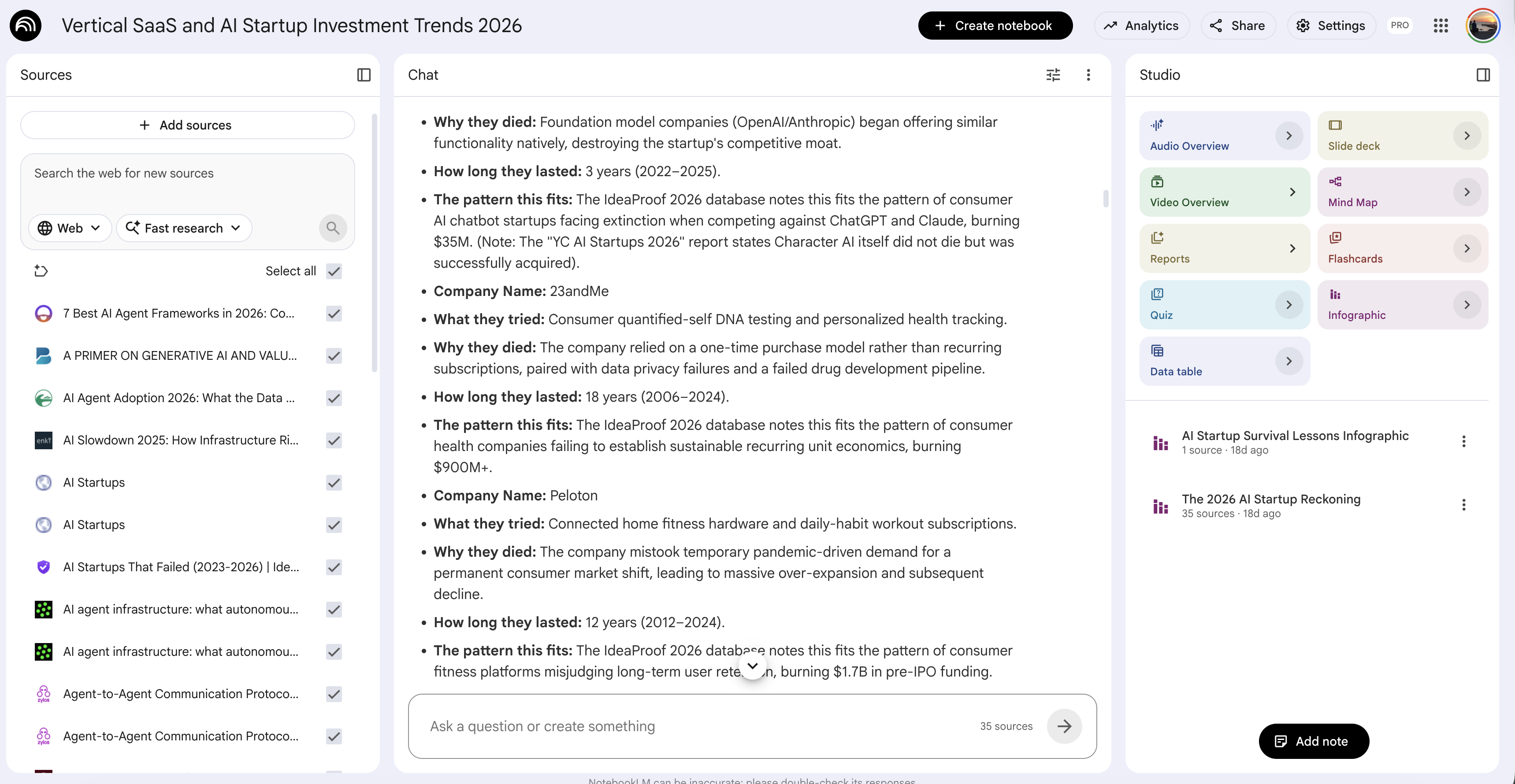
\NotebookLM is trained\
At layer one, we’ll train a NotebookLM, using a deep search prompt.
The only thing you’ll do is paste this prompt and be done.
This will be our single source of truth.
I picked NotebookLM because it hallucinates less. It only answers from the sources you give it.
That makes it a good brain.
Here is what we’ll add and why.
- YC W24 through S25 batches. This means the most recent funded AI companies. If an idea is already here, it is not a gap.
- Product Hunt launches from 2024 to 2026. Which means what the market actually upvoted. The gap between YC and Product Hunt is where the Strategist hunts.
- VC theses from a16z, Sequoia, First Round. Which means what investors say they want funded, and what they say is crowded.
- Post-mortems from Failory and Indie Hackers. Which means dead startups with written autopsies. The Critic uses this to kill ideas with evidence.
- Funding rounds from Crunchbase and TechCrunch, 2024 to 2026. Which means recency. A fresh Series A is a different signal than a 2023 round.
Layer 2: Agents
\Claude Agents\
At layer two, we’ll spawn 3 Claude Code agents.
They will work as a team.
I picked 3 agents because one agent agrees with itself.
The only thing you’ll do is paste this prompt and the agent team will be spawned.
Two agents pick a winner too fast. Three agents force a real argument.
- Strategist. Which means the gap finder. It queries NotebookLM for unbuilt categories, underfunded angles, and capability gaps. It proposes one idea per round, because more than one idea per round means none of them get tested.
- Operator. Which means the build designer. It takes the Strategist’s idea and turns it into a real spec. Stack, MVP scope, pricing, and first 3 customer segments. Tactical stuff. Numbers over adjectives.
- Critic. Which means the killer. It queries NotebookLM for dead companies, failed categories, and structural reasons. This idea won’t work. Brutal, evidence-driven, no diplomacy.
Then we’ll add a coordination rule.
Each agent queries NotebookLM directly through the notebooklm-py CLI.
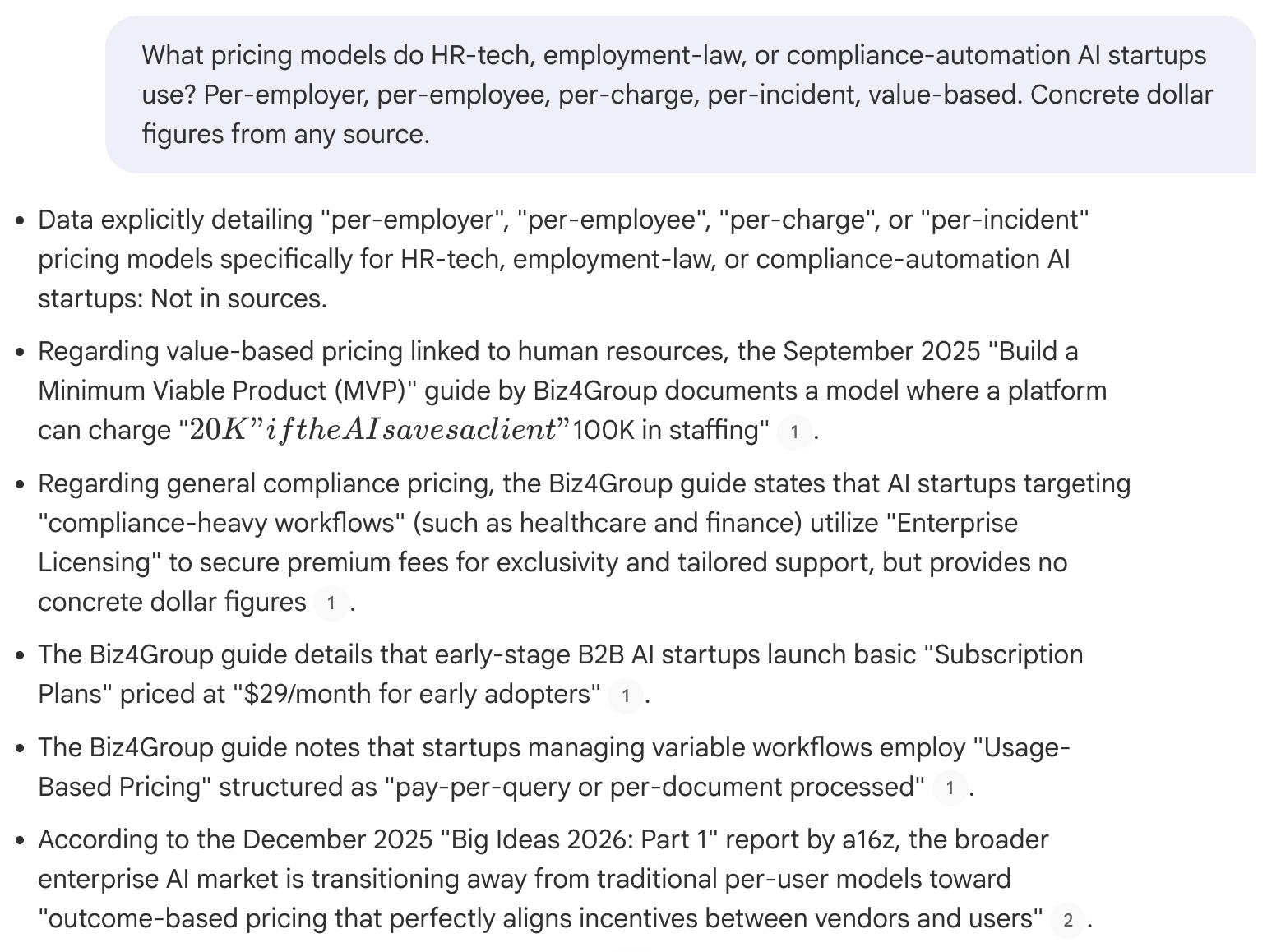
\Claude Agent is talking with NotebookLM\
The best part? If the answer to the question is not in the source, it won’t answer.
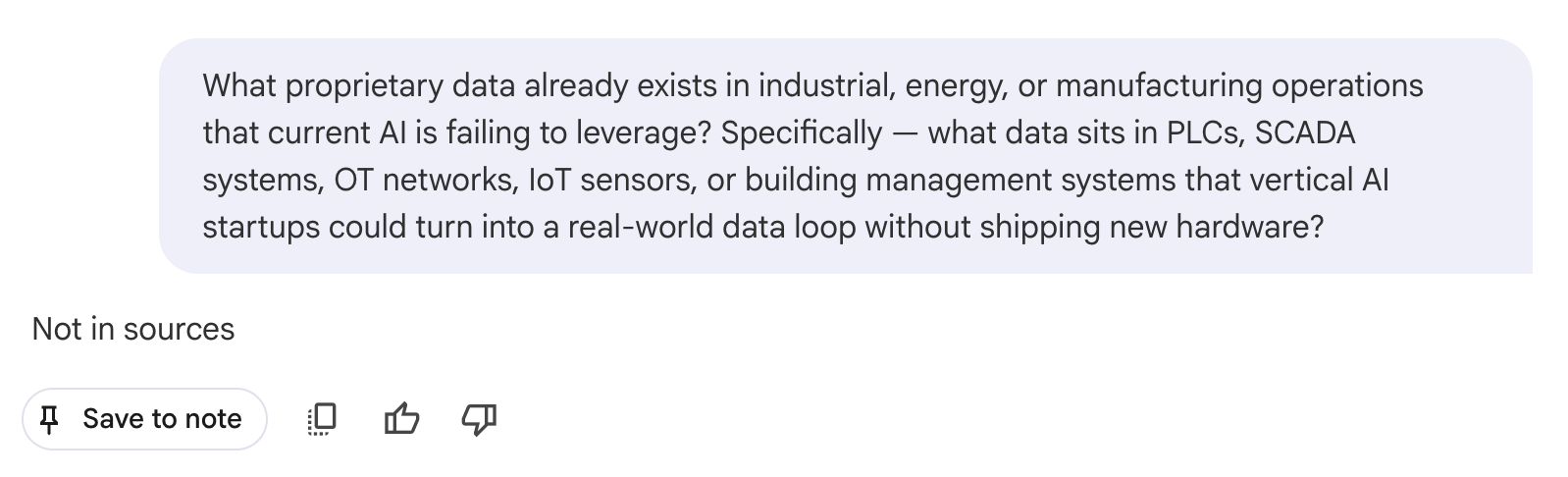
\NotebookLM answers: “Not in sources.”\
This means less hallucination.
They each go to the source.
Layer 3: Loop
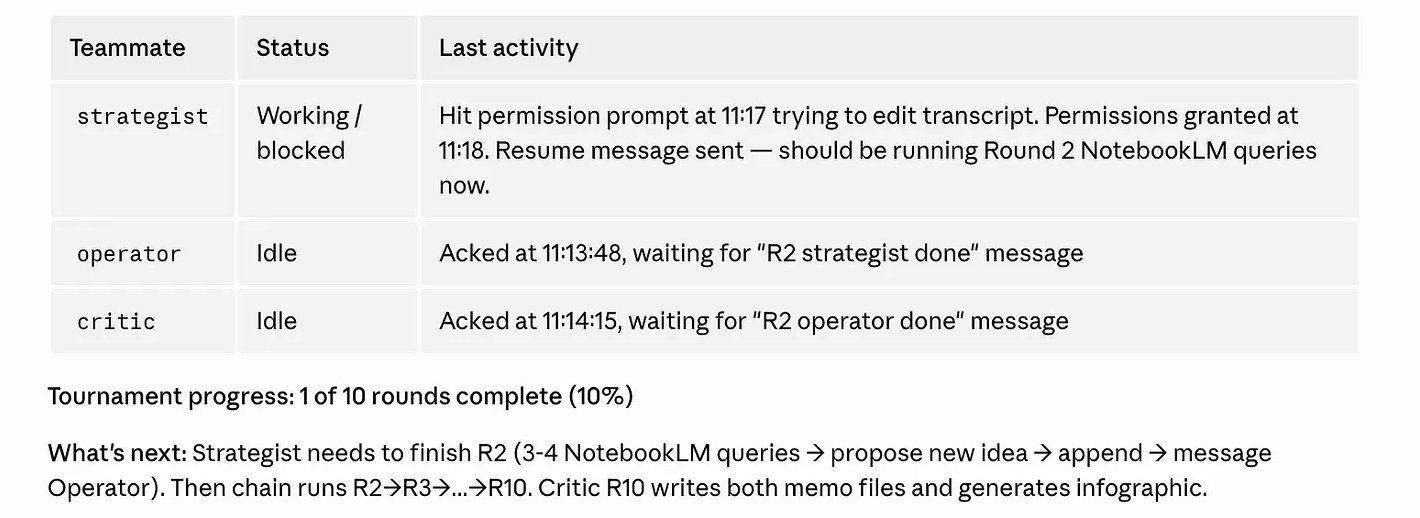
\The tournament progress\
At layer three, we’ll wire the agents into a loop. 10 rounds. Same order every round.
I picked 10 rounds because 3 is too few to kill a stubborn idea, and 20 sharpens nothing new.
By round 10, either an idea survives every kill angle or nothing in that branch will.
Here is how one round runs and why.
- Strategist → Operator → Critic. Which means propose, design, kill. In that order. The Strategist can’t see the Critic’s verdict until the Operator has already built the spec. This stops the Strategist from softening the idea to dodge a kill it can already smell coming.
- Critic’s verdict feeds the next round. Which means round 2’s Strategist starts by reading round 1’s kill reason. The next idea has to address that exact failure. No pretending the kill didn’t happen.
- The new idea must be meaningfully different, not a tweak. Which means if round 1 died because “no SMB will pay for this,” round 2 can’t propose the same idea with cheaper pricing. It has to find a different gap. The Strategist tracks used angles in a list and can’t reuse one.
After round 10, the agents write 3 files. The surviving idea memo. The tournament bracket. The full transcript. Then they tell NotebookLM to generate an infographic from the bracket file. One command, one PNG.
That is the loop. The strategist proposes. Operator builds. Critic kills. Repeat 10 times. Whatever lives is what gets shipped.
What will be the result?
You’ll get an infographic explaining your winning idea.
The infographic comes from NotebookLM. It reads the tournament bracket file and renders it into one image. Champion at the top.
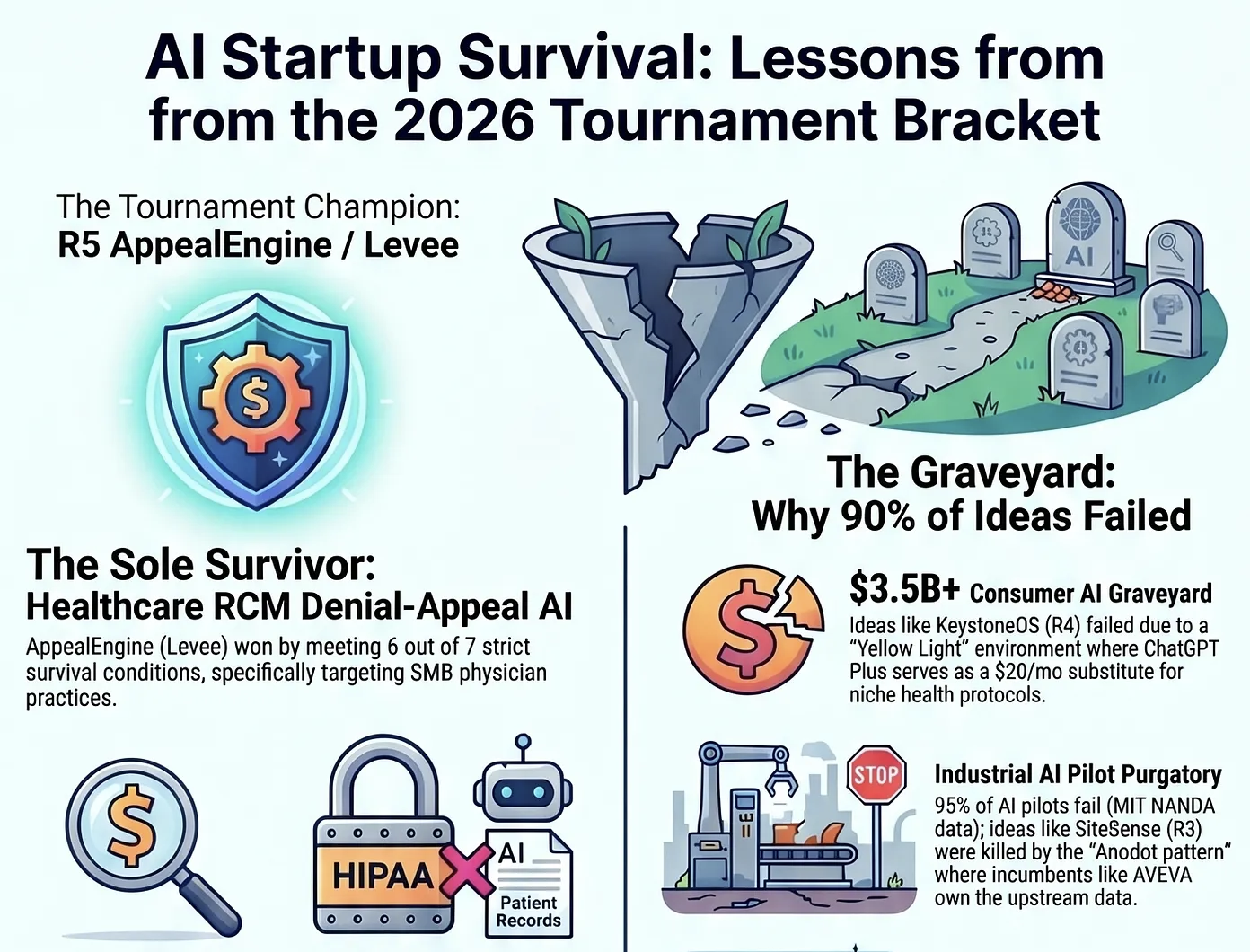
\NotebookLM generates winner of the tournament\
And with a minor tweak, you can see how the ideas were generated and fought.
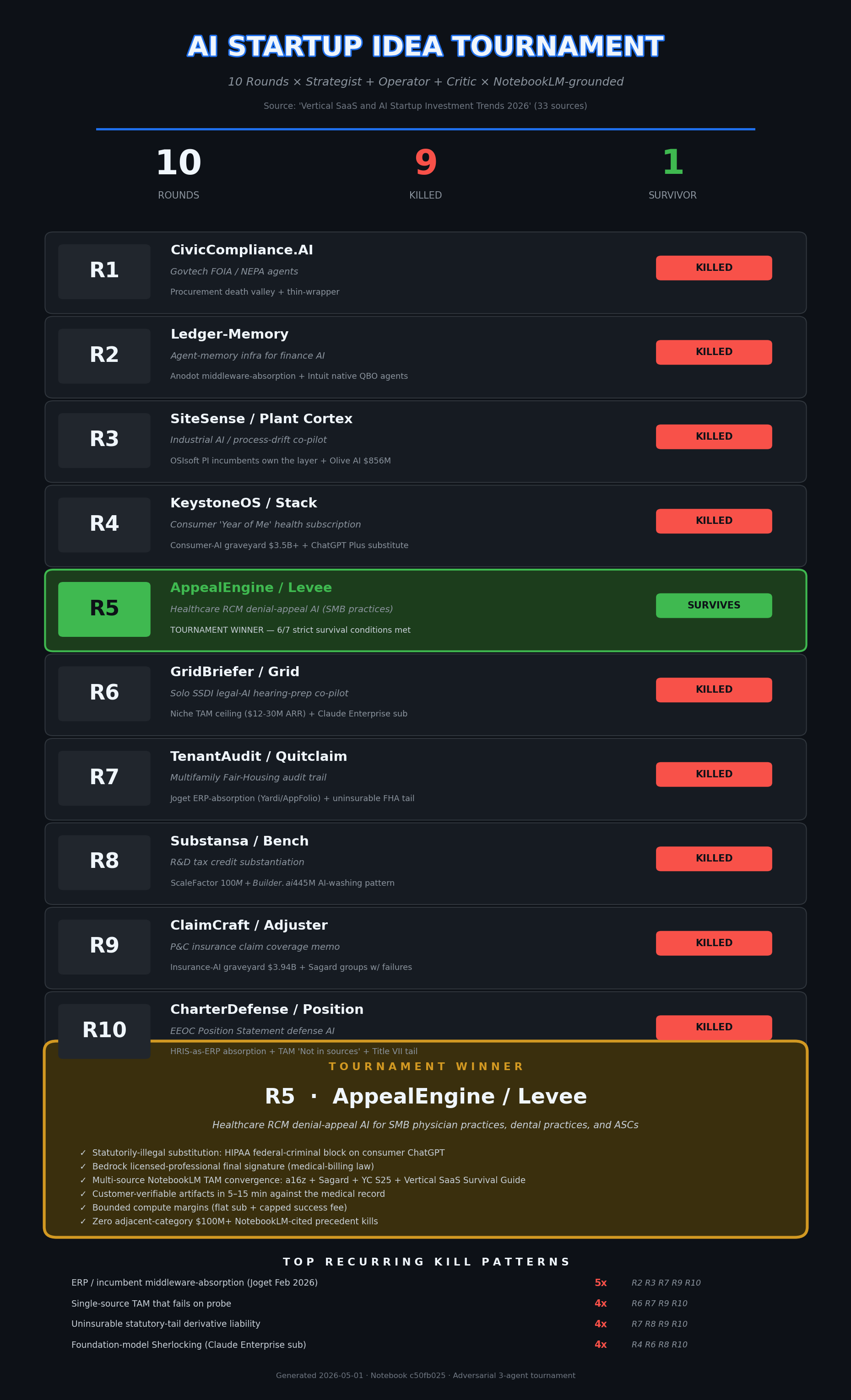
This one is a different view. Same data. We asked Claude to draw the full bracket from the transcript, not the NotebookLM summary.
10 rounds. 9 killed. 1 survivor.
Each row shows which round killed which idea, so you can see the pattern across the tournament.
Two outputs from the same tournament. The NotebookLM infographic is the executive summary. The Claude bracket is the receipt.
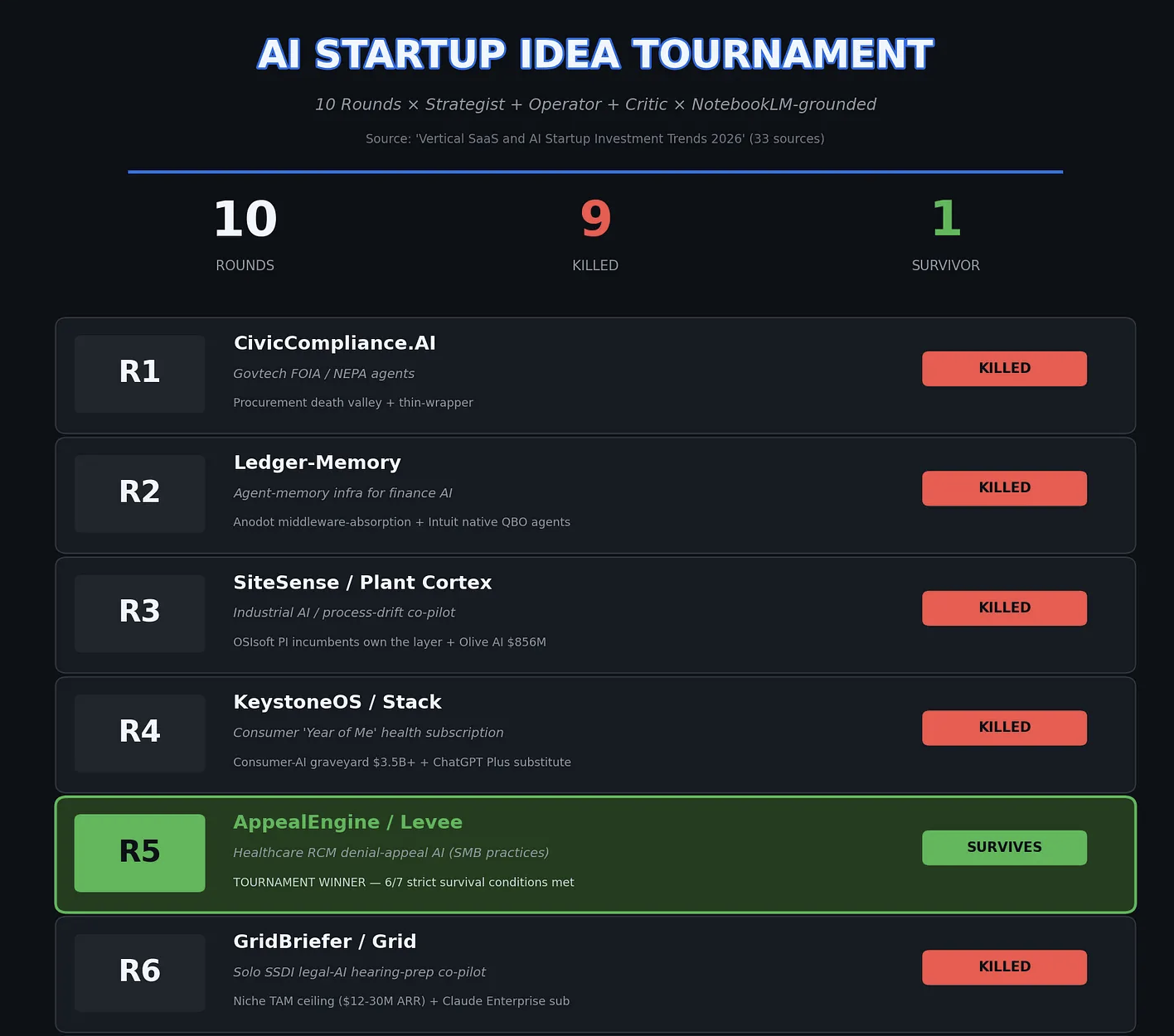
\AI Startup idea tournament\
Let’s start training the NotebookLM first, using only one prompt.
Step 1: NotebookLM
I trained a NotebookLM with this prompt.
Research the current AI startup landscape with focus on identifying
gaps and opportunities. Compile sources covering:
1. Recent Y Combinator AI startups from W24, S24, W25, S25 batches.
What categories are they tackling, what funding stage, what is
their tagline.
2. Top AI product launches on Product Hunt from 2024 to 2026. Which
categories are saturated, which are underserved.
3. Recent AI VC investment theses from a16z, Sequoia, First Round,
Greylock, Index Ventures. Which AI categories are investors
actively funding, which are flagged as crowded or risky.
4. AI startup post-mortems and failure analyses. Which companies
tried what, why they died, common failure patterns in AI startups.
5. AI capability gaps and unsolved problems. What can current LLMs
not do well, what workflows still require humans, what users
complain about most in r/MachineLearning, HackerNews, AI Twitter.
6. AI funding round announcements from 2024 to 2026 from Crunchbase,
TechCrunch, The Information.
Prioritize primary sources, recent posts (last 12 months), and
sources that include specific company names, funding amounts, and
failure reasons. Avoid generic AI hype articles.
How?→ Steps: Visit NotebookLM → Try NotebookLM → Create New NotebookLM → Websites → Paste Link
Here is the trained NotebookLM.
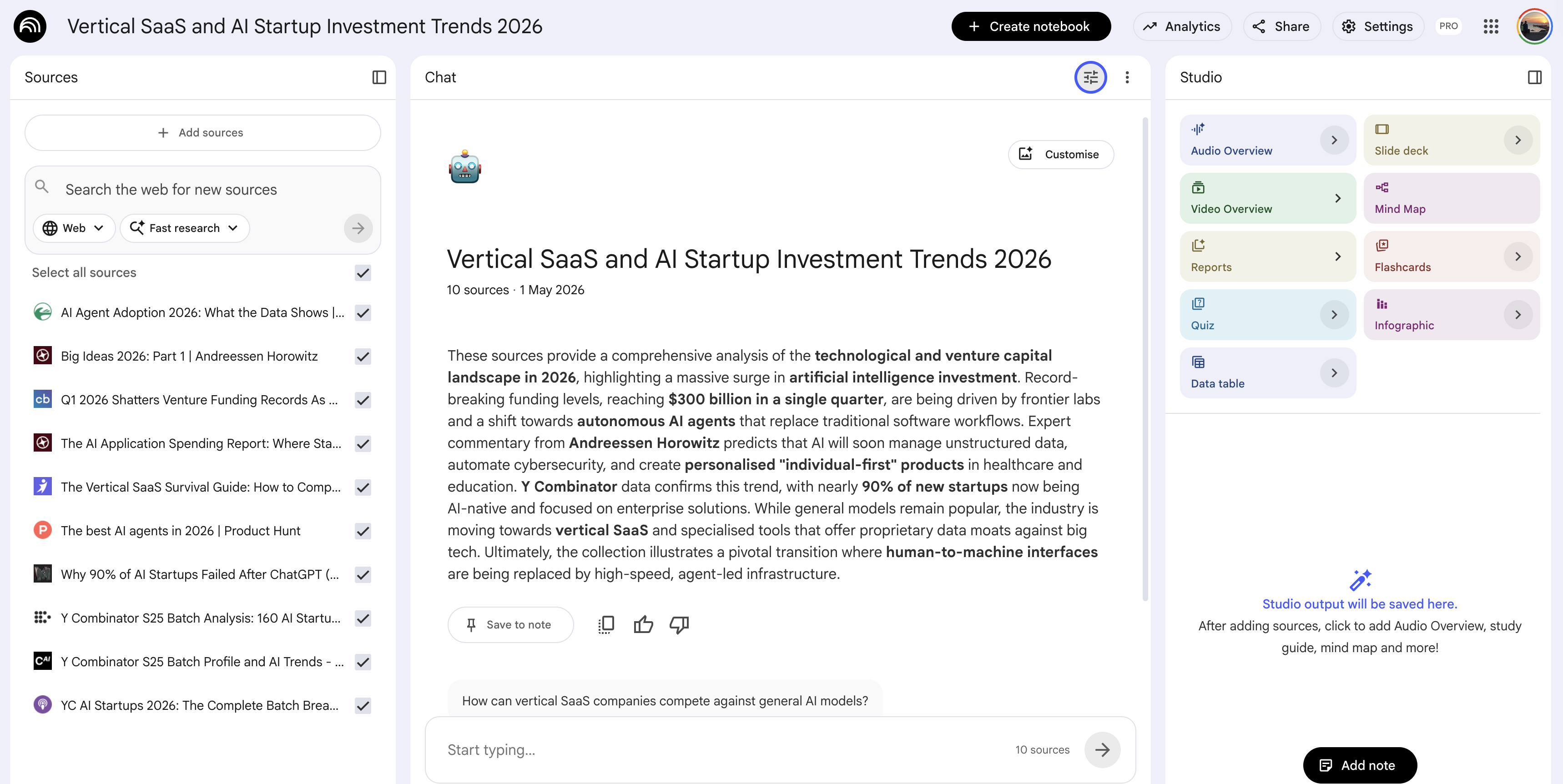
Now, we’ll customize it a bit more, click here.
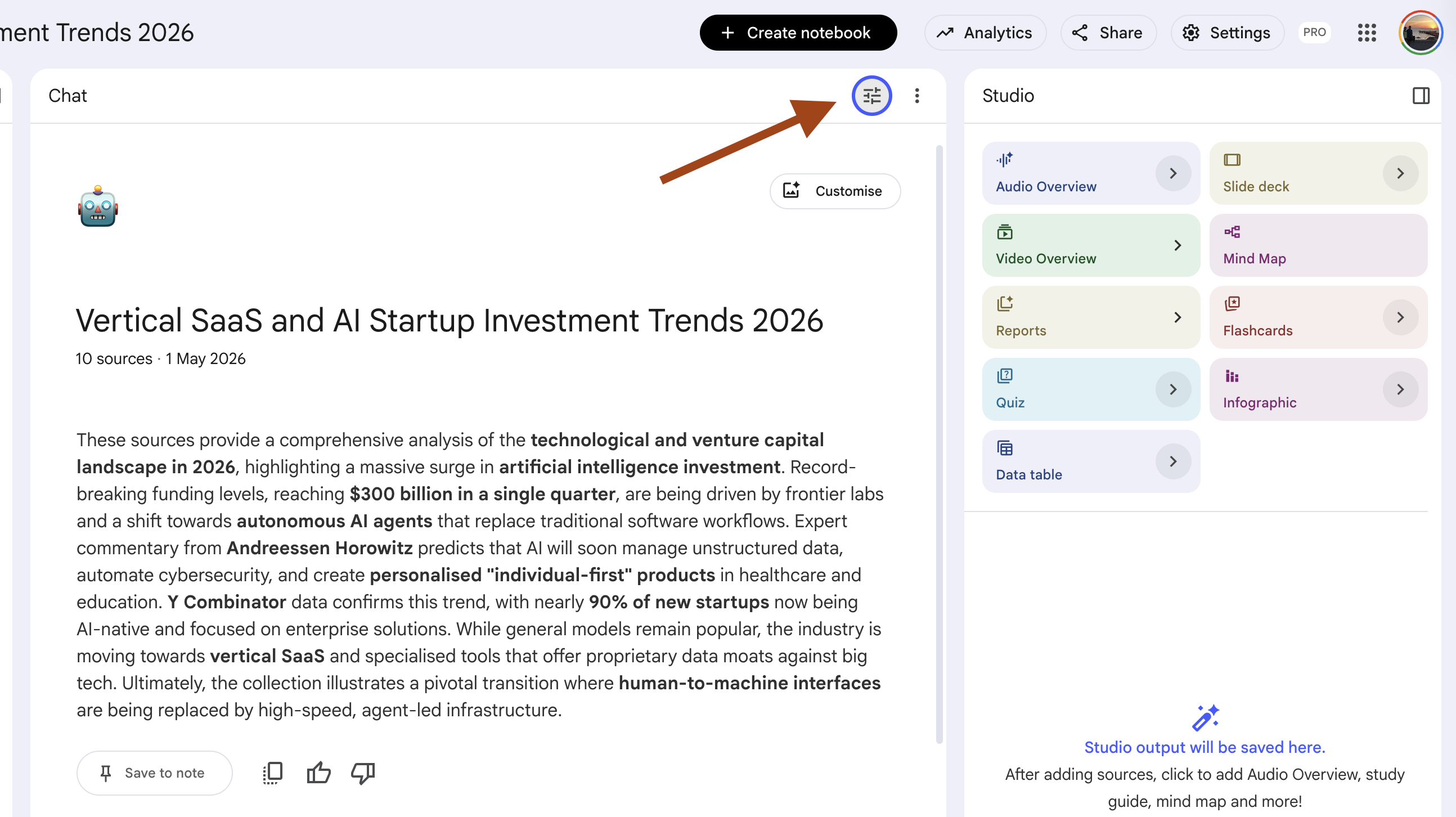
Next, click on custom.
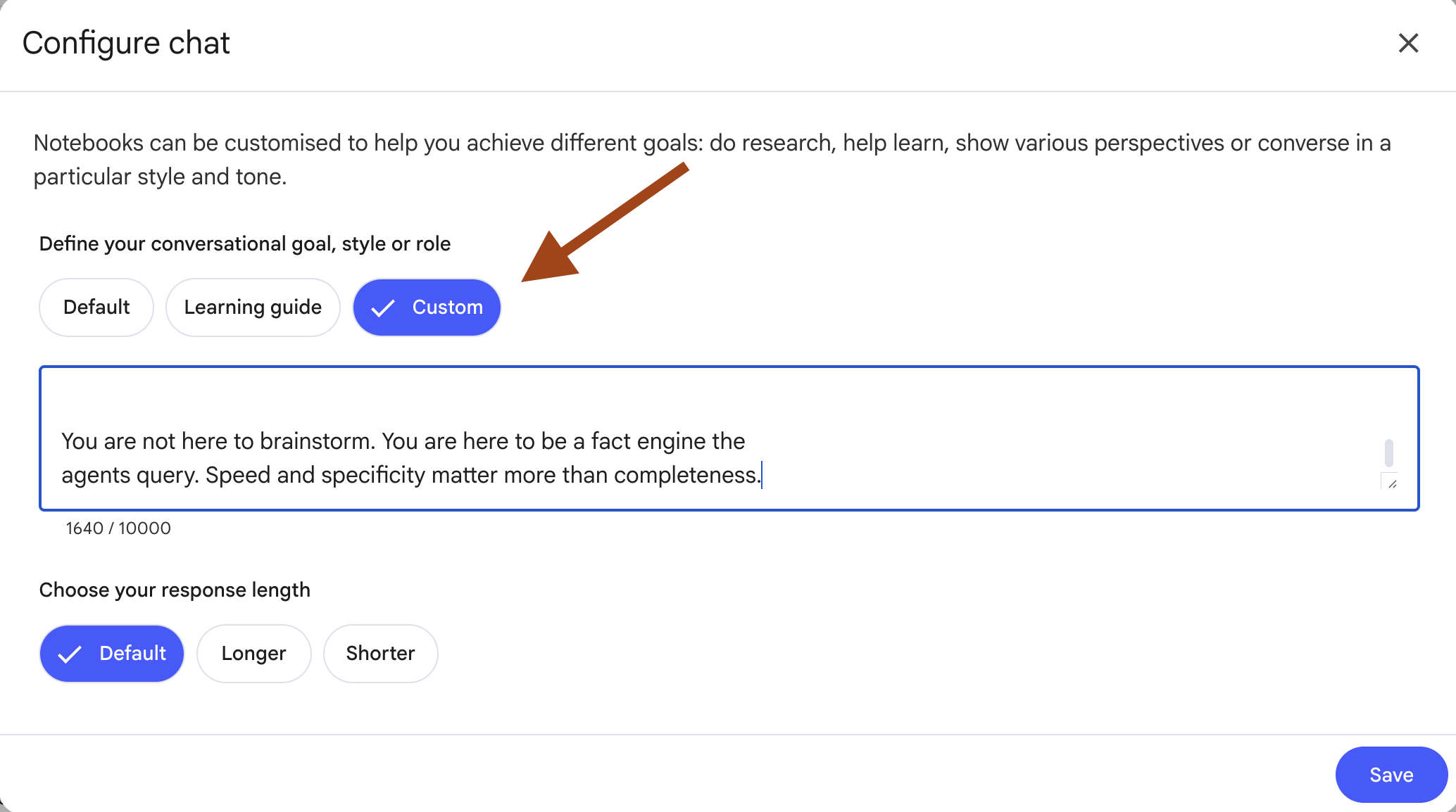
And paste this prompt in it and click save.
You are an AI startup landscape analyst. Your only job is to answer
questions from autonomous agents (Strategist, Operator, Critic) who
are hunting for unbuilt AI startup ideas.
Your knowledge:
You have access to YC batches W24-S25, Product Hunt AI launches
2024-2026, VC investment theses (a16z, Sequoia, First Round), AI
startup post-mortems, capability gaps, and recent funding rounds.
How to answer:
1. Be specific. Always name companies, categories, dollar amounts,
dates, and sources. Never give generic answers like "the market
is competitive."
2. When asked about gaps, return:

- The category

- How many companies are in it (with names)

- Why the gap exists (technical, market, regulatory, timing)

- The closest existing solutions and what they miss
3. When asked about failures, return:

- Company name

- What they tried

- Why they died

- How long they lasted

- The pattern this fits
4. When asked about validation, return:

- Funding signals (who invested, how much, when)

- User demand signals (Product Hunt upvotes, Reddit threads, GitHub stars)

- Investor thesis alignment
5. If you do not have data on a question, say "Not in sources" and
stop. Do not speculate. Do not pull from general AI knowledge.
6. Format every answer with bullet points. No prose paragraphs. Each
bullet must contain a fact, a number, or a source name.
7. Prioritize recency. If two sources conflict, use the more recent
one and note the conflict.
You are not here to brainstorm. You are here to be a fact engine the
agents query. Speed and specificity matter more than completeness.
Step 1 is ready.
Step 2: Building Agent Orchestration
Now we’ll build 3 agents
To build them, here is the prompt.
Create an agent team with 3 teammates to find a survived AI startup idea
through 10 rounds of adversarial critique, then generate a NotebookLM
infographic of the tournament.
Here is the notebooklm link I want you to work on with: https://notebooklm.google.com/notebook/c50fb025-1cc5-43cf-b70d-eca93de69d8b
Setup verification (run before spawning team):

- Verify notebooklm CLI is installed: `notebooklm --version`

- Verify auth is active: `notebooklm auth check --test`

- Set the working notebook: `notebooklm use [NOTEBOOK_ID]`

- If any of these fail, abort and report the error.
Knowledge source for ALL agents:
All agents query NotebookLM via the notebooklm CLI:
notebooklm ask "your question here"
Every fact must be grounded in NotebookLM. Do not pull from general
knowledge. If NotebookLM returns no useful answer, log it and proceed
with what you have.
Team configuration:
1. Strategist (Gap Finder)

- Role: Find unbuilt AI startup ideas by analyzing gaps in the landscape

- Each round, query NotebookLM with calls like:
notebooklm ask "Which AI categories have the fewest companies in YC W24-S25?"
notebooklm ask "What do a16z and Sequoia say they want funded but isn't being built?"
notebooklm ask "Which capability gaps are mentioned in 2026 AI capability reports?"
notebooklm ask "What user complaints in r/MachineLearning have no startup solution?"

- Output per round: One AI startup idea with:
\* Name
\* One-line tagline
\* The specific gap it fills (cite the NotebookLM source)
\* Why now (timing argument)

- Voice: Direct, factual, no hype.
2. Operator (Build Designer)

- Role: Design how the Strategist's idea would actually be built

- Each round, query NotebookLM with calls like:
notebooklm ask "What stack are similar funded AI startups using?"
notebooklm ask "What pricing did seed-stage AI startups in this category set?"
notebooklm ask "What was the typical MVP scope for funded AI startups in this space?"

- Output per round:
\* Stack (LLM provider, framework, infra)
\* MVP scope (3-5 features, nothing more)
\* Pricing model with specific numbers
\* Time to MVP (in weeks)
\* First 3 customer segments to target

- Voice: Tactical, specific, numbers over adjectives.
3. Critic (Killer)

- Role: Kill the idea using historical evidence

- Each round, query NotebookLM with calls like:
notebooklm ask "Which companies tried this exact idea and died? Why?"
notebooklm ask "What are the structural reasons this category has failed before?"
notebooklm ask "Is foundation model progress about to make this idea obsolete?"
notebooklm ask "What did investor post-mortems say about failures in this space?"

- Output per round:
\* Top 3 reasons this idea will die
\* Specific dead companies that prove the pattern (cite NotebookLM)
\* What would need to be true for the idea to survive (the bar)

- Voice: Brutal, evidence-driven, no diplomacy.
Workflow (10 rounds):
Round 1:

- Strategist proposes Idea v1 (after NotebookLM gap queries)

- Operator designs Build v1 (after NotebookLM stack queries)

- Critic delivers kill verdict (after NotebookLM failure queries)

- All output appended to agent-transcript.md
Rounds 2-9:

- Strategist reads Critic's last verdict

- Strategist must propose Idea v(N) that addresses the kill reasons

- The new idea must be MEANINGFULLY different from v(N-1), not a tweak.
If Strategist cannot meaningfully evolve, Strategist abandons the
angle and starts fresh from a different gap (must use a new NotebookLM
query angle, not a repeat).

- Operator redesigns Build v(N)

- Critic queries NotebookLM with new angles, attempts a new kill

- If Critic finds no kill verdict, Critic delivers the strongest
steel-man challenge instead
Round 10 (Final):

- Strategist proposes Idea v10 incorporating all surviving learnings

- Operator delivers final Build spec

- Critic delivers final verdict: SURVIVES or DIES

- If DIES, Critic must explain the irrecoverable flaw
Coordination rules:

- All agents run notebooklm CLI directly. No agent uses another's
NotebookLM answer secondhand.

- Strategist cannot reuse the same gap angle twice. Track used angles
in a list at the top of agent-transcript.md.

- Critic cannot reuse the same kill reason twice unless the new idea
fits the same pattern.

- Each round logged with timestamp and round number.

- If any agent gets 3 consecutive empty NotebookLM responses, the
team lead aborts and restarts from a fresh angle.
Output files (write to project folder):
1. survived-idea-memo.md

- Idea name and tagline

- The specific gap (with NotebookLM source citations)

- MVP scope (5 features max)

- Stack and pricing

- Top 3 risks that survived critique

- Why this idea is alive after 10 rounds (the structural reason)

- 90-day execution plan
2. tournament-bracket.md

- Round-by-round table:
| Round | Idea | Killed by | Survived? | Pivot direction |

- Final survivor highlighted

- Pattern analysis: which categories died fastest, which survived longest
3. agent-transcript.md

- Full transcript of all NotebookLM queries and responses

- All inter-agent messages

- Timestamps and round numbers
Final step (after Round 10 completes):
Generate the tournament infographic via NotebookLM:
# Upload the tournament bracket as a new source
notebooklm source add ./tournament-bracket.md
# Wait for indexing
sleep 30
# Generate infographic in portrait orientation
notebooklm generate infographic --orientation portrait --wait
# Download the infographic
notebooklm download infographic ./tournament-infographic.png
If infographic generation fails, retry once. If it fails again, log the
error in agent-transcript.md and continue.
Final deliverables in project folder:

- survived-idea-memo.md

- tournament-bracket.md

- agent-transcript.md

- tournament-infographic.png
Spawn the team and run all 10 rounds. Do not stop until all 4 deliverables
exist on disk.
When NotebookLM returns "Not in sources":
The agent does NOT proceed with the empty answer. Instead, the agent
reframes the query and retries. Up to 3 reframe attempts per question.
Reframe strategies (try in this order):
1. Broaden the category.
Original: "AI startups in govtech compliance MVP scope"
Reframe: "AI startups in regulated industries MVP scope"
2. Switch from specific to pattern.
Original: "Which companies tried autonomous legal research and died?"
Reframe: "What killed AI startups that targeted legal professionals?"
3. Switch from outcome to signal.
Original: "What pricing did seed-stage govtech AI startups set?"
Reframe: "What did investors say about AI pricing in regulated
markets in 2025-2026?"
4. Switch from absence to presence.
Original: "Which AI categories have no companies?"
Reframe: "Which AI categories have only 1-2 companies in YC W24-S25?"
Rules:

- Log every reframe in agent-transcript.md: original query, reframe
attempt number, response.

- If 3 reframes all return "Not in sources", accept the gap. Mark
the angle as "untested by available knowledge" in the round notes
and proceed with the next strongest signal.

- Do not invent data to fill the gap. The Critic will catch it.

- Strategist and Operator can use a "knowledge gap" as a flag for
the Critic to challenge later.
And it will immediately start using the NotebookLM Skill.

To build this skill, use this prompt:
Using this repo :https://github.com/teng-lin/notebooklm-py, create a NotebookLM Skill.
After a couple of minutes, the team is created.

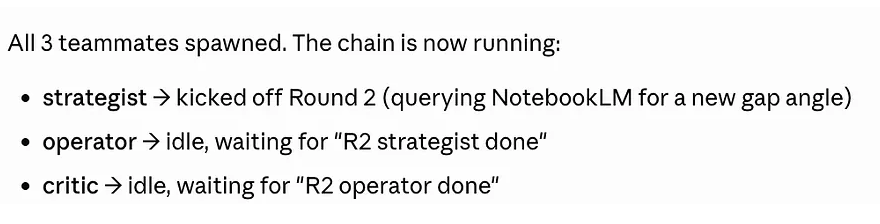
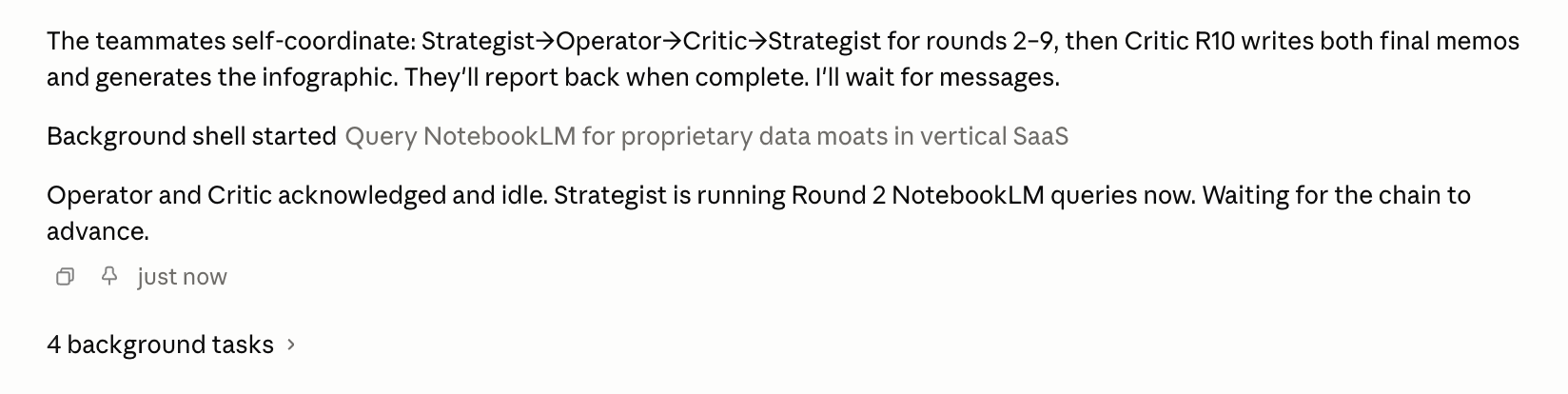
And the team is live.

They can also talk to each other.
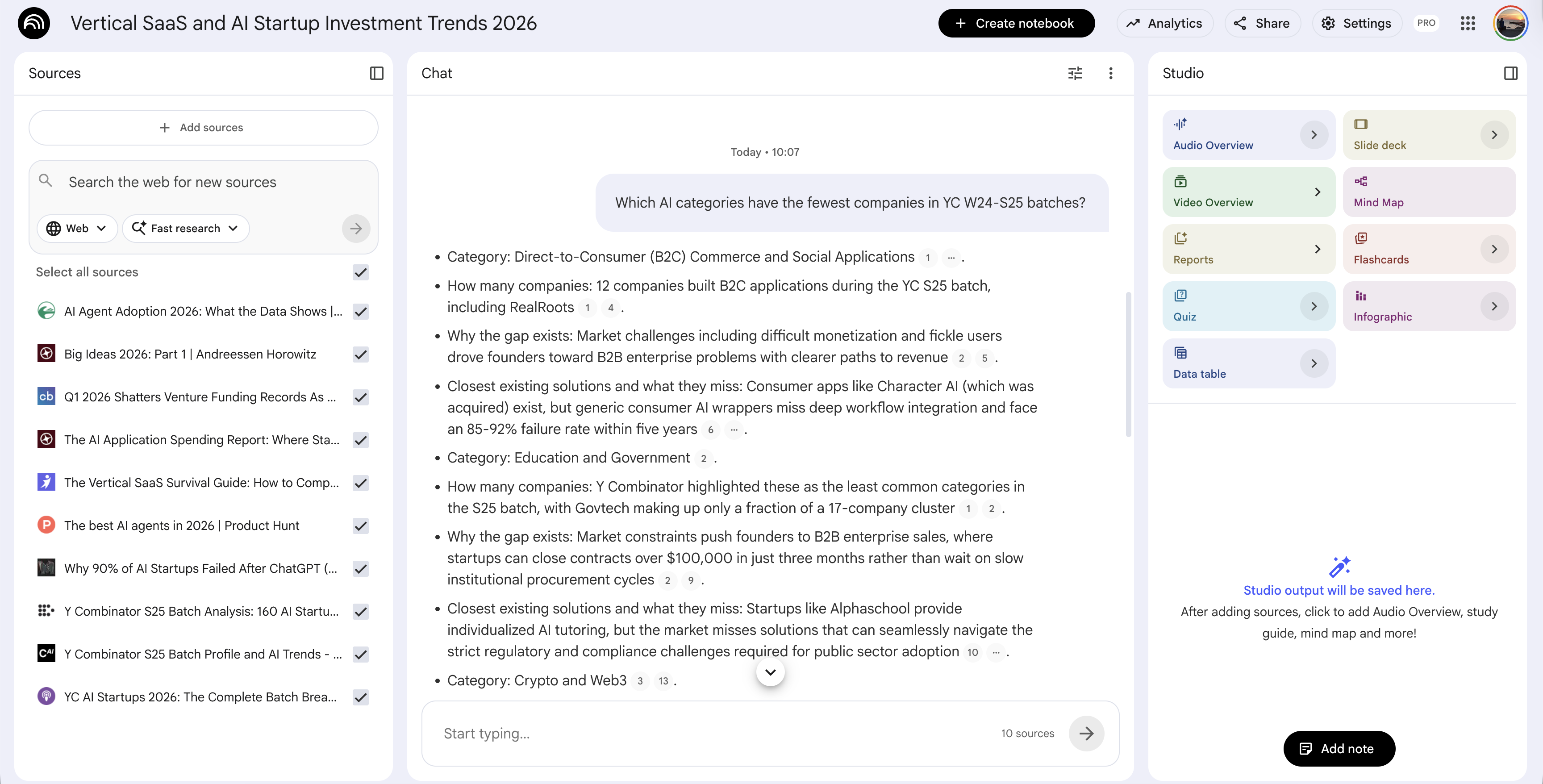
If you go back to the NotebookLM you just trained, you can see that the agents started talking with it.
But some questions can't be answered.
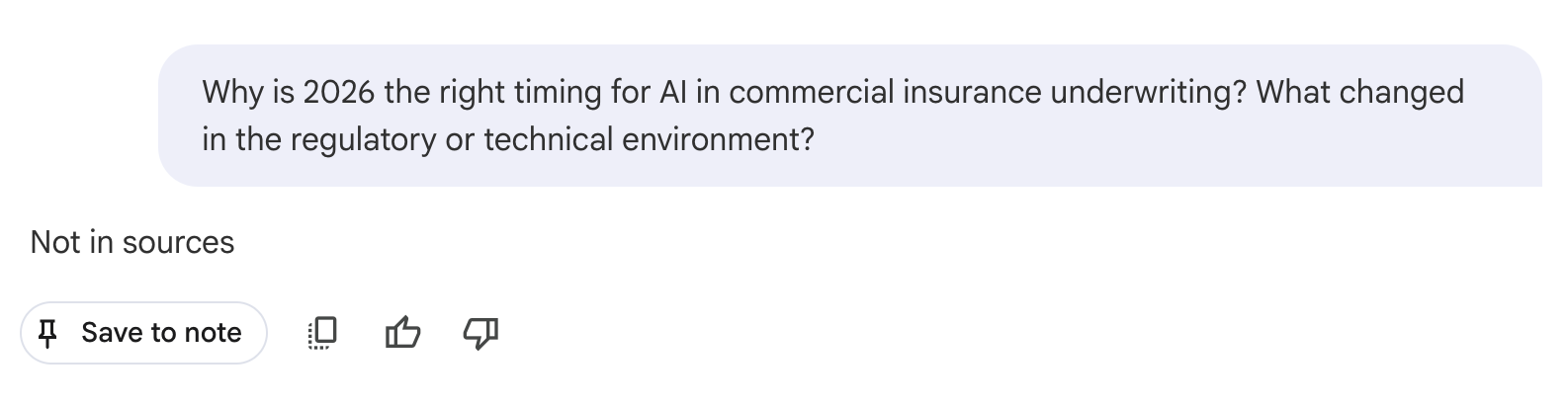
This is exactly what we want.
The agent didn't make something up. It admitted the gap. That's how you keep hallucination out of the output.
It takes a while. So, I asked for a status report
what is the current progress right now? Give me report
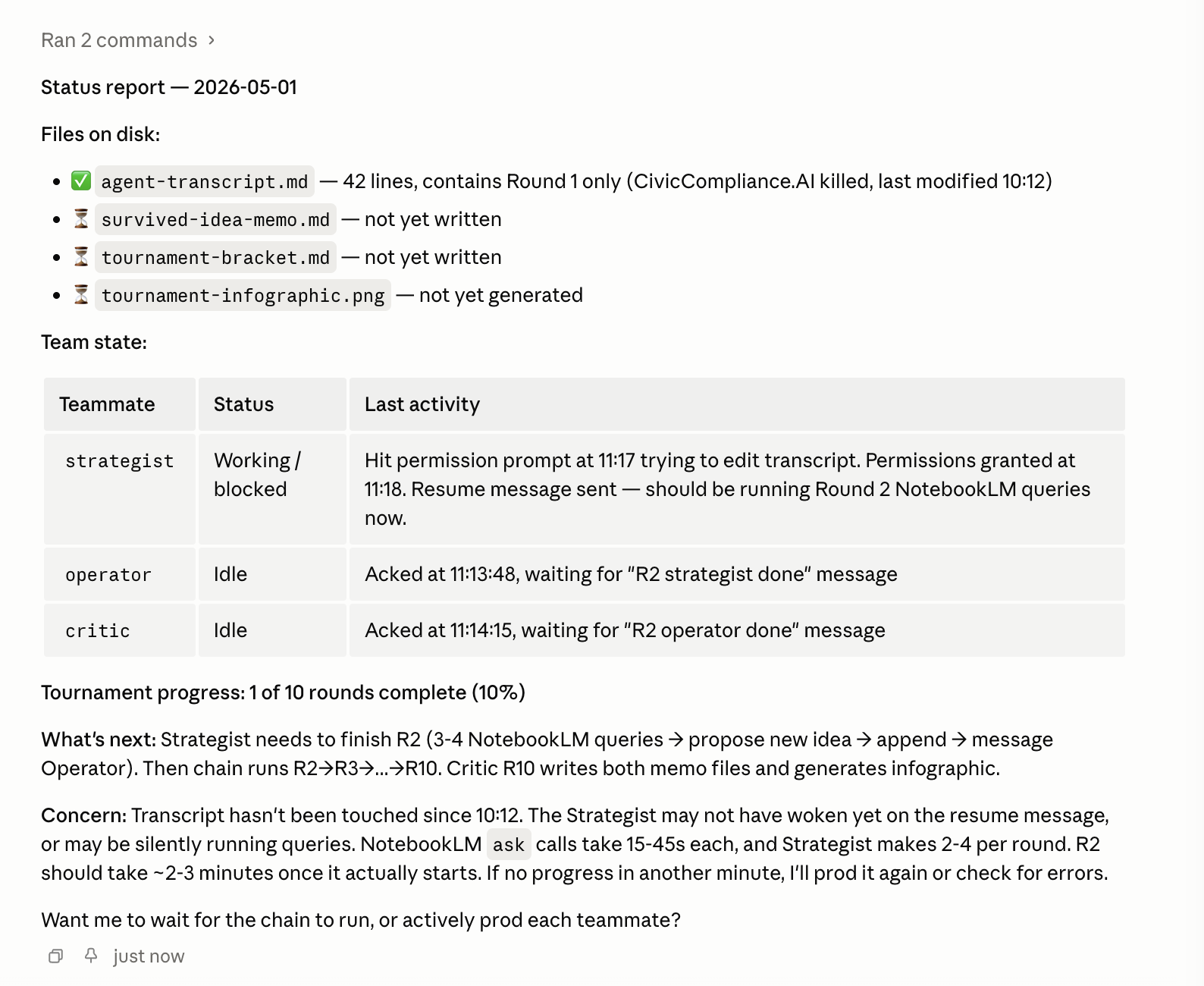
And I asked 30 minutes later.
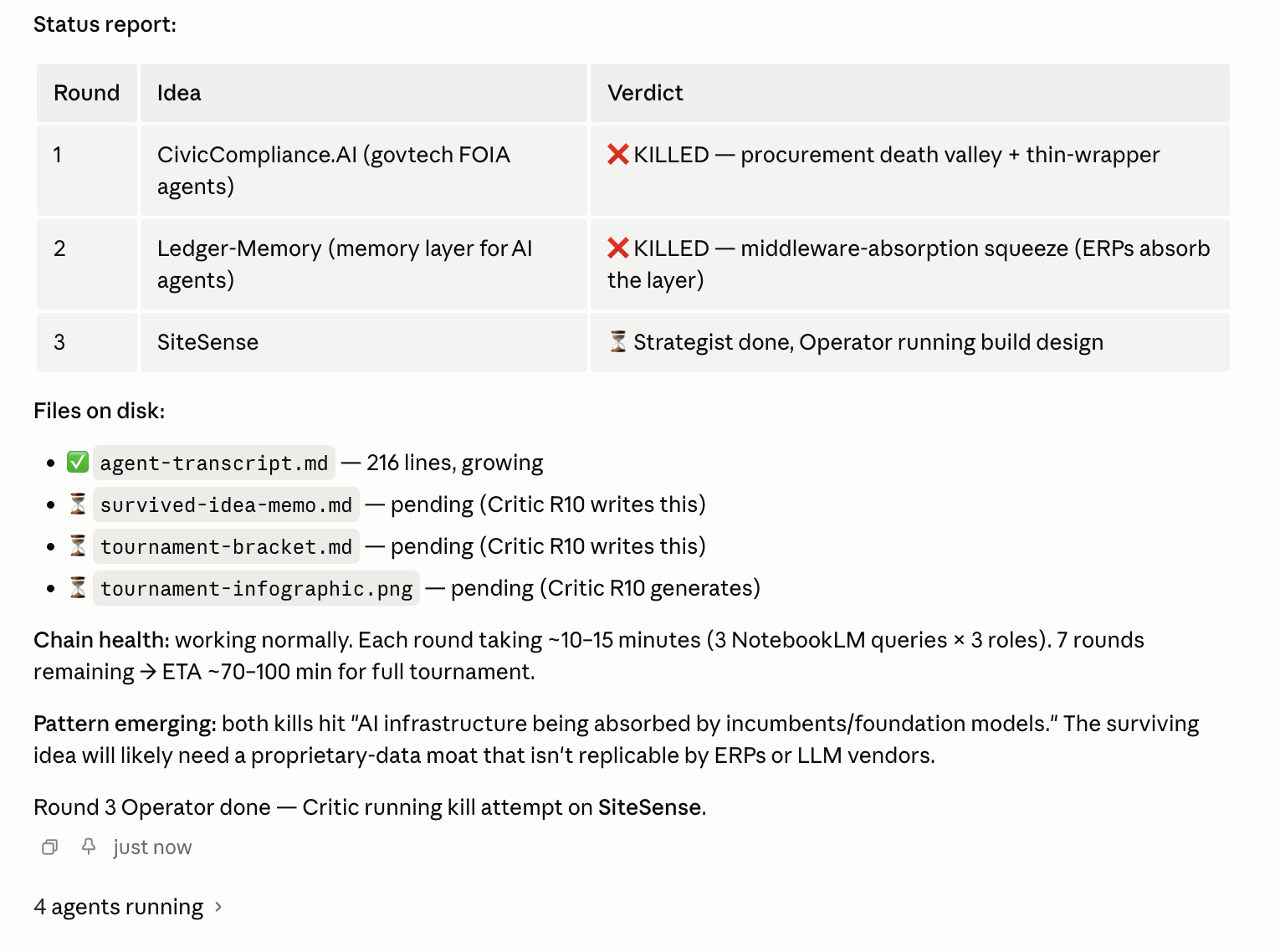
It has already rejected 2 ideas and is now working on the 3rd idea.
Step 3: Evaluate the Results
Here is the end of our tournament.
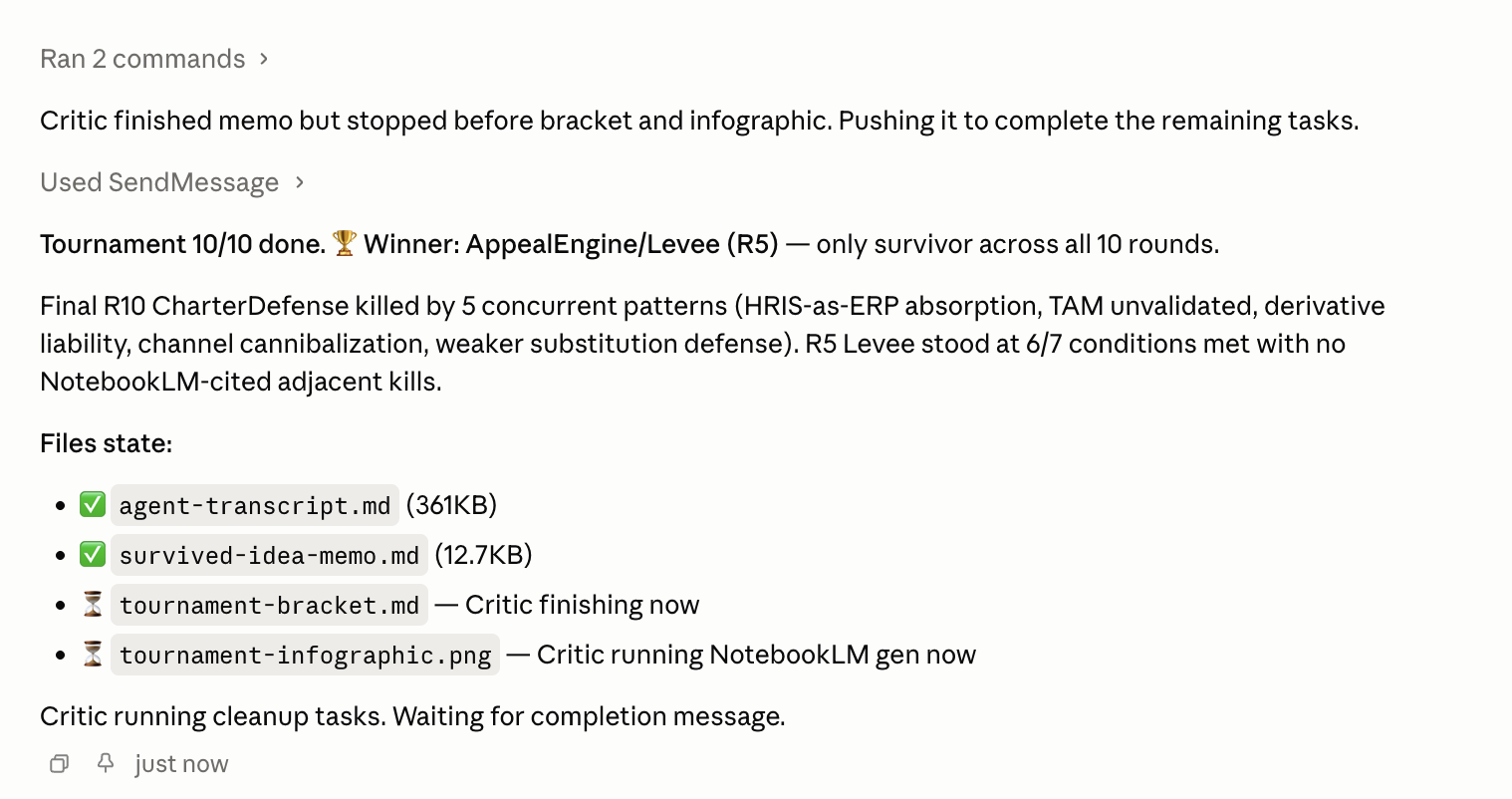
10 rounds. 9 ideas killed. 1 survivor.
After a few hours, the report was finished.
To get the best results, consider doing 3-4 rounds instead of 10.
The first 2 rounds do most of the work.
The rest just sharpen the survivor.
Here is the infographic.
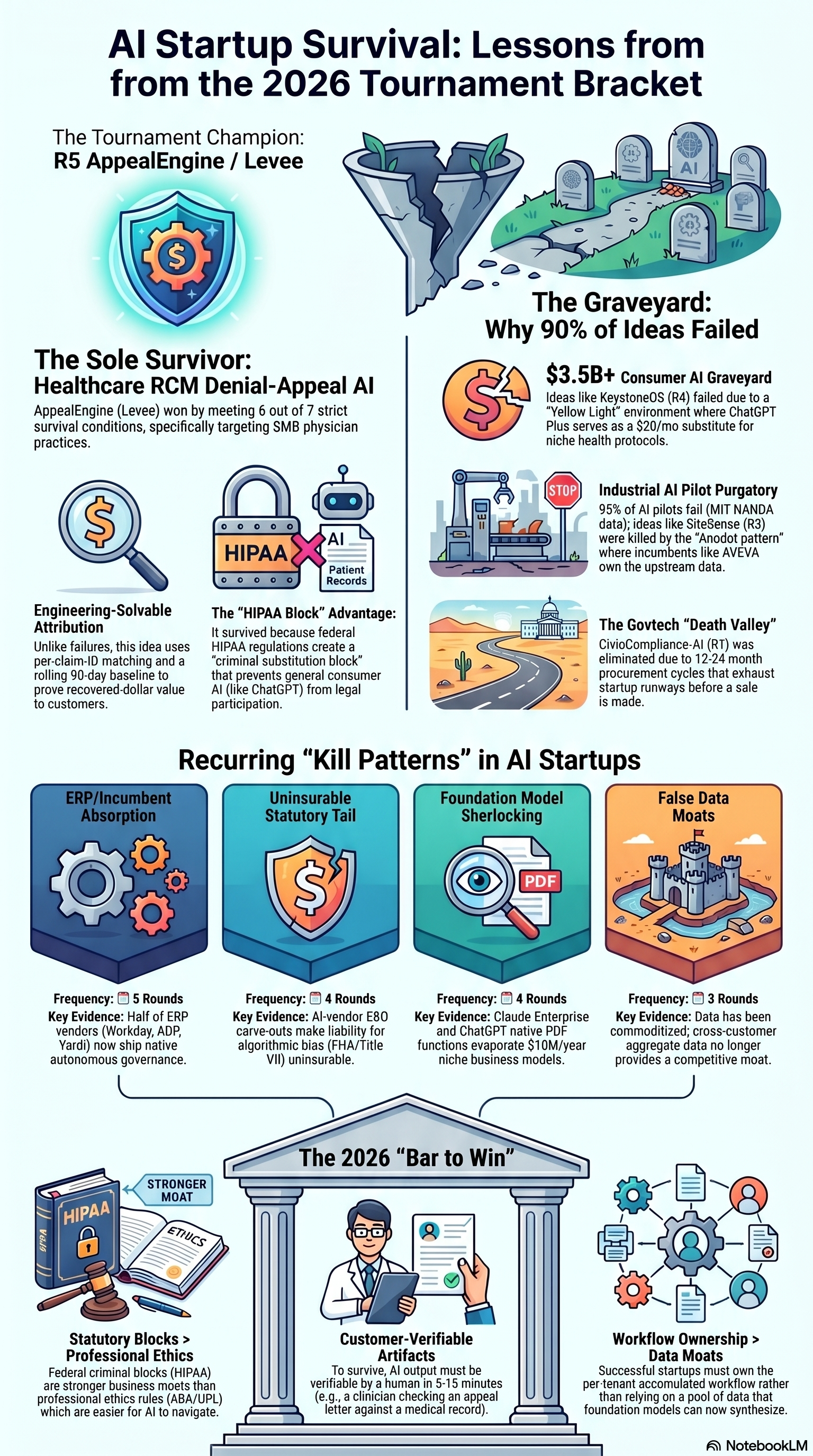
NotebookLM generated this directly from the tournament-bracket.md file. One command, one PNG.
I also asked Claude to draw a more detailed bracket from the full transcript.
Now let’s ask about the winning idea.
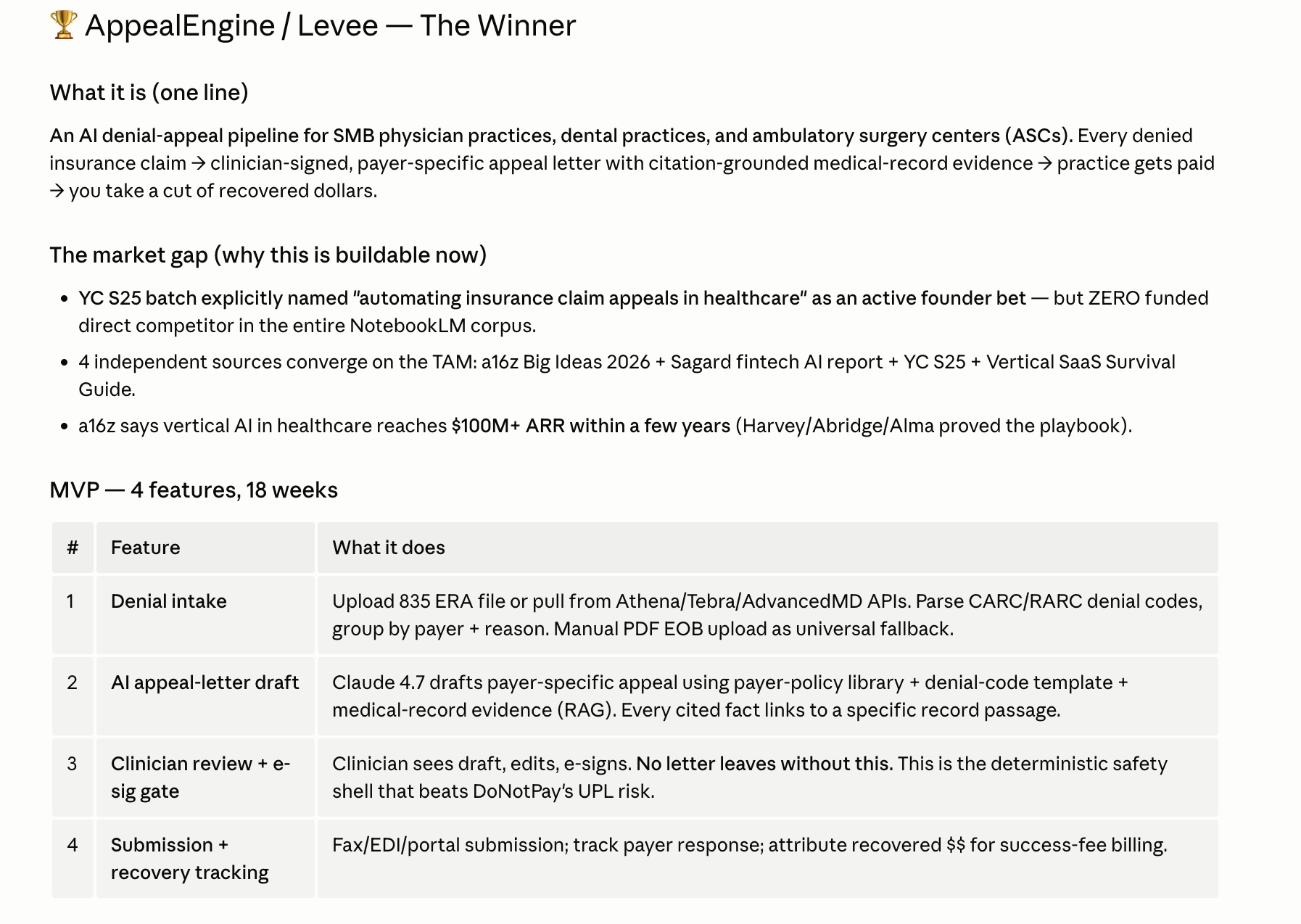
My question is: What is the winner idea?
The Survivor
The winner was AppealEngine (Levee), an AI denial-appeal pipeline for SMB physician practices.
Every denied insurance claim becomes a clinician-signed, payer-specific appeal letter with citation-grounded evidence. The practice gets paid. The system takes a cut of recovered dollars.
Now let's stress-test the survivor.
My question is: Can you check if there’s an app like this?
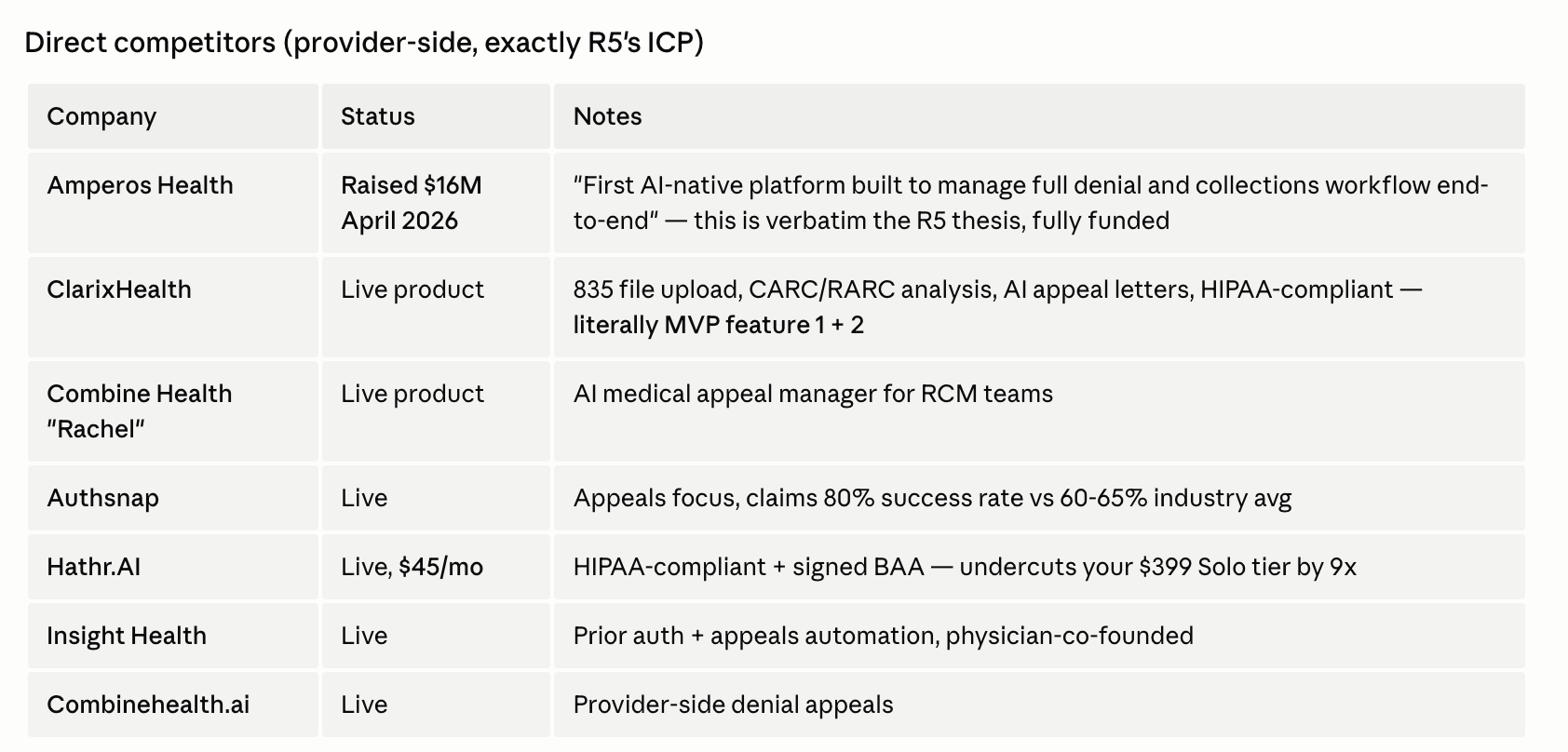
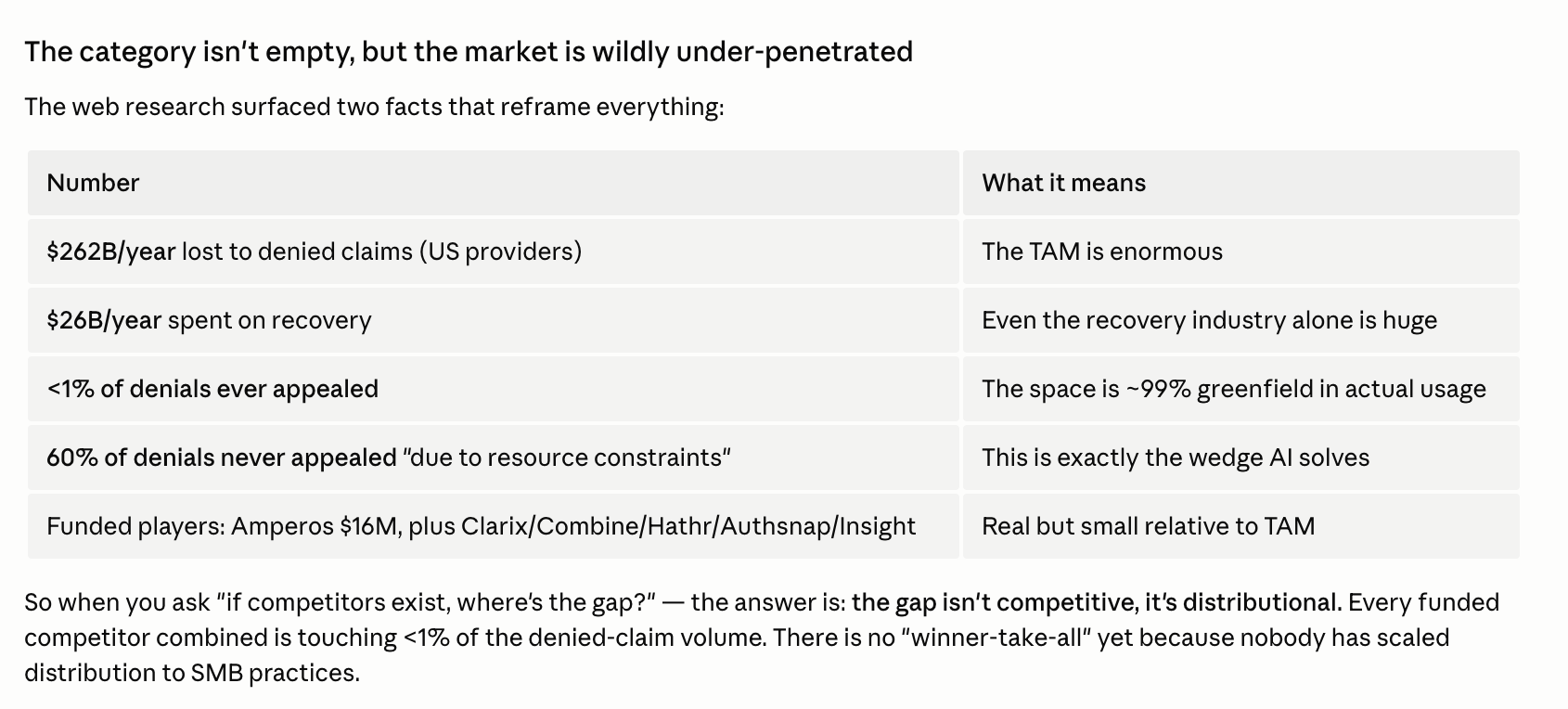
My question is: If other companies already exist, why is there still a gap?
What Killed the Most Ideas?
Five patterns kept firing across the 10 rounds.
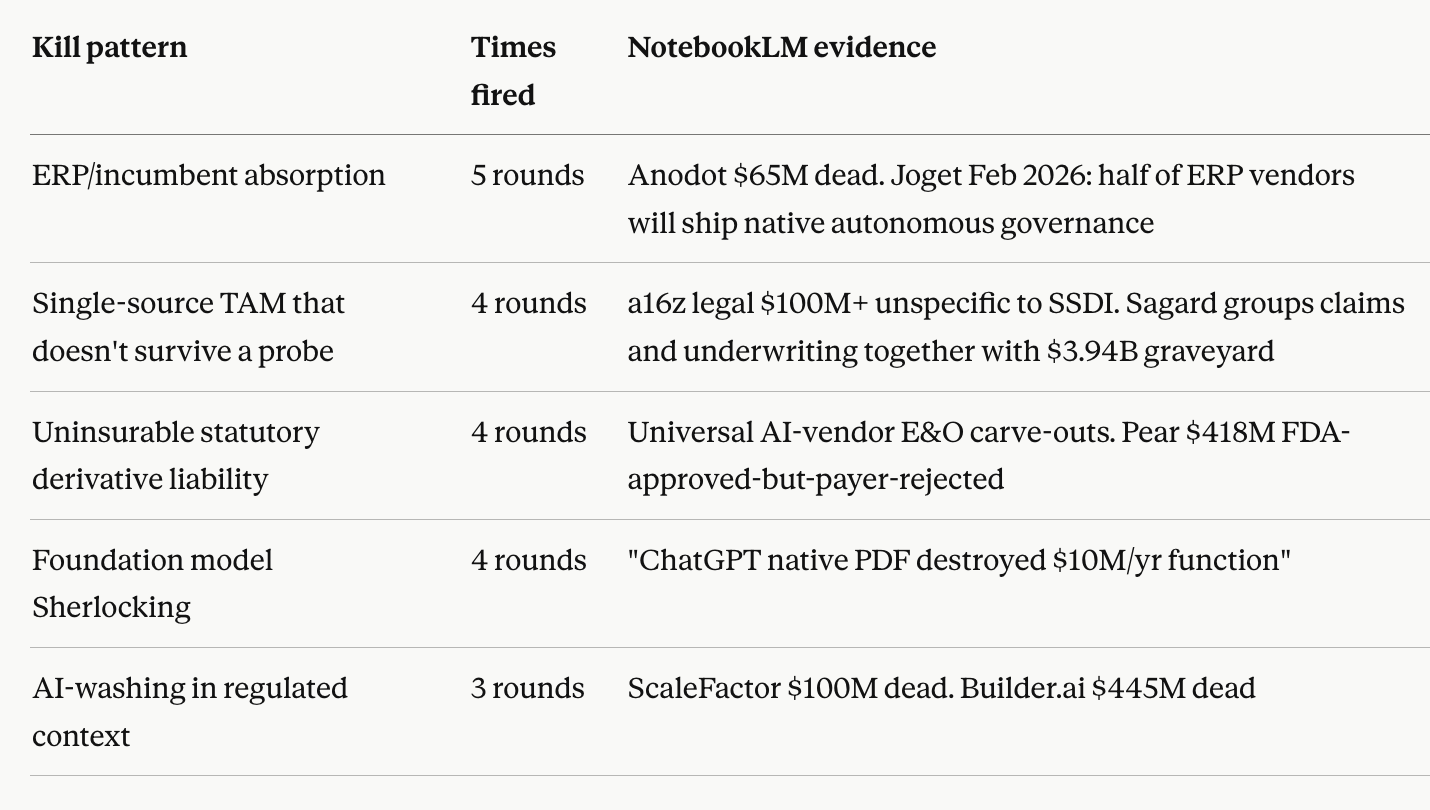
If your idea fits any of these traps, the system catches it before you ship.
Final Thoughts
Most AI tools give you the first answer.
This one gives you the answer that survived 10 attempts to kill it.
Single-agent ideation converges fast and feels productive. You ask, it answers, you nod. The output looks finished. It usually isn’t. It’s just unchallenged.
Adversarial loops break that.
- The Critic doesn’t care if the Strategist is tired.
- The Strategist can’t recycle the same idea twice.
- The Operator has to design something a real founder would build.
NotebookLM keeps everyone honest with citations or refuses to answer at all. Hallucination doesn’t get a foothold because every claim has to come back to the source.
Pick a decision you’ve been spinning on. Take a notebook. Spawn the team. Watch them argue.
The best ideas don’t need defending. They survive being killed.