Machine learning analysis of 478 electric vehicles shows the truth about range, efficiency, and which brands actually deliver.
By Gencay
Published: 2025-10-23
URL: https://www.learnwithmeai.com/p/data-project-9-which-electric-car
The electric car market includes too many different models, but here’s what nobody tells you: choosing the wrong electric car could cost you $10,000+ in inefficiency, range anxiety, and depreciation over 5 years.
This isn’t another opinion piece. We analyzed 478 electric vehicles across 22 specifications using machine learning, statistical testing, and clustering algorithms to answer the questions that actually matter:
- Which factors determine range?
- Do premium brands justify their price?
- Is faster acceleration worth the efficiency penalty?
By the end of this analysis, you’ll know exactly which EV segment, brand, and feature set matches your needs, backed by data, not marketing.
Here’s what we’ll uncover using 7 data science techniques applied to real-world EV specifications:
- Which factors affect electric vehicle range?
→ Technique: Multiple Linear Regression & Correlation Analysis
- How do EVs cluster by performance and efficiency?
→ Technique: K-Means Clustering & PCA Visualization
- Does faster acceleration reduce range?
→ Technique: Correlation Analysis & Comparative Statistics
- Which vehicle segment is most efficient?
→ Technique: ANOVA (Analysis of Variance)
- Which cars charge fastest relative to battery size?
→ Technique: Feature Engineering & Ranking Analysis
- Do larger vehicles have worse efficiency?
→ Technique: Correlation Analysis & Volume Calculation
- Which brands offer the best range and efficiency?
→ Technique: Aggregation Analysis & Brand Positioning
At the end, you’ll learn these techniques, how to apply them, and the results will help you make information-based decisions.
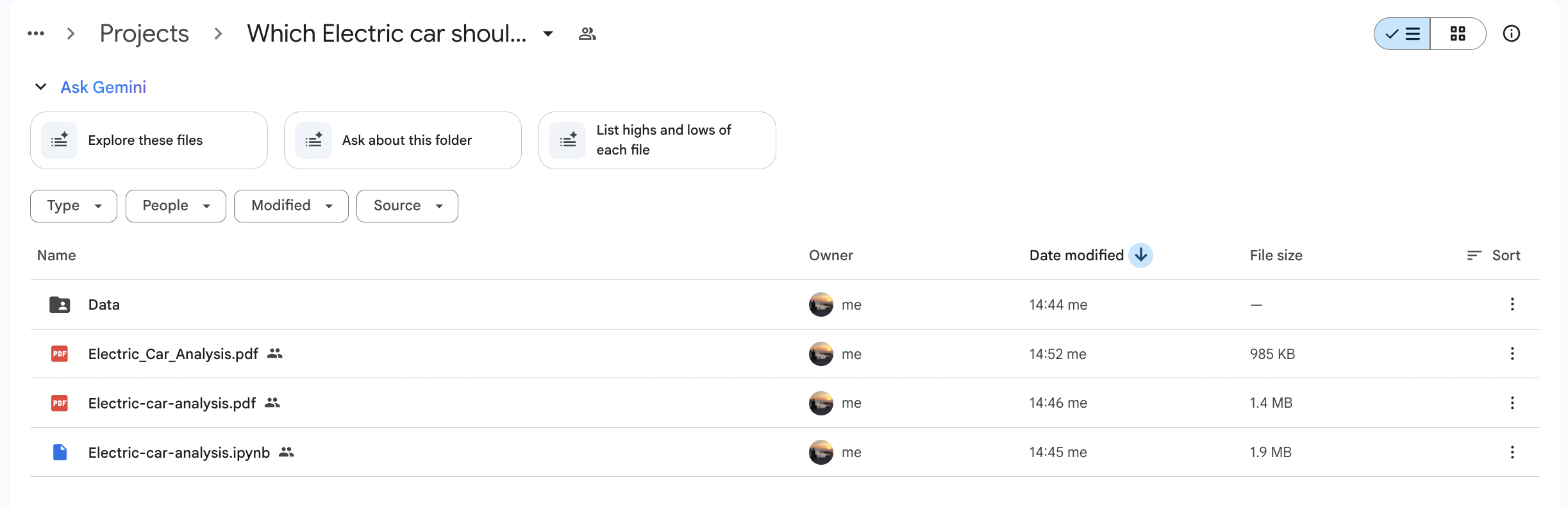
There are four related files in the gDrive.
- Data
- Jupyter Notebook includes code
- Jupyter Notebook turned into a PDF with code
- Report created with AI
What do we offer to the paid subscribers?
Paid subscribers get more than articles; projects with code, custom GPTs, and prompts designed after thousands of hours of experience.
This week’s project:Data Project 8: I Analyzed 182,111 Chicago Crimes. The Arrest Lottery Has Patterns You Won’t Expect
This week’s topic: Stop Googling for Hours. Use These Research Prompts Instead.
And last week, we tuned in with AI news and discussed this AI shift,
Join the community to build real projects, master new prompt techniques (future prediction, simulation), and stay ahead of critical shifts before they reshape your industry 👉
Question 1: Which Factors Affect Electric Vehicle Range?
The most asked question when buying an EV: “How far can it go?”
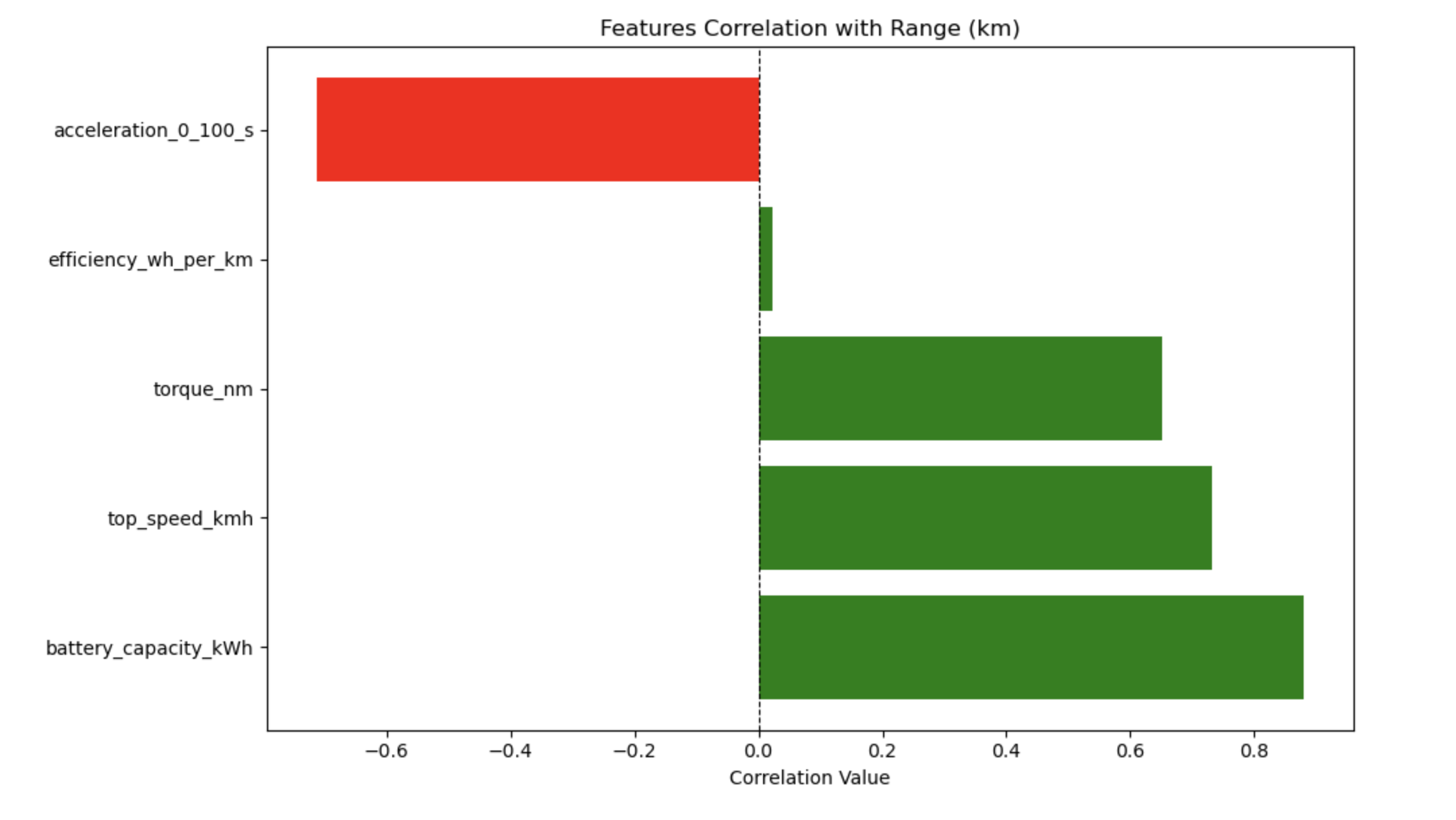
We ran a multiple linear regression model on 478 vehicles to find out what actually drives range. The results? Battery capacity explains 77% of range variation on its own; but when you add efficiency, acceleration, and torque into the mix, prediction accuracy jumps to 91%.
Here’s what matters:
🔋 Battery Capacity is King
Every additional 1 kWh of battery = +4.7 km of range. This is the single most important factor. A car with a 100 kWh battery will go roughly 225 km further than one with a 50 kWh battery, all else equal.
⚡ Efficiency Has a Hidden Impact
Raw correlation showed efficiency barely mattered (r=0.02), but when we controlled for battery size, it revealed its true effect: -0.90 Wh/km coefficient. Translation: Inefficient designs burn through big batteries faster. Premium cars often hide poor efficiency behind massive battery packs.
🏎️ Speed Kills Range
Faster acceleration (lower 0-100 km/h times) significantly reduces range. Each second slower = +6.3 km more range. That Porsche Taycan’s 2.8-second sprint? It’s costing you ~40 km compared to a more relaxed 6-second car with the same battery.
🎯 The Regression Model: 91% Accurate
Our model can predict range with 91% accuracy (R²=0.91) using just five factors: battery capacity, efficiency, top speed, acceleration, and torque. If a manufacturer claims an exceptional range, we can now verify if it’s real engineering or just marketing.
Key Takeaway: Want maximum range? Prioritize battery size first, then look for efficient designs (low Wh/km), and accept that blazing acceleration comes with a range penalty.
Question 2: How Do EVs Cluster by Performance and Efficiency?
Not all EVs are created equal, but how many “types” actually exist?
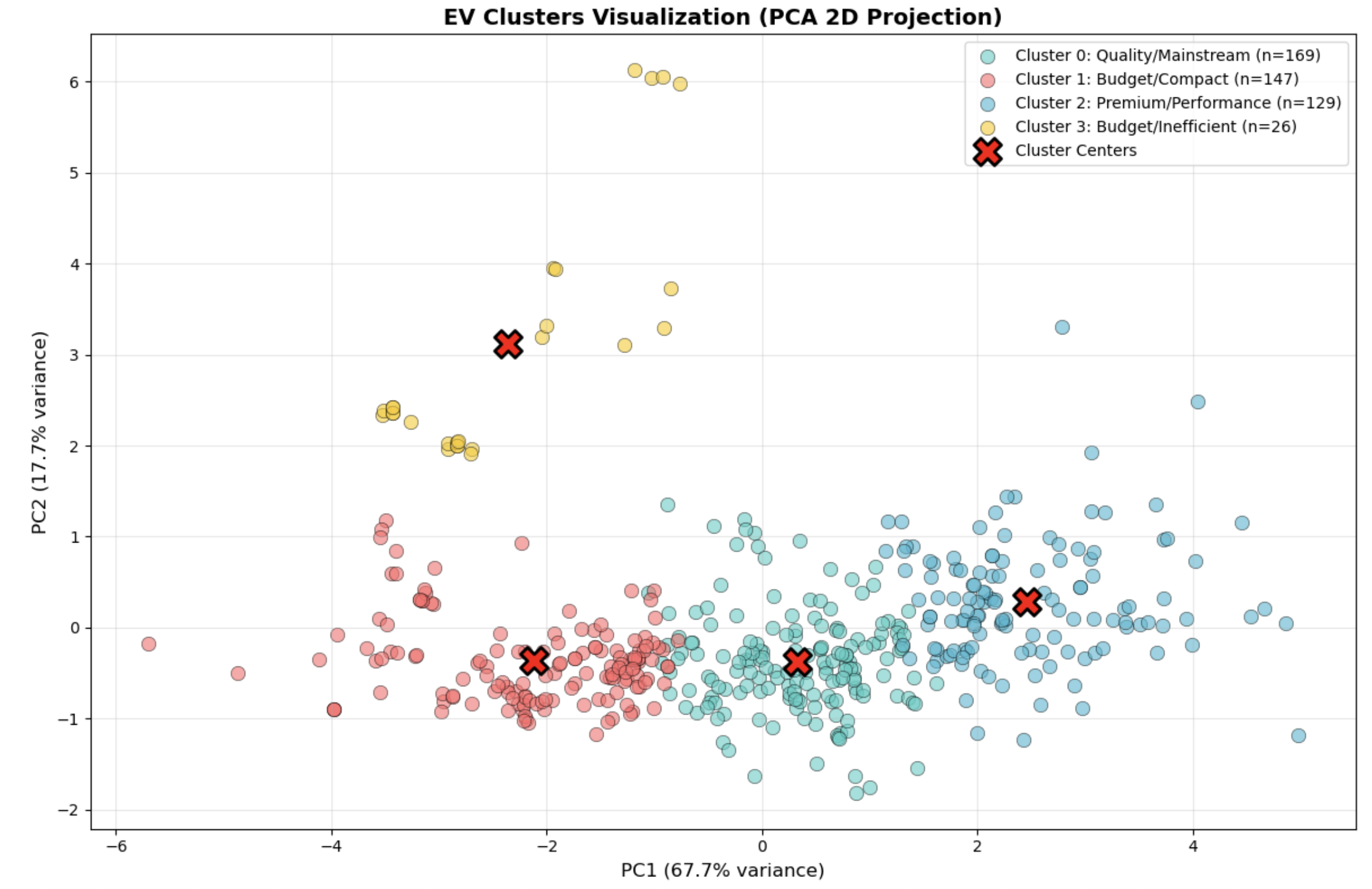
We used K-Means clustering to group 478 vehicles based on battery capacity, range, efficiency, top speed, acceleration, and torque. The algorithm found four distinct clusters, and they map perfectly to real-world buyer segments.
🏆 Cluster 2: Premium Performance (129 vehicles, 27%)
These are the heavy hitters. Average 95.8 kWh battery, 483 km range, 4.3-second 0-100, and 801 Nm of torque. Think Tesla Model S Plaid, Porsche Taycan, BMW iX M60. They dominate both speed and range, but sacrifice efficiency (184 Wh/km). If you want the best of everything and don’t mind paying for it, this is your tier.
⚖️ Cluster 0: Quality Mainstream (169 vehicles, 36%, largest group)
The sweet spot. 78.5 kWh battery, 431 km range, 6.3-second acceleration, and the best efficiency among high-range cars (154 Wh/km). This is where Tesla Model 3/Y, Hyundai Ioniq 5, and VW ID.4 live. Best value for most buyers; balanced performance without compromise.
💰 Cluster 1: Budget Compact (147 vehicles, 31%)
City warriors. Small 51.2 kWh batteries, 295 km range, slower (9.0s), but decent efficiency (141 Wh/km). Nissan Leaf, Mini Cooper SE, Fiat 500e. Perfect for urban commuting, terrible for road trips. If your daily drive is under 100 km, these save you money upfront.
⚠️ Cluster 3: Budget Inefficient (26 vehicles, 6%, smallest group)
The problematic outliers. Small batteries (62.9 kWh) but the shortest range (235 km) due to terrible efficiency (250 Wh/km). Slowest acceleration (12.4s), lowest torque (308 Nm). These are likely older EVs with outdated tech or poorly designed vehicles. Avoid this cluster entirely.
📊 The Visual Proof
When we compressed all six features into 2D using PCA (capturing 85.4% of variance), the clusters separated beautifully:
- Horizontal axis (67.7% variance): Budget → Premium (size/power spectrum)
- Vertical axis (17.7% variance): Efficient → Inefficient (design quality)
Key Takeaway: The EV market naturally segments into 4 tiers. 36% of vehicles fall into the balanced mainstream cluster, your best bet unless you specifically need premium performance or ultra-compact city driving. Avoid Cluster 3 at all costs.
Question 3: Does Faster Acceleration Reduce Range?
Here’s where intuition fails you.
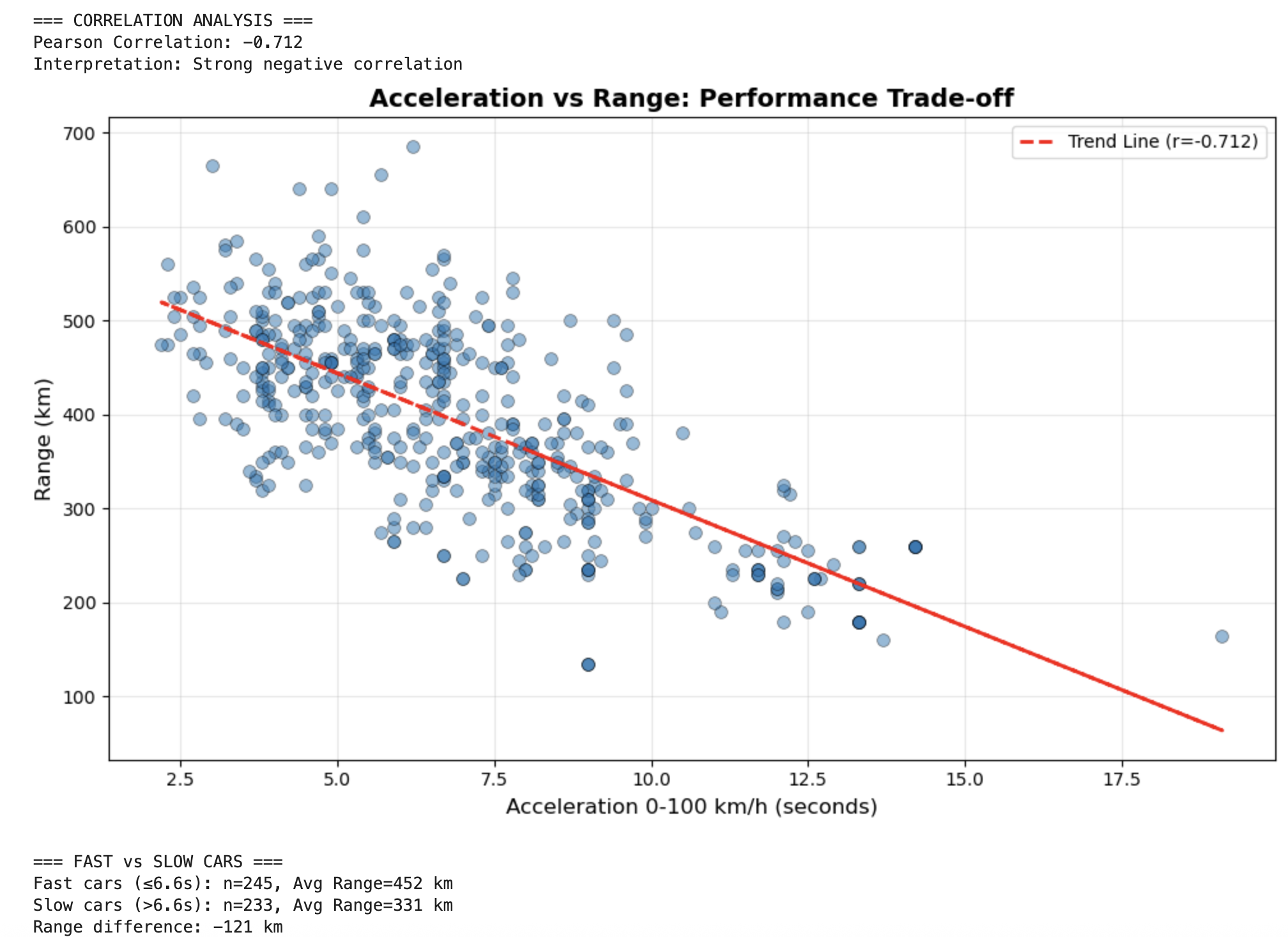
Common wisdom says, “Fast cars burn energy faster, so they must have worse range.” We tested this with 478 vehicles, and the data tells a completely different story.
🤯 The Shocking Result: Fast Cars Have MORE Range
Correlation between acceleration and range: r = -0.71 (strong negative). Remember, lower acceleration seconds = faster car. So this means: faster cars actually have longer range.
The numbers are stark:
- Fast cars (≤6.6s): 452 km average range
- Slow cars (>6.6s): 331 km average range
- Difference: +121 km for the fast cars!
🔍 What’s Really Happening: The Battery Size Trap
This isn’t magic, it’s a confounding variable. Premium performance cars pack massive batteries that deliver both blistering speed AND long range. A Porsche Taycan doesn’t choose between performance and range; it gets both because it has a 93 kWh battery. Meanwhile, a budget EV with a 50 kWh battery is slow AND short-ranged.
⚖️ The Truth Within Segments
When you compare cars with the same battery size, faster acceleration DOES reduce range; physics still applies. But across the entire market, the pattern flips because battery size correlates with both performance and range.
Example:
- Lucid Air Sapphire: 1.89s, 687 km (118 kWh battery)
- Nissan Leaf: 7.9s, 270 km (40 kWh battery)
The Lucid is 4x faster AND has 2.5x more range. Not because speed helps efficiency, but because Lucid spent $30,000+ more on batteries.
Key Takeaway: Don’t assume fast = inefficient. In the EV market, speed and range often come together if you can afford the battery that enables both. But within the same price/battery tier, yes, acceleration still costs you kilometers.
Question 4: Which Vehicle Segment is Most Efficient?
Size matters, and physics doesn’t care about your preferences.
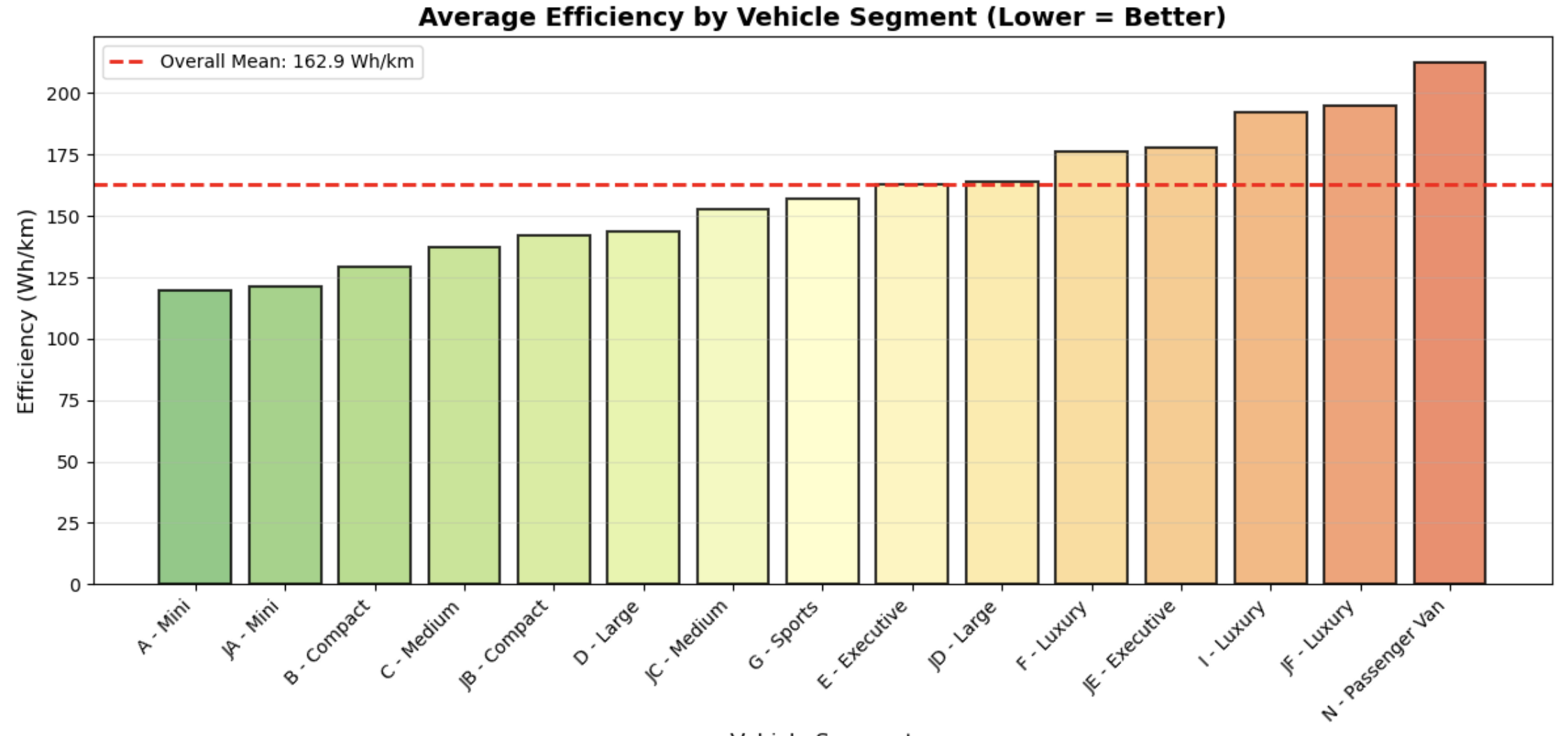
We ran an ANOVA test across 14 vehicle segments (Mini, Compact, SUV, Luxury, Vans, etc.) to see if segment choice significantly impacts efficiency. The result? F-statistic of 29.8, p-value essentially zero. Translation: Segments are VASTLY different in efficiency, and this isn’t random chance.
🏆 The Winners: Small is Beautiful
- A-Mini: 119.7 Wh/km (champion, 26% better than average!)
- JA-Mini: 121.5 Wh/km
- B-Compact: 129.3 Wh/km
- C-Medium: 137.1 Wh/km
These tiny urban warriors dominate efficiency. A Mini EV uses almost half the energy of a passenger van to travel the same distance.
❌ The Losers: Vans Are a Disaster
- Passenger Vans: 212.4 Wh/km (worst, 77% worse than Minis!)
- JF-Luxury: 195.1 Wh/km
- I-Luxury: 192.0 Wh/km
Vans aren’t just inefficient, they’re catastrophically bad. High variance (61 Wh/km standard deviation) suggests inconsistent, poorly optimized designs. Box-like aerodynamics + heavy weight = efficiency nightmare.
📏 The Size Penalty: Every Step Up Costs You
Clear pattern emerges:
- Mini/Compact (A, B, JA, JB): ~120-145 Wh/km
- Medium/Large (C, D, JC, JD): ~145-165 Wh/km
- Executive/Luxury (E, F, JE, JF): ~165-195 Wh/km
- Vans (N): 210+ Wh/km
Each size category up = roughly 10-20 Wh/km penalty. This isn’t a design choice; it’s physics. More mass + more frontal area = more energy to push through air.
🚙 The SUV Tax
SUVs (244 vehicles, 51% of the dataset!) average 161.5 Wh/km. You’re paying a 20% efficiency penalty vs compacts for that high seating position and cargo space. Most popular segment, but far from most efficient.
Key Takeaway: If efficiency matters to you, stay in the A/B/C segments (Compact/Medium). Every size jump costs real money in electricity. And if someone suggests an electric passenger van? Run.
Question 5: Which Cars Charge Fastest Relative to Battery Size?
Raw charging power is meaningless; what matters is the ratio.
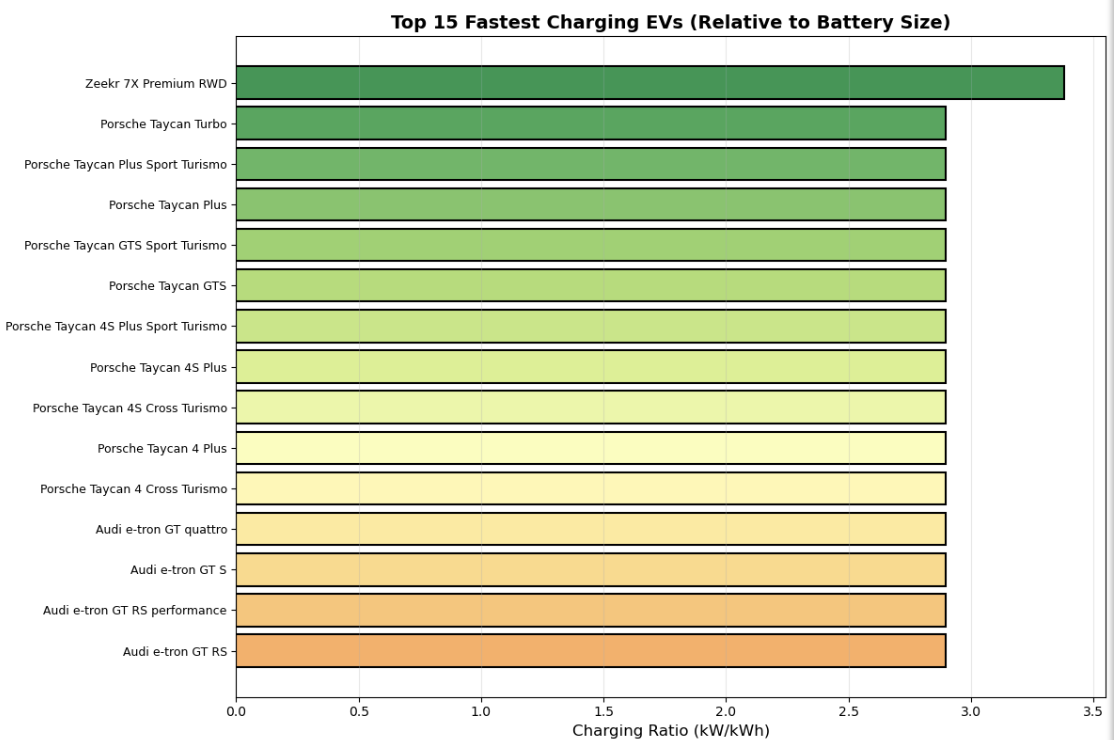
A 250 kW charger sounds impressive, but if you’re charging a 120 kWh battery, you’re actually charging slower than a 150 kW charger filling a 50 kWh battery. We created a new metric: Charging Ratio (kW/kWh), how much power per unit of battery capacity.
🏆 The Charging Champion: Zeekr 7X Premium RWD
3.38 kW/kWh (240 kW / 71 kWh battery)
This Chinese upstart demolishes the competition. Zeekr charges 104% faster than the industry average (1.65 kW/kWh). In real-world terms: 10-80% charge in roughly 18 minutes vs. 35-40 minutes for average EVs. That’s the difference between a coffee break and a full lunch stop on road trips.
🥈 Premium Brands Dominate Top 15
- Audi e-tron GT variants: 2.90 kW/kWh (281 kW / 97 kWh)
- Porsche Taycan family: 2.90 kW/kWh (10+ variants, all identical!)
Porsche’s consistency is remarkable; every Taycan variant (Turbo, GTS, 4S, Plus, Sport Turismo) shares the same 281 kW / 97 kWh setup. They’ve standardized ultra-fast charging across the entire lineup.
🔌 The 800V Architecture Advantage
Notice a pattern? Zeekr, Audi e-tron GT, and Porsche Taycan all use 800-volt electrical architecture (vs. standard 400V). This enables:
- Higher charging power without overheating
- Thinner, lighter cables
- 2-3x faster charging than budget EVs
📉 Budget Cars Get Left Behind
Most mainstream EVs cluster around 1.5-1.7 kW/kWh. Budget cars often sit below 1.2 kW/kWh, meaning 50+ minute charging sessions. The charging speed gap between premium and budget EVs is widening, not shrinking.
💡 The Sweet Spot Strategy
Zeekr wins by optimizing BOTH sides of the equation:
- Battery not too big (71 kWh keeps costs down)
- Charger very powerful (240 kW via 800V tech)
Compared to a Tesla Model S (250 kW / 100 kWh = 2.50 ratio), it's good, but not champion-level.
Key Takeaway: If road trips matter, check the kW/kWh ratio, not just peak charging power. Zeekr, Audi e-tron GT, and Porsche Taycan offer 2-3x faster charging than average. Budget EV buyers: expect long charging stops.
Question 6: Do Larger Vehicles Have Worse Efficiency?
Spoiler: Physics always wins.
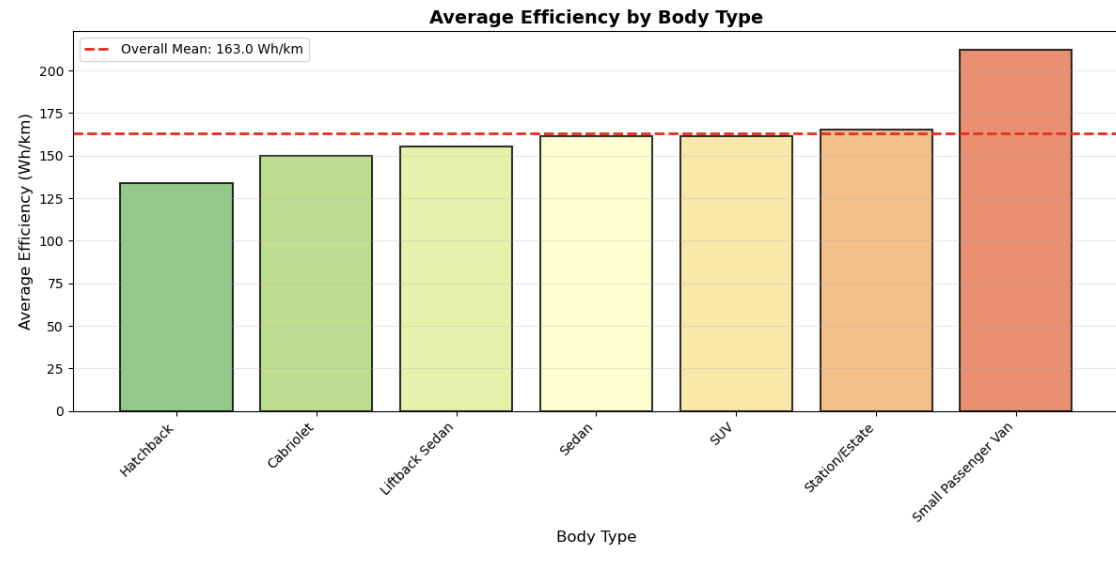
We calculated vehicle volume (length × width × height) for all 477 EVs and correlated it with efficiency. The result? r = 0.753, a strong positive correlation. Translation: Bigger cars are definitely, measurably, significantly less efficient.
📊 The 23% Size Penalty
Split the dataset at median volume (13.96 m³):
- Small vehicles (≤13.96 m³): 146.4 Wh/km
- Large vehicles (>13.96 m³): 180.0 Wh/km
- Penalty: +33.6 Wh/km (23% worse!)
That’s not a rounding error; that’s a 50+ km range loss on the same battery, or $300-500 more in annual electricity costs.
🎯 Every Cubic Meter Costs You
The regression line is nearly linear: every 1 m³ volume increase = ~10-15 Wh/km penalty. This isn’t a design flaw; it’s fundamental physics:
- More frontal area = More air resistance (drag increases with the square of speed)
- More volume = More mass (bigger structure, more materials)
- Both factors compound exponentially
🚗 Body Type Efficiency Hierarchy
- Hatchback: 133.7 Wh/km (56 vehicles, 18% better than average!)
- Cabriolet: 149.8 Wh/km (5 vehicles)
- Liftback Sedan: 155.4 Wh/km (33 vehicles)
- Sedan: 161.2 Wh/km (63 vehicles)
- SUV: 161.5 Wh/km (244 vehicles, most popular!)
- Station/Estate: 165.3 Wh/km (27 vehicles)
- Passenger Van: 212.4 Wh/km (47 vehicles, disaster!)
🚙 The SUV Paradox
SUVs dominate 51% of the market (244/477 vehicles) despite being 20% less efficient than hatchbacks. Buyers prioritize space, cargo, and seating position over efficiency. Fair choice, but it’s costing them.
📦 Vans: The Efficiency Black Hole
Passenger vans aren’t just worse, they’re 59% worse than hatchbacks. Terrible aerodynamics (giant flat front), heavy structure, high ride height. If you need a van, accept you’re burning 1.5-2x the energy of a car. There’s no engineering fix for a brick pushing through air.
🔬 The Scatter Plot Tells the Story
Volume vs. efficiency shows a clear upward trend. A few outliers exist (efficient large cars, inefficient small ones), but the correlation is undeniable. You CAN’T cheat physics, only optimize around constraints.
Key Takeaway: Want efficiency? Buy small. Every size upgrade (compact → sedan → SUV → van) costs you 10-20 Wh/km. Hatchbacks are 18% more efficient than average; vans are 30% worse. Choose based on needs, but be aware of the efficiency penalty you’re paying.
Question 7: Which Brands Offer the Best Range and Efficiency?
Brand reputation vs. actual data, let’s see who delivers.
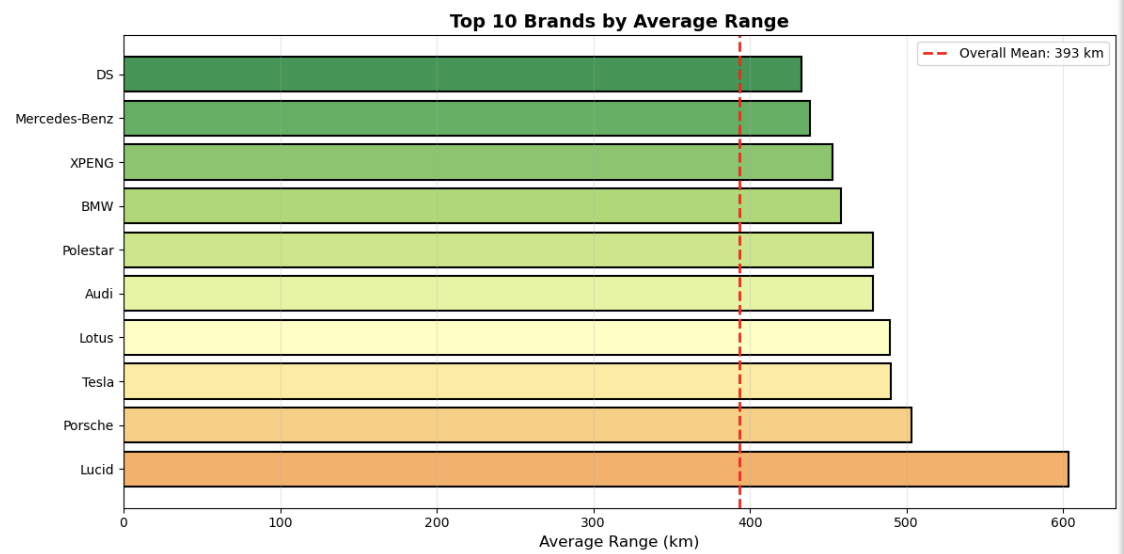
We aggregated 478 vehicles across 59 brands, filtering for brands with at least 3 models (reliable sample size). Then we ranked them on the two metrics that matter most: average range and average efficiency. Some results confirmed expectations. Others shocked us.
🏆 The Absolute Champion: Lucid
- Range: 603 km (#1 in dataset, 53% above average!)
- Efficiency: 138 Wh/km (#5 best, 15% better than average!)
Lucid appears in BOTH top-10 lists. Only 3 vehicles in dataset, but the consistency is stunning. This is what happens when ex-Tesla engineers obsess over aerodynamics (0.197 drag coefficient) and battery chemistry. No other brand matches this combination of range and efficiency.
⚡ Tesla: The Consistency King
- Range: 490 km (#3, 25% above average)
- Efficiency: 138 Wh/km (#6, tied with Lucid!)
11 vehicles, all delivering. Tesla proved premium brands CAN be efficient, you don’t need to sacrifice one for the other. Every Model 3, Y, S, and X sits above 450 km range while maintaining sub-140 Wh/km efficiency.
💎 The Hidden Gem: DS Automobiles
- Range: 433 km (#10)
- Efficiency: 136 Wh/km (#3!)
French luxury brand nobody talks about, but the data doesn’t lie. Only 5 vehicles, but they nail the balance. DS proves you don’t need Silicon Valley or German engineering to build great EVs.
🎯 The “No Compromise” Club (13 Brands)
These brands beat average on BOTH metrics simultaneously:
Premium: Lucid, Tesla, Audi, Polestar
Mainstream: Hyundai, Kia, Volkswagen, Skoda, XPENG, Zeekr, CUPRA
Surprise: DS, Volvo
This list is your shortlist. If a brand isn’t here, they’re compromising on range, efficiency, or both.
📉 The Efficiency Leaders (Who Sacrifice Range)
- Fiat: 120 Wh/km (champion efficiency, but only 209 km range)
- Mini: 135 Wh/km (302 km range)
- Renault: 138 Wh/km (310 km range)
These are city car specialists. Ultra-efficient for urban commuting, terrible for road trips. Budget-friendly upfront, but the range limitation is real.
🏎️ The Range Leaders (Who Sacrifice Efficiency)
- Porsche: 503 km / 180 Wh/km (long range, but 10% worse efficiency than average)
- Lotus: 489 km / 219 Wh/km (third-longest range, but 34% worse efficiency!)
- Mercedes-Benz: 438 km / 195 Wh/km (luxury comfort, efficiency penalty)
Premium performance brands choose range over efficiency. They can, because customers paying $100k+ don’t worry about electricity costs. Big batteries cover up inefficient designs.
📍 Brand Positioning Map
When you plot range vs. efficiency, four quadrants emerge:
Top-Left (IDEAL): Lucid, Tesla, DS, Polestar, Audi
→ Long range + High efficiency = Best overall value
Top-Right (Long Range But Inefficient): Porsche, Lotus, Mercedes
→ Premium performance, efficiency is secondary
Bottom-Left (Short Range But Efficient): Fiat, Mini, Renault
→ Budget city cars, perfect for urban use
Bottom-Right (Short Range & Inefficient): [Few brands, poor performers]
→ Avoid this quadrant entirely
🔢 Sample Size Matters
- Lucid (n=3): Impressive, but small sample
- Tesla (n=11): Reliable consistency across lineup
- Mercedes-Benz (n=42): Largest premium sample
- Hyundai/Kia (n=14-16): Strong mainstream contenders
Key Takeaway: Lucid and Tesla prove you don’t need to choose between range and efficiency, both are achievable with proper engineering. 13 brands deliver above-average performance on both metrics. Fiat wins efficiency but sacrifices range. Porsche/Lotus prioritize range and speed over efficiency. Your choice depends on priorities: daily commute (choose efficiency), road trips (choose range), or both (choose Lucid/Tesla/Polestar tier).
Final Recommendations
Ready to actually choose?
Best Overall: Lucid or Tesla (if budget allows)
→ 500+ km range, 138 Wh/km efficiency, no compromises
Best Mainstream Value: Hyundai, Kia, Volkswagen
→ 400+ km range, <160 Wh/km, excellent price-to-performance
Best City Car: Fiat, Mini
→ 120-135 Wh/km efficiency, perfect for urban driving under 100 km/day
Best Long-Distance Cruiser: Lucid, Porsche, Tesla
→ 500-600 km range, minimal charging stops
Best Fast Charging: Zeekr, Audi e-tron GT, Porsche Taycan
→ 2.9-3.4 kW/kWh ratio, 18-25 minutes, 10-80% charging
Avoid: Passenger vans (unless essential), Cluster 3 vehicles, brands not in the “No Compromise” list.