Analyzed 100K+ responses from Survey to detect how AI changes industries and what to do next.
By Gencay
Published: 2025-09-18
URL: https://www.learnwithmeai.com/p/data-project-5-stackoverflow-developers

Between 2024 and 2025, something unprecedented is expected in the tech industry: 97.2% of developers have adopted AI tools, fundamentally reshaping how the industry values skills and experience. ( Want to say hi to my colleague mocking AI.)
I analyzed over 100,000 responses from Stack Overflow's Developer Surveys to understand this transformation between 2024 and 2025.
The numbers reveal a new reality where traditional career rules no longer apply. Junior developers, senior architects, and remote workers are all affected differently by this AI revolution. Most surprising: the benefits of AI vary dramatically based on your experience level and geography.
Here are the critical questions we'll answer using Stack Overflow's Developer Survey datasets, through statistical and data analysis:
- Do AI-using developers actually earn more?
- Can AI skills compensate for years of experience?
- How did remote work salaries change post-AI adoption?
- Which programming languages are thriving or dying in the AI era?
- Which countries lead in AI adoption and pay the highest premiums?
What do we offer to the paid subscribers?
We don’t just give you articles; we offer far more resources. Price: $8 per month or $80 per year until November. (Price increases by 40% starting in November.)
- Learn AI: Weekly Articles, Data Projects- how-to guides about AI, I publish every Thursday.
- Weekly AI Pulse: Analyze important shifts on AI and the most important AI news, tools, and practical prompts each week.
- AI Projects: Complete project walkthroughs with source code, including data analysis projects likeLife Longevity Factors, Election Prediction, Obesity Analysis, and Cracking the Dating Algorithm.
- Custom GPTs: 10+ Custom GPTs will save you a lot of hours. Links will be included in the welcome email after you subscribe.
- Prompts: With over 500+ hours of prompt engineering experience, I've developed specialized prompts that help you automate mundane tasks.
Methodology: How We Analyzed 100,000+ Developer Responses
To understand AI's impact on developer compensation, I performed a statistical analysis on Stack Overflow's 2024 and 2025 Developer Survey datasets (available at https://survey.stackoverflow.co/), totaling over 100,000 responses.
Here's how the analysis was conducted:
Data Preparation:
- Filtered for valid salary data (removing outliers below $1,000 and above $500,000)
- Identified AI users through the
AISelectfield (97.2% adoption rate discovered)
- Cleaned and normalized responses across both years for an accurate year-over-year comparison
Statistical Analysis:
- Applied Mann-Whitney U tests for statistical significance (p < 0.00001 for AI premium)
- Calculated median salaries rather than means to avoid skewing from outliers
- Segmented data by experience levels, geographic regions, and work arrangements
- Cross-referenced AI tool usage with compensation across 170+ variables
Key Metrics Tracked:
- Salary differentials between AI users and non-users
- Year-over-year changes in compensation by category
- Adoption rates across different developer segments
- Tool-specific salary correlations
Now let’s start answering these questions.
If you want to see the source code, I added it to the gDrive, and I also added slides, where you can see the report without coding.
Question 1: Do AI-using developers Earn More?
Answer: Yes – 16.5% more.
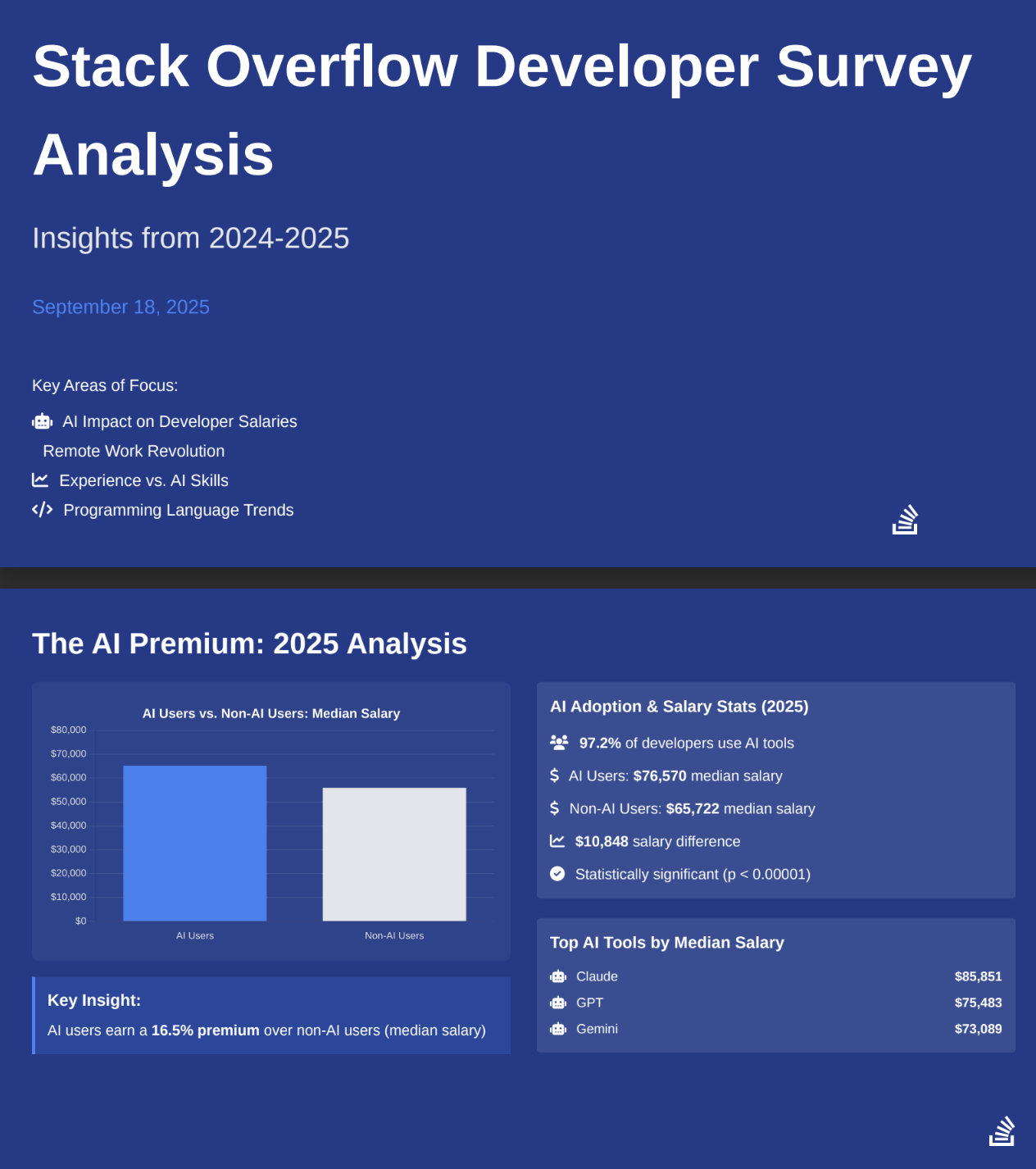
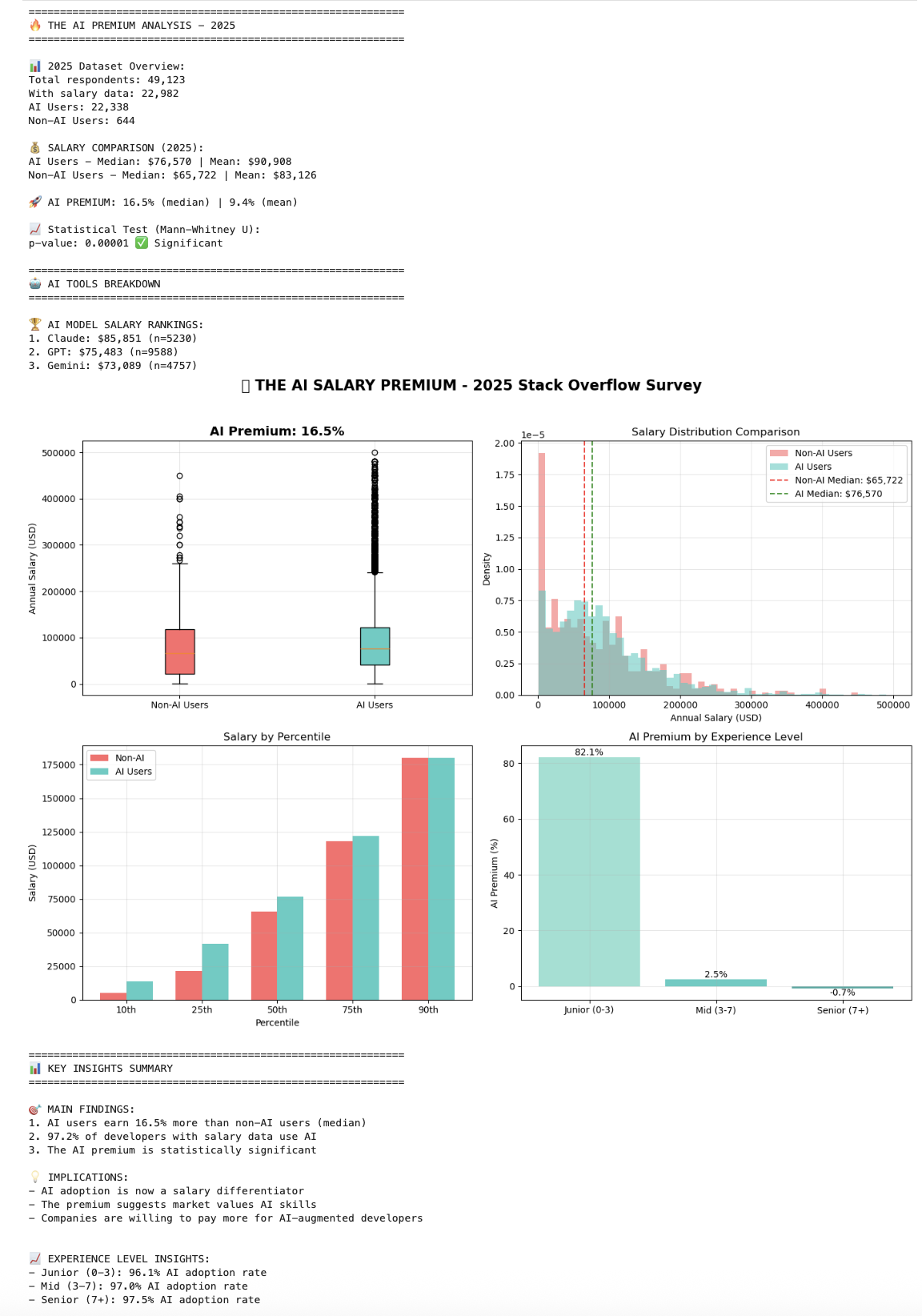
The data is clear: developers who use AI tools earn a median salary of $76,570, compared to $65,722 for non-users. This $10,848 difference is statistically significant (p < 0.00001).
More striking: 97.2% of developers now use AI tools. Only 644 out of 22,982 surveyed don't use AI – making non-users a vanishing minority.
The Experience Paradox
The AI premium varies dramatically by experience level:
- Junior Developers (0-3 years): 82.1% premium
- Mid-Level (3-7 years): 2.5% premium
- Senior Developers (7+ years): -0.7% premium
Junior developers gain the most from AI adoption, essentially closing the salary gap with more experienced peers. For seniors, AI is table stakes – not a differentiator.
Tool Choice Matters
Median salaries by AI tool:
- Claude: $85,851
- GPT: $75,483
- Gemini: $73,009
The Bottom Line
The 2025 data reveals three critical insights:
- How early you adopt AI matters most – juniors see 82% premium, seniors see none
- Which tools you master affects compensation – some tools correlate with $10K+ differences
- How strategically you apply AI becomes crucial – especially for senior roles that need to go beyond basic usage
With 97% adoption, the question isn't whether to use AI anymore – it's how to use it strategically for your career stage. Junior developers should go all-in immediately. Senior developers need to think beyond tools to AI strategy and architecture.
The AI revolution in developer compensation isn't coming – it's here, and the salary data proves it. (Here is the output of the complete analysis I made:)
Question 2: How Did Remote Work Salaries Change Between 2024-2025?
Answer: Remote salaries increased 19.7%, now surpassing in-person work.
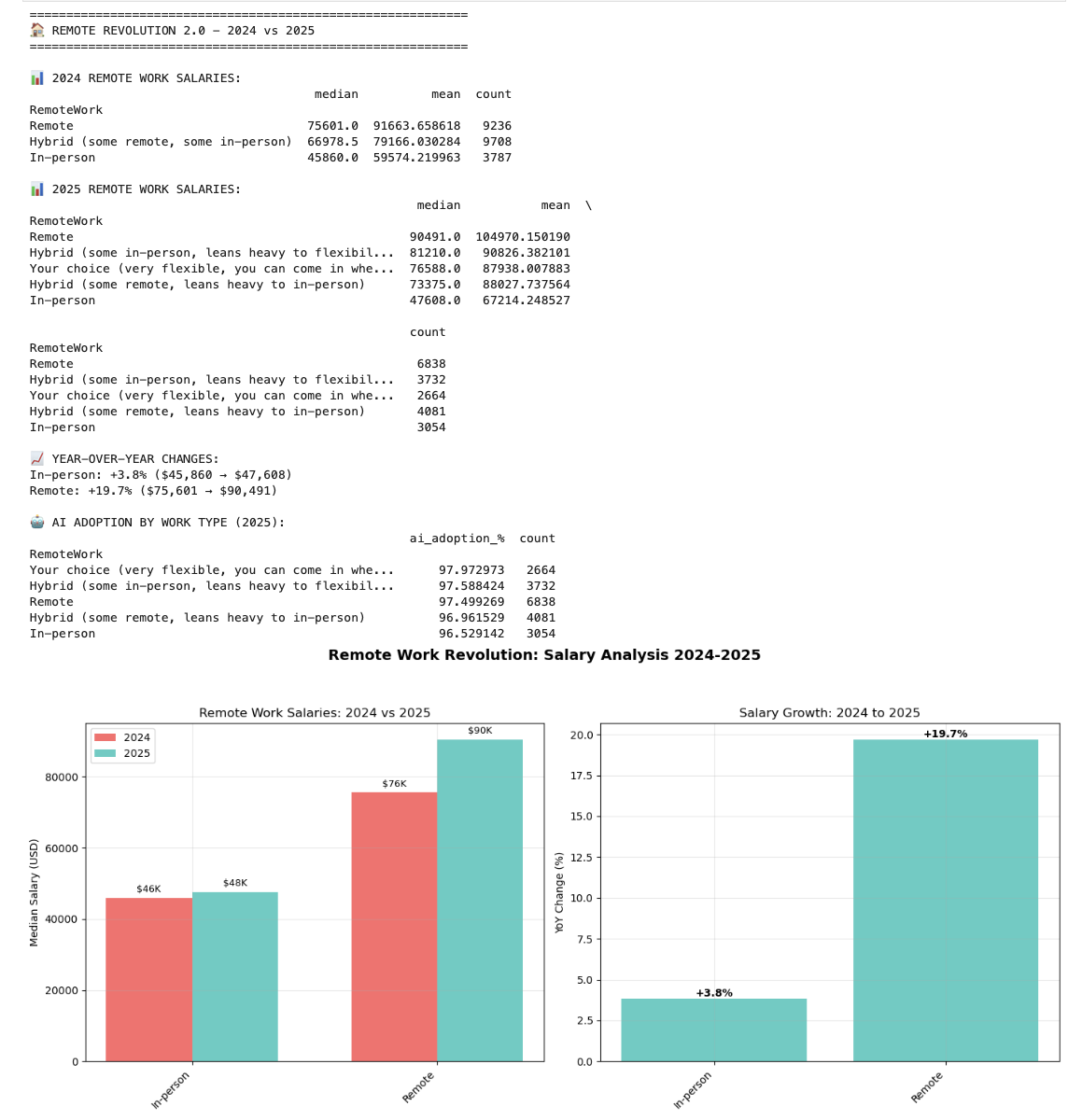
The data reveals a dramatic shift in remote work compensation. In 2024, remote workers earned a median of $75,601, which jumped to $90,491 in 2025 – a 19.7% increase. Meanwhile, in-person salaries only grew 3.9% (from $45,860 to $47,608).
Most notably, remote workers now significantly outearn in-person workers by 90% in 2025, compared to 65% in 2024. Hybrid work, which commanded the highest salaries in 2024 ($81,210), saw minimal growth to $81,375.
The AI adoption data provides context: 97.5-97.9% of workers use AI regardless of location, suggesting the remote premium isn't about AI access but rather companies competing globally for talent. (Here is the output of the full analysis I made:)
Question 3: Can AI Skills Compensate for Years of Experience?
Answer: For juniors, yes – they earn 126% more with AI. For seniors, AI is expected.
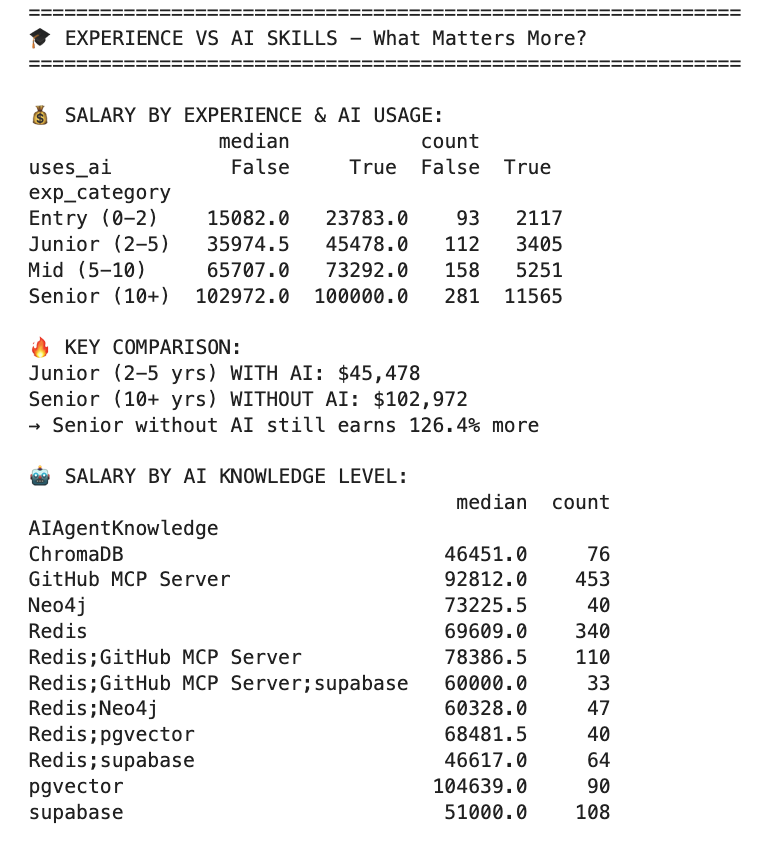
The data shows a fascinating experience-AI dynamic. Junior developers (2-5 years) with AI earn $45,478, while seniors (10+ years) without AI earn $102,972. Though seniors still earn more, the gap has narrowed dramatically.
More striking is the AI knowledge hierarchy: developers using advanced AI tools like pgvector earn $104,639 – matching senior salaries. Those with GitHub MCP Server knowledge earn $92,812. This suggests deep AI expertise can indeed accelerate compensation growth.
The key insight: AI acts as an experience multiplier for juniors (126% salary boost) but becomes table stakes for seniors (virtually no premium). (Here is the output of the full analysis I made:)
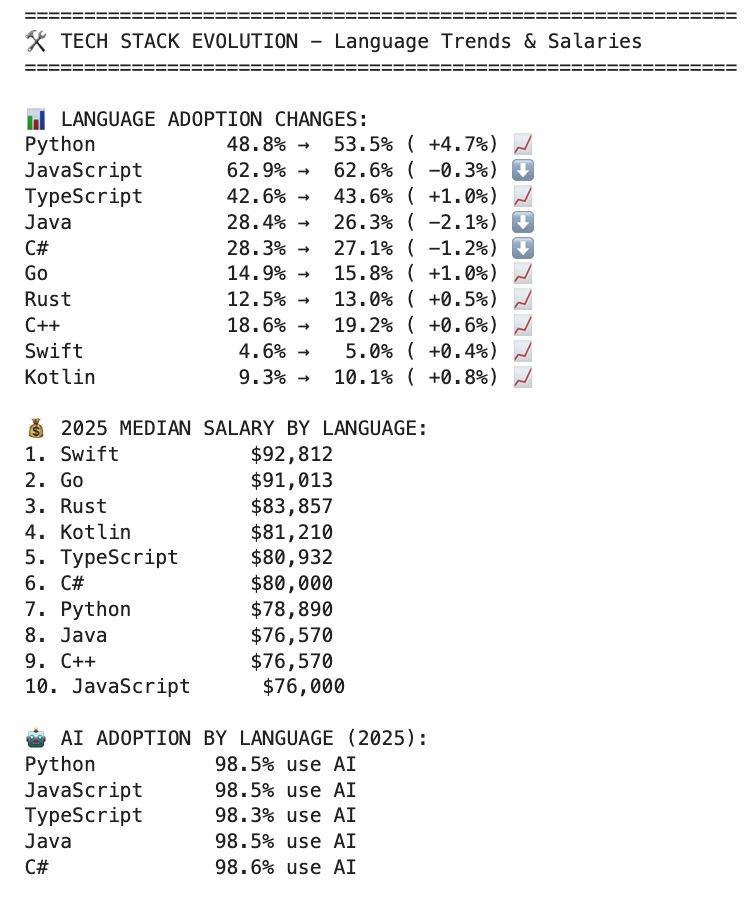
Question 4: Which Programming Languages Are Rising or Falling?
Answer: Python leads growth (+4.7%), while traditional languages stagnate.
Python strengthened its dominance, growing from 48.8% to 53.5% adoption. TypeScript remains stable at 43.6%, while JavaScript slightly declined (-0.3%). The surprise: Go and Rust showed modest growth (+0.8% and +0.5%), despite industry hype.
Salary-wise, Swift developers earn the most ($92,812), followed by Go ($91,013) and Rust ($83,857). JavaScript, despite 62% adoption, pays the least among major languages ($76,000).
The AI correlation is clear: languages with 98%+ AI adoption (Python, JavaScript, TypeScript, C#) are becoming essential, while those without AI integration risk obsolescence. (Here is the output of the full analysis I made:)
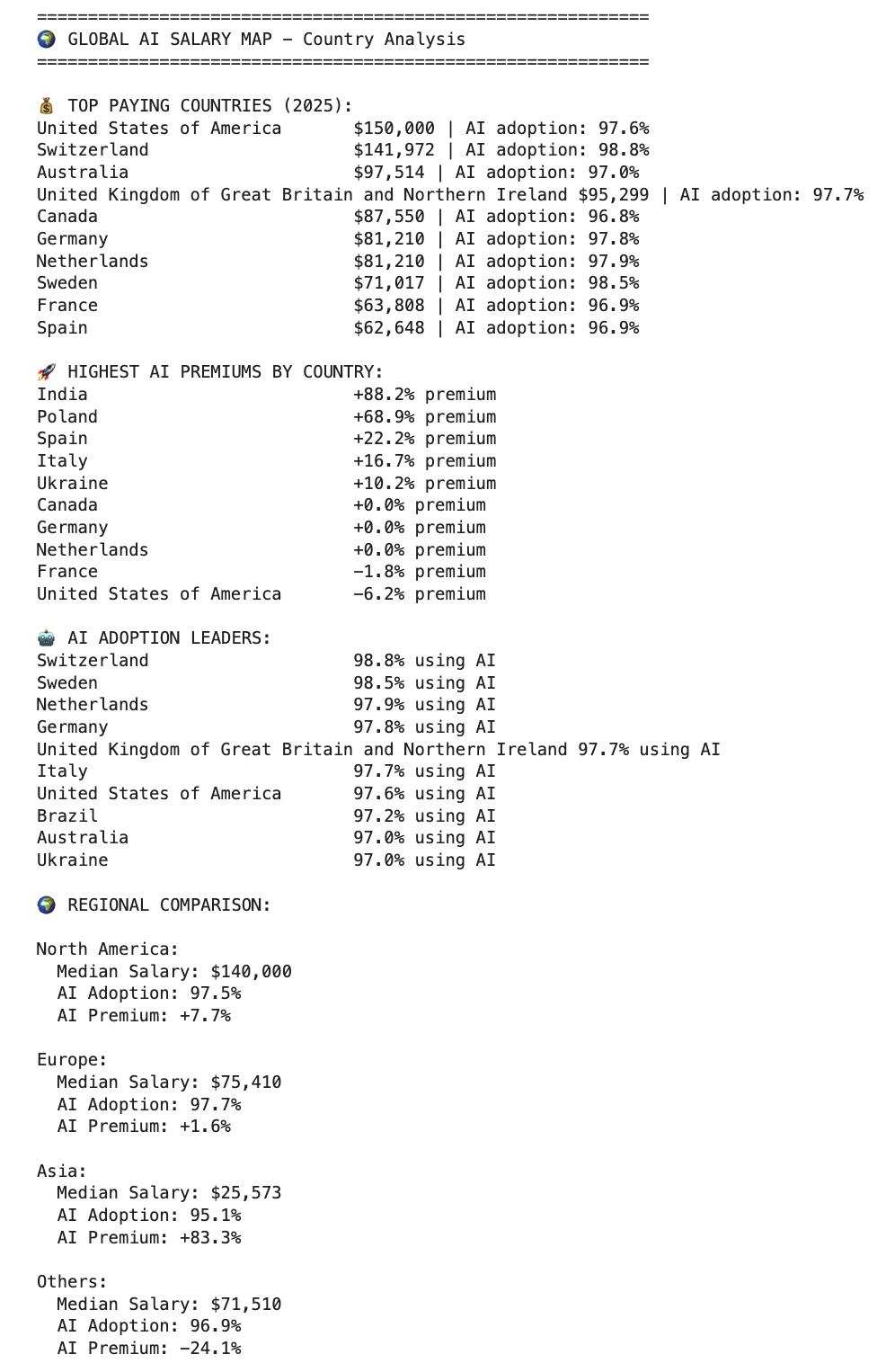
Question 5: Which Countries Lead in AI Adoption and Pay Premiums?
Answer: India leads in AI premium (+88%), while the US shows negative premium (-6.2%).
Geographic disparities are striking. The US pays the highest absolute salaries ($150,000 median) but shows a negative AI premium (-6.2%), suggesting AI is a baseline expectation. Conversely, India shows an 88.2% AI premium despite lower absolute salaries ($25,573).
European countries cluster around 97-98% AI adoption with minimal premiums (+0 to +1.6%), indicating market maturity. Emerging markets (Poland +68.9%, Spain +22.2%) show higher premiums, suggesting AI skills remain differentiators.
Switzerland leads in adoption (98.8%), while Asia exhibits interesting variance, characterized by high adoption rates but significant salary ranges.
Key Takeaways
The New Reality
- 97.2% of developers use AI – adoption is essentially complete
- Remote work pays 90% more than in-office (19.7% YoY increase)
- The question shifted from "should I use AI?" to "how do I optimize AI usage?"
Career Stage Matters
- Juniors: 82% salary boost with AI – massive opportunity
- Mid-level: 2.5% boost – AI alone won't differentiate
- Seniors: -0.7% – AI is expected, not rewarded
Geographic Arbitrage
- US: Highest pay ($150K) but negative AI premium (-6.2%)
- India: 88% AI premium on $25K base
- Europe: 97-98% adoption, minimal premiums (market maturity)
Tool & Language Insights
- Python dominates: 53.5% usage, 98.5% with AI
- Claude users earn most: $85,851 vs GPT at $75,483
- Swift pays best: $92,812 despite lower adoption
- Advanced AI tools (pgvector) command senior-level salaries
Remote Work Revolution
- Remote salaries up 19.7% YoY (vs 3.9% for in-person)
- Hybrid work stagnated – only 0.2% growth
- Remote + AI combination creates maximum earning potential
Strategic Implications
Juniors: Go all-in on AI + remote work for fastest salary growth
Mid-level: Combine AI with specialized skills for differentiation
Seniors: Focus on AI strategy/architecture, not just usage
The Bottom Line
We've moved from the AI adoption phase to the AI optimization phase. With near-universal adoption, success now depends on:
- When you adopt (earlier = better for juniors)
- What you master (tool choice matters)
- How you apply it (strategic use over basic adoption)
The window for "AI premium" is closing. Position yourself strategically now.
Thanks for reading this Data Project!
See you Sunday on this week’s AI Pulse!