I tested text from Claude models and Google Gemini 3.5 Flash for SynthID-family watermarks.
By Karen Spinner
Published: 2026-08-23
URL: https://wonderingaboutai.substack.com/p/a-mostly-plain-language-primer-on
TL;DR: Anthropic will embed a SynthID-family watermark in Claude’s text to comply with the EU AI Act. Models launched on or after August 2 will have it, and existing models will be retrofitted; Anthropic hasn’t said when this will happen. To see for myself, I ran three SynthID detection tests, one taken from a published paper and two adapted from it, on text from Claude Sonnet 5, Claude Opus 4.8, Gemini 3.5 Flash, and GPT-5.2.
The results suggest no watermark is present in output from Claude Sonnet 5, Claude Opus 4.8, and GPT-5.2. But output from Gemini 3.5 Flash generated through the Google AI Studio API tested positive, which answers a question developers had been asking Google about whether SynthID is applied to API-generated text.
Disclosure: I used Claude Fable to build the harness for the study, which I directed, and to package the results into this article. I wrote the introduction, conclusion, and the first paragraph of every section by hand and worked with Fable to fill in the rest. I edited the Fable outputs for quality and double-checked all cited sources. Honorable mention to Opus 4.8, which I pulled in to complete the study when it tripped Fable’s guardrails.
Pangram scored this article as mostly human content with some AI assistance, which is just about right.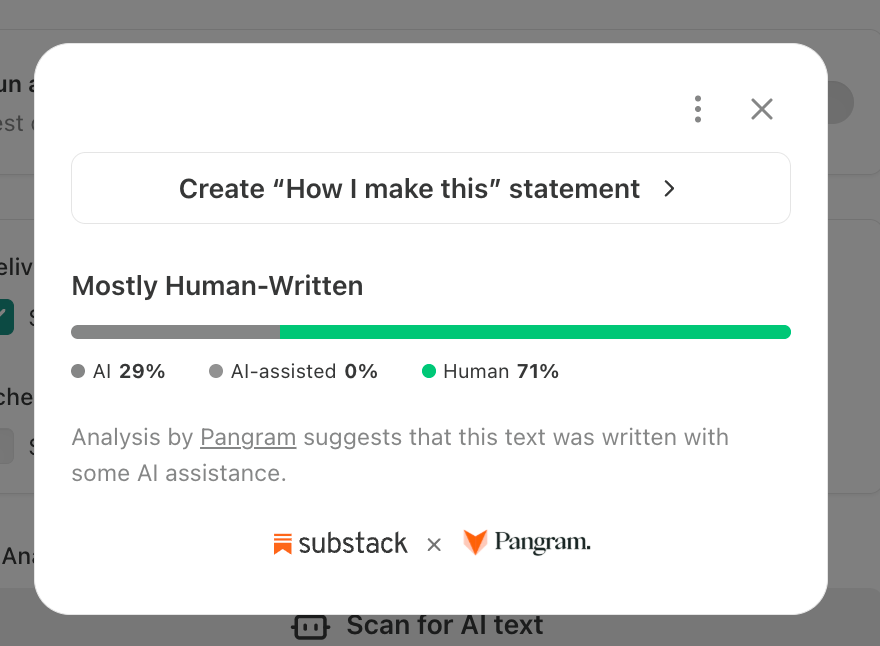
Just when I was getting a little tired of talking about Pangram, which Substack recently embedded into its UI,[1] Anthropic popped up in my newsfeed with an announcement that its next generation of models will embed a SynthID-style watermark in all the text they generate.[2]
Soon after, reporting suggested OpenAI plans to do the same. Its support page now says the company intends to extend its provenance signals to text, and City AM reports it is working through the details.[3] Gemini has embedded a SynthID watermark in generated text since 2024, and the experiment I’ll describe later suggests that applies to text generated through the API as well as through its app.[4]
So far, no one has released a publicly available API for decoding any of these watermarks, although Google offers early access to its SynthID Detector to journalists and researchers through a waitlist.[5] Anthropic says a detection API is coming but hasn’t given a date.[6]
This means that, in a year or two, it will probably be possible to tell, to a reasonable but not perfect degree of certainty, whether text has been touched in any way by AI. Depending on how the decoders are implemented, they could show a degree of AI involvement or a simple yes/no.
Between these watermarks and the growing use of AI detectors in publishing, Substack’s Pangram integration being the one I’m most familiar with, we are quickly heading toward a world in which any moderately motivated reader can find out if you use AI in your writing process. (Of course, it can’t tell you if the result is any good.)
In this article, I’ll take a closer look at these watermarks, what they can and can’t tell us about how text was produced, and how their fingerprints can be detected.
Subscribe for more DIY AI research, tech tips, and stories about my latest builds.
Why did Anthropic and other AI labs add the watermark
Anthropic and other AI companies added the watermark to comply with the European Union (EU) Code of Practice on Transparency of AI-Generated Content, which is part of the regulatory framework that makes up Article 50 of the EU Artificial Intelligence Act. It requires AI providers to mark audio, image, video, and text outputs so they’re detectable as made by AI.[7]
The motivations behind this rule are straightforward. Its authors want to prevent the spread of AI-generated misinformation and also protect the livelihoods of creators, like musicians, videographers, and, yes, writers.
Because Europe is a giant market, the AI providers were eager to comply. The Code was published on June 10, and by the end of July about 190 organizations had signed it, with Google, Meta, Microsoft, Mistral, and OpenAI joining Anthropic in the section that covers marking and detection.[8] xAI did not sign.[3]
The watermark is worldwide because Anthropic chose not to build a European-only version. In its explainer, the company says it applied the mark everywhere because it doesn’t yet have “a durable way to scope it by region.”[6] Euronews summed it up as EU compliance, delivered globally.[9]
This is a reversal from two years ago. In August 2024, the Wall Street Journal reported that OpenAI had developed a working text watermark for ChatGPT and shelved it, partly because an internal survey found 30 percent of users said they would use ChatGPT less if it added a watermark and a competitor didn’t.[10] OpenAI told TechCrunch at the time that it was taking a “deliberate approach.”[11] A rule that binds every provider at once removes the reason to hold back.
When it will roll out (and will we know)
Anthropic said that all new models will include watermarked text and that it will retrofit existing models to comply.
The cutoff is August 2. Models launched on or after that date support marking from day one.[2] Claude Fable 5 launched on June 9,[12] and the newest model the API served when I checked on August 21 was claude-opus-5, launched July 24.[13] So every Claude model you can call today predates the cutoff. A watermark would appear in today’s output only if a retrofit had already gone live without an announcement.
For older models, Anthropic says watermarking will be rolled out over the coming months.[6] The EU gives systems that were already on the market until December 2 to comply.[14] And a separate deadline of February 2, 2027 covers an interoperable way for outsiders to detect the marks.[15]
Anthropic has promised a detection API and says it’s still working out the details. Until it’s available, no one outside Anthropic can check text for the mark using the key. Of course, this made me wonder if the mark could be detected without the key. To answer that, I first had to understand Anthropic’s approach.
What kind of watermark did Anthropic choose
Anthropic is using two different marks for two different kinds of output. Text gets a statistical watermark woven into the model’s word choices. Files such as .png, .jpg, and .svg get a signed metadata label using the C2PA standard, the same system camera makers and photo editors use to record where an image came from.[2] The file label is metadata and disappears if you screenshot or re-save the file. The text watermark travels with the words when they’re copied and pasted, and may survive light editing.
Anthropic says the text watermark adds no hidden characters and no extra tokens, so it costs nothing more to run, and it doesn’t contain information about the user or the chat it came from.[6] The method itself is Anthropic’s adaptation of SynthID-Text, which Google DeepMind published in Nature in October 2024 and has run inside the Gemini app since then.[4]
How SynthID watermarks work
SynthID watermarks are designed around how LLMs make word choices. These models write one word at a time, and at each step, they build a ranked list of candidates. Sometimes one candidate is clearly right. Often there are several credible synonyms. Anthropic’s own example is “The weather today was cold and...” where “overcast” and “grey” are both fine, and a random number settles the choice.[6] (Many writers would dispute whether these words are interchangeable from a stylistic point of view.)
A SynthID watermark changes where that random number comes from. Instead of an arbitrary generator, the model uses a secret key plus the few words that came before, its hash window, to decide which of the near-equal candidates wins. Google’s implementation draws several candidates from the model’s own list and runs a small tournament among them, with the key-derived scores picking the winner at each round, so the mark can only ever promote a word the model was already considering.[4] The reader sees a normal sentence.
Someone holding the key can go back through the text, recompute what the keyed choice would have been at each position, and count how often the text agrees. The more it agrees, the higher the probability that the watermarked model was involved. Short passages give the test little to work with. Facts with one right answer and code give it almost nothing, and so does light proofreading, where nearly all the words are human-selected.[6]
Can this kind of watermark be reliably detected?
Yes.
Researchers at ETH Zurich designed statistical tests that can detect whether a model is watermarked using only ordinary queries, with no key or decoder required. In 2024 they ran the tests against GPT-4, Claude 3, and Gemini 1.0 Pro and found no sign of a watermark in any of them.[16] When Google open-sourced SynthID-Text, the same team confirmed their test catches it on a local model.[17]
But for this approach to work, you first have to work out how many preceding words the key reads. A mark of this kind reads only the last few tokens, so the model’s choice at a given slot should change when you edit a nearby word but remain the same when you edit a distant one.
The ETH team also flagged a second issue, namely that SynthID skips the watermark at any position where the preceding few tokens have already appeared earlier in the text, and Google’s developer documentation says the same.[18] (Remember this, it will be important later.) Overestimate the window, or feed the model repetitive text, and the queries come back carrying no information about the key.
The week Anthropic made its announcement, a developer named John Wang ran the ETH tests against Sonnet 5 and Fable 5 and got negatives on all of them. He was careful to say the nulls didn’t settle anything, because he had no confirmed watermarked model to check the tests against.[19] I decided to run the same experiment and add a model known to be watermarked as a control.
The experiment: Searching for the watermark
I started by downloading the code from the ETH experiment, which showed how it works.[16]
It starts by asking a model to pick a random fruit from a four-word list to finish the sentence “I ate {number}.” A keyed watermark biases that choice based on the few tokens just before it. So for a fixed number, the same fruit gets nudged the same way no matter how the sentence started, and that cross-context agreement shows up as a pattern when it’s tested against a shuffled null. With no watermark, the fruit choice is independent of the number.
In practice, each query is a one-line task. The model sees a sentence opening that ends in a number, something like “I ate 473829105624381” and is told to finish it with one of four fruits, chosen at random, and nothing else. The fruit is the only free choice in the whole response. A four-way pick between near-equal words is the kind of low-stakes decision a watermark acts on, and it is easy to count. Ten different sentence openings stand in for the “how the sentence started” part, and the number before the fruit is the context a watermark would read.
The ETH original uses bland numbers, a single digit repeated fifteen times, like 111...1 or 222...2. This is because a plain repeated digit has no meaning that could sway the fruit on its own, so any agreement left over must come from the key. The paper validated the test on open models and caught watermarks at overwhelming significance.
A null where there should have been a signal
Next, I repeated the ETH experiment with Gemini 3.5 Flash accessed via the Google AI Studio’s API, because Google has said its text outputs are watermarked with SynthID. This run (and all subsequent ones) used the four fruits selection from the ETH code library: strawberries, blueberries, raspberries, and blackberries.
Surprisingly, this test came back null. That left a few possibilities:
-
Google doesn’t watermark API text, which some developer forums suggest is the case.
-
The test was ignoring SynthID watermarks.
-
The repetitive digits in the test methodology were not assigned SynthID watermarks, per the limitation the ETH team had mentioned.
I leaned towards the third option. Without a skip rule, repetitive passages like lists or boilerplate would be altered unnaturally, and the mark would become visible in the text.[4]
Two variants of the published method
To know for sure whether the test was failing in some way or if Gemini outputs produced via API truly aren’t watermarked, I worked with Claude to design an additional experiment that would evaluate the test method itself.
We started by building two variants of the ETH test to see if choosing different numbers for the “I ate {number}.” passage would affect the results. These were:
Window-k. This design uses nine numbers that share the same fourteen leading digits and differ only in the last one. The number is held almost constant, which means the fruit can't shift because of what the number "means." But the hash window, the few tokens the watermark reads just before each word choice, does change, because its last digit is different in every variant.[20] If the last digit alone reassigns the fruit, that suggests a positive result.
Random-k. This design uses nine distinct fifteen-digit random numbers. The rationale was that, because distinct random numbers almost never repeat a group of numbers, SynthID wouldn’t skip the watermark. But distinct numbers have distinct content, which could also have an impact on the fruit selection independent of the watermark. (The ETH experiment used bland, repetitive numbers to avoid this possibility.)
Validating the tests on a watermark I control
Before applying these methods to Claude or Gemini, I wanted to try them out on a model that I was 100% certain was generating text with a SynthID watermark. So I took an open model that supports SynthID, Mistral-7B, and tested it twice with each approach: once with a real SynthID watermark switched on at generation time and once with it off, using the open-source implementation in the HuggingFace transformers library.[21] Each run used the same model and the same prompts; the watermark’s ON/OFF status was the only difference.
Window-k and random-k flagged watermarks only on the watermarked run. The published test came back null even with the watermark switched on, which confirms that repeated digits trip SynthID’s skip rule, so the mark is never embedded where the test measures.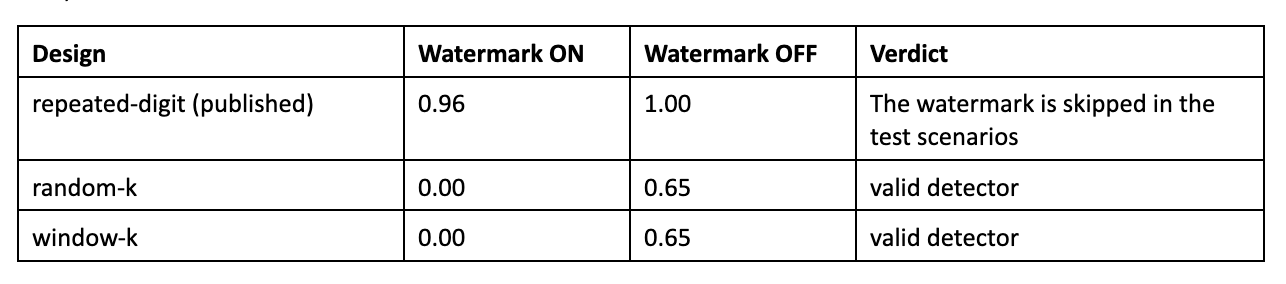
A null reading from the standard test cannot confirm that a model’s output isn’t watermarked, and that applies to the nulls Wang reported for Sonnet 5 and Fable 5 as well as to my first Gemini run.
The tests, run on the live APIs
For each model I ran the full grid of ten sentence openings, nine numbers each, and up to a hundred samples per cell, at the model’s default settings.
The scores compare how consistently a given number influences the fruit selection across all ten openings vs. ten thousand random shuffles, repeated over a hundred bootstraps. A median result below 0.05 means patterns consistent with watermarking appear too consistently to be caused by random chance.[22]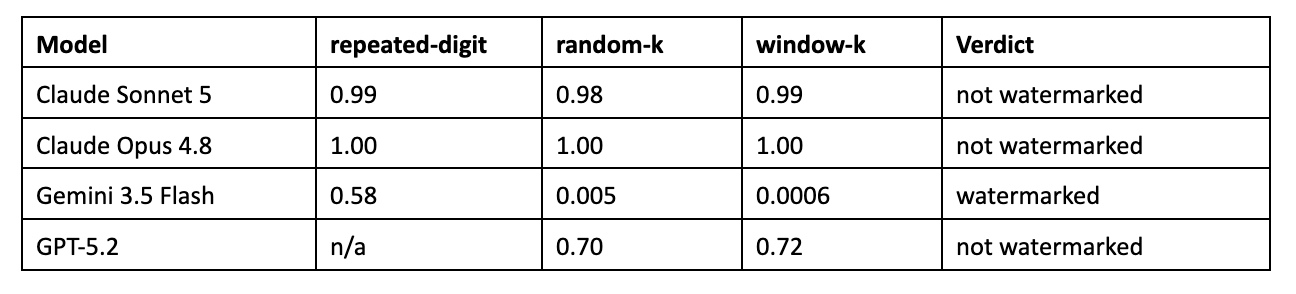
What the results resolve
Google AI Studio’s Gemini API most likely watermarks its text output. Google’s SynthID materials scope text watermarking to the Gemini app and web experience,[23] and a thread on Google’s own developer forum, opened by someone trying to meet their Article 50 obligations, had gone unanswered.[24] As far as I can find, this had not been shown publicly before.
I validated the detectors against SynthID as implemented in the open-source Hugging Face Transformers library, the same scheme Google uses, but not its exact production settings.
But Claude Sonnet 5 and Claude Opus 4.8, as of August 22-23, most likely do not watermark text. This was what I’d initially wanted to check, and I’ll probably run this test again in a few months on Claude models to see if anything has changed.
Where do we go from here
As someone who writes regularly but also struggles to keep up with a regular publishing schedule, I use AI in my writing all the time and disclose how I use it at the top of every article.
And I think the broad adoption of watermarks, combined with the EU’s promise to enforce transparency rules, is leading us to a world where AI content will be labeled by default, whether we want this or not.
I don’t believe the right response is to stop using AI altogether and require every document to be written by hand, although you could make a principled economic case for it.
Instead, I think we should normalize the thoughtful use of AI and treat “made with some AI assistance” as more of a neutral descriptor and less of a scarlet letter. People were producing bad writing long before AI came along, and the AI writing spectrum defined here represents a modern and balanced way to evaluate hybrid AI-human work.
And nobody, no matter how they write, should be panicking about the watermarks. Based on my limited tests, at least one of the newer Claude models doesn’t watermark text. Plus, the compliance deadline for existing models is about three months away, on December 2, and publicly available decoders for the watermarks, even for Gemini’s, do not exist.
This means writers have time to think through how they will disclose AI use and whether the labeling will make any difference to their writing and publishing practice.
And, as always, DM me for data and methodology details. I’m hoping to put the raw data onto GitHub sometime over the next few weeks.
Sources
1. I read Pangram 4’s technical report so you don’t have to. Wondering About AI. August 10, 2026.
2. Anthropic, “How Claude marks AI-generated content,” Anthropic Help Center, updated August 2026. https://support.claude.com/en/articles/16266773-how-claude-marks-ai-generated-content
3. “ChatGPT to follow Claude’s watermark pledge, but Grok to swerve it,” City AM, August 2026. https://www.cityam.com/chatgpt-might-follow-claudes-watermark-pledge-but-grok-to-swerve-it/ OpenAI’s support page, updated August 2, 2026, states a goal of expanding provenance signals to text models.
4. Dathathri, S. et al., “Scalable watermarking for identifying large language model outputs,” Nature 634, 818–823 (October 2024). https://www.nature.com/articles/s41586-024-08025-4
5. Wiggers, K., “Google’s new SynthID Detector can help spot AI slop,” TechCrunch, May 20, 2025. https://techcrunch.com/2025/05/20/googles-new-synthid-detector-can-help-spot-ai-slop/ Access began with early testers; journalists, researchers, and developers can join a waitlist.
6. Anthropic, “How Claude’s text watermark works,” August 14, 2026. https://www.anthropic.com/news/claude-text-watermark
7. Regulation (EU) 2024/1689 (AI Act), Article 50. Text and commentary at https://artificialintelligenceact.eu/article/50/
8. Southern, M. G., “Anthropic To Mark Claude Text & Files Under EU AI Act Code,” Search Engine Journal, August 2026. https://www.searchenginejournal.com/anthropic-claude-watermarks-eu-ai-act-code/585355/ See also the European Commission’s Code of Practice FAQ, June 10, 2026: https://digital-strategy.ec.europa.eu/en/faqs/code-practice-transparency-ai-generated-content
9. “EU compliance, delivered globally: Anthropic to watermark Claude’s output worldwide,” Euronews, August 11, 2026. https://www.euronews.com/next/2026/08/11/eu-compliance-delivered-globally-anthropic-to-watermark-claudes-output-worldwide
10. Seetharaman, D. and Barnum, M., “There’s a Tool to Catch Students Cheating With ChatGPT. OpenAI Hasn’t Released It,” Wall Street Journal, August 4, 2024. Survey figures as reported in secondary coverage, e.g. Morales, J., Tom’s Hardware, August 2024: https://tech.yahoo.com/ai/articles/openai-built-text-watermarking-method-145312665.html
11. Wiggers, K., “OpenAI says it’s taking a ‘deliberate approach’ to releasing tools that can detect writing from ChatGPT,” TechCrunch, August 4, 2024. https://techcrunch.com/2024/08/04/openai-says-its-taking-a-deliberate-approach-to-releasing-tools-that-can-detect-writing-from-chatgpt
12. Anthropic, “Redeploying Claude Fable 5,” June 30, 2026 (confirms the June 9 launch). https://www.anthropic.com/news/redeploying-fable-5
13. Anthropic release notes; model list retrieved from the Claude Models API on August 21, 2026.
14. Cooley LLP, “EU AI Act: Transparency Obligations Take Effect 2 August 2026,” August 3, 2026. https://www.cooley.com/news/insight/2026/2026-08-03-eu-ai-act-transparency-obligations-take-effect-2-august-2026
15. Reed Smith, “Transparency obligations for AI-generated content: The Code of Practice adequacy decision and the final EU Commission Guidelines on Article 50 AI Act,” July 2026. https://www.reedsmith.com/our-insights/blogs/viewpoints/102nbz0/transparency-obligations-for-ai-generated-content-the-code-of-practice-adequacy/
16. Gloaguen, T., Jovanović, N., Staab, R., and Vechev, M., “Black-Box Detection of Language Model Watermarks,” ICLR 2025. arXiv:2405.20777. Code: https://github.com/eth-sri/watermark-detection
17. Jovanović, N., Gloaguen, T., and Vechev, M., “Probing Google DeepMind’s SynthID-Text Watermark,” SRI Lab, ETH Zurich, December 20, 2024. https://www.sri.inf.ethz.ch/blog/probingsynthid The post notes that SynthID’s caching requires the context size to be estimated correctly, because overestimating it triggers the cache and the queries stop carrying information.
18. Google AI for Developers, “SynthID: Tools for watermarking and detecting LLM-generated text,” Responsible Generative AI Toolkit. https://ai.google.dev/responsible/docs/safeguards/synthid States that repeated n-grams within the context history are not watermarked.
19. Wang, J., “How Claude’s watermarking (probably) works,” August 12, 2026, updated August 20, 2026. https://johnjwang.com/post/2026/08/12/how-claude-watermarking-probably-works/
20. Kirchenbauer, J. et al., “A Watermark for Large Language Models,” ICML 2023. arXiv:2301.10226
21. SynthID text watermarking as implemented in Hugging Face Transformers (SynthIDTextWatermarkingConfig, available since v4.46), an open-source port of Google DeepMind’s SynthID-Text (ref 4; reference code at https://github.com/google-deepmind/synthid-text). Docs at https://huggingface.co/docs/transformers/en/generation_features. Validation run used Mistral-7B-Instruct-v0.1 on a RunPod RTX 4090 with ngram_len 5.
22. Detection code ports the ETH Red-Green test (upstream eth-sri/watermark-detection). API grids in watermarkredgreen.py; ON/OFF validation in cloudvalidate.py. Statistic: cross-prefix consistency against a 10,000-permutation null, median over 100 bootstraps.
23. Google DeepMind, SynthID. https://deepmind.google/technologies/synthid/ Confirmed August 2026; DeepMind’s materials scope text watermarking to “the Gemini app and web experience.”
24. Google AI Developers Forum, “Does Gemini API text output carry SynthID watermarking?” August 2026. https://discuss.ai.google.dev/t/does-gemini-api-text-output-carry-synthid-watermarking-gemini-2-5-flash-lite-gemini-3-1-flash-lite-eu-ai-act-art-50-2/177241