Pangram’s lab numbers look impressive, but do they reflect how people use AI in the real world?
By Karen Spinner
Published: 2026-08-10
URL: https://wonderingaboutai.substack.com/p/i-read-pangram-4s-technical-report
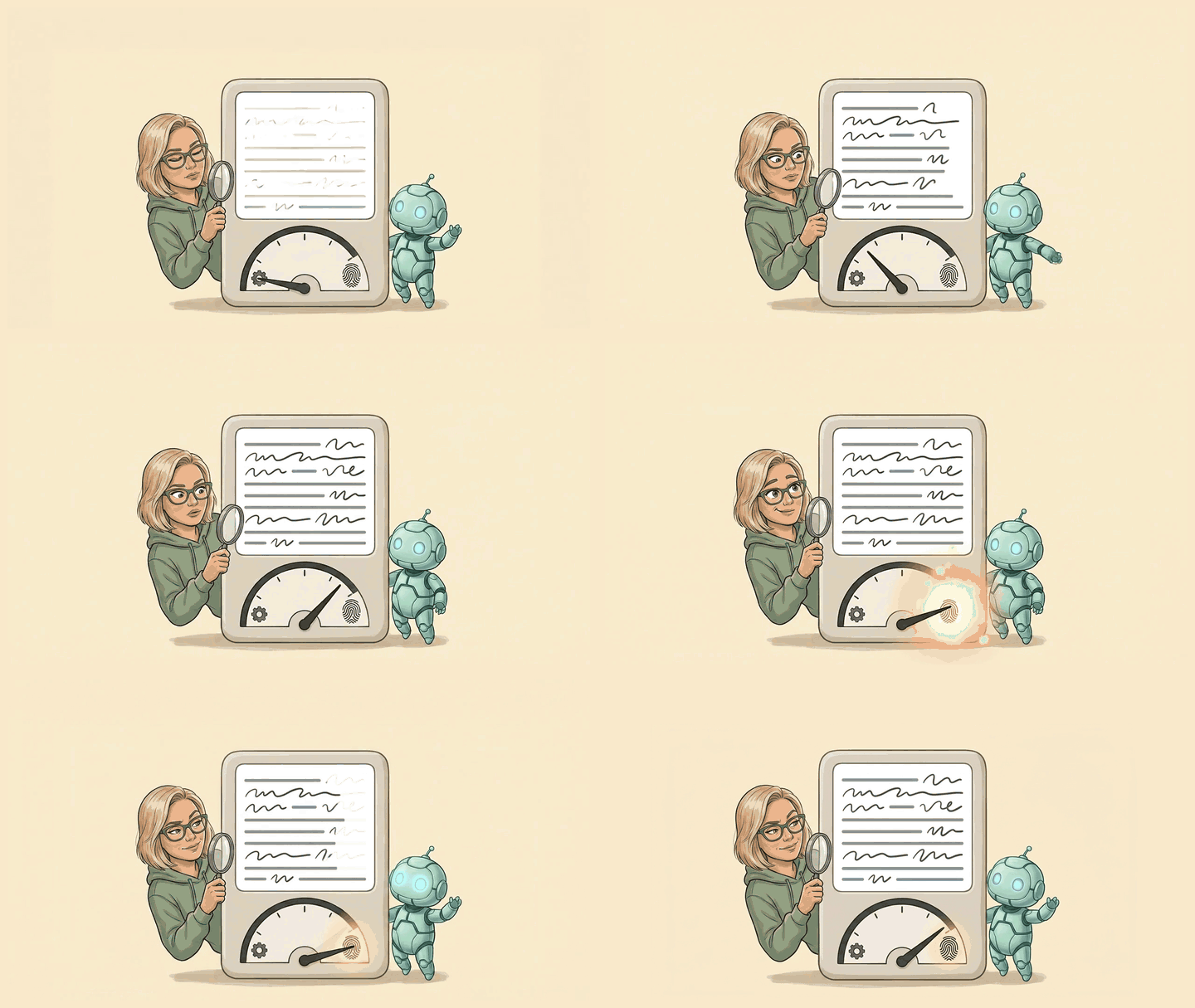
Disclosure: I have no connection to Pangram Labs. Every number below comes from the company’s own technical report, which is free to read on arXiv. DM me if you want the table and section references for anything I cite. Also, I edited a draft by Claude Fable to produce this article. It received a 100% human score from Pangram.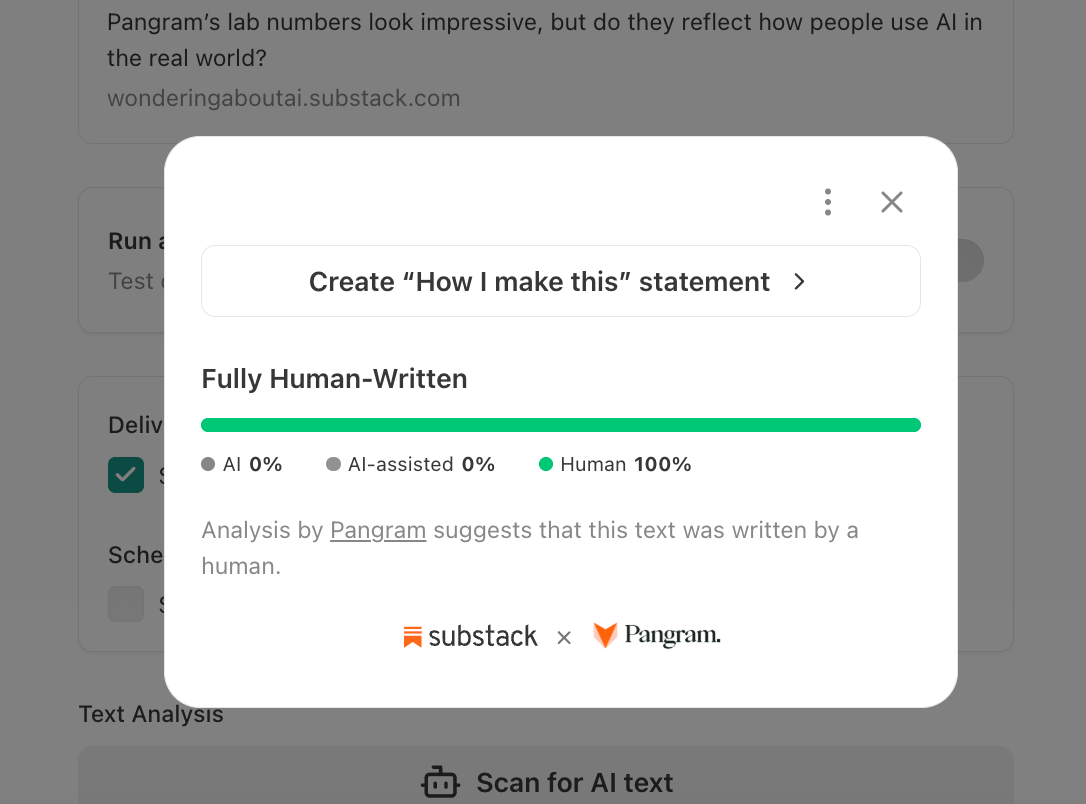 Pangram doesn’t always catch AI-generated text produced via more sophisticated prompting techniques or edited by a human.
I’ve seen a lot of writing on Substack lately covering its new partnership with Pangram, related privacy issues, and how it will almost inevitably falsely accuse some writers while also missing lots of AI-generated text.
For the record, I don’t think we should be running our copy through an AI detector.
Authors on this platform are generally writing in their limited spare time, and anything that adds friction, like the need to edit their articles to please a machine judge, is likely to reduce participation.
But I’m also curious about machine learning and how language works, and so I wanted to know how Pangram analyzes text, where its training data comes from, and how confident it is in its claims.
So I read Pangram’s latest technical report on arXiv, and I’ve summarized it here, along with what I think it means.
TL;DR: Pangram 4 posts the best lab numbers in AI detection. But the company doesn’t share its test data, so these numbers can’t be reproduced. Also, the AI text used in the study was generated through one-time prompts, and the human-written control text predates 2022. Outside benchmarks involving style imitation, mixed drafts, and short texts showed a much lower degree of accuracy. This makes it a useful tool for measuring AI use across thousands of documents, but not for judging any individual writer.
Subscribe for AI research, tech tips, and no judgement if you are using AI to help you write.
How Pangram 4 works
Pangram 4 is a classifier, a type of machine learning model that sorts things into categories. For example, a spam filter is a classifier with two categories, spam and not spam. Pangram 4 sorts writing into three categories: Human, AI-assisted, or AI-generated.
For each sentence, Pangram generates a classification. And then it counts how many sentences were tagged for each category. This is how it arrives at its percentage human, mixed, and AI scores.
How AI-generated text is defined
The report defines AI-generated text as:
-
Open-ended prose. Factual answers are out of scope. For example, if you asked an AI model and a person “What’s the capital of France?” both will say Paris, so there is no AI-generated text to find.
-
Texts longer than 50 words. Short snippets are out of scope, and Pangram must have at least 50 words of text to run.
-
AI summaries. If AI condensed text instead of adding to it, the output counts as human.
Tuned to minimize false positives
The headline numbers in Pangram’s report cite one false accusation for every 24,000 human documents and one missed AI text in every 300, based on controlled lab experiments. At this rate, a platform scanning ten million posts wrongly flags around 400 human writers.
A false positive is human writing that gets wrongly flagged as AI. A false negative is AI text that is wrongly labeled as human. Every detection model makes tradeoffs between the two. For example, if you tune the model to be more suspicious, it will catch more AI text but falsely accuse more humans.
Pangram tuned its model in the writer-protective direction, which shows the company at least has an awareness of how harmful false accusations can be. And the 1-in-24,000 number is better than what similar tools have posted in comparable studies.
But are these numbers likely to hold up on text that isn’t generated by controlled prompts, and that may mix AI and human writing and editing?
This study cannot be reproduced.
To generate AI text to evaluate, Pangram used open-ended writing prompts drawn from Chatbot Arena, a public collection of real conversations between users and chatbots. They generated more than 500,000 documents.
For the human writing examples, the company selected over a million texts from their own collections, plus web text in more than 100 other languages gathered before 2022. They chose older writing because it was produced before ChatGPT was released. (I’ve used older writing in my studies, too.)
Because Pangram anonymizes its model architecture, doesn’t share its training data, and doesn’t identify the sources of the million-plus human texts in its false positive test, its results can’t be produced.
Why the lab results don’t reflect the real world
While I couldn’t reproduce Pangram’s exact study, what they did share about its design suggests that the top-line accuracy numbers may not hold up for many writers on Substack.
Tests relied on simple one-time prompting techniques.
The AI text in Pangram’s benchmark was made with one-time prompts, in which models were prompted with a single set of instructions and no follow up. This doesn’t reflect how most people work with AI, which usually involves multiple rounds of conversation and revision. For example, when I use AI to write, I almost always throw out its first draft.
Outside benchmarks show what happens when Pangram evaluates text produced through more sophisticated prompting techniques. Epoch AI tested three leading detectors on two kinds of AI text: passages written from a basic prompt, and passages where the model was shown five samples of a real author’s work and asked to mimic it. Pangram (the previous version, 3.3.2) caught every basic-prompt passage. On the style imitations, it missed 10 percent overall, and 25 percent of the scientific writing.
Pangram’s report says the new model roughly halves the misses on this same test. But that figure is the company’s own run on Epoch’s data. Epoch hasn’t published results for Pangram 4.
When Pangram scored its new model on short (under 50 words) passages University of Chicago researchers had run through an evasion tool, it missed 27 percent of them. And that was with the threshold set to allow one false positive in a hundred, a much looser budget than the one-in-24,000 rate Pangram runs in production.
While Pangram stress-tested itself against the most popular “humanizer” services and caught 97.7 percent of their output, most of these tools are paraphrasing AI output, not editing the way a skilled custom tool or human editor would.
Older human writing may not reflect how people write today
Why is the age of the writing an issue? Because writing styles evolve, and lately they’ve been evolving fast.
People are easily influenced by what they read every day, and since 2023, a lot of what people are reading online was written by AI.
For example, my antithesis study showed that the phrase “it’s not this, it’s that” (and its many variants) appears on Substack five times more often now than it did before 2023. Some of that may have come from new writers who picked it up organically.
It’s possible that Pangram may see “AI tells” in modern writing and be more likely to flag it as AI-written. And the report’s limitations section concedes this point: “[the model] does not account for people who intentionally write like LLMs” or who have absorbed the style through exposure.
On the bright side, there is some evidence that this detector is less likely to discriminate against text written by non-native English speakers than earlier tools. A 2023 Stanford study found that detectors of that era flagged essays by non-native writers at unusually high rates.
Pangram tested four public collections of English-learner writing (ELLIPSE, ICNALE, PELIC, and the TOEFL essays from the Stanford study itself) and produced a single false positive across 24,586 samples.
Hybrid writing is often not detected
The Pangram 4 study also looked at hybrid writing, and results were mixed.
Their researchers built a test set of hybrid drafts by taking human-written student essays and editing them with the tools people use in real life, including Grammarly, Apple Intelligence, Gemini in Google Docs, and chatbots like GPT-5.5 and Claude.
If AI was used strictly to fix spelling, grammar, and punctuation, Pangram performed well. It only flagged one in 11,363 lightly edited human documents as AI.
Heavier AI edits are a different story:
-
When the team substantially rewrote student essays with AI, the model labeled the result fully Human 41 percent of the time. (This is consistent with my experience editing AI-generated copy.)
-
On a second test built from over 4,800 real editing prompts mined from public chatbot logs, it labeled 28 percent of substantially AI-edited texts fully Human.
-
And on an outside benchmark with character-level ground truth, a document that was 99 percent AI text received an average predicted AI share of about 70 percent.
How the model reasons is a “black box”
The limitations section of the study also flagged some potentially concerned information for anyone concerned about submitting their writing to be evaluated by this tool:
-
The predictions are a black box. Even Pangram finds them difficult to explain.
-
The same passage can get a different label on its own than it gets inside a longer document.
-
The confidence score measures how settled the model is internally. It is not the probability that the label is correct.
When a dashboard says “98 percent confidence,” most people hear a 98 percent chance the label is right. But that’s incorrect. It actually measures how decisively the model’s internal predictions converged on one answer instead of another, and the report states plainly that this is not a recalibrated probability of correctness.
A model can converge decisively on a wrong answer, the same way a person can feel completely certain and still be mistaken.
What it all means
As a measuring instrument for large collections of writing, Pangram is potentially useful. When it estimates that more than 40% of long-form LinkedIn posts are AI-generated, I’m inclined to believe it, because error rates will wash out over large samples.
But I’m not convinced we should be using it to judge individual writers.
Outside studies attempting to replicate real-world writing conditions showed higher error rates. And Pangram’s own study showed it struggles to accurately classify hybrid text.
Even if Pangram and other AI detectors were 100% accurate, they couldn’t tell you whether any given piece of content is actually slop. People and content farms have been producing slop since before the advent of generative AI.
Both content farms and AI-native publishers generate industrial quantities of slop for only one reason: platform algorithms reward high-volume publishing.
A better solution might be to limit the incentives that make slop at scale so rewarding, which would also reduce the pressure to publish frequently. Perhaps Substack could try limiting how many Notes and articles any given account could produce over a week or a month?
I’m not sure how or if this would work. But I think we should keep searching for solutions, because AI detection is not the answer to slop.
Thank you for making it to the end!