What every educator needs to know about edtech compliance, AI model training, and why IT denies your app requests.
By Jacob Carr
Published: 2026-08-20
URL: https://whatteachershavetosay.substack.com/p/nixon-era-laws-harry-potter-and-the
A quick disclaimer before we jump in: I am not a network administrator, a database engineer, or a district compliance attorney. I don’t even work in IT. In fact, I joke about a mug I once saw that said “No, I’m in edtech, but I’m happy to put you in touch with someone in IT.” The simple fact is that I am an educator who found himself neck-deep in the weeds of student privacy, trying to make sense of the tangled mess beneath. This piece is my attempt to corral, digest, and translate all of this machinery so we can actually talk about it like normal human beings. Consider this my working notes as I chip away at learning it alongside you. If this is your area of expertise, or you just spot something that’s off or wrong, I’d love if it you would comment, send me a message, or otherwise let me know….kindly.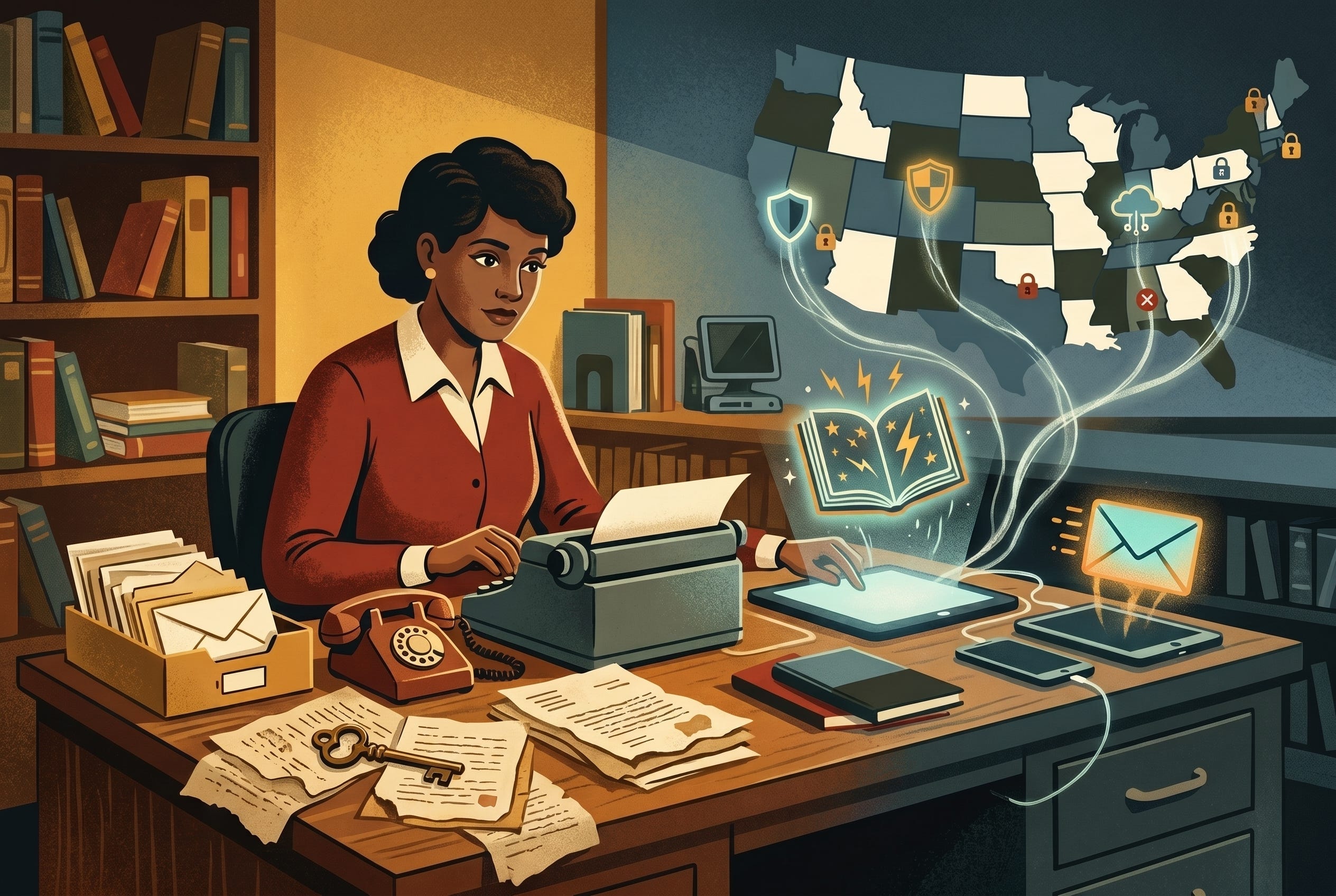 Illustration generated by ChatGPT with DALL·E, based on a prompt by Jacob Carr.
I caught myself doing it again at a training this weekend in San Diego…bleeding acronyms and jargon into the conversation as if everyone worked with them like I do. FERPA-compliance. NDPAs. COPPA. ZDR …the list not only goes on and on, but keeps growing and growing! Standard ed-tech jargon sometimes just sounds like a compliance officer clearing their throat. But also, it feels like it turns privacy into someone else’s headache or something somehow unknowable.
Unfortunately, it isn’t. It’s our headache, at least on some level. And, as technology continues on the path it’s going, the headache is getting worse and worse. It’s both our circus and our monkeys.
But, I’m rambling a bit. Here’s the problem. Every time an IT department skuttles a software request without explanation, what’s happening is that you’re actually staring at a giant, toothy legal machine grinding away beneath our classrooms.
This is my attempt to pull back the curtain and make that more understandable. I’ll do my best to not make it suck; you do your best to keep with it. It’s a little dry, but it’s a lot important.
The Federal Baseline: FERPA’s Hidden Door
Starting back in, as one of my sophomores once put it, “the late 1900s” (…like it was the time of the Victorians or something,) 1974 to be exact, a law was written. That is Nixon-era legislation (signed by Gerald Ford a few days after the resignation), and if it feels ancient, it’s from even before I was born. But it created the Family Educational Rights and Privacy Act (FERPA), which should sound familiar, because, this law, that is older than most teachers on your campus, is still dictating how we handle digital privacy.
FERPA’s default setting is brutal: share student records without signed parental permission, and you land in the legal blast zone. Taken literally, that single rule nukes every digital tool in existence. No Canvas. No Gimkit. No Snorkl. Certainly no MagicSchool or Google Classroom, because nobody is chasing down a student-body’s worth of signed paper waivers, for every platform, every September, just to launch a quick quiz app. Can you imagine LA Unified collecting ~400k signatures for each platform?!?!
So how does the multi-billion-dollar ed-tech industry exist at all? It rides on one legal carve-out: the school official exception. Remember that term, because it runs parallel to just about everything related to tech in schools
Under this exception, tech vendors get temporary status as school staff, bypassing the parental consent requirement entirely. But this pass requires four specific criteria for it to work:
-
Real Staff Work: The tool has to perform a task that an actual school employee would otherwise do.
-
Direct Control: The school district must maintain full control over how the vendor handles student data.
-
Need-to-Know Access: Data access is restricted strictly to what is required for the tool to function.
-
Zero Side Hustles: The vendor cannot monetize, harvest, or sell student data for commercial gain.
Pull out a single one, and the whole thing falls apart…and the lawyers descend.
Take a platform harvesting student writing samples to train a commercial AI model for a product update. That breaks rule four instantly. A pretty user interface and helpful features do not save them from that violation. Pre-AI plagiarism checkers survived this solely because districts essentially contracted them to archive work specifically for school anti-cheating purposes, not for selling consumer data…but it feels shaky at best.
But, when vendors want to bypass that restriction, their favorite move is to simply strip the student’s name off the top of the essay, slap on the label “de-identified,” and suddenly FERPA looks the other way while an algorithm chews through your ninth-graders’ writing. Except, in the world of modern AI, true anonymity is purely performative theater. You can delete the name and ID number, but once a system ingests enough context and quasi-identifiers (a hyper-local sports reference, a niche family hobby, specific stylistic quirks, a less-observed disability in a rural setting, etc.), an algorithm can connect the dots and re-stitch that student’s identity in seconds. Legally, FERPA states data is not de-identified if a reasonable person in the school community could figure out who wrote it. Modern machine learning shatters that standard without flinching.
Here’s an example for you. While hosting a training in my city, I played the following game. “I’m thinking of a student.” I said to the crowd of local educators. “It’s a red-headed, male ninth grader, who likes golf and coding. What’s that kid’s name?” Eight people raised their hands and positively identified my son by name. De-identified does not stop something from being easily re-identified, especially with the power of AI behind the task.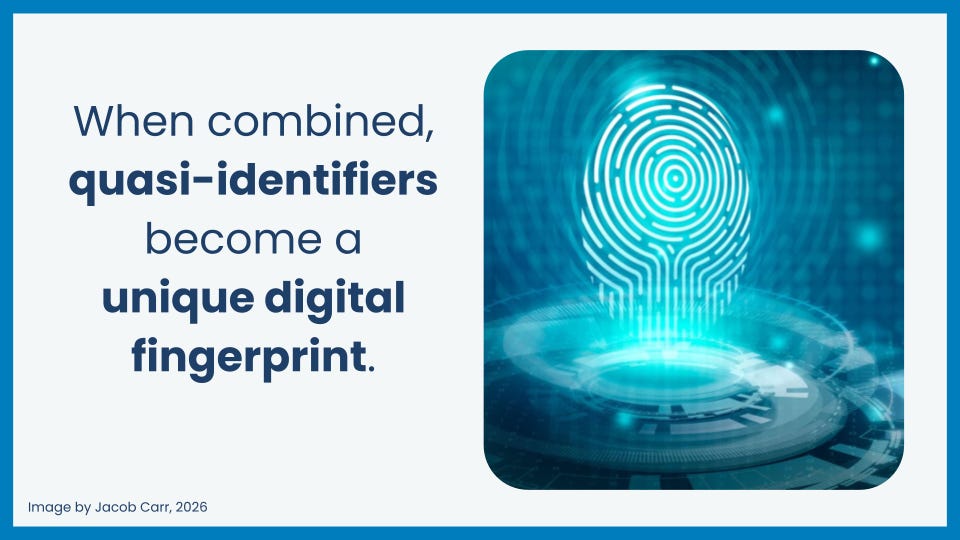 Image sourced from the presentation, “An Overview of AI” by Jacob Carr, © 2026.
And, here’s another, much more “eyebrow raising” one. Years ago, when I was brand new at a school that offered independent study, a student came to me wanting to learn Russian. I was not familiar with all the specialized programs our district had on the shelf, so I sent off a quick email from my official school account asking my colleagues if we had an adopted curriculum for it.
A coworker replied that we did, noting she had not used it in a while, but that the program was by a company called Pimsleur. I had never heard of them. I knew Rosetta Stone and Duolingo, but Pimsleur was completely foreign to me.
To my shock, ads for Pimsleur started popping up in my personal Facebook feed shortly thereafter. It still skeeves me out, but it fundamentally changed how I treat my inbox. So many educators genuinely believe that because they are typing inside a district email account with enterprise protections, their communication exists in a hermetically sealed vault. But modern ad tech and digital fingerprinting do not care about your school firewall.
Just like the de-identification illusion we talked about, the invisible connective tissue between your work email, your IP address, your browser cache, and your personal social feed is constantly mapping your behavior. We think “district-protected” means private. The tech ecosystem thinks of it as just another data point waiting to be reconciled with your profile. I still don’t quite know how I feel about all this.
Yet tech companies lean on that “anonymized” illusion to sell educators on quick classroom rollouts, decorating the footers of their websites with glossy self-certified compliance badges. Those colorful badges on the bottom of a website mean squat compared to an actual signed district contract.
But, when a district executes a Data Privacy Agreement (DPA), it establishes the mandatory direct control that keeps the school official exception alive and legally bars the company from using your students as raw fuel for their models. When an individual educator bypasses that process and clicks “I Agree” on a rogue freemium app, the vendor does not inherit the risk.
The educator does. Without a district contract in place, that hidden door slams shut, potentially leaving you floating in legal zero-gravity.
Why “FERPA Compliant” Is a Marketing Illusion
When a splash page screams “FERPA Compliant,” laugh. FERPA binds educational institutions. It literally cannot bind a private software vendor. They aren’t subject to the statute.
A vendor declaring itself compliant is just broadcasting good intentions, like someone promising they’re a safe driver before getting behind the wheel. Real compliance is an action your district takes via contracts.
This is why shadow usage, like a teacher signing up for Claude for Teachers using an institutional email, is a legal void. The tool might treat your data like gold to be bought and sold. Or it might not. Without a district agreement establishing “direct control,” the legal safety net was never rigged up in the first place.
No hate to Claude or Anthropic. It’s actually my favorite LLM, but right now, the Claude for Teachers product is a misaligned trap people might not recognize.
Curious why Claude’s free educator tier triggers red flags under current district procurement rules? Read the complete Claude for Teachers breakdown here:
COPPA, Middle Schools, and the Age-Floor Trap
Then came 1998. That’s the year I moved home from a near tech-less existence in The Netherlands (..my choice, not that NL is somehow Luddite). With it came the explosion of the internet, email, chatrooms, and banner ads. In the US, Congress realized that online companies were quietly tricking young kids into giving away their home addresses and phone numbers in exchange for digital prizes, all without their parents ever knowing. To stop the Wild-Wild-West of early internet data harvesting, they passed the Children’s Online Privacy Protection Act (COPPA).
Unlike FERPA, which controls school districts, COPPA puts the crosshairs squarely on commercial tech companies. It carries one non-negotiable rule: if you run a website or app that collects data from children under 13, you must get verifiable parental consent first.
But you don’t remember signing a waiver for your kindergartener to be issued a district email (Gmail), do you? There’s a workaround for classrooms. Schools can step in and consent on behalf of parents, but only under strict terms. The tool can only collect data for an authorized, non-commercial educational purpose. The second a vendor uses a fifth-grader’s inputs to build ad profiles, train proprietary models, or monetize features, that proxy authority dies on the spot. The collection instantly becomes illegal under federal law, and the school has walked a child right into an unauthorized commercial funnel.
Hence, the corporate age-wall maneuver. Check this out.
Check the terms of service on the consumer web: Discord, Canva, and countless interactive platforms draw a hard line at age 13. AI platforms like Claude push that floor straight to 18. Why? It is simple business math. Imagine the following word problem:
Problem 4: A tech company wants to avoid federal privacy fines. If Path A costs $15 million to engineer custom consent workflows and zero-retention databases for minors, and Path B costs $0 to simply write "must be 13 or older" into the terms of service, which path do the shareholders choose? Show your work.
That corporate shortcut tosses a live grenade straight to local school boards. Imagine a middle school teacher finds an engaging interactive lab, a graphic design tool, or an AI reading coach to boost fluency. At the start of the school year, most sixth graders are eleven years old. See the brick wall? A teacher cannot simply say, “Go to the website and make a free account.” Doing so forces an eleven-year-old to falsify their birth year, breaches the platform’s terms of service, and dumps student data into an unvetted consumer pipeline.
To bridge that gap, a district must negotiate custom enterprise agreements or deploy specialized student-facing educational editions that explicitly trigger the school consent exception. With recent federal updates expanding protected COPPA data to cover biometrics, voice recordings, and facial geometry, tools that listen to a middle schooler read or analyze their webcam feed trigger intense regulatory scrutiny.
This creates a stark digital divide in our classrooms. A high school sophomore can legally click into dozens of experimental platforms with teacher guidance, but the moment you step across town into a middle school, those same tools become federal legal tripwires.
If you do not have an enterprise contract locking down that data at the district level, you are not just bending an app’s terms of service. You are walking your students straight past federal guardrails and assuming the risk on their behalf. Worse yet, you are leaving yourself completely out in the cold the moment the district decides it is not going to back your legal fight.
The State Patchwork: Rules Change at State Lines
These two federal laws are just the sub-floor. States build whatever wild extensions they want on top. Here are just a few examples:
-
California (SOPIPA & AB 1584): Attacks vendors directly. Targeted ads, profiling, and selling student data are strictly illegal by default, while contracts must mandate district data ownership and mandatory post-contract wiping.
-
New York (Ed Law 2-d): Focuses heavily on security infrastructure. Mandatory National Institute of Standards and Technology (NIST) cybersecurity frameworks, a public Parents’ Bill of Rights, and an actual named Data Protection Officer with veto power over software.
-
Illinois (SOPPA): Full glass-house transparency. Signed privacy agreements are mandatory before a single byte of student data moves, and those contracts—plus subcontractor lists—must be posted on a public web page within ten business days.
-
Texas: Focuses squarely on district cyber defenses. It requires mandatory district cybersecurity coordinators, strict incident-reporting timelines to the state, and compulsory staff cybersecurity training.
What’s the practical takeaway for classroom teachers? Imagine doom-scrolling on TikTok one night and coming across a teacher in Dallas raving about a rad new AI lesson assistant. It looks incredible, and it feels like the exact solution to a grading bottleneck you are trying to solve. You cannot simply start using it in Chicago or Albany, because a tool greenlit under Texas rules might be dead on arrival in Illinois. Maybe the vendor refuses to sign a public-facing SOPPA contract. Or, maybe they rejected it in New York because its database encryption fails the state NIST standard. Or worse, the vendor never signed a compliance agreement anywhere at all; they simply paid an influencer to hype their freemium product directly to exhausted educators.
When your tech director denies an app request, it is almost never about stifling your creativity or making your job harder. Other than budget constraints, it’s usually about keeping the district on the right side of a fragmented state map where an innocent download can trigger an audit, a security breach, or a state investigation.
Registries and the “Vendor Declined” Trap
Nobody has the time or budget to negotiate four thousand bespoke software contracts every school year, which is why the Student Data Privacy Consortium (SDPC) created the National Data Privacy Agreement (NDPA). This is a standardized, pre-vetted legal contract designed to streamline school compliance. In states like California, regional alliances managed through organizations like California IT in Education (CITE) run public registries of these signed agreements. The registry offers a nice shortcut: once a single school district convinces a vendor to sign the standard agreement, every other district in the state can simply “piggyback” on that existing contract with a single signature.
So what happens when you search for a major player and see the dreaded label “Vendor Declined to Sign”? I ran into this firsthand while researching an article I was writing when Anthropic launched their free Claude for Teachers. Being in California, I pulled up the California registry, searched for Anthropic, and there it was: "Vendor Declined to Sign. Before hitting the panic button, recognize what that tag actually means. “Vendor Declined to Sign” is not a formal government ban or somehow nefarious. It simply means that a massive tech company with an army of corporate attorneys refused to sign a standardized, state-specific template off the shelf. Silicon Valley giants often reject boilerplate public contracts because they insist on their own custom terms regarding liability limits, server audits, and breach timelines. A school district can still legally adopt that software, but the shortcut is gone. The district’s legal team must sit down, trade redlines with the vendor, and negotiate a custom enterprise contract from scratch. It is tedious and it takes months, meaning “Vendor Declined” is not an absolute legal roadblock, but the easy pass has expired and you are officially in the slow lane of customized contract law.
Model Training, Memory, and the New Risk Profile
The real ghost in the machine moving forward is model training. Traditional school software locks student records inside structured databases behind virtual padlocks and permission settings, but multimodal generative AI does not store data in neat files or folders. Whether you feed it text, spoken audio, student artwork, or photos of classroom work, the system digests those inputs, blends them together, and bakes them directly into the mathematical brain of the model itself.
Upload a sensitive handwritten IEP accommodation note, a recorded speech sample, or an original student drawing into an unvetted consumer tool, and that content can theoretically resurface months later when a stranger on the other side of the world prompts the system.
If that sounds like science fiction, consider what cybersecurity researchers have already demonstrated with commercial AI systems. By using targeted extraction prompts, researchers pulled over 90 percent of entire copyrighted books like Harry Potter and the Sorcerer’s Stone word for word, while image diffusion models have been caught faithfully reconstructing private, copyrighted photos directly from their training sets. If a consumer model AI can memorize and spit back nearly entire novels and exact imagery, it can certainly retain and expose the unique details of a student’s personal writing, voice patterns, or visual assignments.
That fundamental external risk is why Zero Data Retention (ZDR) clauses are the most critical battleground in school tech contracts today. Without an explicit, legally binding zero-retention guarantee, every word, voice recording, or image fed into a platform risks becoming permanent fuel to train a company’s next commercial product.
Yet the risk is not only about data escaping out the front door to a tech vendor. It is also about how we redefine privacy on the inside. A colleague and I recently came across a scenario that we are looking deeper into. Imagine working inside your secure, district-managed Google Workspace. You open a routine document, ask the Gemini side panel for a quick draft, and what comes back includes specific details pulled straight from your administrator’s recent, private evaluation of you. Terrifying. If I can track this down more concretely, you better believe we’ll talk about it here.
Realistically, nobody hacked the system, and no outside company stole a file. But it does expose the massive divide between how a tech corporation might define privacy and how educators actually live it. To a vendor, “private” simply means the data never left the district’s secure perimeter, so the compliance box gets checked. Then again, how did the Pimsleur Russian thing happen? Was my email data just de-identified? So inside that perimeter of compliance, what does privacy actually mean to the human beings working there?
We assume our day-to-day work, evaluations, and sensitive student notes are tucked safely into private corners. Yet the moment a powerful AI layer is turned loose across a shared environment (i.e. giving permission to your whole Google Drive, including student work from Google Classroom), the boundaries we thought existed begin to blur. It forces an uncomfortable realization: keeping your data inside the school garden wall is not the same thing as keeping it private from each other.
Where Do We Go From Here?
So the next time your tech department pushes pause on that shiny new app you saw on social media, take a breath. They are (hopefully) not trying to crush your classroom mojo or throw up arbitrary bureaucratic hurdles. They are likely doing the grueling, unglamorous work of standing between your students and a multi-billion-dollar data extraction engine that views classroom work as free training material.
Data privacy in modern education is about understanding that when we bring powerful, networked tools into our rooms, the traditional boundaries between public, private, and de-identified vanish in a hurry.
But, you do not need to become a corporate attorney or memorize every acronym in the state registry. Before you fire off another software request, run through this quick checklist.
Before You Ask IT: A Practical Cheat Sheet
To make this dead simple for your own classroom or department, I put together a quick one-page cheat sheet. It breaks down the essentials into two quick steps:
-
Check This Yourself First: Is it already approved on your district list? Does the vendor’s stated age minimum match your students? Does it support Single Sign-On, or are you forcing kids into unmanaged third-party logins?
-
Bring This to IT: Do you have the vendor’s policy on commercial model training in writing? Does the tool’s permission access match the actual assignment? Does it align with your state’s registry rules?
It also includes two ready-to-use email templates: one for pitching a new tool with the answers IT will ask for anyway, and one for asking constructive, bridge-building questions if a request gets denied without an explanation.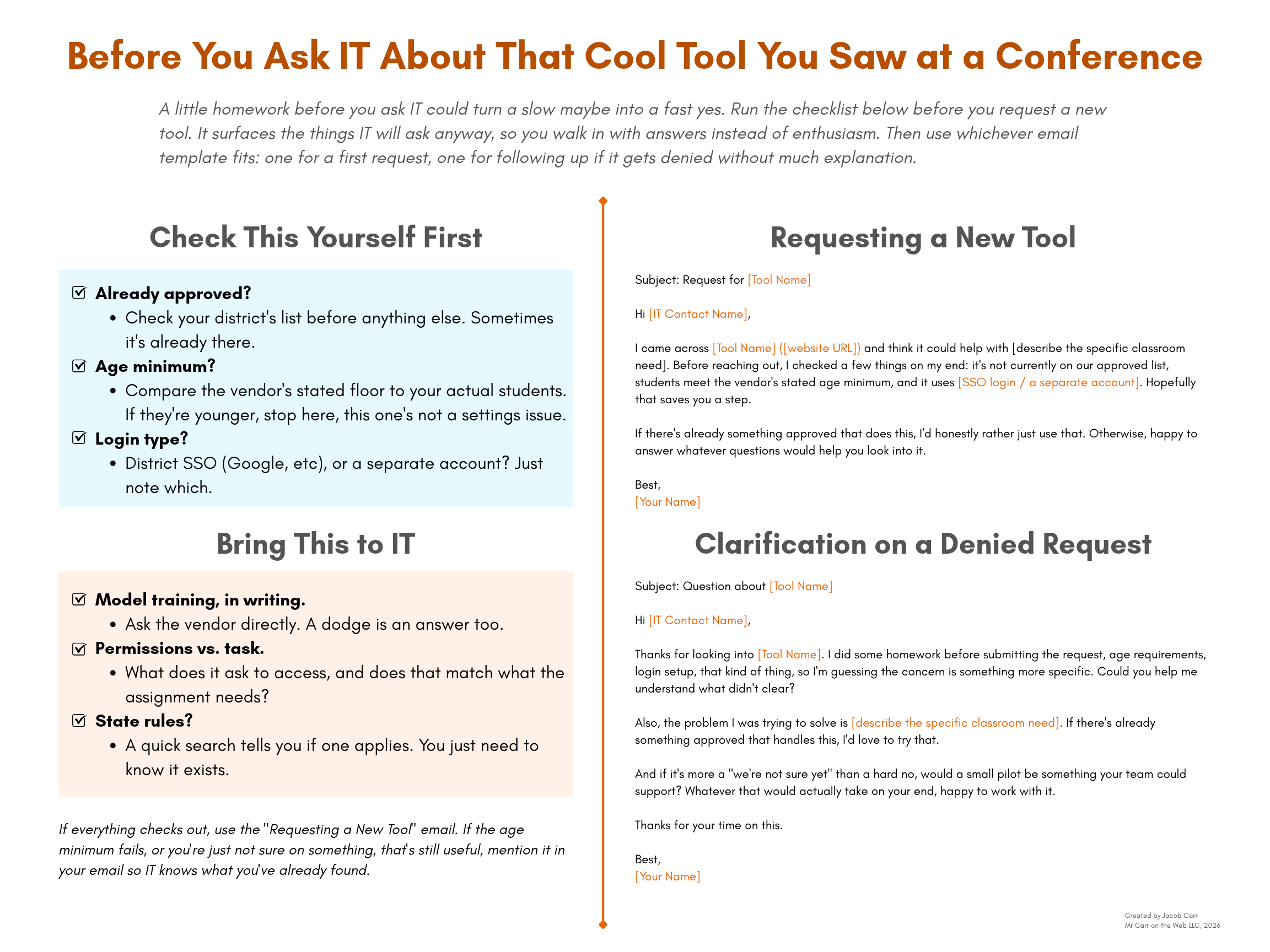
Grab the full high-resolution PDF of the one-pager to keep by your desk or share with your team:
We got into this profession to teach kids, spark curiosity, and build meaningful skills, not to referee software licensing disputes. But in this new era, protecting student privacy is no longer just an IT headache. It is classroom management. It is digital ethics. And whether we like the extra homework or not, it belongs to all of us.