Demosthenor Toolkit: A Public Speaking EduProtocols Expansion Pack!
By Jacob Carr
Published: 2026-07-22
URL: https://whatteachershavetosay.substack.com/p/the-skeleton-that-taught-public-speaking
Helene Adelaide Shelby of Oakland, California, believed criminals would confess to a ghost. Her invention in the 1920s was a courtroom apparatus built around a large, glowing skeleton, designed to terrify a suspect into telling the truth on the theory that the guilty party would assume the skeleton was real. Whether a big glowing skeleton crosses the line of scaring someone too much was, the article we read dryly notes, never legally settled.
This is the strange gift I handed a room of teachers at the EduProtocols Summer Academy in Laguna Beach this year, because absurd source material is the best kind for practicing serious skills. The serious skill in question: public speaking. And the way in was a reminder that not every EduProtocol is a stand-alone activity. Some are built to attach to whatever you’re already running.
A problem with how we teach public speaking
Demosthenes, the great orator of ancient Greece, did not get great by giving speeches over and over. The stories about him are stories of deliberate practice on pieces: pebbles in his mouth to fight a speech impediment, projecting over the crashing waves at the beach, an underground room built for uninterrupted work. He broke his weaknesses into manageable chunks and attacked them one at a time.
Classrooms mostly do the opposite. Students rarely present at all, and when they do, it’s the whole compounded skill at once: the research, the writing, the slides, the delivery, the nerves, all riding on one big cliched TED-style event. That’s like training for a marathon by only running marathons.
The Demosthenor Toolkit, from my book The EduProtocols Field Guide: ELA Edition, is my answer, and it isn’t a standalone protocol. It’s an EduProtocols Expansion Pack: five considerations of public speaking, isolated so students can practice them in small, frequent doses.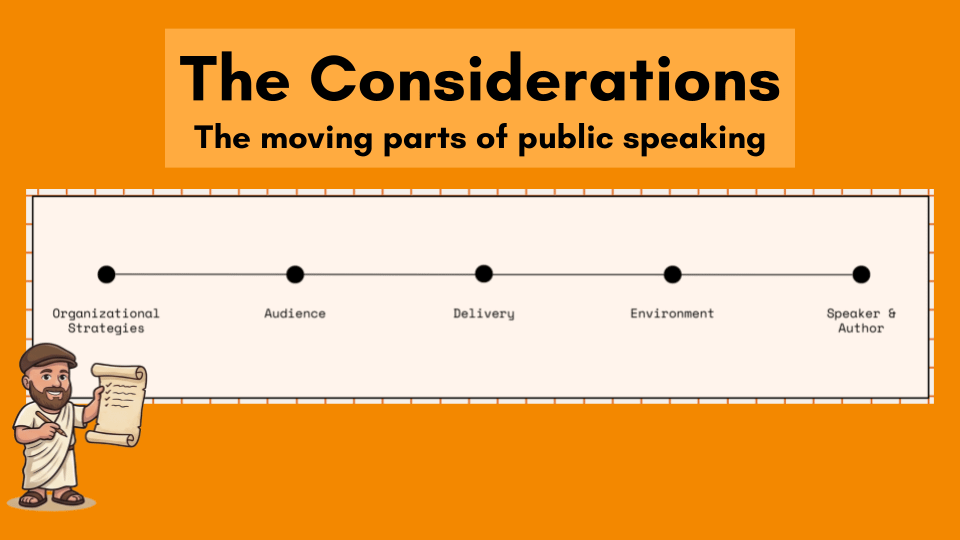
-
Organization. How will the material be structured?
-
Audience. Who receives the message, and how will they react?
-
Delivery. What tools carry the message: props, media, gestures, volume?
-
Environment. What setting is this delivered in, and what does that change?
-
Speaker. What’s the speaker’s purpose, and how do they establish credibility?
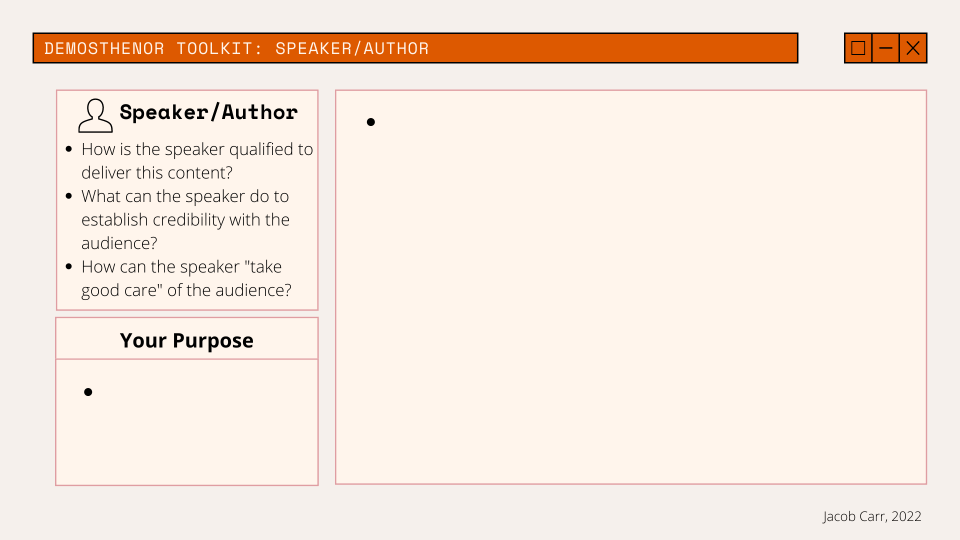 One of the five consideration templates. Each pairs a prompting question set with a blank “Your Situation” box for students to fill in. The full set, all five templates plus the Smart Start scenarios, is in the session slide deck.
Teach the skill before you use the skill
Before any of these considerations gets dropped into real content, students need to already know what an “Audience move” feels like versus a “Delivery move,” the same way they’d need to know a Frayer Model before you could run Claim Jumper EduProtocol on top of it. So at the Academy, we ran a Smart Start first: silly, low-stakes scenarios with zero real content at stake, just enough for students to practice recognizing and using one consideration at a time before it ever touches something that counts. [Find a link to Smart Start resource in the presentation deck.] Same principle as everywhere else with EduProtocols: always start with low-cog/no-cog practice. Go slow to go fast. Skip this step and you’re asking students to make a sophisticated speaking choice using a tool they’ve never held.
One drop, out of many
Once students have a working knowledge of the considerations, you drop one into whatever you’re already teaching. But dropping one in takes two decisions, not one.
-
First, which consideration does this moment need?
-
Second, what’s the scenario that makes it real?
A consideration sitting on its own is just a question. It needs something to be applied to, and that something is rarely already lying around. Usually you have to invent it.
Here’s how the lesson could go:
First, context: everyone got familiar with the Confession Skeleton, Shelby’s real invention, through an article and a short explainer video.
Then a Thick Slide EduProtocol: a deconstructed paragraph capturing a quote, four key facts, an image, and a comparison table, in this case putting the skeleton next to a slug for a surprisingly rich discussion of structural support.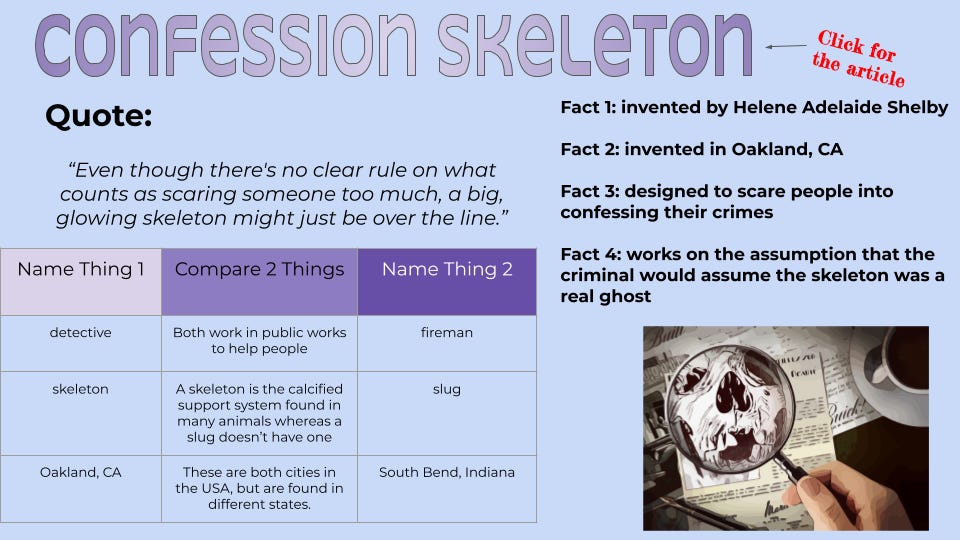
Then came the scenario for the Demosthenor Toolkit: Here’s the version we ran at the Academy. Teams would pitch the Confession Skeleton on the television show Shark Tank to a panel of skeptical investors, but each team worked from exactly one consideration. A team holding only Audience had to think hard about skeptical investors and millions of viewers, and nothing else. A team holding Delivery was deciding where the dramatic pause lands and whether you unveil the skeleton or just describe it. Five teams, five lenses, one ridiculous product, and every consideration in the toolkit got exercised without anyone delivering a full formal speech. By groups sharing their work, the whole class begins developing better understandings of the considerations.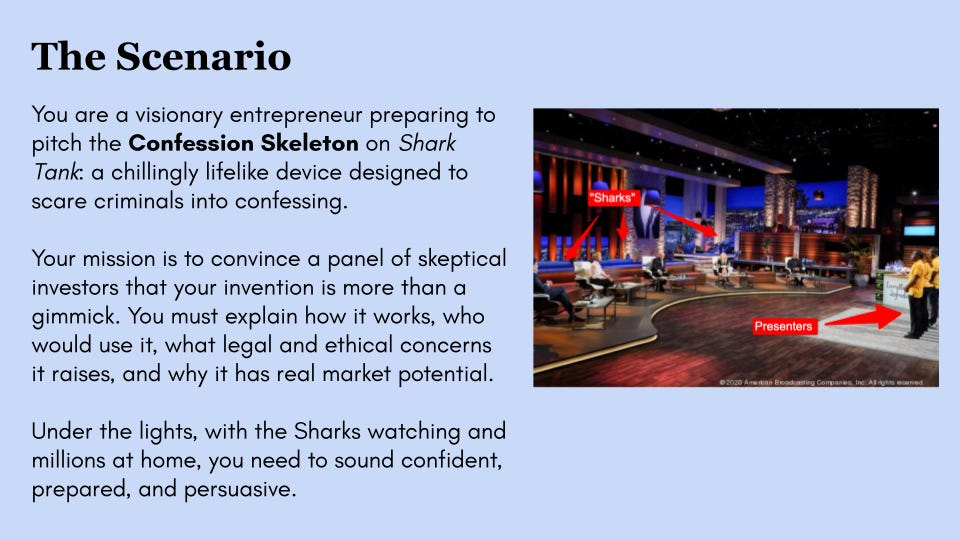
Nothing about Shark Tank came from the Confession Skeleton article itself. I made that scenario up because “pitch this to skeptical investors” gives students something urgent to push against. A different scenario, a courtroom trial, a museum exhibit pitch, a late-night infomercial, would have worked the considerations just as hard, in a completely different direction. But that Thick Slide is just the base I happened to be running that week. The same drop works on activities already in your rotation. Add an Organizational Strategies slide to a Walk the Line, and students format their line of reasoning according to a scenario with a specific purpose instead of a default structure, the purpose being whatever scenario you’ve handed them, a legal brief, a eulogy, a campaign speech. Add a Delivery slide to a Frayer Model built on character traits, and students imagine which props, gestures, or volume would convey that character’s traits to a given audience. Add an Audience slide to a Socratic seminar prep, and students predict how their argument lands with a specific listener before they ever open their mouth. The considerations don’t care what you’re teaching. They only care that you’re already teaching something.
That’s the expansion pack idea, literally. You don’t buy an expansion pack to play it alone. You own one because you already own the base game, and every consideration only exists in relation to whatever lesson is already running.
The one worth using constantly
Of the five, Organizational Strategies is the one with the most bang for your buck. It’s usable almost anywhere, in nearly any subject, on nearly any day. But that leverage only shows up after students have been taught the seven organizational strategies individually, well enough to choose among them and craft with them on their own. Drop this in before that groundwork is laid and you’re asking students to pick a structure from a menu they’ve never read. Teach the seven strategies first, then this consideration turns into one of the most reusable moves in the whole toolkit.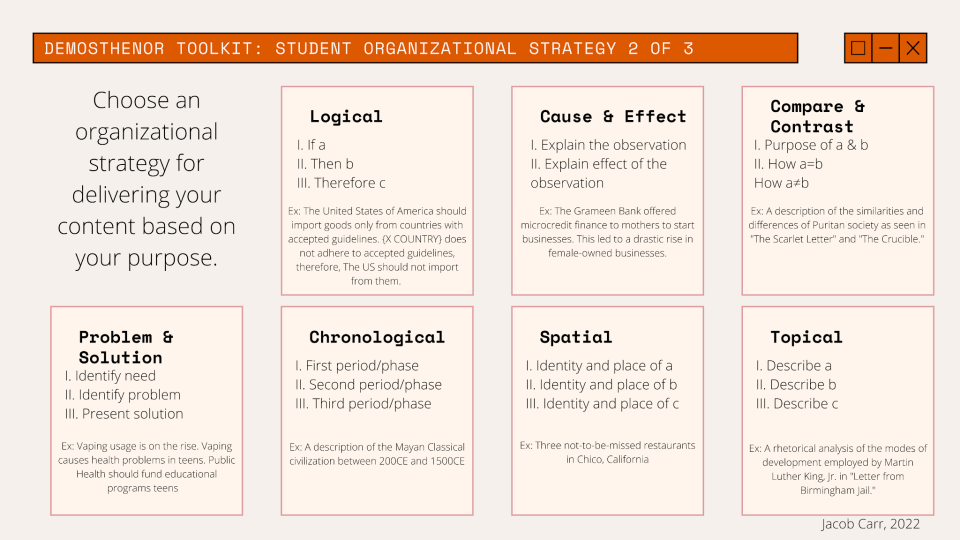
Why this Smash, that day
Thick Slides handled the thinking for us that day: gathering, compressing, and organizing the material. Demosthenor handled the transmitting: shaping that material for a listener. Separately, each is useful. Smashed together, students moved through the full arc from comprehension to communication in one class period, and the speaking practice arrived in a dose small enough that nobody’s anxiety spiked.
A confession of my own: we ran short on time, so instead of building out the pitch slides, we debriefed each consideration aloud as a whole group. The protocol flexed and lost nothing, which is worth knowing. These frames survive contact with the clock.
Get the recipe
The full workshop slide deck, including the Confession Skeleton article, the Thick Slide example, the Shark Tank scenario cards, and the Smart Start scenarios, is here as a force-copy link: click it and Google Slides hands you your own editable copy. The Demosthenor Toolkit chapter, with all five considerations, the organizational strategies, and much more is in The EduProtocol Field Guide: ELA Edition.
Which speaking consideration do your students need most: organization, audience, delivery, environment, or credibility? Pick one and drop it into an activity you’re already running this week. Tell me which one you chose in the comments. If this lands, pass it to a teacher who needs it.