What if you never had to plan the same kind of lesson twice?
By Jacob Carr
Published: 2026-07-19
URL: https://whatteachershavetosay.substack.com/p/just-like-grandma-used-to-make
My Grandma Ruby never decided what the menu for Thanksgiving would be; it was settled long before anyone asked. The same dishes in the same order, year after year. Her macaroni salad was one of them: tiny ditalini pasta and canned shrimp that had to be “scrunched up” between your fingers and thumbs. Nobody voted on it; nobody workshopped it; it just appeared, and we would have rioted if it hadn’t. And even now, more than 20 years after her passing, she still “shows up” for Thanksgiving just like always. That salad is legendary, and Grandma Ruby barely had to think about it. Instead, her energy went into the cooking, the family, the day itself.
For the first ten years of my teaching career, I did the opposite. New units, new activities, new formats, every day was a fresh invention. Looping with the students, I never repeated a lesson for 10 years, if you can image that, and for the majority, there wasn’t even an adopted curriculum. If you have ever felt the Sunday Scaries creep in around four in the afternoon, you know what that decision debt feels like. Looking back, so much of that exhaustion was about deciding, endlessly, what the teaching would look like, let alone creating the activities. I will relent, however, that decade honed me into a master of backwards planning.
Recently, at the fifth annual EduProtocols Summer Academy in Laguna Beach this summer, I gave a keynote about the way out: stop reinventing good wheels. Cook from recipes that worked before. This article is that keynote, rebuilt for you, and if you found this article because we met at the Academy, welcome. You are among friends here, and this piece doubles as the map for a short series covering the sessions I taught in Laguna.
What I mean by a recipe
The instructional recipe we’re talking about is a pre-decided sequence built from EduProtocols, the repeatable lesson frames from the EduProtocol Field Guide series. The frame stays constant while the content changes, which means students stop spending brainpower on directions and spend it on thinking instead. The learning science underneath is old and sturdy: retrieval, spaced repetition, recursion, immediate feedback, and students teaching material back to peers.
At the keynote, we worked with three kinds of recipe elements.
Stack. Repeat the same EduProtocol multiple times to deeply reinforce learning. A Mesopotamia unit might run multiple CyberSandwich lessons across readings on the Tigris and Euphrates, Hammurabi’s Code, trade routes, and the invention of the wheel. The protocol never changes; just the content. By the third round, students walk in already knowing the moves and executing them well.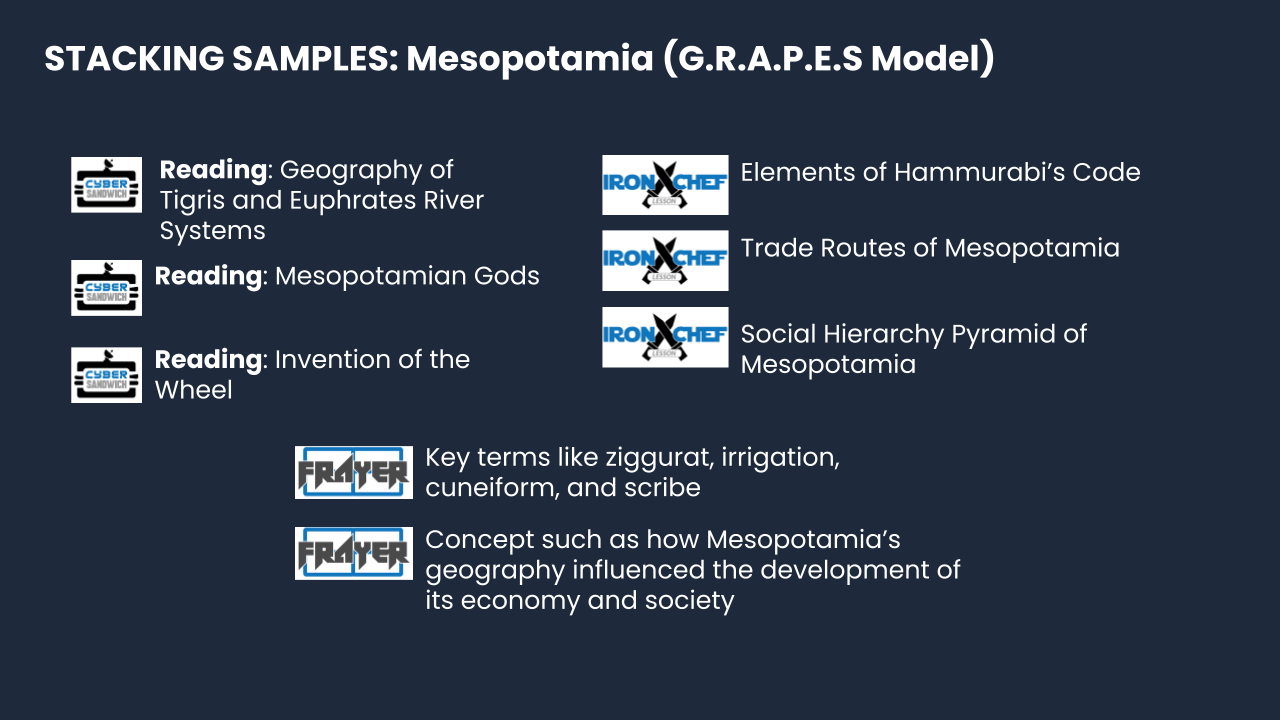
Smash. Combine two EduProtocols into a single blended activity. A few from the keynote: while completing a 3xCER, students rearrange the claims into a ranked list. Smash a Frayer Model into the “tell” side of a Sketch & Tell. Or, use a Graph & Tell as the center prompt for a Wicked Hydra.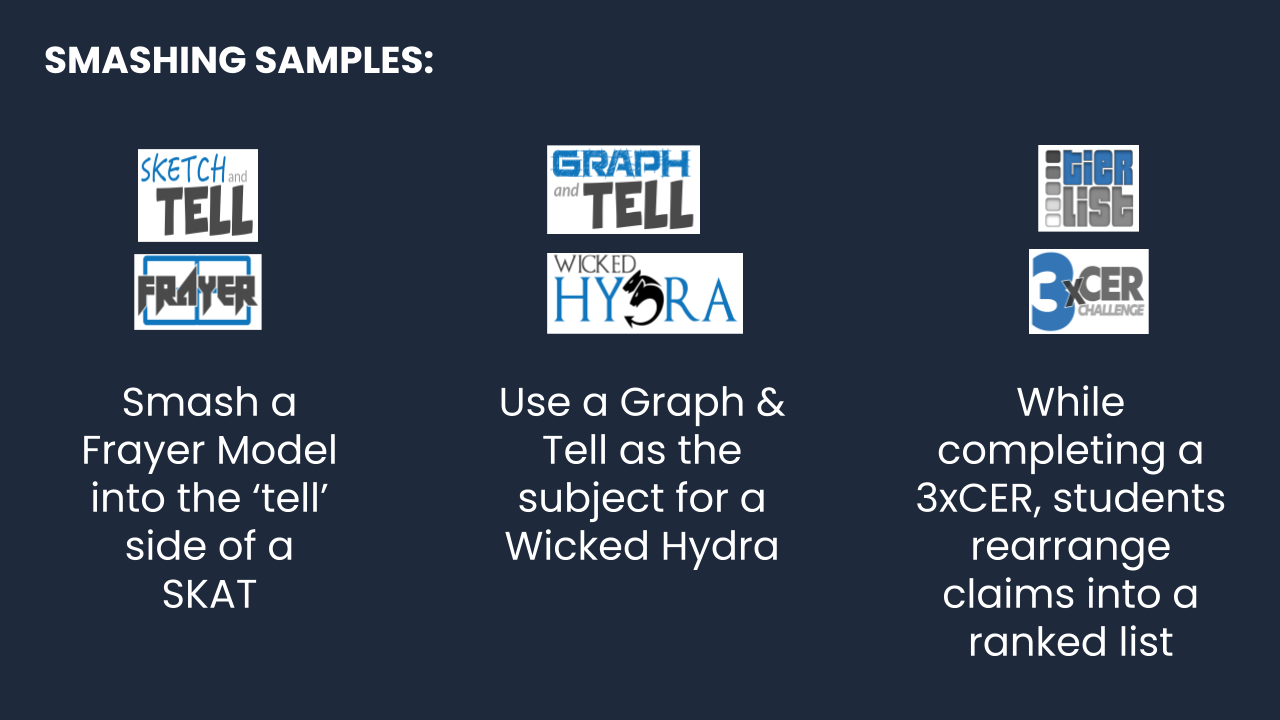
Rack & Stack. Run multiple different EduProtocols back to back in one complete period, sequenced so the cognitive demand rises as the hour goes on. Fluency work feeds ideation, ideation feeds synthesis, synthesis lands in clear expression, and so on. Build these once, and you’ve solved a recurring instructional need for as long as that need keeps showing up in roughly the same shape. The next time you need to teach vocabulary, or argument, or questioning, you’re not designing a lesson from scratch. You’re pulling a Rack & Stack off the shelf and pouring new content into it.
If some of those names are new to you, here is the quick tour of every protocol I just mentioned, and why you would reach for each one (with links to learn more).
-
Fast & Curious is gamified retrieval: short multiple-choice rounds on a platform like Gimkit, reteach the three or four most-missed questions, then run it again. Use it when students need to own vocabulary or foundational facts before they can do anything interesting with them. Here’s an overview by Matt Miller from Ditch That Textbook.
-
Frayer Model is the classic four-square chart for dissecting a new concept from multiple angles. Use it when you need to more deeply construct meaning with vocabulary. A TikTok Tutorial
-
Iron Chef Lesson is a fast jigsaw. Each student builds one slide on their slice of a topic, folds in a “secret ingredient,” and teaches it to the room in seconds. Use it when you need to cover a wide swath of content quickly and want students doing the explaining. Here’s a YouTube Tutorial.
-
Wicked Hydra is the questioning protocol. One open prompt in the middle of the page, and students build branching trees of follow-up questions, no answers required. Use it when you want curiosity and inquiry instead of recall. I wrote a full walkthrough here: When Students Stop Answering and Start Asking.
-
3X Challenge, originally developed by Josie Wozniak (tiktok.com/@jwoz_teaches), asks students to respond to one prompt three times through three different lenses. There are various “flavors” such as POV, Genre, etc. 3xCER is the argument flavor: three rounds of claim, evidence, and reasoning on the same source. Use it when you want volume and flexibility of thinking without three separate assignments. Here’s a 3xGenre TikTok Tutorial.
-
Sketch & Tell, has students draw their thinking first, explain it to a partner, and only then write. Use it to lower the stakes for reluctant writers and give visual thinkers a doorway in. Graph & Tell is the same move with a graph standing in for the drawing, which makes it a natural fit for math and science. Here’s a YouTube Tutorial.
-
Thick Slides is a deconstructed paragraph on a single slide: bullet-point facts, a quote, an image, and a mini thesis. Use it when you want the thinking of a paragraph before you ask for the writing of one. Here’s a great blog post by Adam Moler on Thick Slides.
A recipe in action
How about some examples. Here is a full Rack & Stack for any novel, straight from the keynote.
-
Open with Fast & Curious to review key terms from the book.
-
Move into a Wicked Hydra posing three starting ideas for understanding the themes.
-
Close by having students write three Claim-Evidence-Reason statements side by side (3xCER) built from the Wicked Hydra discussion.
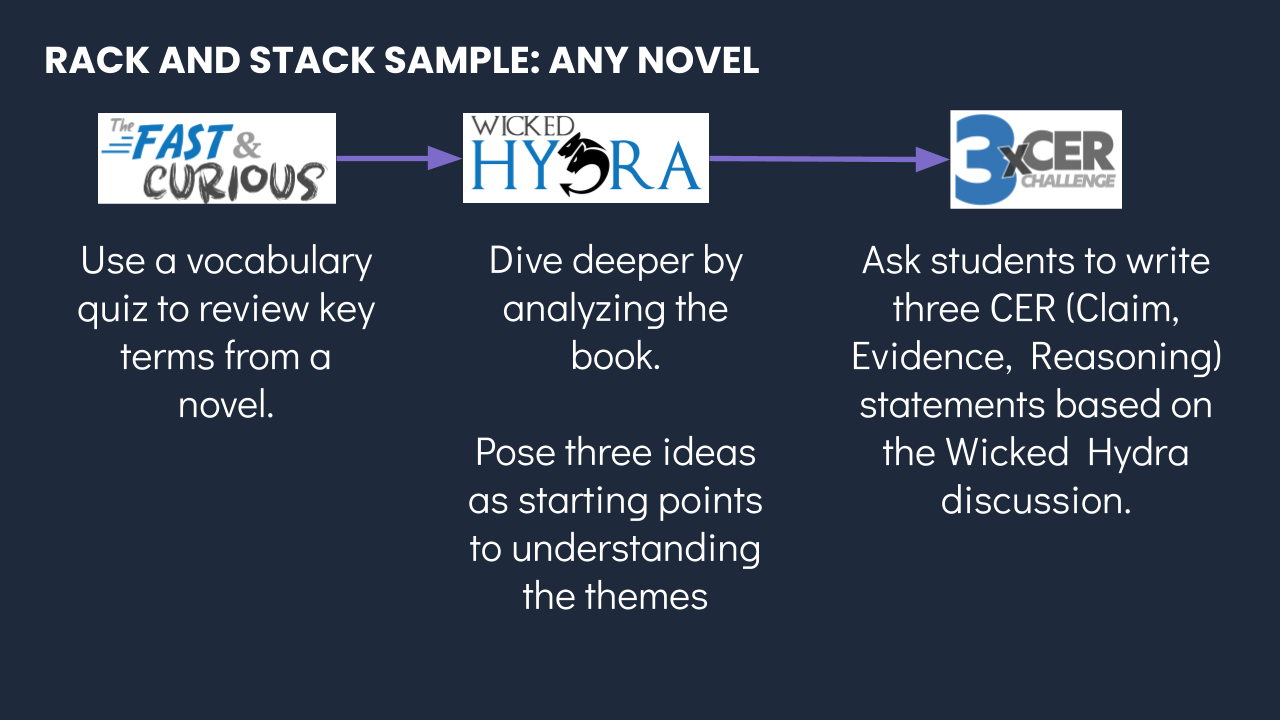
One period: three EduProtocols. The vocabulary feeds inquiry, inquiry feeds argument.
Another favorite came from , who I learned this one from directly. His Vocab Intro stack runs as follows:
-
Fast & Curious
-
Frayer Model
-
Iron Chef Lesson
-
Fast & Curious
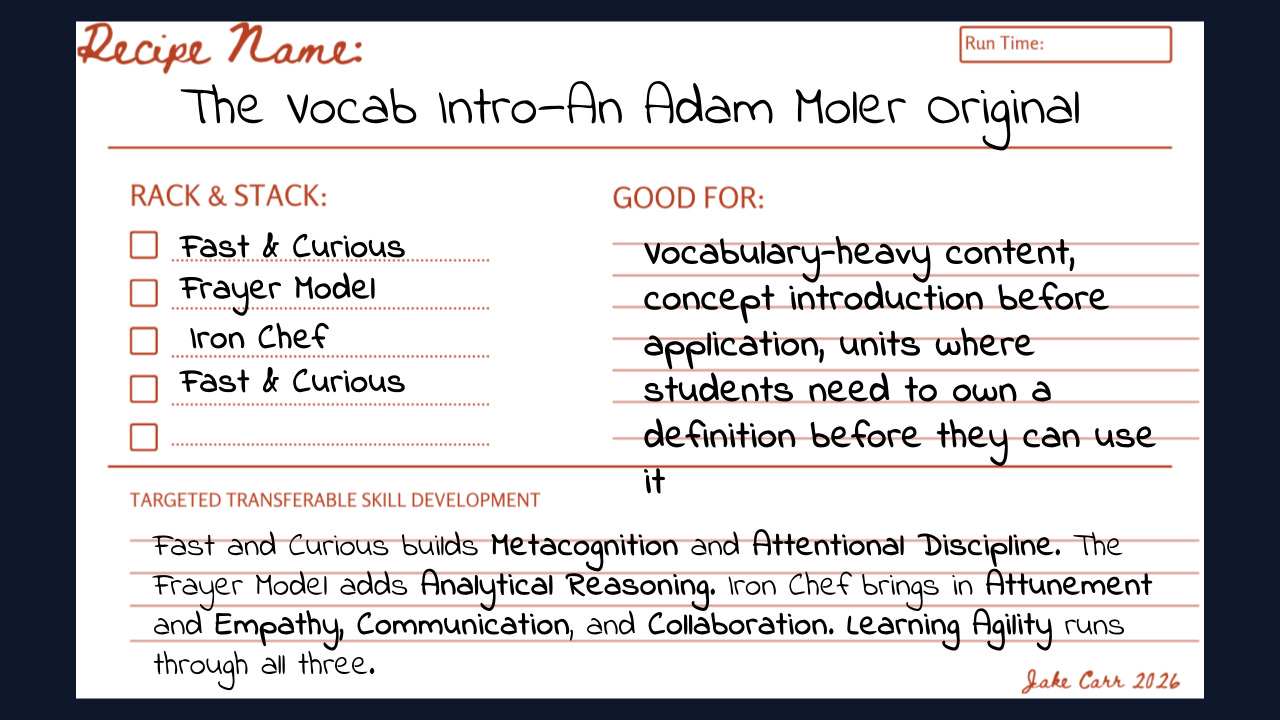
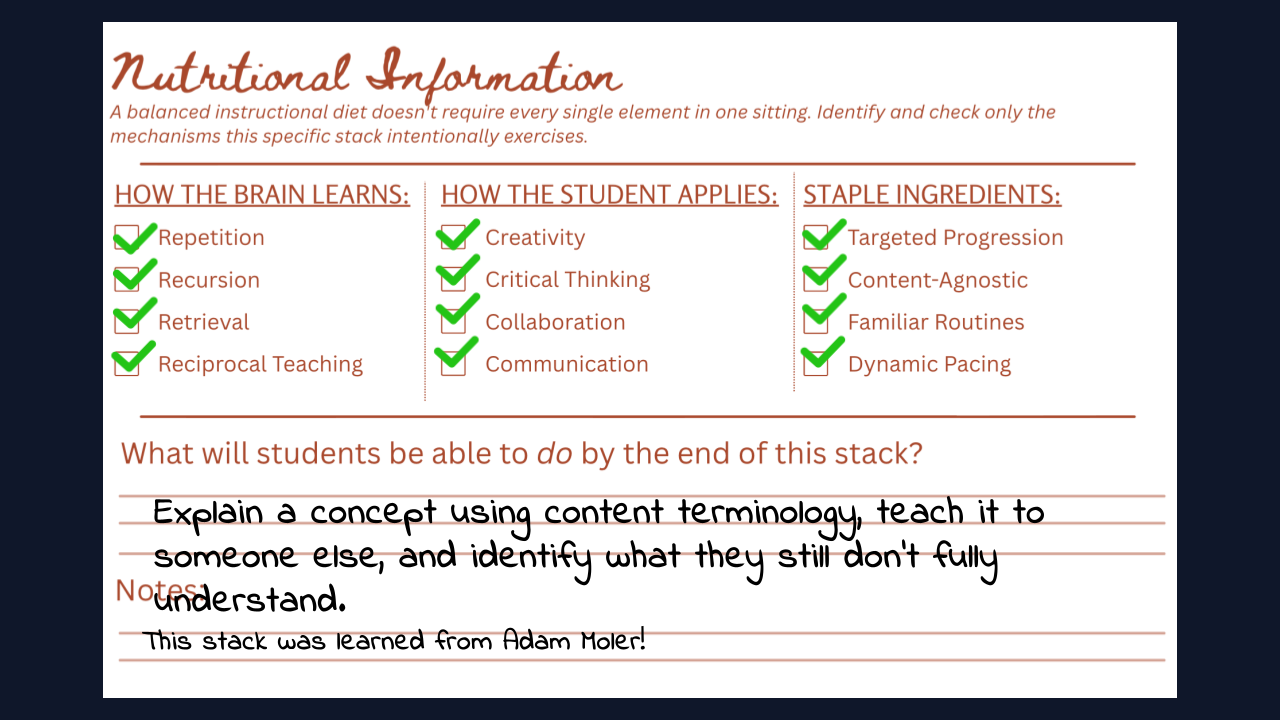
Students drill the terms with Fast & Curious, dissect the more difficult concepts using Frayer Model, then encounter and deepen the concepts using those terms with Iron Chef Lesson. Finally, close up with a last round of Fast & Curious. Four movements, one arc, and the definitions actually stick because students used them different ways in a single class. Notice what this means for the next time you need to teach vocabulary. You’re not asking "how should I structure this lesson?" You’re only asking "what terms go in it today?"
So, what makes a recipe worth cooking twice? At the keynote we named a few things things.
-
Targeted Progression: Activities intentionally build toward a common skill goal.
-
Content-Agnostic: Uses frameworks that are repeatable across any subject
-
Reduced Cognitive Load: Familiar routines so students focus on the learning, not the instructions.
-
Dynamic Pacing: Shifts classroom energy naturally by alternating independent work, peer collaboration, and rapid feedback.
But notice that all four of those qualities describe what happens on the day you run the recipe. They don’t touch the bigger reason to build one. Most lesson planning treats every day as a fresh problem: what am I teaching, and therefore what do I need to build. A Rack & Stack flips the question. What skill or outocme does today need to practice, and therefore which recipe do I already have that solves it? The content still changes every time, but the method stays familiar. That’s the whole economy of the idea: the thinking gets done once, and it pays out every time that instructional need comes back around.
Name the Rack & Stack, write it down somewhere you’ll actually look, and the next time that same instructional need shows up, you’re not starting over, you’re opening a file. (I might actually ‘squee a little’ if I saw an old school recipe box full of Rack & Stacks at a teacher’s desk.)
But, if you’re really gonna make a great Rack & Stack, it might also address the 4 R’s and the 4 C’s, because the same qualities that make a recipe worth reusing in your planning are the things happening in the student’s brain while they run it. As a refresher, here are those:
The 4 R’s: How the Brain Learns
-
Retrieval: Pulling info out, rather than cramming it in.
-
Reciprocal Teaching: Students must process material deeply enough to teach it back to peers.
-
Repetition: Intentional, spaced practice with immediate feedback.
-
Recursion: Continuously looping back to core concepts, but engaging with them at increasing levels of complexity.
The 4 C’s: How the Student Applies
-
Creativity: Approaching problems from novel angles
-
Critical Thinking: Objectively analyzing information
-
Collaboration: Working effectively and respectfully with diverse teams
-
Communication: Articulating thoughts and ideas clearly
A counterargument worth taking seriously
Some of you are reading this and hearing an echo of scripted or formulaic curriculum, and I understand the flinch. I have argued in this newsletter that scripts treat teachers as delivery mechanisms. So let me draw the line plainly.
A scripted curriculum is macaroni salad bought premade at the store: sealed, uniform, dished out exactly as it arrives, with nothing of you in it. A recipe is not that. A recipe decides the structure and leaves the cooking to you. Grandma Ruby’s macaroni salad was pre-decided down to the ingredient list, and she still ground every shrimp by hand, still judged the salt, still owned the dish. Nobody would have mistaken it for something scooped out of a deli tub. A script removes the cook, whereas a recipe assumes one.
In an EduProtocols classroom, the thinking stays exactly where it belongs: the teacher choosing the ingredients, the students doing the cognitive work. Worth naming honestly, though: this fixes the reinvention you’re doing by choice. It doesn’t touch the reinvention forced on you by a new pacing guide, a new evaluation rubric, or a role change. Those are real, and no recipe makes them disappear.
And fair warning on the choice-driven kind: the first round of any protocol is messy, and should not be done with content. We call them SmartStarts. Always start by teaching how to do the eduprotocol with simple, fun, low-cog material. Then, you can move to content. It takes most classes two to five repetitions before the frame becomes automatic. So with any new routine, start simple. Go slow to go fast.
Time to cook
Building your own is simpler than it looks. Name the recurring instructional need, not the unit; vocabulary, argument, questioning, synthesis. Choose two or three EduProtocols that build toward it. Sequence them so demand rises through the period. Then name the recipe and file it somewhere you’ll find it again.
If you want a running start on that process, I built a tool for it: the Rack & Stack EduProtocols Recommender, a Gemini Gem you can just talk to. Tell it what you’re teaching, and it’ll ask a few clarifying questions before handing you back a full recipe card: named, timed to the minute, with the ingredients you’ll need to gather and the learning science behind each step already spelled out. It still leaves the cooking to you. It just saves you the blank page.
This was our fifth Academy, and the room in Laguna Beach held teachers from across the United States plus colleagues from Japan and Mexico. Past years have brought educators from as far as Bahrain. For many, summer professional development has a reputation for feeling mandated and heavy. This is the opposite, and the proof was the end of the keynote, when everyone drafted a recipe onto a vintage half-sheet recipe card and shared them rather than tucking them away. That’s the Grandma Ruby move. She never rebuilt Thanksgiving from scratch, and once you’ve built a Rack & Stack, neither do you. The menu is set; only the ingredients change.
So here is your card. Pick one recipe from the menu we used at the Academy, or draft your own on the recipe card template. Copy it exactly the first time. Then swap a step, rename the dish, or change something to make it yours.
This wasn’t the only thing I delivered at the Academy. Over the next few weeks, I’ll publish the full work-ups for the sessions I taught at Laguna Beach: Claim Jumper, Ikonic, the 3X Challenge, and a Demosthenor Toolkit session involving a haunted courtroom skeleton that I promise makes sense in context. Several of these come from my book, The EduProtocol Field Guide: ELA Edition, where you’ll find the complete versions with templates, variations, and AP adaptations.
Tell me in the comments. Some of what you’re rebuilding every week is yours to hand off to a recipe. Some of it isn’t, and no framework fixes a staffing shortage or a mandate that changed in August. This is for the part that’s actually yours to solve.
If this lands, pass it to a teacher who needs their weekends back.
You didn’t think I’d bogart grandma’s recipe, did you?